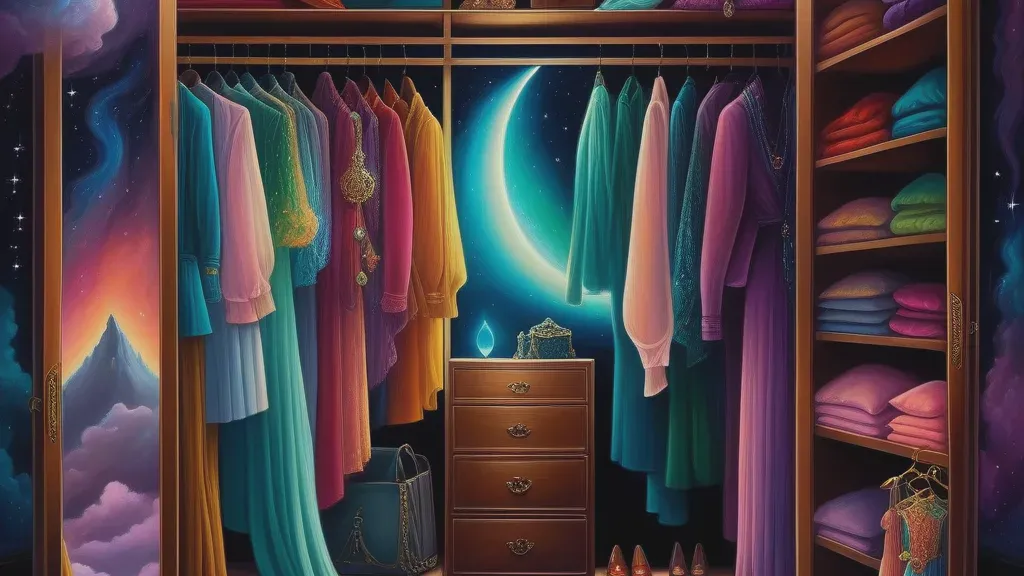
Closet
Jungian Archetypes
Meaning
A closet in a dream holds what a household has decided should stay out of daily view without being thrown away, which makes it a precise image for material the dreamer has chosen to keep rather than confront - not gone, not disowned, simply stored behind a door that stays shut by habit rather than necessity. What the dreamer finds inside, and how the door behaves when they try to open or close it, usually measures how ready they currently are to let that stored material back into view.
Psychological Interpretation
A closet that will not open, or that sticks and resists, often reflects active avoidance rather than genuine inability - something inside is known, at some level, to exist, and the dream's mechanical obstacle is standing in for the dreamer's own reluctance to face it head-on. This differs from a locked room elsewhere in a dream, which more often signals material the dreamer has not yet consciously registered at all; a stuck closet door usually concerns something already partly known. What is found inside changes the reading considerably. Clothes that do not belong to the dreamer suggest an identity, role, or expectation that was handed to them rather than chosen, still stored and occasionally worn despite not fitting. A closet unexpectedly empty, where the dreamer remembers keeping something, can mark a loss, a decision already made without full awareness, or a piece of the self quietly given away. Finding the closet larger inside than the house should allow often signals that the material being stored there is more extensive, or more significant, than the dreamer has been consciously willing to admit.
Traditional Symbol Meaning
Because a closet is defined by what it withholds from view, older dream interpretation treated it with more caution than most household furniture - a locked or crowded closet was frequently read as a warning about buried guilt, family secrets, or trouble the dreamer had not yet been honest with themselves about. An open, orderly closet, by contrast, was more often read as a sign of a clear conscience or a well-managed private life, the implicit assumption being that what a person keeps hidden says as much about them as what they display. This suspicion of hidden storage runs through Bluebeard and its many folkloric relatives across Europe, in which a forbidden room or chest, rather than a closet specifically, holds violence its owner has taken elaborate care to keep concealed from a trusting new arrival. The moral logic of these stories rarely blames curiosity itself; it treats the discovery of the hidden room as inevitable and, in most versions, ultimately necessary, since the concealment was protecting real harm rather than a private matter someone was simply entitled to keep to themselves. The mid-twentieth-century idiom of coming out of the closet complicates the older, more suspicious reading considerably, by naming a form of concealment that protects the person hiding rather than concealing wrongdoing. Read against both traditions at once, a dream closet is not automatically a site of shame; the more useful question is whether what is stored inside is being protected from unfair judgment, or is something the dreamer has simply not yet found the safety, timing, or courage to let back into view.
Jungian / Archetypal
A closet holding clothes maps unusually directly onto Jung's concept of the persona - the social costume a person assembles to meet the world's expectations, kept, in this image, literally on hangers rather than worn at all times. A dream closet crowded with garments the dreamer no longer wears, or that never quite fit, can represent an accumulation of personas tried on across different chapters of life: professional identities, family roles, relationships, each one still stored rather than discarded, available to be put back on under the right pressure. What the closet conceals behind or beneath the clothes belongs to a different register. Where the persona is what a person shows, the closet's deeper contents - boxes pushed to the back, a door behind the rail, a smell or sound that does not belong - more often carry material closer to the Shadow: capacities, desires, or memories the dreamer has not integrated and keeps at a manageable distance. A closet that turns out to be larger inside than the house allows, or that leads somewhere unexpected, echoes a genuinely useful contemporary image for exactly this kind of threshold: C.S. Lewis's ordinary household wardrobe opening onto an entire other world once a child pushes past the coats at the back. Individuation, in this frame, does not require emptying the closet entirely or leaving every door flung open at all times. It asks the dreamer to know honestly what is being stored, and why, rather than mistaking a door kept shut out of habit for one that must stay locked out of necessity.
Gestalt / Parts of Self
Everything in your dream closet belongs to you, including the door itself. If it stuck or resisted opening, ask what in you is genuinely not ready to look at something, versus what has simply gotten used to keeping that door shut without checking whether it still needs to be. If instead you opened it easily and found nothing alarming, notice that too - not every closet is guarding a wound, and some are simply storage you have stopped needing to think about. Try becoming the closet. A closet that says 'I'm not hiding anything, I'm just not being asked about' is describing a very different situation than one that says 'if that door opens, everything falls out at once.' Notice honestly which of these is closer to true for you right now, and how much of the difference is about the contents versus about how long the door has stayed shut. If you found clothes that were not yours, put them on in imagination and speak as whoever wears them. Whose expectations, role, or voice is that - a parent's, a partner's, an old version of yourself? Ask that borrowed identity directly what it wants from you, and whether you are still willing to keep wearing it when no one is watching. If the closet itself felt too full to close, ask what you would need to remove, not add, before it could shut without a fight.
Psychodynamic / Freudian
A closet is among the most literal images the unconscious has for repression itself: material judged unacceptable is not destroyed, only moved out of the rooms where it might be seen, and kept just accessible enough to retrieve if it were ever needed again. Freud's account of repression describes exactly this arrangement - the mind does not eliminate unwanted material, it manages where that material is allowed to surface, and a dream closet dramatizes the management system rather than its contents alone. Compartmentalization, a related defense, shows up clearly in a dream closet holding items that seem to belong to entirely separate versions of the dreamer's life, stored side by side without apparent conflict as long as the door stays closed. The tension in these dreams usually arrives the moment two compartments threaten to touch - a professional identity and a private one, a current relationship and an old one, kept manageable only by never being examined in the same light at the same time. A closet the dreamer is specifically afraid to open, rather than one simply forgotten, often signals material close enough to consciousness to generate real anxiety on approach - not deeply buried, but actively guarded. The fear in these dreams is frequently less about what will be found than about no longer being able to close the door again once its contents have actually been seen.
Contemporary Psychological
Psychologist Michael Slepian's research on secrecy has found that the burden of keeping something hidden comes less from the act of concealment itself and more from mind-wandering - the unbidden, intrusive thoughts about the secret that surface during ordinary unrelated moments, quietly consuming attention the person is not even aware of losing. A dream closet that keeps intruding on unrelated scenes, or that the dreamer cannot stop thinking about even while doing something else in the dream, maps closely onto this finding: concealment functions less like a closed door and more like a low, constant cognitive tax. This research also found that the felt weight of a secret correlates more strongly with how often a person thinks about it alone than with how often they must actively hide it from others, which reframes what a dream closet is often actually tracking. The dream may have less to do with fear of discovery and more to do with the private, repetitive rumination the dreamer has been doing about whatever the closet holds, whether or not anyone else is close to finding out. Slepian's work also suggests that disclosure to even one trusted person substantially reduces this cognitive burden, which gives the dream's more hopeful variant - a closet successfully opened, sorted, and closed again without dread - a fairly direct waking parallel: the relief in that image plausibly reflects the same measurable relief that follows telling even a single person what has been stored away.
Cultural & Historical Origins
The idiom a skeleton in the closet for a hidden family shame is often traced to English usage in the first half of the nineteenth century, with the novelist William Makepeace Thackeray among the earliest writers commonly credited with popularizing the phrase in print, in his novel The Newcomes, though the exact coinage remains genuinely uncertain. Charles Perrault's fairy tale Bluebeard supplies an older and more literal version of the same image: a new wife given every key to her husband's chateau except one, to a forbidden chamber that turns out to hold the bodies of his previous wives - curiosity, prohibition, and hidden violence bound together in a single locked room. C.S. Lewis's wardrobe in The Lion, the Witch and the Wardrobe took the closet in the opposite symbolic direction, turning it into a threshold rather than a hiding place, a plain piece of household furniture that opens onto an entire other world once a child is willing to push all the way to its back. The modern idiom of coming out of the closet, which entered common use in the mid-twentieth century to describe publicly revealing a previously concealed sexual orientation, gave the closet its most direct contemporary meaning: not a place holding shameful objects, but a chosen, often costly state of concealment a person can decide to leave.
Contextual Variations
A closet door that sticks and won't fully open
A closet that resists opening usually reflects active, if not fully conscious, reluctance rather than genuine inability to access what's inside. The specific effort it takes to force the door open in the dream often mirrors how much resistance you are currently putting up against looking at something you already partly know.
Finding clothes in the closet that aren't yours
Clothes that belong to someone else in your closet typically point to a role, expectation, or identity handed to you rather than freely chosen - one you keep stored and occasionally still put on, even though it was never really tailored to you. Notice whose clothes they resemble; that detail usually names whose expectations are actually being stored.
A closet that is larger inside than it should be
A closet larger inside than the house should allow suggests the material being kept out of view is more extensive than you have consciously admitted. This dream often surfaces when someone has been minimizing, even to themselves, how much they have actually set aside rather than dealt with directly.
Cleaning out and organizing a cluttered closet
Successfully sorting and organizing a closet in a dream usually reflects real psychological progress: material once avoided is being examined, categorized, and given a place, rather than left in an undifferentiated pile behind a door you were afraid to open. The relief at closing the door afterward is the dream registering that the material is now contained on purpose, not by avoidance.
Frequently Asked Questions
Why did the closet door in my dream refuse to open?
Why did I find clothes that weren't mine in my dream closet?
Is it normal to dream about a closet being much bigger inside than outside?
Why did cleaning out a closet in my dream feel like such a relief?
Journaling Prompts
- Think of one thing right now that you know is true but have been keeping out of your own daily view. Write down what specifically makes it hard to open that door, and whether that reason still holds up under examination.
- Name one role or expectation you have been carrying that was handed to you rather than chosen. Write down what it would look like to finally set it down instead of storing it for occasional use.
- If your current life has a closet holding more than you have admitted to yourself, describe honestly what you think is actually in there, even if you are only guessing at some of it.
- Recall the last time you told even one person something you had been keeping private. Write down what changed afterward, and whether that relief is available to you again with something you are currently still storing alone.
Related Symbols
Dreamed about Closet?
Get a personalized AI interpretation that connects this symbol to your specific life circumstances.
Interpret My Dream