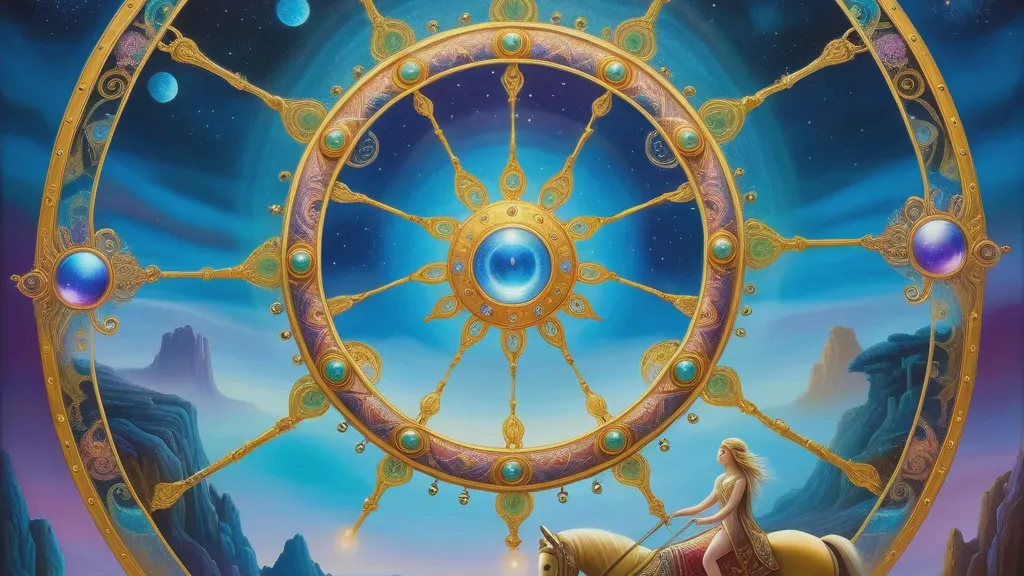
Chariot Wheel
Jungian Archetypes
Meaning
A chariot wheel is the part of a fast, driven vehicle that actually touches the ground. The charioteer holds the reins, the horses supply the force, but the wheel is where intention meets road, and a chariot is only as good as its wheels' willingness to turn true. In dreams the wheel carries that whole arrangement: the dreamer's sense of agency, the machinery beneath their forward motion, and the hub at the centre that stays still while everything around it spins. A wheel that wobbles, sticks, comes off or turns without going anywhere reports on the state of the dreamer's control over their own momentum, and its ancient, martial form says that the stakes feel higher than a daily commute.
Psychological Interpretation
The wheel is not the chariot. Dreamers who fix on the wheel rather than the vehicle, the horses or the driver are being shown the mechanism of their progress rather than its direction, and the first question is what the wheel was doing. A wheel turning smoothly under a moving chariot is the rare dream of momentum that feels earned; a wheel that wobbles is agency that works only while the dreamer stares straight ahead; a wheel that sinks in mud is a commitment stalled at the worst possible moment. When the wheel comes off and rolls away, the dream separates the dreamer from their own means of motion and often reveals, as they chase it, that they had been gripping the reins rather than steering. The chariot's antiquity matters. Nobody drives one, so the dream is reaching past the dreamer's actual life for an image of movement that is public, fast and dangerous, with an audience, and this usually points to a situation in which the dreamer feels watched while trying to keep something on course. The wheel's circular form carries the second theme. A wheel that spins in place, or that the dreamer turns by hand while watching its patterns repeat, is the psyche's picture of a cycle the dreamer is inside: a recurring argument, a habit, a season of life that keeps coming round. The still hub at the centre is the part most dreamers forget to look at, and it is where the way out of the cycle usually is.
Traditional Symbol Meaning
The wheel in older dream lore is first of all the wheel of fortune, and the chariot wheel is its fastest form. Boethius, writing The Consolation of Philosophy in prison in the sixth century, gave the medieval world its picture of Fortuna turning a wheel on which kings rise and fall, and the image passed into the Tarot as the tenth trump. A dreamer who saw a wheel turning was being reminded that position is temporary; a dreamer who saw it break was being told that the mechanism of their rise or fall had reached its limit. The Tarot's seventh card, the Chariot, sharpened the reading toward will: a crowned figure drives two creatures of opposite colour without visible reins, and the card was taken to mean victory through mastery of contrary forces. Where the Chariot promised control, its wheel, considered alone, spoke about whether the control would hold. In the Indian traditions the chariot wheel became a religious symbol in its own right. The chakravartin, the wheel-turning monarch of Buddhist and Hindu political thought, was the ruler whose chariot wheels rolled unopposed to the edges of the world, and the Buddha's teaching was called the turning of the wheel because it set going a movement that would not stop. Yet the same literature preserved the wheel's failure. Karna, the great warrior of the Mahabharata, had been cursed that his wheel would sink at the moment he needed it most, and when it did, and he stepped down to free it, he was killed unarmed. Traditional readers took the stuck wheel as the image of a fate that arrives exactly when one is most committed, and of the way old promises and old curses catch up with a person in motion. The Bible offered two wheels. Elijah was taken up in a chariot of fire, and Ezekiel saw wheels within wheels, rimmed with eyes, that moved wherever the spirit went; the second vision became the seed of Merkabah mysticism, in which the visionary ascends by contemplating the divine chariot. Christian legend added St Catherine of Alexandria, whose spiked execution wheel shattered at her touch, turning the wheel of torture into a sign of a will that could not be broken. Folk reading absorbed all of this into a few rules: a wheel turning true meant a life in motion under its owner's hand, a wheel spinning in place meant labour without progress, and a wheel lost or broken meant a journey interrupted by something the dreamer had not been steering. The hub gathered the quieter tradition. The Tao Te Ching's observation that the emptiness at the centre is what makes the wheel useful passed into later commentary as advice about stillness within action, and Buddhist teachers used hub and rim to describe the still mind at the centre of turning experience. For the dreamer the layers converge: the chariot wheel is fortune, will, fate catching up, and the still point inside all three.
Jungian / Archetypal
Jung's writing on the mandala begins with wheels. The circular figures his patients drew in periods of confusion, and that he found in Tibetan painting, in the rose windows of cathedrals and in the alchemists' diagrams, had a centre and a rim and often spokes or quadrants, and he understood them as spontaneous images of the Self, the ordering centre that appears when the ego has lost its bearings. A chariot wheel is a mandala with a job: it has to turn and bear weight and stay true at speed. When it appears in a dream, the Self is not only pictured but tested, and the wheel's condition, its wobble, its break, its turning without progress, describes the current relation between the ego that drives and the centre that carries. The chariot invites amplification. Plato's charioteer holding a noble horse and an unruly one is, in Jungian terms, an ego managing instincts of opposite temper, and Phaethon, who took his father's chariot and could not hold it, is the puer whose inflation ends in fire. Ixion, bound to a turning wheel of fire in Tartarus for reaching above his station, is inflation punished by the wheel itself. Jung read Ezekiel's vision of the wheels as a quaternity, a mandala of the Self glimpsed by a prophet in exile, and the Buddhist wheel of Dharma is the same image turned into a path. Against these stands Karna's wheel sinking into the earth, the moment when the Shadow, in the form of an old curse and an old betrayal, reaches up and holds the hero still. A dreamer whose wheel sticks is often meeting exactly that: something disowned that has waited until the moment of greatest commitment to make itself felt. Individuation, in Jung's phrase, is a circumambulation of the Self, a circling that returns to the same themes at higher levels rather than a straight road. The wheel the dreamer spins by hand, watching its patterns repeat, is this circling seen from inside, and the crucial detail is whether the dreamer knows they can stop it. The Maiden figure the tradition attaches to the wheel, Catherine whose wheel shattered at her touch, points to an innocence that has not yet learned it can act on the mechanism. The compensatory reading follows. To a dreamer who has been all driver, all will and grip, the wheel comes off to show that motion was never theirs alone. To a dreamer who has felt driven by everyone else's chariot, the wheel spinning under their own hand is the unconscious offering the hub back.
Gestalt / Parts of Self
Every part of the chariot is you, and Gestalt dreamwork asks you to speak as each one. Be the wheel first: I am the part that touches the ground. I carry the whole weight and nobody looks at me until I wobble. I go round and round and I never get to choose the direction. Then be the charioteer: I hold the reins, I am the one people see, I am terrified of what happens if the wheel gives out. Then be the horses, and the road, and the crowd if there was one. Say each in the first person, in the present tense, and notice which voice makes you want to stop. The part you least want to speak is the part you have been leaving on the road. A wheel is a natural image of the contact cycle, because its rim meets the ground and leaves it with every revolution: contact, withdrawal, contact, withdrawal, at speed. A wheel turning true is a life in which reaching out and drawing back follow each other without a snag. The wobble is an interruption at the moment of contact, the point where you touch the ground and flinch. The stuck wheel is contact that has become confluence, sunk into the mud of a relationship or an obligation and unable to withdraw. The wheel that comes off and rolls away is withdrawal that has become total, and chasing it is the organism's attempt to close a gestalt it has been leaving open. Ask what in your life the road stands for and where on it you flinch, sink or fly off. The polarity in this dream is between driving and being driven, and most dreamers have been living at one pole. If you were gripping the reins so hard that the wheel wobbled, own the gripper and then own the wheel that wanted to turn on its own; if you were a passenger with no reins at all, own the passenger and then the driver you have been projecting onto someone else. Finish the dream awake. Let the wheel come off and see where it rolls; let the stuck wheel sink and see what you do when the chariot is no longer possible; put your hand on the spinning wheel and stop it, and stay with what you feel in the silence afterward. Then find the hub, the still part at the centre that does not move, and let it speak: I am here whatever the rim is doing. That voice is yours as well.
Psychodynamic / Freudian
Freud's image for the ego's relation to the id was a rider on a horse who must borrow the horse's strength and often has to go where it wants to go. The chariot adds a third term. Between the driver and the horses there is a mechanism, and the wheel is the ego's instrument for turning drive into motion over real ground; the dream of a chariot wheel is therefore about the apparatus of control rather than about will or desire directly. Its latent content is usually an anxiety about performance in the widest sense, the fear that the means by which the dreamer converts wanting into doing will fail at the moment of exposure. A wobble that steadies only when the dreamer looks ahead is the classic form: the apparatus works until it is inspected, which is how many people experience their own competence. The wheel that goes round and round belongs to a different chapter. In Beyond the Pleasure Principle Freud described the compulsion to repeat, the tendency to re-enact painful patterns rather than remember them, and a wheel turned by hand while its patterns recur on the ground is that compulsion made visible; the dreamer's discovery that they can stop it is the first movement from repetition toward memory. Displacement is at work in the choice of a chariot, since the archaic vehicle keeps the conflict at a safe distance from the car, the career or the marriage it stands for. Condensation packs several figures into the wheel: the parent whose steadiness the dreamer relied on, the dreamer's own body, and the fate that older stories say catches up with a person in motion. Object relations give the wheel a history. Winnicott described the infant's going-on-being, the continuity a reliable environment protects and impingements break, and the smooth turning of the wheel is that continuity while the jolt is impingement, the moment the ground was not where the child expected it. Bion's container is the hub, the still centre that holds the spokes, and a dreamer whose wheel has no hub, only a rim spinning without an axle, is picturing an early environment that could not hold. In the transference the analytic frame is the wheel the patient rides on, turning at the same hour each week, and dreams of the wheel wobbling or coming off cluster around breaks and endings, when the patient tests whether the analyst's steadiness is real. What the patient does with the loose wheel, chases it, abandons it or brings it back to be refitted, is often their first statement of how they expect the relationship to survive their own force.
Contemporary Psychological
A vehicle that will not steer is a familiar anxiety dream, and the content-analysis tradition that Calvin Hall and Robert Van de Castle began and that G. William Domhoff has continued would file the chariot as a vehicle dream in archaic clothes. The continuity hypothesis predicts that it will appear when a waking situation involves speed, exposure and a fear of losing control: a project with an audience, a family in transit, a role the dreamer has to hold at pace. The wheel's substitution for the car is not arbitrary. Dreams draw on stored imagery, and a person who has recently seen a chariot race on screen, visited a museum or read the Mahabharata supplies the sleeping brain with a form it then uses for a present concern. The wheel is borrowed; the wobble is the dreamer's own. The sense of agency, studied experimentally by Patrick Haggard among others, depends on a tight match between intended and observed outcomes, and a wheel that responds only when the dreamer looks ahead is a compact model of that match breaking down under self-monitoring. Antti Revonsuo's threat-simulation theory reads the wobbling or detaching wheel as rehearsal for the loss of control over a moving body, a threat as old as running and as recent as driving. Ernest Hartmann's proposal that dreams contextualise emotion in a single picture fits the stuck wheel: the feeling of being committed and immobilised at once, hard to state, is easy to see when a wheel sinks in mud in the middle of a battle. Rosalind Cartwright's findings on dreaming and mood regulation suggest that such pictures are part of how the night processes a stressful week, not merely a replay of it. The wheel that turns in place has its own neuroscience. Sleep replays procedural and motor memory, and the hypnotic repetition of a spinning wheel resembles the loop of a rehearsed action being consolidated; predictive-processing accounts add that a system re-running the same prediction without new input produces exactly this experience of motion without progress. The dreamer's discovery that they can stop the wheel maps onto the return of prefrontal control within the dream, a feature associated with lucid and near-lucid states. Three variables carry the information: whether the wheel is on or off the chariot, whether it turns under the dreamer's hand or someone else's, and whether the dreamer, at any point, found the still hub and used it.
Cultural & Historical Origins
The spoked wheel and the light war chariot appear together in the Sintashta burials of the Eurasian steppe around 2000 BCE, and within a few centuries the chariot had become the vehicle of gods and kings from Egypt to China; six chariots were sealed into Tutankhamun's tomb. The Trundholm Sun Chariot, a Bronze Age bronze horse drawing a gilded sun-disc on wheels, found in a Danish bog, shows how early the wheel was joined to the sun's daily journey, an association that runs through Helios's chariot and through Phaethon, who could not hold the horses and set the earth on fire in the second book of Ovid's Metamorphoses. Plato's Phaedrus made the chariot a picture of the soul, a charioteer managing one noble horse and one unruly one. In India the chariot wheel became the wheel of law: the Buddha's first sermon is called the turning of the wheel of Dharma, the Ashoka Chakra with its twenty-four spokes stands on the flag of India, and the thirteenth-century Sun Temple at Konark is built as Surya's chariot with twenty-four carved stone wheels. The Mahabharata gives the single most famous chariot wheel in literature, the wheel of Karna's chariot that sinks into the earth at Kurukshetra, leaving him defenceless as Arjuna kills him; in the same war Krishna, who had sworn not to fight, lifts a broken chariot wheel in fury against Bhishma. Ezekiel's vision of wheels within wheels, full of eyes, gave Jewish mysticism its Merkabah tradition, and the Tao Te Ching's eleventh chapter observed that thirty spokes meet at a hub and it is the emptiness there that makes the wheel useful.
Contextual Variations
A chariot wheel that wobbles until you look straight ahead
Your control works only while you are not inspecting it. A wheel that steadies when you look forward and wobbles when you look down at it is the dream's picture of competence that fails under self-monitoring: the presentation, the relationship, the parenting that goes fine until you start watching yourself do it. The dream is not telling you to stop paying attention. It is telling you that your grip on the reins has become part of the problem, and that the wheel was built to turn without supervision. Ask where you have been checking the mechanism so often that the checking itself is the wobble.
The wheel comes off and rolls away across a field
The means of your motion has left you. A wheel that detaches and runs off on its own separates you from your momentum in a single image: the plan, the job, the routine or the person that carried you forward is suddenly going somewhere without you. Most dreamers chase it, and the chase is where the message lives. If you caught the wheel and realised, as many do, that you had been pulling too tightly rather than steering, the dream has diagnosed the cause. If you never caught it, look at what is rolling away while you run after it, and whether you want it back or only fear being still.
A chariot wheel sinking into mud in the middle of a battle
You are stuck at the moment of greatest commitment. This is Karna's wheel from the Mahabharata, the wheel that sinks when its owner most needs to move, and it appears when a long effort has ground to a halt exactly as the stakes peak: the final year of a degree, the decisive stage of a negotiation, a relationship at the point of promise. The mud is usually something old, a debt, a habit, a promise that was always going to catch up. The dream asks whether you will climb down to free the wheel, which leaves you exposed, or stay in the chariot and go nowhere. There is no third option, and that is the point.
Finding an ancient chariot wheel buried in the ground
You have dug up a mechanism from an earlier age. A wheel unearthed from soil, spoked and intact, belongs to a vehicle that no longer exists, and the dream is showing you a way of moving through life that you inherited rather than built: a family's way of driving forward, a strategy from an earlier version of yourself, a pattern of striving that once carried someone to glory. Ask whether you meant to use it or to study it. Dreamers who try to fit the old wheel to a modern vehicle often find that it does not turn, and the dream may be saying that the inheritance deserves a museum rather than a road.
Frequently Asked Questions
Why did I dream of a chariot instead of a car?
Is a broken chariot wheel in a dream a bad omen?
Why do I keep dreaming of a wheel turning without going anywhere?
Is my chariot wheel dream connected to the Tarot Chariot card?
Journaling Prompts
- Describe the wheel exactly as you saw it: its size, whether it was on or off the chariot, whether it turned true, wobbled, stuck or spun in place. Then write about the part of your life that moves the way the wheel moved, and about who or what supplies the horses' strength to it.
- If you gripped the reins in the dream, write about what you are gripping awake. Name the plan, relationship or role you have been holding hardest, and describe what would happen, in concrete terms, if you loosened your hands by a quarter and let the wheel turn on its own for a week.
- Find the hub, the still centre of the wheel that does not move while the rim turns. Write about the part of you that stays in place while your life goes round: what it knows, what it wants, and when you last acted from it instead of from the rim. Then write one decision you could make from the hub this month.
- Think of a cycle in your life that has come round more than three times, an argument, a resolution, a pattern of leaving or staying. Write it as a wheel: where it starts, where it touches the ground hardest, where it lifts off. Then write about the moment in the turn when you could put your hand on it and stop.
Related Symbols
Dreamed about Chariot Wheel?
Get a personalized AI interpretation that connects this symbol to your specific life circumstances.
Interpret My Dream