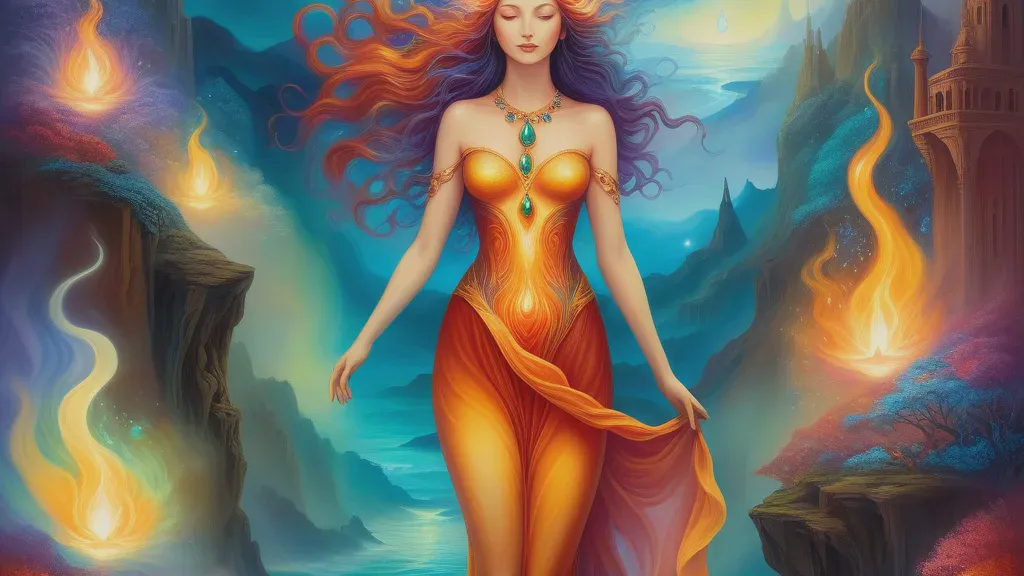
Chaotic Flame
Jungian Archetypes
Meaning
A chaotic flame is fire that will not keep its shape. It leaps sideways, changes colour, splits into tongues, dies down and flares without any reason the dreamer can see, and it ignores the hearth, candle or fire pit that was supposed to hold it. Fire in dreams is the usual image for energy, appetite, anger and creative heat; the chaotic qualifier says that this energy has slipped the forms the dreamer built to contain it. The dream arrives when feeling is running ahead of regulation, when something in the dreamer burns hotter than their composure allows, and it asks a double question: what is this heat for, and what happens if it is neither put out nor given a place to burn.
Psychological Interpretation
The first thing to read is the container. A candle, a stove, a campfire ring and a fireplace are all agreements between the dreamer and their own intensity, and the chaotic flame is that agreement breaking down. Fire that stays in the grate is warmth and competence; fire that wanders off the wick and along the tablecloth is feeling that has stopped answering to the dreamer's intentions. The behaviour of the flame is the diagnostic detail. A flame that grows and shrinks unpredictably points to moods the dreamer cannot forecast; one that changes colour points to feeling that keeps turning into something else, anger into grief into desire; one that throws sparks onto other people points to intensity that is beginning to cost relationships. The second thing to read is the dreamer's stance. Many people are surprised to find that they are not afraid of the chaotic flame but absorbed by it, and the fascination matters: the psyche is showing the dreamer that the unruly energy is also their liveliness, the part that has been sitting too quietly under a polite surface. Frantic attempts to smother the fire, hide it or take responsibility for it while no one else notices point instead to a long habit of managing feeling privately. The chaotic flame is not asking to be extinguished. It is asking for a form that fits it, a hearth built to its actual size rather than the size the dreamer would prefer to be.
Traditional Symbol Meaning
Folk interpretation has always split fire into the tame and the wild, and it read the two in opposite ways. A fire burning steadily in its proper place, on the hearth, in the lamp, on the altar, was among the best of omens: warmth, prosperity, a household in good order, a love that would last. A fire that escaped its place was among the worst. The older dream books took a flame that jumped, guttered, spread or would not be governed as a sign of quarrels, fever, rash acts and sudden loss, and the interpretation followed the fire's behaviour more than its size. A small flame that would not stay on its wick was a worse sign than a large fire burning quietly, because the tradition was reading temperament rather than destruction: the ungoverned flame was the ungoverned heart. The sacred fires of antiquity taught the same lesson through discipline. Vesta's hearth in Rome and the fire temples of the Zoroastrians were tended by people whose task was to keep a flame constant, and a fire that flared irregularly, went out or was polluted was a public alarm. The Vedic householder kept three fires and knew the rites for each, so that Agni, who could as easily become the forest fire, remained a guest rather than an invader. In all these traditions the flame was a living thing with a will, and the work of civilisation was the work of persuading it to keep to its shape. A dreamer watching a flame refuse its shape is watching that persuasion fail, and older interpreters would have asked which appetite or temper in the dreamer's life had slipped its keeping. European folklore added the flame that misleads. The will-o'-the-wisp, the corpse candles of Wales and the jack-o'-lantern of Irish story are all flames that move without a hearth, drifting over bogs and drawing travellers off the path into the water. Here the chaotic flame is not rage but glamour, a light that promises and cannot be followed, and the tradition warned that whoever chased it would be lost. Hawaiian stories of Pele carry the other pole, fire as a goddess whose moods build islands and destroy villages, to be respected rather than mastered. The Buddhist Fire Sermon pushed the image inward: all of experience is burning with craving, and liberation is the fire's going out. The modern folk reading keeps every layer. A chaotic flame is passion, anger or creative heat that has slipped the forms built for it; it is a glamour that leads the dreamer astray; it is the wildfire side of a god who is also the hearth. The traditional advice was never simply to put it out. It was to find the altar, the lamp or the ring of stones that this particular fire was meant to burn in.
Jungian / Archetypal
Jung's Symbols of Transformation devotes long passages to fire-making, to the friction of the fire-drill and to the ancient identification of flame with libido, the psychic energy that drives every wish and every work. Fire is the natural image of that energy because it is visibly alive and visibly hungry. The chaotic flame is libido that no symbol has caught. Jung argued that psychic energy needs a channel, a form or image that turns raw drive into something the personality can use, and when no adequate form exists the energy does not disappear; it burns wherever it can. A flame that will not stay in the candle or the grate is the dream's report that a quantity of life-force in the dreamer has no container equal to it. The archetypes involved depend on the setting. Where the flame threatens a house, an office or a public ceremony, the Persona is in play: the mask of composure the dreamer wears in company is being scorched from inside, and the frantic wish to hide the fire from colleagues is the Persona defending itself. Where the flame is held in the hands and both fascinates and frightens, the Shadow is closer, the disowned anger or desire the dreamer has been treating as not their own. Amplification places these images in a long line: Agni who is both hearth and forest fire, Pele who builds and destroys, Heraclitus's world-fire that is cosmos only when it burns in measure. The Maiden archetype belongs here too, through the Vestals whose vocation was keeping a flame constant, an image of the innocence that maintains order by never letting the fire show its temper. The alchemists spoke of calcinatio, the burning that reduces a substance to ash so that what is essential can be recovered, and Jungian analysts, Edward Edinger most thoroughly, read it as the stage of individuation in which an old adaptation is consumed by feeling that has become too strong to manage. The chaotic flame is calcinatio arriving before the dreamer has built the vessel for it. The compensatory reading is the practical one. To a dreamer whose conscious life is cool, controlled and correct, the unruly fire comes as the missing heat, and the task is not to smother it but to give it work: a conflict spoken, a piece of art begun, a love admitted. To a dreamer already living in outbursts, the same image shows the cost of energy with no form, and the vessel, the disciplined practice or relationship that can hold the fire, becomes the goal.
Gestalt / Parts of Self
Be the flame before you interpret it. In Gestalt dreamwork every element of the dream is a piece of yourself, and the flame that will not hold its shape is the most alive piece of all. Speak as it: I go where I want. I change colour when I feel like it. I do not stay on the wick. I jump onto whatever is near me and I do not apologise. Say the sentences aloud and notice which ones feel like a confession and which ones feel like a lie, because both kinds are yours. Then be the container, the candle or the fireplace or the ring of stones: I was built to hold this and I cannot. I am too small. I was made for a smaller fire than the one I have. The dialogue between the two is the whole dream, and the chair you least want to sit in is the one to start with. Fritz Perls described anxiety as excitement that has lost its breath, excitement the organism cannot support because it is holding itself in. The chaotic flame is excitement in exactly that condition: energy rising toward contact with no support under it, so that it flares and collapses instead of burning. Ask what you were about to do or say or want in the dream at the moment the flame went wild, because that is the contact the fire was trying to make. Then look for the interruption. If you turned the heat on yourself, burning your own hands or your own house, you were retroflecting, doing to yourself what you wanted to do outward. If you kept talking calmly while the flame roared, you were deflecting. If you tried to hide the fire from everyone in the office, you were protecting a confluence with people who have only ever seen you cool. The polarity is heat and composure, and you have been living at one end of it. The dream's task is not to choose the other end but to own both: I am the one who burns and I am the one who holds, in one breath, without the fire shrinking to make the sentence easier. Finish the dream in imagination. Let the flame have what it wants, a room, a person, a page, and notice what shape it takes once it is no longer fighting a container too small for it. Then notice where the heat lives in your body right now, the chest, the throat, the hands, and ask that place what it has been waiting to do.
Psychodynamic / Freudian
The manifest content is a fire misbehaving; the latent content is an affect the dreamer cannot yet claim. Freud's late paper on the acquisition and control of fire speculated that civilisation began with the renunciation of an instinctual urge toward the flame, and whatever one makes of the argument, the intuition beneath it holds in the consulting room: fire in a dream is drive, sexual or aggressive, and the chaotic flame is drive that has escaped repression in a form still disguised enough to be looked at. The dreamer who cannot say I am furious with my mother or I want someone I should not want can say that a flame leapt sideways off the candle and would not be put out. The chaos is the disguise; it presents the energy as an accident rather than a wish. The defences are visible in how the fire is handled. Displacement moves the heat from the person it belongs to onto a desk, a house, a hand; reaction formation appears as the strange calm many dreamers keep while everything around them burns, isolation shows itself when the dreamer watches beautiful, patterned flames consume a home and feels only aesthetic interest. Freud's most famous fire dream, the father who dreams that his dead child stands beside him saying that he is burning, shows a real flame in the next room rewritten by the sleeping mind; Freud read it as a wish to see the child alive a moment longer, and later readers have heard in the child's words a reproach the father could not feel awake. A chaotic flame that no one else in the dream notices is often a feeling the dreamer's family did not notice either. Object relations ask who was meant to hold the fire. Bion described raw emotional experience, before it has been thought, as beta elements, and the mother's mind as the container that receives them and returns them in bearable form; a flame that will not take a shape is affect that never found such a container and so never learned one. Winnicott would ask about the early environment's ability to survive the child's intensity without retaliating or collapsing, and a dream in which the dreamer alone must contain a fire that keeps escaping often reproduces a childhood in which strong feeling had nowhere to go but inward. In the transference the chaotic flame flares when the patient begins to feel toward the analyst something never permitted toward anyone: desire, rage, love, each experienced as a fire that might burn the room down. The work is to let it burn in the session and discover that the room survives.
Contemporary Psychological
During REM sleep the amygdala and the emotional circuits of the limbic system are highly active while the prefrontal regions that supply executive control are relatively quiet, a pattern Allan Hobson's models of dreaming have long emphasised. A flame that changes size and direction without reason is a faithful image of what that neurochemistry feels like from inside: strong affect with the regulator switched off. Matthew Walker has argued that REM's low noradrenaline lets the brain replay charged memories with the alarm dampened, so that intense feeling can be rehearsed without the full stress response, and the odd fascination many people report while watching a chaotic flame is consistent with that account. The heat is real; the brake that would normally make it terrifying is off. Ernest Hartmann proposed that dreaming works by finding a picture that contextualises an emotion, and he observed that people after overwhelming experiences often dream not of the event but of an image with the same feeling, a tidal wave being the example he cited most. Fire that will not hold its shape does the same work for arousal too diffuse to name, anger and desire and creative excitement at once. Rosalind Cartwright's studies of mood across a night of dreaming suggest that such images are part of the processing by which feeling is integrated. Antti Revonsuo's threat-simulation theory reads the fire as an ancestral danger being rehearsed; wildfire and burning shelters are among the oldest threats humans faced, and a fire spreading unpredictably through a house is exactly the scenario the simulation would favour. Michael Schredl's survey work on fever dreams adds a bodily footnote: raised temperature goes with more bizarre, more intense dream imagery, and heat is a common theme. The continuity hypothesis, defended by William Domhoff, predicts that this dream follows waking intensity: a conflict held in, an attraction unacted on, a creative project stalled. Predictive-processing accounts add that a fire which refuses to behave is a high-surprise stimulus, and the dreaming brain generates such stimuli to test how its model of control responds. The useful data are the timing and the setting. A chaotic flame that recurs on the nights after a confrontation was avoided, or in the weeks a piece of work sits untouched, is the brain flagging unspent arousal; a fire that breaks out in the dreamer's workplace rather than their home says where the regulation is costing most.
Cultural & Historical Origins
The Rigveda opens with a hymn to Agni, the fire that carries offerings to the gods, and the Vedic tradition distinguished the domestic fires of the household altar from the forest fire, davagni, that consumed everything in its path; the same god was both, and the disciplines of tending the hearth fires existed to keep him in the first form rather than the second. Heraclitus made fire the underlying substance of the cosmos and, in one surviving fragment, described the world-order as an ever-living fire kindling in measures and going out in measures, a definition that makes the chaotic flame a fire without measure. Rome placed its safety in the flame of Vesta, tended by the Vestal Virgins, whose fire was never to go out and whose lapses were punished as a danger to the state, and Zoroastrian fire temples still keep flames that must not be polluted. The Buddha's Fire Sermon, the Adittapariyaya Sutta, declared that the whole of experience is burning with passion, hatred and delusion, a text T. S. Eliot borrowed for the third section of The Waste Land. European folklore gave the erratic flame its own names, the will-o'-the-wisp and ignis fatuus, the wandering light over marshes that leads travellers off the path, and Irish legend attached it to Stingy Jack, doomed to roam with a coal in a turnip lantern. In Hawaii the volcano goddess Pele embodies fire's temper, generous and destructive by turns, and Gaston Bachelard's The Psychoanalysis of Fire, published in 1938, gathered these threads into a study of how reverie before a flame shapes the imagination.
Contextual Variations
A candle flame that grows into a whirling column
Something small has become something you cannot look away from. A candle is the most domesticated fire there is, a flame kept to a wick and a purpose, and when it rises into a spinning column the dream is showing you a feeling you thought was manageable turning into a force. The whirl matters: it is energy going in circles, intensity with no direction yet. Ask what you have been treating as a minor irritation or a small attraction, because the dream says it has outgrown the wick. The column is not yet destructive. It is asking you to give it somewhere to go before it finds its own way.
Fire spreading through your house in unpredictable jumps
The house is your inner life, and the fire is moving through it without a pattern you can predict. A blaze that jumps from the kitchen to a bedroom to the stairs, skipping rooms and doubling back, is feeling that surfaces in one part of your life and then, without warning, in another: a temper from work that appears in a marriage, a longing that turns up in the wrong place. Notice which rooms burned and which were spared. If you felt inspired rather than frightened, the dream is showing you an appetite for a change so complete that only fire could clear the ground.
Holding a flame that changes colour and shape in your hands
The fire is in your hands, which means it is yours to use and yours to be burned by. A flame that shifts from blue to orange to white while you hold it is feeling that will not settle into one name: anger becomes grief becomes wanting while you watch. Dreamers with this image often describe trying to speak calmly and hearing their words come out hot. The dream is about the gap between what you are carrying and what you let yourself say. Look at the last conversation in which your tone surprised you. The hands say you can shape this fire; the colours say you have not yet decided what it is.
A campfire that throws sparks onto everyone around it
Your heat has begun to land on other people. A fire built for company, a ring of stones and a circle of friends, that starts spitting embers into laps and hair is intensity that has stopped being private. The dream is honest about cost: the warmth that drew people close is now singeing them, and you are usually the one who built the fire. Ask who was sitting in the circle and who moved back first, because those are the relationships currently feeling your temper or your urgency. The task is not to douse the fire but to tend it, adding wood more slowly and noticing the wind.
Frequently Asked Questions
Why did the fire in my dream keep changing shape?
Is dreaming about uncontrollable fire a sign that I am angry?
Why was I fascinated by the chaotic flame instead of afraid of it?
Can a chaotic flame dream be about creativity rather than destruction?
Journaling Prompts
- Describe the container the fire was supposed to stay in, the candle, the stove, the ring of stones, and then describe the real-life arrangement it resembles: the routine, the role or the relationship that is meant to hold your intensity. Write about the moment you first noticed the arrangement was too small.
- Watch the flame change in memory and name each colour or shape with a feeling: this flare was anger, this blue moment was wanting, this collapse was grief. Then write about a recent day when your feelings changed just as fast, and about who was standing close enough to be singed.
- Write a short letter from the fire to you. Let it say where it wants to go, what it has been waiting to burn and why it would not stay on the wick. Then answer it in your own voice, and pay attention to whether your answer is a refusal, a bargain or an invitation.
- Imagine building a hearth that fits the fire exactly, a place where it could burn as hot as it likes without harming anyone. Describe it in concrete terms: the hours, the practice, the person, the page. Then write down the first small thing you would have to do this week to lay its foundation.
Related Symbols
Dreamed about Chaotic Flame?
Get a personalized AI interpretation that connects this symbol to your specific life circumstances.
Interpret My Dream