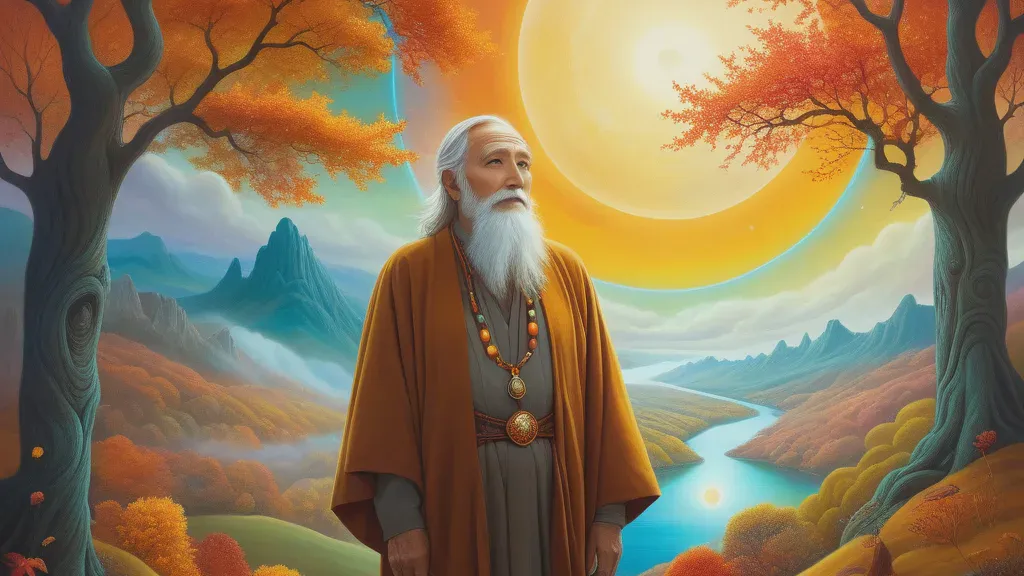
Autumn Equinox
Jungian Archetypes
Meaning
The autumn equinox is the moment of exact balance on the way down: day and night stand equal for a single turning, and from then on the dark lengthens. As a dream image it belongs to thresholds, but a specific kind. It is not the beginning of something or its end; it is the hinge at which gain becomes loss, harvest becomes storage and outward effort turns inward. Dreamers meet it when a life has reached its midpoint in some sense, a career, a marriage, a body, a year of work, and the psyche wants to mark the turn honestly rather than pretend the light is still growing. The equinox asks what has ripened and must be gathered, what has to be let fall, and how the dreamer intends to live in a season of longer nights.
Psychological Interpretation
Dreams choose the autumn equinox when the dreamer needs an image of poise between two movements, and the details show which. The exact balance of light and dark is a picture of a decision held in suspension: two claims of equal weight, a relationship at the moment when staying and leaving are evenly matched, a life in which past and future briefly weigh the same. The direction of the tilt matters more than the balance. Because the autumn equinox opens onto darkness, the dream usually concerns acceptance of decline, aging, diminishing energy, an ending seen clearly and some way off, and the task inside it is to gather rather than to fight. A harvest in the dream, a field of cut grain, a golden light going cool, describes what the past season produced and what must now be brought in. Guests who mourn while others celebrate hold the double feeling of the turn, and a dreamer who manages both shows a capacity the psyche prizes: to carry loss and gratitude in one hand. A calm equinox dream is a sign of integration, the season changing and the dreamer changing with it. A frightening one suggests the turn arrived before the dreamer was willing, and that the dark half of the year is still being experienced as theft rather than as the other half of the same year.
Traditional Symbol Meaning
Traditional readings of the autumn equinox turn on harvest, and the dream lore follows. Harvest festivals, from the English Harvest Home with its last sheaf carried in and its corn dolly plaited from the final stalks to the Jewish Sukkot, which falls in the same weeks and commands both rejoicing and the memory of wandering, treat the season as a time of accounting: what the year yielded, whether it will last the winter, and what is owed in thanks. Dreams of harvest in the old dream books were correspondingly read as reckoning, abundance if the crop was good and warning if it was thin, and the equinox concentrates that reckoning into a single day of exact measurement. The Eleusinian tradition supplied the descent. The Greater Mysteries, held around the equinox, took initiates through Demeter's search and Persephone's return, and the promise made to them was that having seen the descent enacted they would not fear death. The autumn equinox in that light is the door through which the maiden goes down, and it stands in the dream for every departure into a dark that is nonetheless part of a cycle. The Japanese Higan makes the same equation openly: the equinox is the season of the other shore, the days when this world and the next are said to lie closest together and the appropriate act is to visit the graves. Michaelmas, at the end of September, gave Christian Europe an archangel with a sword at the same hinge, and Steiner's reading of the season, as a call to inner strength precisely when the outer light fails, remains one of the fullest modern statements of what the equinox asks. Literature has its own equinox. Keats's To Autumn, written in September 1819, is the season's balance rendered as a mood: fullness and drowsiness, the gathering swallows, a light that does not yet admit the cold. Rilke's Herbsttag begins with the flat announcement that it is time, the summer was immense, and ends with the person who has no house now and will not build one, who is alone and will stay alone, writing long letters and walking the avenues as the leaves blow. The tradition these poems carry is that autumn is neither triumph nor tragedy but ripeness, and that ripeness is heavy. In dreams, that heaviness is often what the dreamer notices first. The scales of Libra, which begin at the equinox, give the last traditional strand. Weighing is judgement, and the tradition reads the equinox as the year's assize: the moment the light is measured against the dark and found exactly equal before the verdict goes against it. A dream set at the autumn equinox therefore carries all four meanings at once, reckoning, descent, ripeness and judgement, and which of them is uppermost usually depends on what the dreamer has been counting.
Psychodynamic / Freudian
The autumn equinox is the psychoanalytic season. Freud's Mourning and Melancholia distinguishes healthy grief, in which the lost object is slowly relinquished piece by piece, from melancholia, in which the loss is turned against the self; a dream set at the turn of the year toward darkness is very often a mourning dream in disguise, the manifest harvest concealing a latent loss the dreamer has not yet named. Displacement is doing the work. It is easier to dream of the light going cool in a room than of a parent aging, a child leaving or a body no longer young, and the equinox provides a socially acceptable image of decline into which private grief can be poured. Melanie Klein's depressive position describes the achievement the dream is testing. In it the person accepts that the good and the bad belong to the same object, that what they love is also what they will lose, and that their own destructiveness has damaged what they depend on; the accompanying wish is to make reparation. The guests who both celebrate and mourn at one table are that position exactly, and a dreamer who manages to hold the party together has reached it, at least for the night. Winnicott's account of the capacity to be alone adds the Rilke note: the person who has no house now and will not build one is, in a good outcome, not abandoned but able to be alone in the presence of an internalised good object. Clinicians often notice a run of such dreams in September, because the analytic year has its own equinox: the return from the summer break, the resumption of work under a lengthening dark, the transference reawakened by the analyst's return. Anniversary reactions cluster in the same weeks for people whose losses fell in autumn, and repetition compulsion brings them back to the same balance point year after year until the mourning is done. The wish beneath the dream is usually double, to have the light back and to be allowed to stop pretending it is not going. The analyst's task is to receive both, and the dream in which the dreamer stays at the table, telling the truth about what is ending while still passing the bread, is the sign that the work is taking.
Contemporary Psychological
Sleep and mood both change with the light, and the autumn equinox is where the change becomes measurable. Shorter days lengthen the nightly melatonin signal and shift the circadian clock; people in temperate latitudes sleep longer as autumn deepens, and some laboratory work has reported more REM sleep in winter than in summer. Since dreaming is concentrated in REM, the season of the equinox dream is not incidental: the brain is entering the part of the year in which it dreams more, and a dream that marks the turn may be tracking a real shift in its own physiology. Light exposure, morning activity and the timing of sleep all alter how that turn is felt. The equinox is also a temporal landmark, and behavioural science has shown how much those matter. Hengchen Dai, Katherine Milkman and Jason Riis described the fresh start effect: at the start of a week, a month or a year, and after a holiday or a birthday, people are markedly more likely to begin new goals and to disconnect from their past failures. A dream that stages the equinox as a hinge, with clocks slowing or a sun setting due west, is the brain using the same mechanism, converting an astronomical fact into a personal reset point. The continuity hypothesis predicts that such dreams follow real reflection about direction, and dreamers who have recently been asking what to keep and what to drop will recognise their own accounting in the harvest imagery. Memory consolidation supplies the harvest itself. During sleep the hippocampus replays recent experience and the cortex integrates it into long-term structure, a process that has been compared, not fancifully, to gathering and storing; an equinox dream full of fields, tables and gathered fruit may be the brain's own image of that work at a time of year when there is a season's worth of experience to file. Rosalind Cartwright's finding that people who dream about a stressor adapt better than those who avoid it, and Matthew Walker's account of REM as a setting in which emotion is stripped from memory, both suggest that the mourning in the dream is functional. The dreamer wakes lighter not because the light has come back but because the loss has been processed one more turn.
Jungian / Archetypal
Jung's essay The Stages of Life divides a human life by the sun's course and warns that a person cannot live the afternoon of life by the programme of the morning; what was true and right at dawn becomes a lie by evening. The autumn equinox is the exact point at which the afternoon begins, and a dream set there is almost always a dream of the midlife turn in some domain: the moment when the values of expansion, achievement and outward conquest have run their course and the psyche calls for their opposite. The Hero, who belongs to the morning, is asked to give way to the Wise Old Man, who belongs to the afternoon, and the dream shows the handover happening in the light. The image is also a picture of enantiodromia, Heraclitus's law of things running into their opposite, which Jung made central to his account of psychic energy. At the equinox the light is at its most balanced and, for that very reason, about to become its contrary. Dreams of scales that tip as soon as they are looked at, of a sun that sets due west, of a room in which the gold goes cool while the dreamer watches, are all enantiodromia caught in the act. Amplification with Persephone's descent adds the anima's movement: the maiden goes down into the earth at exactly this season, and the outward life that Demeter represents is plunged into mourning until the return. A dreamer who follows the descent rather than resisting it is doing what the Eleusinian initiate did, and receives the same reassurance. Balance in Jung's sense is not a resting state; it is the tension of opposites held long enough for a third thing to arise, which he called the transcendent function. The equinox dream is that tension made seasonal. Day and night are not reconciled, they are equal, and the dreamer standing between them is being asked to hold both the harvest and the coming dark without collapsing into either gratitude or grief. The Self, in this dream, is often present as the landscape itself: the field, the low sun, the still air, the sense of a whole year visible at once. Individuation asks the dreamer to accept the turn as their own and to go into the dark half of the year with what the light half produced, which is precisely the work of the afternoon.
Gestalt / Parts of Self
Gestalt begins with the here and now, and an equinox dream is a here and now of unusual precision: a moment in which nothing is dominant, a figure that has not yet separated from its ground. Stand in the dream and describe what you notice, in the present tense. The light is level. The air is still. I am between. Most dreamers find that the stillness is difficult to stay in, that they want either to celebrate or to mourn, and the difficulty is the material. The equinox is the balance point before a new figure forms, and Perls called that place the fertile void, the blank in which a person who can tolerate it discovers what they actually want next. Autumn is the season of unfinished business, and Gestalt takes unfinished business literally. Bluma Zeigarnik, whose findings Perls drew on, showed that incomplete tasks stay active in memory long after completed ones fade; an equinox dream is often a list of open gestalts presented as a harvest that has not been brought in. Become the field. I have grown this all year and no one has gathered me. Become the falling leaf. I am done and I am letting go. Then take the polarity seriously: the part of you that wants to keep growing and the part of you that knows it is time to cut, dry and store. Put them in two chairs and let them argue until each admits the other is right. The divided guests, some celebrating and some grieving, are the dream's clearest polarity, and ownership means recognising both parties as you. The Gestalt experiment is to host them. Speak as the celebrant, fully, without hedging; speak as the mourner, fully, without consoling; then notice what happens in your body when both have been allowed. Contact with a season means feeling its temperature rather than arguing with it. In the coming days do one physical thing that belongs to autumn, gather something, put something away, watch the sun go down at the actual time, and stay present to the feeling that comes rather than the story about it.
Cultural & Historical Origins
The equinox is one of the few calendar events that every culture with a horizon can find, and the autumn one has been marked in stone and story for millennia. Mnajdra, a Neolithic temple on Malta, is aligned so that the equinox sunrise passes through its main doorway; at Chichen Itza the afternoon equinox sun casts a serpent of light and shadow down the stairway of the pyramid of Kukulkan. The Greeks held the Greater Mysteries of Eleusis in the month of Boedromion, around the equinox, re-enacting the descent of Persephone and the grief of Demeter told in the Homeric Hymn to Demeter, the myth by which the coming of the dark half of the year was made bearable. In Japan the equinox is Shubun no Hi, a national holiday at the centre of the Buddhist observance of Higan, the other shore, when families visit graves and the moment of balance stands for the passage from this world to the next. The Chinese Mid-Autumn Festival, with its moon-viewing and the story of Chang'e who flew to the moon, falls near the equinox on the full moon of the eighth lunar month. Christian Europe kept Michaelmas on 29 September, the feast of the archangel who casts down the dragon, and Rudolf Steiner made it the festival of inner courage against the encroaching dark. The French Revolution began its calendar on the autumn equinox of 1792, so that the Republic's first day coincided with the balance of the year. The modern pagan name Mabon was proposed by Aidan Kelly in 1974, and the sign of Libra, the scales, begins at the equinox in Western astrology.
Contextual Variations
Standing in a field as the sun sets exactly due west
The equinox is the only time the sun sets due west, and the dream has placed you where the year is measurable. A field is what you have grown; the level sunset is the moment of assessment. Dreamers who receive this image are usually taking stock of a long effort, a project, a marriage, a decade, and the dream asks them to see it whole in the last flat light before the dark. Notice whether you face the sun or turn your back on it. Facing it is acceptance of the turn; turning away suggests you would rather not count what the season yielded, and the dream is inviting you to look.
A harvest table where half the guests are grieving
This is the emotional truth of the equinox in a single scene. Something has ripened and something is ending, and the two feelings sit at the same table. If you spent the dream trying to make the guests agree, you have been trying to resolve in waking life a feeling that cannot be resolved, only held: joy at what a season produced alongside grief that the season is over. The dream's most hopeful version is the one in which you stay, pass the food and let both parties speak. That capacity, to celebrate and mourn at once, is exactly what the coming dark half of the year requires.
Leaves turning colour while you watch, faster than they should
Time made visible is the equinox's signature, and leaves that turn in minutes rather than weeks describe a transition arriving faster than you expected or wanted. This variation often follows news that shortens a horizon, a retirement date, an illness in someone else, a child's departure, and the accelerated colour is the psyche registering that the calendar has jumped. The beauty of the image is not incidental. Turning leaves are the tree's preparation, not its death, and a dream that lets you watch the change closely is offering you the chance to prepare rather than be overtaken.
Walking down into the earth as the equinox sun goes down
Persephone goes down at exactly this season, and the descent dream places you on her stair. Something is drawing you inward and downward as the light fails: a period of withdrawal, a grief that has to be entered rather than managed, a depth of yourself that the summer's activity kept you from. If the descent was calm, you are following the season correctly; the dark half of the year is where the seed lies. If it was dread, ask what you fear will not come back up. In the myth everything that goes down at the equinox returns in spring, and the dream tends to know this even when you do not.
Frequently Asked Questions
Why did I dream of the autumn equinox when it is not even September?
Is an autumn equinox dream about getting older?
Why did my equinox dream feel calm rather than sad?
Should I make a decision after dreaming of the autumn equinox?
Journaling Prompts
- Take stock as if it were the last flat light of the year. List what this season of your life has actually produced, in work, in love, in your body, in your character, without modesty or complaint. Then mark what can be stored, what must be eaten now, and what was never going to keep.
- The equinox is the one day the scales stand level. Write down the two things in your life that currently weigh exactly the same, two options, two loyalties, two versions of yourself, and describe what a single added grain would do to either side. Then admit which side you have quietly been adding to for weeks.
- The equinox is the moment before the dark lengthens. Name what you are afraid of in the coming season of your life, less energy, less attention, less time, and write what you would need to bring into it: which people, which habits, which single source of warmth.
- Rilke's autumn poem ends with someone who stays awake, reads and writes long letters while the leaves blow. Write the long letter this season is asking of you, to a person, to a younger self or to the year itself, saying plainly what was immense about the summer and what you intend to do with the long evenings.
Related Symbols
Dreamed about Autumn Equinox?
Get a personalized AI interpretation that connects this symbol to your specific life circumstances.
Interpret My Dream