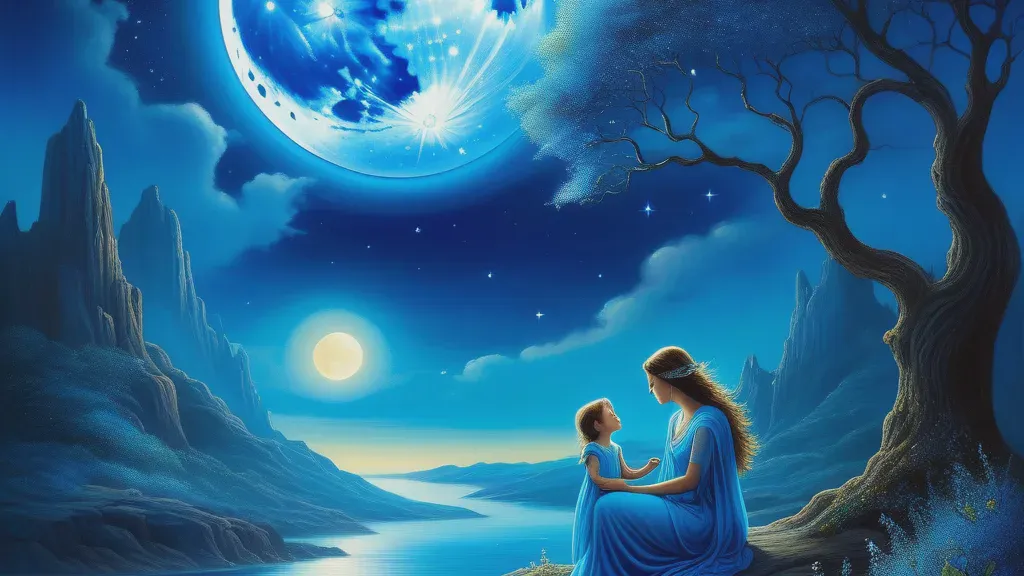
Blue Moon
Jungian Archetypes
Meaning
A blue moon is the moon that will not fit. Lunar months and solar years do not divide evenly, so every few years a season or a calendar month receives one full moon more than it has room for, and that surplus moon is the blue one. Nothing about it looks different in the sky; its rarity is entirely a matter of reckoning. To dream of a blue moon is therefore to dream about timing rather than about the moon, and specifically about an event the dreamer's ordinary schedule cannot accommodate: a chance, a feeling, a person, a decision that arrives outside the normal count. The colour adds distance and melancholy to the rarity, and dreams of it tend to come when something exceptional is either being offered or being mourned.
Psychological Interpretation
Everything depends on the dreamer's relation to the rare thing, and the possibilities are few. The moon may be witnessed, and the feeling is then awe mixed with a pressure that has no obvious source, the sense that something is being asked because such a night will not come again. It may be waited for, in which case the waiting, sometimes lasting the whole dream, is the content. It may be missed, glimpsed too late or through cloud, and that version arrives during seasons of regret. Or it may hang there unattended while the dreamer does something unrelated, which is its own comment on how the exceptional usually passes. Underneath all four runs one question about scarcity. The dreaming mind has decided that some part of life is rationed, and the blue moon is the ration made visible. That verdict is often inherited rather than observed: people raised to believe that love, permission, luck or rest come once in a great while will produce a blue moon when any of them appear, and will treat an ordinary chance as a final demand, which is a reliable way to freeze at the moment of choice. The blue carries the other half. It is the colour of distance in landscape and of sorrow in idiom, and its presence suggests the rarity is felt as loss as much as gift, receding while it is still in the sky.
Traditional Symbol Meaning
Older dream lore treats the moon as the great indicator of change and reads it almost entirely through clarity and colour. Gustavus Hindman Miller's Ten Thousand Dreams Interpreted of 1901 takes a moon in an otherwise normal sky as success in love and business, a weird and uncanny moon as domestic trouble and disappointing ventures, a moon in eclipse as contagion, and a blood-red moon as war. Artemidorus, seventeen centuries earlier, had made the moon stand for the women of a household, its brightness or darkening foretelling their fortunes. Neither has a category for a second full moon in a month, a calendrical curiosity rather than a visible event, but both agree that a moon which looks wrong means an unusual turn of affairs, and Miller's weird and uncanny moon is as near as the old books come to a blue one. The calendars themselves are the deeper tradition. Lunisolar reckoning has always had to solve the problem of the leftover moon, and the solutions are among the oldest institutions we have: the Hebrew calendar inserts a second month of Adar in seven years out of nineteen, and the Metonic cycle known to Babylonian and Greek astronomers rests on the same near-coincidence of nineteen years with two hundred and thirty-five lunations. A blue moon is what that arithmetic looks like when it is not corrected. Cultures that live by the moon have therefore always known both a regular time and an extra time, and have often marked the intercalary period as unlucky, sacred or exempt from normal rules. The dream of a rare moon touches this very old idea of a season outside the schedule. Full moons carry heavy social meaning wherever they organise the year. The Mid-Autumn Festival in China gathers families under the harvest moon and links the round moon to reunion and to the story of Chang'e, who drank the elixir and rose to live there alone. In Buddhist countries the Vesak full moon marks the birth, awakening and death of the Buddha on a single day. European agricultural custom named the moons by their work, the harvest moon and the hunter's moon, and the naming shows what the moon was for: it told people when to do things together. Against that background a moon that does not belong to any of the named ones is genuinely anomalous, a full moon with no assigned task. Whatever folk belief claimed about the full moon and sleep, mood or birth, what survives scrutiny is the moon's role as the oldest public clock, the one timekeeper visible to everyone at once. A rare moon in a dream, in the traditional idiom, means the clock has skipped, and the older readings agree on the practical advice that follows: an event outside the usual reckoning is at hand or has just passed, and the dreamer should look at what they have been counting on to arrive on schedule.
Psychodynamic / Freudian
Rarity does economic work in the psyche. What is scarce accumulates charge, and desire that has nowhere ordinary to go attaches itself to the exception, so the blue moon in a dream is often less an event than a reservoir. Freud described a group of patients in a 1916 paper who felt themselves to be exceptions, entitled to something extraordinary because of an early injury they had not chosen and could not name; the compensation demanded is always disproportionate because the wound it answers was never acknowledged. A dream that stages a once-in-a-lifetime night can be the manifest form of exactly that claim, and the giveaway is the tone: not pleasure at something rare, but a kind of urgency or grievance attached to it, as though the moon owed the dreamer a payment. The object relations reading is warmer and often nearer the mark. Winnicott wrote that the precursor of the mirror is the mother's face, and a round, luminous, appearing and disappearing presence in the night sky is an image many analysts have connected to that first face, watched from below by someone who cannot yet reach it. Klein's account of the good object turns on its reliability, on the infant's discovery that what goes away comes back; a moon that returns monthly is a natural emblem of that discovery, and a moon that comes only rarely quietly reports the opposite history, care that arrived unpredictably and was therefore never fully believed in. Dreamers with that background often describe the blue moon with a mixture of longing and mistrust, and will say they knew it would not last while it was still there. The blue itself points toward mourning. Freud distinguished mourning, in which the world is felt to be diminished, from melancholia, in which the loss is taken inside and the self is impoverished instead, and a moon tinted the colour of sorrow while remaining beautiful sits precisely on that border. Such dreams cluster around anniversaries, around the ages at which a parent died or left, and around the deferred recognition of a loss that was never given its time. In treatment the rare moon is a common image at the point when a patient begins to feel how much of their life has been organised around waiting, and the work then is not to catch the exceptional occasion but to grieve the ordinary provision that never came, which is what makes the exception seem necessary.
Contemporary Psychological
Memory research explains part of why this image feels significant on waking. Hedwig von Restorff showed in 1933 that an item which stands out from a series is remembered far better than the items around it, an isolation effect that has held up across nine decades of testing, and the brain treats novelty as a signal worth encoding. Predictive processing describes the same thing in current terms: perception runs on expectation, and what the system attends to and learns from is the mismatch between prediction and input. A moon that appears where no moon was scheduled is a prediction error made visual. A sleeping brain that constructs one is flagging something in the dreamer's recent life that did not fit the model, which is often more useful information than any interpretation of the moon itself. Whether the real moon affects sleep has been argued for a long time, and the evidence is finally getting better. A 2013 reanalysis of laboratory sleep data by Christian Cajochen and colleagues reported shorter and shallower sleep around the full moon and prompted a wave of failed and partial replications. More convincing is the 2021 work by Leandro Casiraghi, Horacio de la Iglesia and colleagues, who tracked sleep in Toba and Qom communities in Argentina and in university students in Seattle and found that people in both settings went to bed later and slept less in the nights before a full moon, with the effect strongest where artificial light was scarce. Moonlight was a real variable in human evenings for the whole of prehistory, and a residue of that scheduling appears to survive. A blue moon is an ordinary moon made exceptional purely by counting, and the sleeping brain is good at exactly that operation: taking a recent, unremarkable event and flagging it as the one that did not fit the month. The practical route in is to look for what has recently been rare, delayed or out of sequence for the dreamer, an offer, a reunion, a result, and to ask whether it was rare in fact or only rare in the dreamer's count. Overnight emotional processing, in Rosalind Cartwright's account and Matthew Walker's, softens a memory's charge while keeping its content, and the blue is the tell: when the mind can render a missed or exceptional moment as beautiful rather than urgent, the regulation is most of the way done, and the right response is to name the waking event rather than wait for the omen to be fulfilled.
Jungian / Archetypal
The moon in alchemy is Luna, and Jung devoted much of Mysterium Coniunctionis to her relation with Sol, the two lights standing for the opposed principles whose union produces the transformed third. Luna is the receptive, reflective, nocturnal intelligence, and in the psychology of a man she is closely bound to the anima, the inner feminine that carries feeling, relatedness and the capacity for images. A moon that appears rarely and in an unnatural colour is that principle arriving as an event rather than as a constant presence, which tells the interpreter something immediately: the dreamer's relation to their own inner life is intermittent. What should be a monthly companion has become an occasion. The Great Mother stands behind Luna in the same image, and dreams that combine the rare moon with a house, a mother, a birth or water are usually working on how reliably the dreamer expects to be held. Jung distinguished the psyche's own timing from clock time in everything he wrote about individuation, and the blue moon is a precise image for it. The Greeks called the opportune moment kairos, as against the mere passage of hours, and a dream that stages a night which does not fit the calendar is presenting a kairos: a moment whose value comes from its position rather than its duration. Synchronicity belongs here too, since Jung reserved that term for coincidences that carry meaning without causal connection, and dreamers who wake from a blue moon often report exactly that quality in the days after, an accumulation of small events that seem addressed to them. Whether such moments are read as significant is itself the individuation question, because the ego prefers regular time and will discount anything that cannot be scheduled. The Child completes the archetypal picture. Rare celestial signs announce births in the mythologies that use them, and Jung wrote of the divine child as the image of new psychic potential appearing under difficult or unlikely circumstances, small and easily overlooked. A blue moon dream that also contains a baby, an animal that has just been born, or something beginning at an odd hour is announcing a possibility with exactly that character: undeveloped, poorly timed by the standards of the dreamer's ordinary life, and therefore likely to be dismissed. The blue is not incidental. Jung generally gave blue to spirit and thought, painters give it to distance, and the tinting of the ordinary moon marks the whole event as coming from further off than the dreamer's usual concerns.
Gestalt / Parts of Self
Take the moon first, and say it as yourself: I am the blue moon, I come seldom, I am the same as the others and I am counted differently. Sit with how that sounds. Many people find, saying it aloud, that they are describing their own experience of being valued only when exceptional, and that is a considerable piece of information about how they hold themselves. Then be the blue: I am the colour that makes you look twice, I am distance, I am sadness at the edge of something beautiful. Then be the calendar, the part of the dream nobody thinks to voice: I keep the count, I have no room for this, I decide what is normal. The calendar is usually the most defended voice in the dream and the most useful one to find, because it is where your rules about what is allowed and when actually live. The polarity here is scarcity against abundance, and it will not resolve by argument. Say both, standing: this comes once in a lifetime, and then this is available to me. Notice which one your body believes. If the scarce voice is the one that lands, look at what you do with that belief, since treating something as unrepeatable is a way of loading a moment until nobody could act inside it. Waiting is the other Gestalt issue in these dreams. Sustained waiting is withdrawal from contact dressed as readiness, and a dream in which you spend the night watching the horizon for a moon is describing a stance you may recognise from waking life, where nothing is refused and nothing is met, and the perfect occasion is always the reason for the delay. Finish with what happened after the moon appeared, because the figure and ground reverse there. While you waited, the moon was figure and your life was ground; once it rose, something else became figure, and that something is worth naming exactly. If the dream ended as it rose, ask what you avoid by ending the story at the moment of arrival. If you turned away from it, ask what you were turning toward. Try the sentence I do not need the blue moon in order to and complete it four or five times without censoring; the completions tend to be the honest inventory of what you have been postponing until conditions are extraordinary.
Cultural & Historical Origins
The idiom is older than the astronomy. A 1528 English pamphlet by William Roy and Jerome Barlow mocks credulity with the line that if they say the moon is blue, we must believe that it is true, so the earliest recorded blue moon is an absurdity, and only later did the phrase settle into meaning something that happens very seldom. The Maine Farmers' Almanac used blue moon for the third full moon in a season containing four, and in 1946 James Hugh Pruett, writing in Sky and Telescope, restated the rule as the second full moon in a calendar month. That simpler version spread through radio and a board game before Philip Hiscock and the astronomer Donald Olson traced the error to its source in the same magazine in 1999. Both definitions are now in use, which suits a symbol whose whole meaning is that the count does not come out even. Moons can also be literally blue. Ash from the eruption of Krakatoa in 1883 scattered light so that the moon appeared blue or green from many parts of the world for months, and the Canadian forest fires of 1950 produced blue moons visible in Britain. Blue was itself for centuries the rarest pigment: ultramarine ground from lapis lazuli could cost more than gold in medieval Europe and was reserved for the robe of the Virgin, binding the colour to the idea of the precious exception long before anyone applied either to the sky. The 1934 Rodgers and Hart song pushed the association another way, making the blue moon a witness to loneliness that is unexpectedly answered.
Contextual Variations
A second full moon rising in the same month, tinted blue
This is the blue moon in its plainest form, an extra the count did not allow for, and the dream usually pairs it with a decision you have been treating as unrepeatable. Notice whether the sight pleased or pressured you. Delight suggests you are receiving something as a gift. Pressure suggests you have loaded the occasion until you cannot move inside it, and that the scarcity is coming from your assumptions rather than the situation. Ask what would happen if the offer came again next year, and watch how strongly you resist believing that it could.
Waiting all night for a blue moon that never rises
The dream that is entirely waiting is describing a stance, not an event. Watching a horizon all night for something that does not come is what postponement feels like from the inside, and it usually maps onto a waking situation in which you are ready, willing and not acting, with the extraordinary occasion serving as the reason. Notice how the waiting felt: peaceful waiting is patience, and restless waiting is avoidance wearing patience as a coat. The useful question on waking is what you would do this week if you accepted that the perfect moment has already declined to arrive.
A blue moon over a house where you used to live
Placing a rare moon above an old address ties the exceptional to the past rather than the future, and these dreams tend to appear near anniversaries or at ages that echo something from that period of your life. The moon lights the house without changing it, which is a fair picture of memory. Ask what was rationed in that house, since a blue moon over a specific roof often names the thing that arrived there only occasionally: attention, calm, money, safety, a parent who came home. Grieving that scarcity is more productive than searching your present life for a rare event to compensate for it.
Someone pointing at the blue moon and telling you to wish
A wish demanded on the spot is a test of what you actually want, and most dreamers go blank or wish for something small and safe. Blankness at the moment of permission usually indicates a long habit of not formulating desire, on the childhood grounds that naming it invites disappointment. Notice also the person pointing. A figure who insists you use the rare moment often carries a voice that treats every opportunity as final, and the dream is showing what that pressure does to your ability to want anything.
Frequently Asked Questions
Why did I dream about a blue moon?
Is a blue moon dream a sign of a rare opportunity?
Why did the blue moon in my dream make me feel sad?
Does dreaming of a blue moon mean a big change is coming?
Journaling Prompts
- Make a list of the things you once believed would never come again: a chance, a person, a kind of happiness, a year like that one. Beside each, write what actually happened afterwards, whether it returned in another form, and how long the verdict of never again held. Then look at the current thing you are calling once in a lifetime, and ask what your own record suggests about that verdict.
- Return to the moment the blue moon appeared in the dream and write it in the present tense, including what you were doing when it rose and whether you stopped. Then describe the last time something exceptional happened while you were busy with something ordinary, and ask what your habitual response is to being interrupted by good fortune.
- If you were waiting in the dream, write down what you are waiting for while awake, and then write about what the waiting itself gives you: what it lets you postpone, what it protects you from finding out, who it keeps you loyal to. Be honest about the benefits, because waiting always has some. Then describe what you would have to face on the first morning the wait was over.
- The blue moon is the moon the calendar has no room for. Write about a part of yourself that does not fit your current schedule, the interest, appetite or capacity that only surfaces when the routine breaks. Describe what it needs, how long it has been waiting, and what a regular monthly appearance rather than a rare one would actually look like.
Related Symbols
Dreamed about Blue Moon?
Get a personalized AI interpretation that connects this symbol to your specific life circumstances.
Interpret My Dream