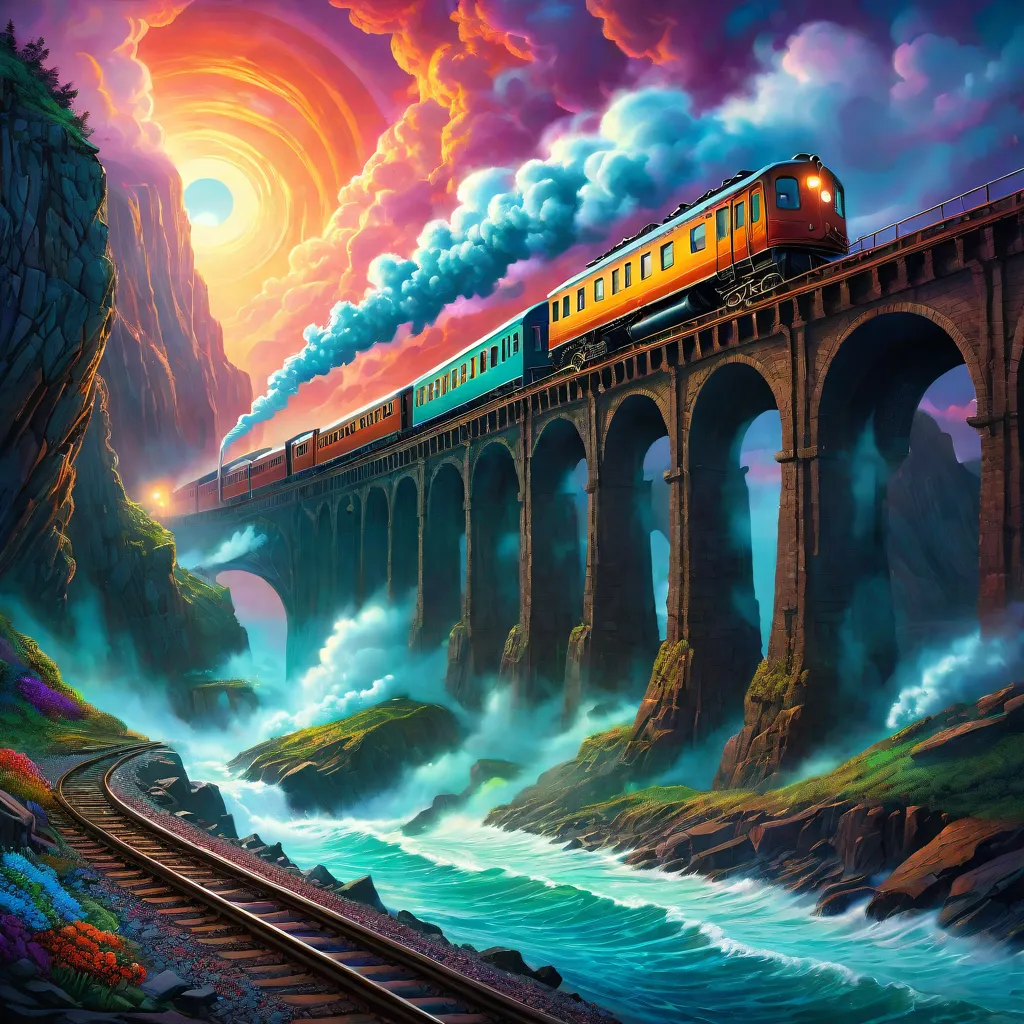
Runaway or Crashing Train
These dreams show a train racing out of control, its wheels screeching as it barrels toward a cliff or a stalled signal, while the dreamer struggles to jump off or pull a lever. The sensation is a rush of adrenaline, a pounding heartbeat, and a metallic clang that echoes in the ears.
Psychological Interpretation
You are likely feeling that a current project or relationship is moving faster than you can manage, and you fear losing control. The dream often appears when deadlines, major decisions, or unexpected changes pressure you to act quickly. It urges you to pause, assess the track you are on, and consider where you can safely apply the brakes.
Had this dream?
On a runaway train, are you pulling the emergency lever or trying to jump before the cliff? Tell us what happened and get a personalized interpretation of your own dream.
Interpret My DreamJungian / Archetypal
In Jungian analysis the image of a runaway or crashing train is read as a powerful manifestation of the archetypal “journey” that carries the psyche through the stages of individuation. The train, with its rhythmic clatter and relentless forward motion, embodies the collective unconscious’s drive toward wholeness, a symbolic locomotive that pulls the conscious ego along a predetermined track. When the train is out of control or collides, the dream signals that the personal unconscious, especially its shadow contents, is demanding attention; the shadow—those disowned impulses, fears, and desires—has accumulated enough kinetic energy to threaten the stability of the ego’s current course. The emotional pattern that typically accompanies this dream is a mixture of panic, helplessness, and a sudden surge of adrenaline, reflecting the inner conflict between the conscious sense of order and the chaotic, unintegrated forces that are trying to break through. People experience this dream when the pace of their waking life exceeds the capacity of their conscious mind to process change, or when a life transition—career shift, relationship dissolution, or a crisis of identity—presses the ego to confront material that has been suppressed. The train’s derailment becomes a metaphor for the psyche’s warning that the current path is no longer sustainable, urging the dreamer to pause, reflect, and re-orient the direction of personal growth. A practical insight that emerges from this interpretation is the invitation to deliberately engage with the shadow material that the dream is exposing: by journaling about the feelings of loss of control, exploring the underlying anxieties about loss of autonomy, and seeking symbolic “switches” in waking life—such as setting boundaries, redefining goals, or seeking supportive counsel—the individual can transform the runaway train from a destructive force into a catalyst for conscious integration, thereby advancing the individuation process.
Gestalt / Parts of Self
In Gestalt theory a train that speeds out of control or collides is read as a vivid projection of a part of the dreamer’s self that has been split off and denied conscious ownership. The locomotive, tracks, and passengers each stand for a facet of the personality that the individual has relegated to the background—perhaps a drive for achievement, a desire for connection, or a fear of vulnerability. When the train runs away, the dreamer witnesses that disowned segment moving forward without direction, suggesting that the inner impulse is operating on autopilot, unchecked by the conscious ego. A crash, on the other hand, signals that the neglected part has reached a point of overload, threatening to rupture the whole system if it remains unintegrated. The emotional texture behind this dream often includes a mixture of anxiety, helplessness, and a lingering sense of responsibility that the dreamer cannot fully articulate while awake. The feeling of being a passenger or a by-stander on the runaway train mirrors an internal conflict where the conscious self feels out of sync with an emergent, unacknowledged drive. This dissonance can arise after periods of chronic self-suppression—such as repeatedly postponing personal ambitions, ignoring relational needs, or dismissing creative urges—creating a pressure cooker that the unconscious mind releases in the symbolic language of the train. The crash scenario amplifies the fear of loss of control, pointing to a deep-seated worry that the unintegrated part will cause a sudden, disruptive breakdown in one’s life. A practical step for the reader is to treat the dream as an invitation to locate and name the “train driver” within. By asking, “What ambition, feeling, or responsibility feels like it is moving forward without my consent?” and then allowing that part to be spoken aloud or written down, the dreamer begins the process of reintegrating the split fragment. Acknowledging the driver, setting boundaries, and consciously directing its energy can transform the runaway train from a threat into a purposeful vehicle, reducing the likelihood of future crashes and fostering a more cohesive sense of self.
Psychodynamic / Freudian
In the psychodynamic view the manifest content of a dream in which a train runs away or crashes is the vivid image of a powerful, uncontrollable vehicle careering off the tracks, often accompanied by a sense of panic or helplessness. The latent content, however, points to an unconscious conflict between the dreamer’s desire for forward momentum and a deep-seated fear that that motion will become destructive. The train, as a symbol of collective progress and societal expectations, can stand for the dreamer’s internalized pressures to succeed, conform, or fulfill obligations that feel imposed by external authority figures. The crash or runaway scenario functions as a disguised wish fulfillment: the unconscious mind may be granting the dreamer a temporary release from the burden of responsibility, allowing a fantasy of total loss of control that paradoxically satisfies a hidden longing to be freed from relentless performance demands. Defense mechanisms such as displacement (shifting anxiety about a specific life domain onto the impersonal train) and denial (refusing to acknowledge the underlying fear of failure) often accompany this imagery, masking the true source of distress behind a dramatic, external event. The emotional pattern that typically underlies this dream is a recurrent cycle of heightened anxiety, feelings of helplessness, and a lingering sense of guilt after the dream awakens. These affective states arise because the unconscious conflict remains unresolved; the dreamer is caught between the wish to escape and the fear of the consequences of such escape, producing a tension that the mind tries to process through the dramatic metaphor of a train disaster. People who experience this dream frequently are navigating periods of transition—career changes, relationship breakdowns, or health concerns—where the stakes feel as high as a speeding locomotive. The practical insight offered by this interpretation is to encourage the dreamer to examine moments in waking life where they feel compelled to accelerate toward goals while simultaneously fearing the potential fallout, and to practice incremental, conscious regulation of those pressures, perhaps by setting realistic pacing and seeking supportive dialogue that can bring the repressed conflict into awareness.
Personal Meaning
The image of a runaway or crashing train often signals a sense that life’s momentum is slipping beyond the dreamer’s control, especially in areas where routine and timing are crucial. From a psychodynamic viewpoint, the train functions as a metaphor for the internal schedule that the unconscious has set for achievement, relationships, or personal growth; when the train derails, the dreamer is confronted with the anxiety that the forward motion they have been counting on is now threatening to collapse. This scenario tends to surface when the sleeper is experiencing a clash between external expectations—such as a demanding job, a looming deadline, or a social commitment—and an inner feeling that the pace is unsustainable. The emotional pattern behind the dream is often a mixture of urgency, fear of failure, and a lingering guilt for not having “kept the train on track,” which can manifest as restlessness or irritability during waking hours. People experience this dream because the mind uses the vivid, high-stakes imagery of a train to dramatize the underlying tension between the desire for progress and the fear of losing direction. To translate the dream into a personal meaning, the reader should examine where in daily life they feel the tracks are slipping. Questions such as “Which projects or relationships feel like they are moving faster than I can manage?” “Do I sense an impending loss of control when I think about upcoming responsibilities?” and “What specific actions have I postponed that now feel like a looming crash?” can help pinpoint the source of the anxiety. By identifying the concrete domain—perhaps a work presentation that has been delayed, a health habit that has been neglected, or a family role that feels overwhelming—the dreamer can devise a step-by-step plan to regain agency. A practical insight is to create a “small-step schedule” that breaks the larger, intimidating goal into manageable tasks, allowing the dreamer to feel the train’s wheels re-engaged under their deliberate direction, thereby reducing the subconscious urge to dramatize the loss of control.
Contemporary Psychological
When a sleeper envisions a train that has broken free of its tracks or is barreling toward a crash, the brain is often replaying a high-velocity threat scenario that engages the same neural circuits activated during real-world danger. The hippocampus, which replays recent episodic memories during sleep, can stitch together fragments of a commuter rush, a news story about a derailment, or an internal feeling of being rushed, and the amygdala amplifies the emotional charge, signaling urgency. In the predictive-coding framework, the mind treats the runaway train as a mismatch between expected order and chaotic motion, prompting a rapid error-signal that the brain attempts to resolve by projecting possible outcomes. This simulation runs in parallel with the consolidation of emotionally salient memories, allowing the sleeper to rehearse a response to a perceived loss of control. From a psychological standpoint, the runaway-train motif often mirrors a pattern of chronic stress where the individual feels propelled forward by external demands while lacking the ability to steer or brake. The emotional palette tends to be a blend of anticipatory anxiety, shame about being “out of sync,” and a latent fear of catastrophic failure. Because the dream’s narrative is tightly linked to waking concerns—tight deadlines, relationship turbulence, health scares—the brain uses the train’s unstoppable momentum as a metaphor for those pressures. The threat-simulation function of dreaming then serves to test coping strategies: the sleeper may experience a surge of panic that, in the safe context of sleep, allows the nervous system to calibrate its alarm thresholds without real-world consequences. A practical takeaway is to translate the dream’s sense of uncontrollable motion into a concrete, daytime planning exercise. By identifying the specific domain that feels “out of track” (for example, a project with an approaching deadline), the individual can break the larger goal into smaller, timed segments that include built-in “brake” moments—scheduled pauses for reflection, brief physical activity, or a brief mindfulness check-in. This structured interruption mirrors the brain’s natural need to reset predictive models, reducing the emotional intensity that later resurfaces as a runaway-train dream and fostering a sense of agency both in waking life and in the nocturnal narrative.
Stress & Emotional Patterns
A runaway or crashing train in a dream often mirrors a feeling that life’s momentum is slipping beyond your control. The train’s relentless forward thrust can represent a schedule, workload, or set of expectations that you have allowed to accelerate without a clear brake system, and the crash-scene amplifies the fear that the inevitable collision will cause damage—whether to your reputation, relationships, or inner sense of competence. In many cases, the dreamer is experiencing a cumulative load of stress that has not been processed; the train’s speed is a metaphor for how quickly tasks, responsibilities, or emotional demands are piling up, while the lack of a conductor or a broken brake signals a perceived loss of agency. This imagery is especially common when you are juggling multiple projects, dealing with looming deadlines, or navigating a personal transition that feels “out of track,” and it can surface as a physiological response—racing heart, shallow breathing, or a lingering sense of dread—both in the dream and after waking. To move from alarm to constructive action, first acknowledge the specific “track” that feels unsafe. Write down the concrete elements that are accelerating (e.g., a demanding boss, a family crisis, a health appointment) and ask yourself where you can introduce a brake: delegating a task, setting a firm boundary, or carving out a short, regular pause for breathing or mindfulness. Small, deliberate adjustments—such as a 5-minute walk before returning to a stressful email, or scheduling a brief check-in with a trusted colleague—can restore a sense of control and reduce the mental “speed” that fuels the dream. If the train’s crash feels inevitable, consider a safety-check ritual: rehearse a mental “emergency stop” by visualizing a lever or a signal that halts the train, then translate that imagery into a real-world coping tool, like a grounding exercise or a brief journaling session that captures the moment’s anxiety and reframes it as information rather than a threat. Over time, consistently applying these micro-interventions can quiet the runaway imagery, signaling to your subconscious that you are capable of steering the train rather than being swept along by it.
Related Symbols
Had this dream?
Get a personalized AI interpretation that connects your dream to your specific life circumstances.
Interpret My Dream