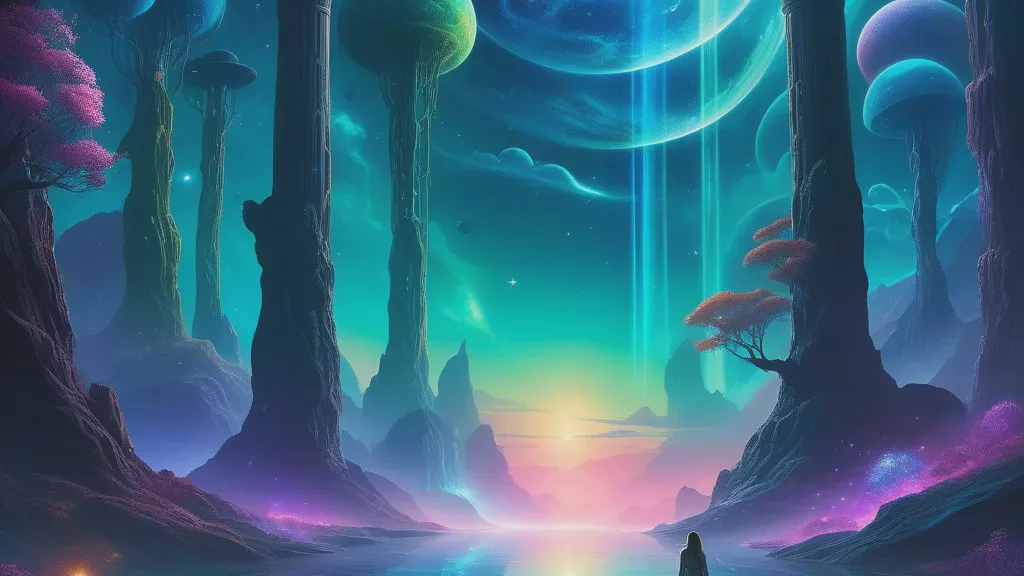
Parallel Universe
These dreams place the dreamer in a familiar setting that suddenly splits into an alternate version, where landmarks are mirrored but subtly altered. The sensation is a blend of déjà vu and disorientation, with vivid colors and a faint echo of familiar sounds.
Psychological Interpretation
You are likely confronting a decision that feels like choosing between two equally plausible outcomes, and the mind creates a parallel world to explore the road not taken. This dream often appears when you feel stuck in a routine and crave a fresh perspective, or when a recent change forces you to imagine alternative versions of your life. It can also signal an underlying tension between your current identity and a hidden desire to reinvent yourself.
Psychodynamic / Freudian
The manifest image of a parallel universe—rooms that look familiar yet differ in subtle details, a self who makes opposite choices, a world where a long-standing problem has been solved—functions as a symbolic stage on which the unconscious can dramatize a wish that cannot be voiced directly. In psychodynamic terms the latent content is the yearning for an alternate life path that would relieve a present sense of failure or loss, a yearning that has been pushed out of conscious awareness because it threatens the ego’s current self-image. The dream fulfills this wish by allowing the sleeper to experience, in a safe, imagined space, the consequences of a different decision without confronting the real-world repercussions. The defense mechanisms that often accompany this theme include splitting, where the mind divides the self into “the one who succeeded” and “the one who failed,” and projection, where undesirable feelings about one’s own choices are placed onto the imagined other self, preserving the ego’s integrity while still acknowledging the underlying discontent. Emotionally, the parallel-universe motif is usually accompanied by a mixture of awe, longing, and a low-grade anxiety that signals an unresolved conflict between the desire for change and the fear of abandoning the familiar. The pattern often emerges in individuals who feel trapped by a particular role, relationship, or career and who have suppressed the possibility of a different outcome because doing so would require confronting painful regrets or admitting a perceived personal inadequacy. The dream’s significance lies in its invitation to examine the parts of the self that have been relegated to the unconscious; the vividness of the alternate world reflects the intensity of the suppressed wish, while the recurring sense of “what if” betrays a defensive avoidance of making a decisive change in waking life. A practical insight for the reader is to treat the dream as a diagnostic cue rather than a literal prediction. By writing down the specific details of the imagined universe—who is present, what has changed, how the dream-self feels—one can trace the symbolic correspondences to current life dilemmas. This reflective exercise often reveals a concrete, previously unacknowledged desire (for example, a need for greater autonomy, a longing for a different relational dynamic, or a craving for creative expression). Recognizing and articulating that desire in waking life can reduce the reliance on the dream’s fantasy as a coping mechanism and open a pathway toward purposeful, conscious change.
Personal Meaning
When a dreamer envisions a parallel universe, the mind is often staging a rehearsal of “what-if” scenarios that feel out of reach in waking life. From a cognitive-psychological perspective, the image of an alternate reality functions as a mental simulation of divergent pathways, allowing the brain to test the emotional consequences of choices that have been postponed or suppressed. The dream typically surfaces when the individual is caught between competing values—such as career ambition versus personal relationships, or the desire for stability versus the lure of adventure. The emotional pattern that underlies this motif is a mixture of curiosity, anxiety, and a yearning for agency; the dreamer may feel both excited by the possibilities of a different self and unsettled by the implication that the present self has missed an opportunity. The parallel-universe scene therefore signals a need to reconcile the tension between the current life narrative and the imagined alternatives that feel compelling yet unattainable. To translate this symbolism into everyday awareness, the dreamer can ask concrete questions: Which decision in the past feels unfinished, and how does that unfinished business manifest as a sense of “another life” in the dream? What aspects of the alternate reality feel most attractive—greater freedom, different relationships, or a distinct identity—and what does that reveal about unmet needs today? By identifying the specific element that feels missing, the individual can design a small, actionable step that brings a fragment of that parallel world into the present, such as allocating weekly time for a hobby that represents the “other self,” or initiating a conversation that addresses a lingering conflict. This practical insight transforms the dream from a passive fantasy into a catalyst for purposeful change, allowing the dreamer to integrate the yearning for an alternate path into a more satisfying, intentional life trajectory.
Contemporary Psychological
When a person dreams of a parallel universe, the brain is often recombining recent episodic memories with imagined alternatives in a way that mirrors the neural mechanisms of memory consolidation. During slow-wave sleep, hippocampal replay stitches together fragments of the day’s experiences, and the default-mode network generates counterfactual scenarios that test the relevance of those memories. A parallel-universe setting provides a vivid scaffold for this process, allowing the sleeper to explore “what-if” versions of recent choices, relationships, or goals without the constraints of waking reality. The imagery therefore signals that the mind is actively evaluating the emotional weight of unresolved events, trying to integrate them into a coherent self-narrative. Emotionally, these dreams tend to surface when the dreamer is caught between competing desires or anxieties. The sense of an alternate world often carries a mixture of curiosity, longing, and subtle dread, reflecting the brain’s threat-simulation system. By projecting a familiar problem into a divergent reality, the amygdala and ventromedial prefrontal cortex can simulate potential outcomes without triggering the full stress response that a direct confrontation would provoke. This creates a safe laboratory for the sleeper to gauge the intensity of fear or hope attached to a particular issue, which in turn influences how the individual prioritizes actions after waking. A practical takeaway is to treat the parallel-universe dream as a diagnostic cue about a specific decision point that feels unresolved. Upon waking, the individual can write down the key elements of the alternate scenario—who was present, what choices were made, and how they felt—and then compare them with the actual situation. This comparison often reveals a hidden preference or a concealed fear, allowing the person to address the underlying concern directly rather than leaving it to be processed indirectly in subsequent sleep cycles.
Stress & Emotional Patterns
A dream in which the sleeper encounters a parallel universe often signals a heightened sense of disorientation between one’s internal expectations and external circumstances. From a clinical perspective, the motif can arise when a person feels that the path they have taken in life diverges sharply from an imagined alternative, creating a mental split that the brain resolves by projecting an entire alternate reality into the dream narrative. The emotional pattern that underlies this scenario typically involves a mixture of curiosity, loss, and a lingering unease that the “what-if” version of one’s life might be more satisfying or less threatening than the current one. This tension can be amplified by stressors such as career uncertainty, relationship transitions, or unresolved trauma that leaves the individual questioning whether their present choices are authentic or merely a compromise. The psychological significance of the parallel-universe dream lies in its function as a rehearsal for coping with uncertainty. When the mind constructs a vivid alternate world, it is attempting to map the possible outcomes of a decision that feels out of reach, thereby providing a safe space to explore the consequences of different choices without real-world risk. This process can be especially pronounced during periods of sleep disruption, when fragmented REM cycles allow intrusive thoughts to surface more readily in dream content. Although the experience is generally benign, a recurrent pattern of such dreams that is accompanied by persistent anxiety, intrusive rumination, or a sense of being trapped in an imagined “other life” may indicate that the individual is struggling to integrate conflicting self-concepts and could benefit from therapeutic exploration of values, goals, and unresolved emotional material. A practical insight for readers is to treat the parallel-universe imagery as a cue to examine the specific life domains that feel bifurcated in waking life. By writing down the details of the alternate world—who is present, what activities dominate, and how emotions differ—one can identify the concrete aspects of one’s current situation that feel unsatisfactory. This reflective exercise can reveal whether the dream is merely a symbolic processing of normal decision-making or whether it signals deeper distress that warrants professional attention, such as persistent feelings of helplessness or intrusive thoughts that interfere with daily functioning.
Jungian / Archetypal
In a Jungian framework the image of a parallel universe functions as a symbolic portal to the unconscious realm that mirrors the conscious self while simultaneously revealing what has been left unintegrated. The dream-er perceives an alternate reality that runs alongside the familiar world, suggesting the presence of a shadowed segment of the psyche that contains desires, fears, or potentials that have not yet been acknowledged. This archetypal motif taps into the collective unconscious’s motif of the “Other World,” a timeless pattern that appears in myths as the underworld, the realm of spirits, or the kingdom of the dead, each representing a hidden dimension of the self that must be explored for wholeness. When the dreamer encounters a parallel universe, the psyche is signaling that a substantial part of the personal narrative is operating on a different frequency, offering a mirror that can illuminate gaps in self-knowledge. The emotional texture that accompanies such dreams often oscillates between fascination and anxiety, reflecting the tension between the desire for expansion and the fear of the unknown. A feeling of curiosity or excitement indicates an emerging readiness to engage with the shadow material, while dread or disorientation points to resistance against confronting aspects of the self that threaten the current identity structure. The dream may arise during periods of transition—career changes, relationship shifts, or existential questioning—when the conscious ego is stretched and the unconscious offers an alternative scenario to test the limits of the dreamer’s current worldview. By projecting possibilities onto a parallel plane, the psyche creates a safe laboratory for experimenting with alternative choices, values, or roles without the immediate consequences of real life. A practical takeaway for the reader is to treat the parallel-universe imagery as an invitation to map the “what-if” scenarios that surface in waking life and to journal the specific symbols, emotions, and choices presented in the dream. By consciously reflecting on how the alternate reality differs from the known world—whether it offers greater freedom, suppressed talents, or unresolved conflicts—the individual can identify concrete shadow elements that need integration. This reflective practice supports the individuation process, allowing the dreamer to gradually bring the hidden content into conscious awareness and thereby expand the sense of personal possibility.
Gestalt / Parts of Self
In a Gestalt reading, a dream of a parallel universe functions as a vivid projection of a facet of the dreamer that has been split off and left unintegrated. The alternate world appears as a mirror that contains familiar objects, relationships, or settings, but they are arranged in a way that feels both recognizable and alien. This juxtaposition signals that the dreamer is confronting a version of themselves that has been denied acknowledgment—perhaps a set of values, desires, or memories that conflict with the dominant self-image. The emotional tone of the dream—whether awe, anxiety, curiosity, or loss—reflects the inner tension between the owned self and the disowned part, and the sense of “another reality” is the mind’s way of keeping the split element at a safe distance while still allowing it to surface. The psychological significance lies in the way the parallel universe creates a space for the disowned part to be explored without immediate threat to the ego’s cohesion. When the dreamer feels drawn to the alternate world, it often indicates a yearning for the possibilities that the excluded aspect promises, such as a different career path, a suppressed emotional style, or an unexpressed relational pattern. Conversely, feelings of dread or resistance suggest that the disowned part carries shame or fear that the conscious self has not yet reconciled. People experience this dream when life circumstances trigger a mismatch between their current role and an inner longing—such as a major transition, a loss, or a decision that forces them to confront what they have left behind. The parallel universe becomes a symbolic arena where the mind rehearses the integration of the split self, testing how the dreamer might negotiate the coexistence of opposing internal narratives. A practical insight for the reader is to treat the parallel universe as an invitation to dialog with the disowned aspect rather than to dismiss it as mere fantasy. By recalling specific details of the alternate world—who is present, what activities occur, what emotions dominate—and then asking, “What part of me does this resemble in waking life?” the dreamer can begin to claim ownership of that fragment. Recognizing the parallel world as a living part of the self opens a pathway for gradual integration, allowing the dreamer to bring the previously hidden values or feelings into conscious awareness and thereby reduce the internal split that fuels the recurring dream.
Stress & Emotional Patterns
Dreams of a parallel universe often surface when the mind is trying to sort out a sense of “what-if” that feels too large to hold in ordinary waking thought. The image of another version of life—perhaps a different job, a different relationship, or a different self—acts as a symbolic container for the anxiety that arises when current circumstances feel constrained, unsatisfying, or overloaded. In the dream, the alternate world can appear inviting, as if it offers a release from the pressure of deadlines, expectations, or unresolved conflicts, but it can also feel unsettling, suggesting that the dreamer is caught between the desire to escape and the fear of abandoning responsibilities. This tension mirrors the emotional load of trying to juggle multiple roles or decisions, where the brain projects the “what-could-have-been” scenario as a way to test the emotional cost of staying the course versus taking a drastic change. A practical way to work with this dream is first to acknowledge the specific elements that felt most vivid—whether it was a different career path, a healthier relationship, or a version of yourself that seemed more confident. Then, map those elements onto concrete aspects of current life that feel out of balance. For example, if the alternate self was more organized, the dream may be signaling a need for clearer boundaries around work or a more structured daily routine; if the other world featured a supportive community, it could point to a feeling of isolation in the present. Grounded steps such as setting a single, achievable micro-goal each day, scheduling brief “reset” moments (a walk, breathing exercise, or journaling), and reaching out to a trusted friend or therapist to discuss the parallel-universe imagery can reduce the overwhelming feeling of being split between possibilities. By turning the symbolic parallel world into a roadmap for small, realistic adjustments, the dreamer can transform the anxiety that fuels the dream into actionable momentum toward greater psychological wellbeing.
Frequently Asked Questions
Why do I have Parallel Universe dreams?
These dreams often reflect supernatural & fantasy aspects of your psyche.
What does Parallel Universe mean?
The meaning depends on your personal context and emotions in the dream.
How can I work with Parallel Universe dreams?
Journaling and reflection can help you understand the deeper meaning.
Related Symbols
Had this dream?
Get a personalized AI interpretation that connects your dream to your specific life circumstances.
Interpret My Dream