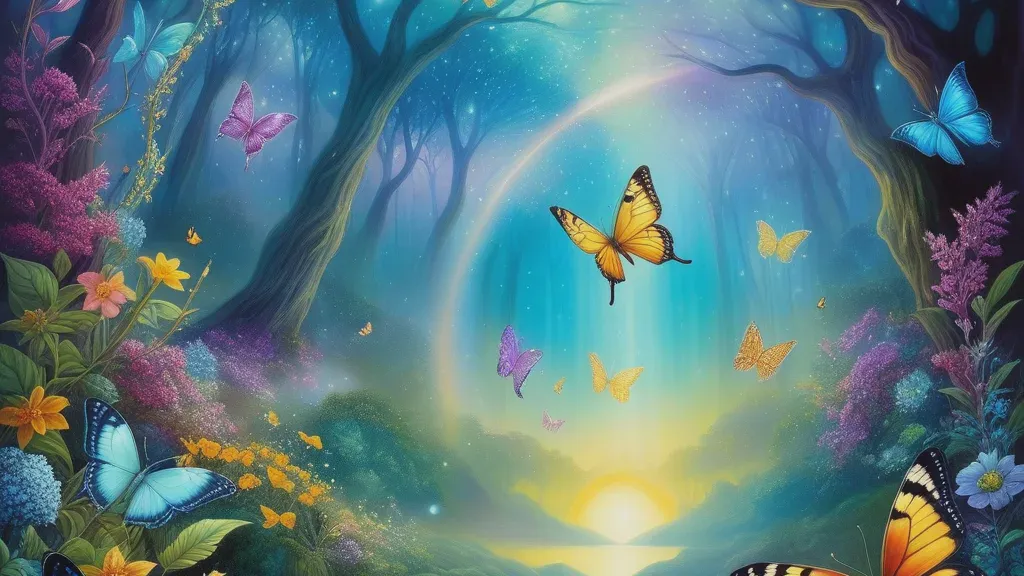
Butterfly
Jungian Archetypes
Meaning
The butterfly represents transformation, rebirth, and the soul's journey through metamorphosis. It symbolizes the ability to transcend limitations and embrace change with grace and beauty.
Psychological Interpretation
In Jungian psychology, the butterfly embodies the Self emerging from the chrysalis of the unconscious. It represents the integration of the Anima/Animus and the conscious realization of one's true nature through psychological transformation.
Contemporary Psychological
When butterflies appear in dreams, they often signal the brain's active processing of identity transitions and major life changes. From a contemporary neuroscience perspective, the butterfly represents the dreamer's cognitive system working through the emotional and practical dimensions of metamorphosis—moving from one stable state to another. The insect's dramatic transformation mirrors how the brain consolidates memories of old patterns while simultaneously integrating new behavioral and emotional frameworks. This is not symbolic magic but rather the mind's way of rehearsing and emotionally regulating the disorientation that accompanies genuine change, whether that change is developmental, relational, or circumstantial. The emotional lightness associated with butterflies in dreams reflects a specific type of emotional regulation at work. After the caterpillar's struggle and the chrysalis's stillness, the butterfly's flight represents the brain's resolution of anxiety about transition—a threat simulation that has moved from "Can I survive this change?" to "I am moving through this successfully." The dream is processing the shift from heaviness to buoyancy, from constraint to freedom, which corresponds to real neurological changes in how the brain encodes safety and possibility. This lightness is not denial but rather the consolidation of new emotional learning: the discovery that the self can be fundamentally different and still be intact. Memory consolidation during butterfly dreams often involves integrating recent experiences of growth, shedding old identities, or releasing outdated coping strategies. The brain is sorting through what needs to be retained from the old self and what can be discarded, much like the caterpillar's body is broken down and rebuilt. This process appears in dreams as the butterfly's emergence—a cognitive pattern where the dreamer's mind is literally reorganizing how it stores and retrieves information about who they are. The dream may reflect recent learning about resilience, new skills acquired, or the gradual recognition that a former limitation no longer applies. The cognitive pattern visible in butterfly dreams is one of adaptive transformation rather than crisis. Unlike dreams of falling or being chased, which simulate threat responses, butterfly dreams simulate the successful navigation of change itself. The brain is running a "what if I can become something new?" scenario and finding the answer to be yes. This represents a shift in the dreamer's cognitive stance toward their own development—from passive acceptance of change to active participation in it. The butterfly's delicate wings and bright colors suggest that the brain is also processing the aesthetic and emotional dimensions of transformation, not just its practical challenges.
Gestalt / Parts of Self
In Gestalt dream work, the butterfly is not a symbol floating outside the dreamer—it is a part of the dreamer's own psyche made visible. The butterfly represents the capacity for transformation, the part of self that knows how to shed what no longer serves and emerge renewed. It embodies the dreamer's own potential for metamorphosis, the inner wisdom that understands change is not something to fear but to embrace. When a butterfly appears in a dream, it is the dreamer encountering their own capacity for growth, their own readiness to move beyond old forms and limitations. The fragility and beauty of the butterfly often point to a part of self that the dreamer may be projecting outward—attributing delicacy or vulnerability to others when these qualities actually belong to the dreamer themselves. The dreamer may see the butterfly as something external, something to admire or protect, when in fact the dream is inviting ownership of this tender, beautiful part within. The butterfly's freedom—its ability to move through air, to navigate space without constraint—mirrors the dreamer's own freedom that may be unowned, unacknowledged, or kept at a distance. The dreamer may be saying, "That freedom is out there, in that butterfly," when the dream is actually asking, "Can you claim that freedom as your own?" The dialogue in butterfly dreams often unfolds between the part of self that wants to transform and the part that clings to the familiar cocoon. The butterfly represents the self that has already changed, already emerged, already knows its wings. The cocoon—whether present in the dream or implied—represents the part that fears the unknown, that questions whether the transformation is safe. Gestalt invites the dreamer to own both: the courage to change and the fear of change are not separate from the dreamer; they are the dreamer in dialogue with itself. The butterfly dream asks: What am I being invited to shed? What new form am I ready to inhabit? And most importantly: Can I claim this transformation as mine, not as something happening to me, but as something I am actively becoming? The ownership that butterfly dreams call for is the reclamation of personal agency in transformation. Rather than waiting for change to happen, or seeing oneself as fragile and needing protection, the dreamer is invited to recognize the butterfly as their own emerging self—the part that is already in motion, already becoming. The dream asks the dreamer to stop projecting beauty and freedom onto something external and to instead ask: What part of me is this butterfly? What am I ready to own about my own capacity to transform, to be free, to be beautiful in my own becoming?
Jungian / Archetypal
The butterfly in dreams embodies one of the collective unconscious's most potent symbols of transformation and the individuation process. In Jungian psychology, the butterfly represents the Self in its fullest expression—the archetype of wholeness and completion that emerges when the ego has integrated its shadow and moved toward psychological maturity. The metamorphosis from caterpillar to butterfly mirrors the alchemical transformation central to individuation: the dissolution of the old identity, the dark chrysalis period of inner work, and the emergence of a more authentic, integrated self. This symbol speaks to the soul's (psyche's) capacity for radical renewal, suggesting that profound change is not merely possible but necessary for psychological development. The butterfly's delicate beauty and ephemeral nature carry a compensatory message about impermanence and acceptance. Where the conscious mind often clings to permanence and control, the butterfly teaches that beauty and meaning arise precisely through transience and surrender. In this sense, the butterfly can represent the Shadow's wisdom—the parts of ourselves we fear losing, the mortality we deny, the vulnerability we reject. When the butterfly appears in dreams, it often signals that the unconscious is inviting the dreamer to release rigid identities, outdated beliefs, or defensive structures that no longer serve growth. The resurrection theme embedded in butterfly symbolism speaks not to literal rebirth but to the continuous death and renewal required for psychological evolution. Archetypal figures associated with the butterfly include the Wise Old Woman or Man (who understands transformation's necessity), the Hero (who undertakes the inner journey), and the Self (the ultimate goal of individuation). The butterfly also embodies the Anima in its most luminous form—the soul's capacity for beauty, grace, and transcendence. Collectively, across cultures, the butterfly has long symbolized the soul's liberation from the body, the triumph of spirit over matter, and the promise that what appears dead or static can awaken into new life. This archetypal resonance suggests that butterfly dreams often mark threshold moments in the individuation journey, where the dreamer stands between old and new selves, invited to trust the transformative process even when the outcome remains invisible. The butterfly's appearance in dreams ultimately conveys a profound compensatory message: that transformation is not something to fear or resist, but to embrace as the very nature of psychological life. It reminds the dreamer that the chrysalis stage—the confusion, darkness, and apparent stagnation—is not failure but necessary gestation. The butterfly calls the ego to release its grip on familiar identities and to trust the Self's capacity to guide the psyche toward greater wholeness, beauty, and authenticity. In this way, the butterfly becomes a symbol of hope grounded in the deepest truths of the collective unconscious: that death and rebirth are one process, that impermanence is the condition of all beauty, and that the soul's true nature is to transform.
Psychodynamic / Freudian
The butterfly in dreams represents a profound wish for transformation that operates at the intersection of desire and defense. At the manifest level, the butterfly is simply a beautiful insect undergoing metamorphosis—a literal image of change. At the latent level, however, the butterfly embodies the dreamer's unconscious longing to escape a confining identity, to shed an old self that no longer fits, and to emerge reborn into a freer, more authentic existence. This wish is often defended against through sublimation: the raw impulse to break free from constraints—whether parental, social, or self-imposed—is transformed into the aesthetically pleasing image of natural transformation. The butterfly allows the dreamer to express a revolutionary desire in a socially acceptable, even beautiful form. The defense mechanisms at work in butterfly symbolism are particularly sophisticated. Displacement operates when the dreamer's actual anger at being controlled or confined is redirected onto the image of the caterpillar's chrysalis—the prison from which escape is necessary. Condensation compresses multiple wishes into a single image: the wish to grow, to be seen, to be free, and to transcend limitation all collapse into the butterfly's emergence. Reaction formation may also be present; the dreamer who consciously accepts their current constraints may unconsciously dream of butterflies as a way of expressing the opposite impulse—the repressed rebellion against those very constraints. The butterfly's delicate beauty serves as a defense against the aggression and destructiveness that true transformation often requires. Childhood origins of butterfly symbolism frequently trace to early experiences of control, constraint, or the pressure to conform to parental or familial expectations. The child who was told to sit still, be quiet, or suppress their authentic self may internalize the butterfly as a symbol of the freedom they were denied. The metamorphosis of the butterfly mirrors the developmental transitions the child experienced—from infancy to childhood, from childhood to adolescence—moments when the old self had to die for a new one to emerge. If these transitions were traumatic, rushed, or unsupported, the butterfly becomes a wish-fulfilling fantasy of a transformation that would be gentle, beautiful, and entirely under one's own control. The butterfly thus represents not just escape, but the fantasy of escape that is painless, inevitable, and ultimately triumphant—a defense against the anxiety that real change provokes. In the psychodynamic reading, the butterfly's ultimate significance lies in what it reveals about the dreamer's relationship to their own becoming. The wish for transformation is universal, but the need to express it through the image of a butterfly—rather than through direct assertion, rebellion, or confrontation—suggests that the dreamer's capacity for change is still bound by early prohibitions against direct expression of desire. The butterfly is beautiful precisely because it allows the dreamer to want something dangerous (freedom, self-reinvention, the dissolution of the old self) while maintaining the appearance of passivity and naturalness. It is a wish that disguises itself as inevitability, a rebellion that looks like grace.
Cultural & Historical Origins
In Greek mythology, Psyche (the soul) is depicted with butterfly wings, symbolizing the immortal soul. The butterfly appears in Mesoamerican cultures as a symbol of resurrection and the soul's ascension to the afterlife.
Contextual Variations
Butterfly landing on you
A sign of personal transformation or spiritual awakening occurring in your life
Butterfly trapped or dying
Resistance to necessary change or fear of personal growth and transformation
Frequently Asked Questions
What does it mean to dream of a butterfly?
Is a butterfly dream always positive?
Journaling Prompts
- What transformation am I currently undergoing or resisting?
- How can I embrace change with the grace and beauty of a butterfly?
Related Symbols
Dreamed about Butterfly?
Get a personalized AI interpretation that connects this symbol to your specific life circumstances.
Interpret My Dream