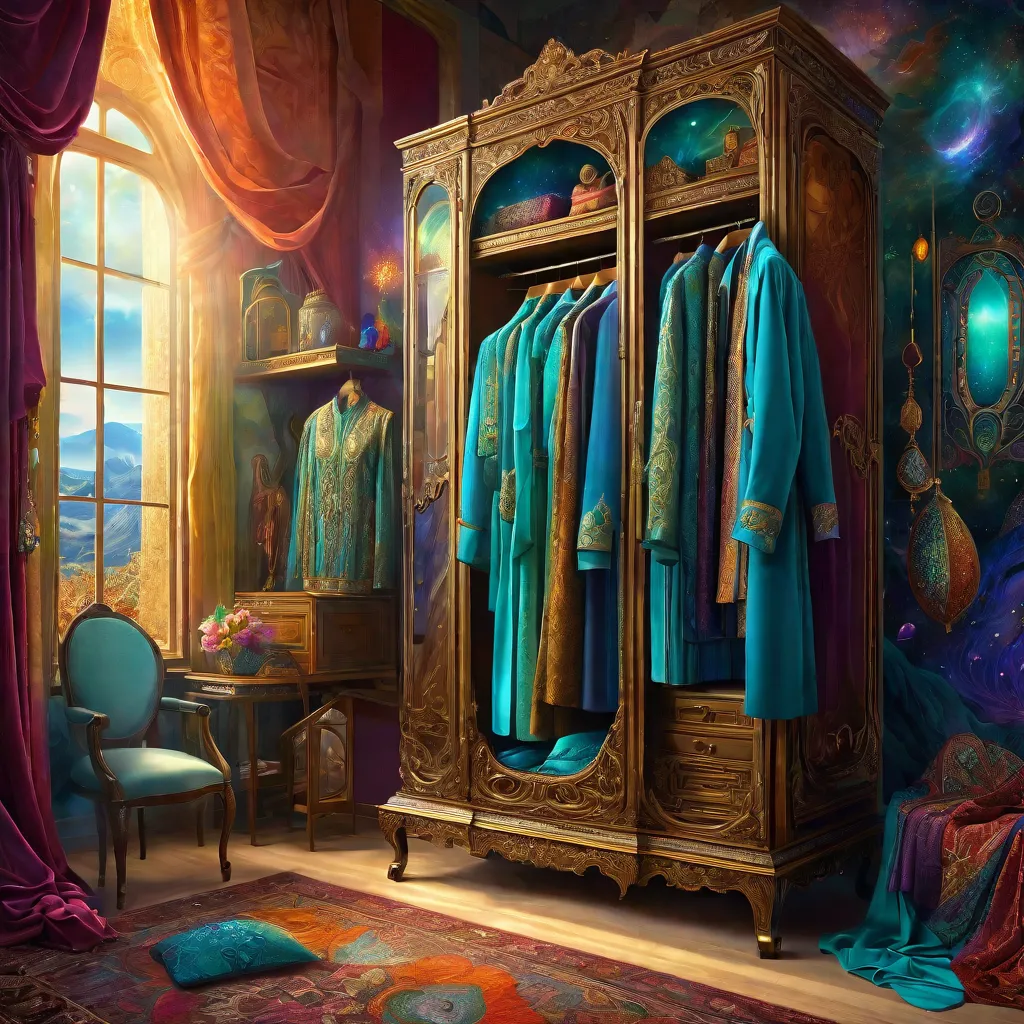
Wardrobe
Jungian Archetypes
Meaning
A wardrobe in a dream catalogs the dreamer's possible selves — the roles and moods currently folded away rather than being worn. Its doors mark the line between the self on display and the self held in reserve: outdated clothes carry outdated identities, unworn garments carry ambitions not yet tested, and the wardrobe's depth hints at how much of the personality stays unexplored. When it opens onto more than clothing — a passage, an impossible room, a drawer that will not appear — the dream proposes that the self in storage exceeds the persona now in use.
Psychological Interpretation
Opening a wardrobe in a dream is an act of taking inventory, and the emotional tone of the search matters more than the contents themselves. A wardrobe that offers exactly the right garment without effort suggests the dreamer already has access to the identity a situation requires; one that yields only wrong sizes, wrong seasons, or nothing at all suggests a mismatch between the self being asked for and the self currently available. Doors that will not close point to a persona under strain, holding more roles than it can contain, while a wardrobe that proves larger inside than its exterior promised signals untapped range the dreamer has not yet had occasion to wear. Because the wardrobe stores rather than displays, dreams that dwell on its far corners or locked sections are usually pointing at material set aside deliberately, not lost by accident.
Traditional Symbol Meaning
Long before Lewis sent a child through its back panel, the wardrobe held a special place in the domestic imagination simply because of its scale: it is the one piece of household furniture large enough to be entered rather than merely used, a room within a room, dark and deep enough that a child hiding inside it could believably imagine the back wall giving way to somewhere else. Fairy tale logic runs on exactly this kind of object — a familiar container that turns out to be larger, older, or stranger than its surface promises — and the wardrobe supplies that logic ready-made. Institutions have long understood the same principle in reverse: confiscating a person's own clothes and issuing a uniform is one of the fastest ways to suspend an individual identity. The sociologist Erving Goffman described this intake ritual in what he called total institutions — prisons, boarding schools, military barracks — where personal effects go into storage and a standardized wardrobe replaces them, a stripping of self that a dream about losing access to one's own clothes can echo closely. Disney's Madame de Garderobe, an enchanted wardrobe who dresses her household for whatever role they are about to play, offers a gentler version of the same mechanism: what a wardrobe supplies is never just cloth, but permission to become someone in particular. Domestic folk practice treats the wardrobe with its own seriousness. Cedar and camphor linings were long used to guard stored clothing from moths, a practical magic of preservation applied to garments not currently in use. In many households, leaving a deceased relative's wardrobe untouched for a period of mourning follows the same logic in reverse: the wardrobe holds past selves as well as possible ones, and closing its doors on someone who has died is a way of guarding an identity that can no longer be worn.
Contemporary Psychological
Clothing is an unusually powerful memory cue, and the wardrobe dream draws on that fact directly. Autobiographical memory research has repeatedly found that objects worn during emotionally significant periods, a job, a relationship, a particular year of life, become tightly bound to the memories of that period, so that encountering the object later can trigger vivid recall out of proportion to its practical value. A dream that lingers on an old coat or a forgotten shelf is plausibly the sleeping brain running exactly this kind of object-cued retrieval, surfacing a period of life the wardrobe's contents happen to file under. The overloaded or impossible wardrobe, too many outfits, none quite right, a search that will not resolve, maps closely onto what decision researchers call choice overload: the psychologist Barry Schwartz's work on the paradox of choice found that an abundance of options can increase anxiety and decrease satisfaction rather than improve outcomes. A dream wardrobe that will not yield the right item may be less about identity in the abstract and more a direct rehearsal of a specific, mundane cognitive burden: too many viable versions of oneself to choose between, with no clear criterion for picking. There is also something worth noting in how ordinary this decision actually is. Choosing what to wear is typically among the first executive-function decisions of a person's day, made before most other demands on attention have arrived, which may be exactly why the wardrobe recurs as dream material during periods of high daytime decision load, the mind rehearsing, at the least consequential possible register, a kind of choosing it will have to do again the moment it wakes.
Jungian / Archetypal
The wardrobe is one of the clearest domestic images Jung's own vocabulary could ask for, since persona is simply the Latin word for a theatrical mask and the wardrobe is where the dreamer's masks are kept between performances. A dream that dwells on this furniture is usually taking stock of the Persona's current condition: whether it fits, whether it has grown too rigid to adapt to a new stage of life, or whether it has come to feel like the only clothing the dreamer owns. A wardrobe crammed with garments that no longer suit the dreamer's age, work, or values often marks a Persona that individuation has already outgrown, even where the ego has not yet admitted it. Depth appears as literal depth in these dreams: a wardrobe with more room inside than its exterior should allow, or a back wall that gives way to another space, points toward the Self holding more range than the current Persona has ever needed to draw on. In this sense the wardrobe borrows the sheltering, gestational quality Jung associated with the Great Mother — a dark, enclosed container in which undeveloped potential is kept safe rather than exposed, waiting for the ego to be ready to take it out and wear it. What unsettles the dreamer about the wardrobe's far corners is often exactly what the Self is offering to add to consciousness next. Old or inherited wardrobes carry a third association, with the Wise Old Man: furniture that has outlived one generation and passed to the next holds a kind of accumulated counsel about how a family has historically clothed itself, literally and psychologically, to face the world. Dreaming of such a piece, heavier and more ornate than anything the dreamer would choose today, often signals that guidance for a current identity question is available in inherited experience, if the dreamer is willing to open a door that predates them.
Gestalt / Parts of Self
Gestalt dreamwork asks you to stop interpreting the wardrobe and become it. Sit with the image and speak as the wardrobe: I hold what you are not currently wearing. I keep your other selves in the dark until you are ready for them. Said in the wardrobe's own voice rather than about it, the dream stops being a puzzle to solve and becomes a part of you that has been waiting to be addressed directly — the part carrying everything you could be but are not, right now, choosing to show. The dream's real material is the polarity between what hangs at the front, within easy reach, and what sits pushed to the back behind clothes you never touch. Try a two-chair dialogue with these positions: one chair is the outfit you reached for without thinking this morning, the other is the item you keep but never wear. Let each side speak to the other. Very often the never-worn side is not useless at all — it is a disowned capacity, a way of moving through the world you decided long ago was too much or not allowed, and it has been waiting in the dark for you to reclaim it rather than simply store it. Notice, too, whether you moved toward the wardrobe in the dream or away from it. Reaching in, searching, trying something on is contact with a possibility you have kept at a distance. Closing the door, losing the key, or finding it locked is withdrawal, and it is worth asking what happens right before you pull back. The wardrobe does not lock itself; you lock it, and the dream is asking what you are protecting yourself from by keeping that particular self out of reach.
Psychodynamic / Freudian
A wardrobe dream frequently uses tidying, searching, or crowding as the visible surface over something considerably more charged underneath. The frantic search for a particular garment rarely stays only about clothing; more often it stands in for an unresolved question about how to appear in a specific relationship or situation, displaced onto fabric because facing the actual question directly feels riskier. A wardrobe that will not close, spilling its contents no matter how many times the dreamer tidies it, often condenses several separate pressures, professional, romantic, familial, into a single overstuffed image that is easier to manage in a dream than to name while awake. Individual garments inside the wardrobe can function the way Donald Winnicott described transitional objects functioning in early life: not merely clothing, but carriers of a relationship, retained past their usefulness because giving them up would mean giving up something about the bond they represent. A coat that belonged to a parent, an old partner's shirt kept at the back of the closet, or a childhood item nobody else would recognize as significant often appears in these dreams exactly where it was left in waking life, unworn, unresolved, not yet grieved. Where the dream frames the wardrobe as forbidden, locked, or belonging to someone else entirely, it is worth considering whose gaze the dreamer is anticipating when choosing what to wear. Early experiences of being dressed, praised, or criticized by a caregiver leave a lasting imprint on how adults relate to self-presentation, and a wardrobe dream carrying unusual anxiety often has an authority figure standing just outside the frame, unnamed but felt.
Cultural & Historical Origins
C. S. Lewis's The Lion, the Witch and the Wardrobe gave the object its best-known modern role: ordinary bedroom furniture that opens onto an entire other world. Lewis drew in part on a wardrobe carved by his grandfather, a piece now held at Wheaton College's Marion E. Wade Center, suggesting the image began as a real object tied to family history before it became a literary threshold. The furniture's older name preserves a different memory: the medieval French garde-robe first named a private room off the bedchamber for storing clothing that, in many castles, also housed the household privy, so guarding one's robes and managing one's most private functions occupied the same small room. England went further still, maintaining an actual royal department called the Great Wardrobe, which stored and produced the monarch's ceremonial robes and state garments for centuries under an officer known as its Keeper.
Contextual Variations
Finding a locked wardrobe with no key
A wardrobe that will not open marks a part of identity the dreamer has deliberately sealed off, not lost track of. The absence of a key suggests the block is not accidental but actively maintained, often because whatever is stored feels premature, dangerous, or too costly to display right now. The dream rarely asks the dreamer to force the door; it asks whether the timing, not the identity itself, is the real obstacle.
Wearing an outfit that doesn't fit anymore
Trying on something that once fit and finding it tight, short, or simply wrong signals a role the dreamer has outgrown without formally retiring it. The discomfort in the dream is diagnostic rather than random: it marks the exact place where an old version of the self has stopped matching present circumstances. Continuing to force the garment on often mirrors a waking habit of maintaining an identity out of loyalty rather than fit.
A wardrobe far bigger inside than outside
A wardrobe whose interior exceeds its exterior suggests unused range, more identity available to the dreamer than daily life currently calls on. Unlike a locked wardrobe, nothing here is sealed off; the excess space is simply unclaimed, which can feel disorienting rather than reassuring, since it implies the dreamer has been living smaller than their actual capacity. The dream's disorientation is less a warning than an invitation to explore corners not yet visited.
Someone else has taken over your wardrobe
Discovering another person's clothes filling what should be the dreamer's own storage points to an identity currently being shaped by someone else's expectations, a parent, a partner, an employer whose preferences have crowded out the dreamer's own. The specific person occupying the space matters: their presence names whose voice the dreamer has been dressing for. Reclaiming even one shelf in the dream tends to accompany a real step toward independent choice.
Frequently Asked Questions
Why can't I ever find the right outfit in my dream wardrobe?
Is it bad to dream about a locked or hidden wardrobe?
Why do I keep dreaming that my wardrobe is bigger inside than it should be?
What could it mean if someone else's clothes are in my wardrobe?
Journaling Prompts
- Picture the shelf in your wardrobe you avoid the most. What is stored there, and when did you last take it out, not to wear, just to look at and remember why you kept it?
- Think of an outfit you own but never wear. If you finally put it on today, what would you be telling people about yourself that you don't usually say out loud?
- Notice whose expectations you got dressed for this morning without questioning it. If your wardrobe answered only to you, what would look different by the end of the week?
- If your wardrobe had one more hidden room, what would need to change in your life before you felt ready to open that door and actually look inside?
Related Symbols
Dreamed about Wardrobe?
Get a personalized AI interpretation that connects this symbol to your specific life circumstances.
Interpret My Dream