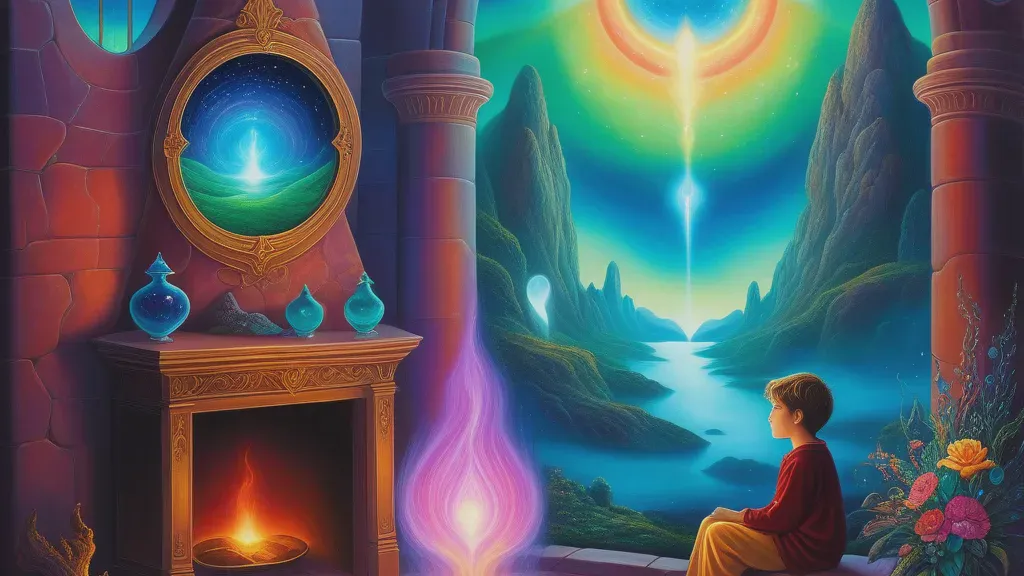
Hearth
Jungian Archetypes
Meaning
A hearth is fire that has been given a floor, a surround and a job. Unlike a bonfire or a burning house, it is contained by design, and the containment is what makes it habitable: the same element that destroys a building heats it, cooks on it and gathers people around it, provided somebody keeps feeding it and nobody lets it out. In dreams the hearth measures the state of the dreamer's inner warmth and who maintains it. Its condition is never incidental — banked and glowing, roaring too high, cold with grey ash, blocked, or burning in a room the dreamer does not recognise — and each state describes something quite precise about their current supply of safety, and about whether that supply is being tended, taken for granted, or asked to burn without fuel.
Psychological Interpretation
The reliable question in a hearth dream is not whether the fire was pleasant but who is responsible for it. A hearth requires continuous small maintenance: wood carried, ash cleared, embers banked at night, a flue kept open. Dreamers who find themselves alone with a fire that must be kept alive are usually carrying a household's emotional temperature by themselves, and the exhaustion in the image is more informative than the warmth. Dreamers who arrive to find a fire already burning and someone else tending it are being shown something about receiving care rather than producing it, which for many people is the more difficult experience of the two. A cold hearth is the version that brings people looking for an interpretation, and it is worth reading carefully rather than pessimistically. Ash means there was a fire, so the image documents a loss of warmth rather than its absence — a household that has emptied, a relationship that has cooled, a period of depletion following effort that nobody replenished. The presence of a single ember changes the reading substantially, since embers require only fuel and breath rather than a new source of ignition. The dream then concerns restoration of something that still exists, which is a different task, and a considerably smaller one, than starting from cold stone.
Traditional Symbol Meaning
The hearth is the oldest domestic technology that is also a religious object, and the two functions have never been fully separable. Before chimneys, the fire sat in the middle of the floor with a smoke hole above it, so the house was literally organised around it: seating, sleeping, cooking and conversation all arranged themselves by distance from the flame. That arrangement produced the hierarchy of the room. Proximity to the fire was status, the seat beside it belonged to the head of the household or the honoured guest, and to be sent away from the hearth was a social act, not a matter of comfort. Much of what a hearth still means in dreams comes from this geometry of nearness. Because it had to be kept alive, the fire also generated obligation. Ember-tending was the last task of the evening and the first of the morning, and traditions across Europe and South Asia treat an extinguished household fire as a serious matter rather than an inconvenience, since relighting could mean fetching flame from a neighbour and admitting the lapse. That is the origin of the smooring prayers, and of the Roman severity toward Vestals who let the state's fire fail. Perpetual flames make a claim about continuity: as long as this burns, the household, the temple or the city has not been interrupted, and the fire's death would mark a break in the line. Hospitality attached itself to the same stone. A stranger admitted to the hearth was under protection, and Greek tradition put suppliants at the hearth precisely because it was the point at which a household's obligations became binding. The fire's warmth was the visible form of a promise, and the ritual of offering food and a place at the fire made an outsider provisionally kin. This is why hearth imagery carries such weight around inclusion and exclusion. It is the place where belonging is decided in the most concrete way available, by whether someone is invited to sit down at it. Administratively, the hearth even became the unit of society. Medieval and early modern states counted households by their fires, which meant a family's existence was registered by the smoke it made, and the taxman's assessor walked through rooms counting fireplaces. The metaphorical usage follows: to keep the home fires burning, to be hearth and home, to have a place by the fire. All of it rests on a single practical fact that dreams reuse without alteration — the fire does not maintain itself, and everything the hearth symbolises depends on somebody getting up in the cold to see to it.
Gestalt / Parts of Self
Take the parts of the dream one at a time and let each one speak as itself. Be the fire: I am not yours, I burn what you give me and nothing else, I will go out without complaint the moment you stop. Be the grate, the chimney, the stacked wood, the cold room at the back of the house, the chair nobody is sitting in. Then be the ash. Most people move quickly past the ash, and it usually has the most to say, since it is what remains of everything already burned and it is swept out without ceremony every morning. The polarity in a hearth dream is tender and warmed, and it is worth finding out which end you occupy so automatically that you did not notice choosing. If you were tending in the dream, try sitting down instead and letting someone else feed the fire, and pay attention to the impulse to get up. If you were being warmed, try the reverse. Many dreamers discover that they can produce heat for a household indefinitely but cannot stay still in front of a fire they did not build, and that discovery, not the imagery, is the useful part of the dream. If the fire was out, resist the urge to interpret and go back into the scene instead. Kneel down, put your hand into the ash, find out whether there is heat under it, and say out loud what you find. If there is an ember, the unfinished business is that you left the room before doing anything about it; finish it now, in imagination, with real fuel and real breath, and notice how much effort it actually took compared to how much you assumed it would. Then ask the fire directly what it wants from you and let it answer in its own voice rather than in yours. What comes back is usually smaller and more specific than the general resolution you were preparing to make.
Psychodynamic / Freudian
Winnicott's account of the holding environment finds an almost literal image in the tended fire. An infant does not require perfect attunement but a reliable presence that keeps conditions survivable while the child gets on with existing, and the mark of a successful version is that the child can eventually be alone in the presence of the other. Sitting by a hearth doing nothing, with someone else in the room, is that capacity in its adult form. Dreams that place the dreamer in exactly this scene are frequently reporting on the state of an internal good object, in Klein's sense: a reliable inner source of warmth that was originally somebody else and has since been taken in. The cold hearth, read this way, is less about present circumstances than about the durability of that internalisation. Some dreamers can be alone for long stretches with the fire still burning; others find that warmth disappears the moment the external source is absent, which points to an object taken in but not securely held. Bion's notion of reverie describes the process by which the warmth gets in — a mind that receives the infant's raw distress and returns it in a bearable form, over and over, until the function becomes the child's own. Dreams of a fire that will not catch often belong to people for whom that return service was unreliable, and who consequently experience their own comfort as something that must be manufactured from scratch each time. Freud approached the same object from an unexpected angle, speculating in a late footnote and a short paper that the founding renunciation of civilisation was the suppression of the impulse to extinguish fire, and that the man who refrained from putting it out was the one who could carry it home. Whatever one makes of the argument, it names something the domestic hearth genuinely required: instinct not abolished but held back and put to use, which is the same operation the ego performs on desire. Hearth dreams appear at times when that balance is under strain, and they intensify around separations, house moves, bereavements and the anniversaries of them, when the question of where the warmth is kept becomes urgent again.
Contemporary Psychological
One of the more interesting findings about firelight comes from the anthropologist Polly Wiessner, who compared daytime and night-time conversation among Ju/'hoansi communities and found that they differ in kind. Daylight talk was largely practical, economic and taken up with disputes; talk around the fire after dark turned to stories, absent people, the imagination and the wider social world. The hearth, on this evidence, is not simply a heat source but the setting that produced a particular mode of human attention, and a brain that evolved with firelit evenings has good reason to treat that scene as a marker of safety. Dreams that stage it are recruiting a very old association between contained flame, darkness and social security. Sleep physiology adds a more immediate explanation. Falling asleep depends on a drop in core body temperature that is achieved partly by dilating the blood vessels of the hands and feet, and research on the distal-to-proximal skin temperature gradient, notably by Kurt Kräuchi and Anna Wirz-Justice, has linked warm extremities to faster sleep onset. Warmth at the periphery in a cool room is close to the exact sensory condition of sitting by a fire, and it is also a condition the sleeping body may simply be registering, since external temperature and bedding are among the stimuli readily incorporated into dream content. Beyond sensation, hearth dreams cluster exactly where waking life is preoccupied with warmth and its loss, which is what the continuity hypothesis would predict. People in the middle of a move, a separation, a first winter alone or the reorganisation of a family dream about domestic warmth because that is what their waking minds are working on. Research on emotional regulation during sleep, including Rosalind Cartwright's studies of people going through marital breakdown, suggests that the way a night's dreams handle distress, and not simply how much of it they contain, is linked to how well people adjust afterwards, so a fire in an otherwise bleak dream is worth noticing rather than dismissing.
Jungian / Archetypal
The hearth is a contained fire, and containment is the whole of its symbolic value. Uncontained fire in dreams is conflagration, possession, the affect that takes the house; the hearth is that same energy given walls, a floor, a flue and a routine, which is precisely what Jung meant by the temenos, the marked-off precinct in which something powerful can be present without destroying its surroundings. Alchemy supplied him with the closest technical parallel in the athanor, the slow furnace whose whole art lay in a moderate and unbroken heat, since the work failed if the fire went out and equally if it flared. A hearth dream is usually asking about that regulation rather than about the presence of fire at all. Jung's own relation to the image was not merely theoretical. At the tower he built at Bollingen he chose to cook on an open fire and draw water by hand, and described in his memoirs how those slow physical operations kept him in contact with something the modern arrangement of life had removed. The hearth in dreams often performs the same corrective for a dreamer whose waking life has become entirely abstract, indoor and instantaneous. Its appearance restores a rhythm of gathering fuel, waiting, tending and banking, and its demand for daily attention is a compensatory message aimed at anyone who assumes their inner warmth is a fixed property rather than an outcome of repeated small acts. As a centre, the hearth belongs to the same family of images as the mandala and shares their function of organising a space around a middle. The fire's condition then reads as a report on the dreamer's relation to their own centre. A steady flame with people around it suggests a psyche whose energies are gathered rather than scattered. A cold grate in an otherwise intact house indicates that the structure of a life has survived while the thing it was built around has not been fed, which is a familiar condition in the second half of life. The ember matters in this reading more than the blaze, since what individuation requires is not a bigger fire but an unbroken one.
Cultural & Historical Origins
Latin gave the hearth a word that outlived its object: focus meant the fireplace of a house before it named the point where rays converge, so the centre of attention is still named after the centre of a home. Rome kept that centrality literal. Vesta was the hearth in divine form, her round temple in the Forum held a perpetual fire rather than a statue, and the Vestals who tended it were punished if they let it go out, and the flame was renewed each March at the start of the old Roman year, in rites Ovid describes in the Fasti. Greek practice ran along the same lines through Hestia, who in the Homeric Hymns receives a share of every sacrifice, first and last, and whose civic fire was carried out to found new colonies. The Vedic householder's fire, the gārhapatya, burned perpetually on the domestic altar and was the source from which the other ritual fires were lit, tying a family's standing to an unbroken flame. Irish tradition preserves a Christianised version: Gerald of Wales, writing in the twelfth century, describes a perpetual fire at Kildare tended in rotation by the nuns of Brigid's community. Domestic practice mattered as much as sacred. In the Hebridean prayers collected by Alexander Carmichael in the Carmina Gadelica, the peat fire is smoored at nightfall into a small mound with a blessing spoken over it so that it can be revived at dawn. States counted hearths rather than heads, from the medieval French feux to the English Hearth Tax levied under Charles the Second, and the historian Fustel de Coulanges built his account of ancient society on the argument that civic religion grew outward from this one fire.
Contextual Variations
A cold hearth full of ash in an empty house
Ash is evidence, so this dream is documenting a loss rather than a lack. Something was burning here and is not now, and the empty house extends that to the people who used to be in the room. Dreams stage this after departures of every kind: children leaving, a separation, the end of a demanding project, the death of the person who actually generated the household's warmth. Note whether you felt grief or simply cold, since the two point in different directions. Grief means the loss is being processed; numbness usually means it has not been admitted yet, and the dream is showing you the grate to make the point.
Feeding a fire that gives no heat to the room
Effort without return is the whole content here, and the dream is unusually blunt about it. You are doing the correct thing, repeatedly, and the room stays cold, which describes any arrangement where your contribution disappears without changing the temperature — a relationship in which care is received but not registered, a job that consumes fuel and produces no warmth, a family role you have held for years. The important detail is that you keep feeding it. Ask what would happen if you stopped for one evening, and notice how quickly the answer arrives and how frightening it sounds.
A stranger already sitting in the chair by your fire
The seat beside the hearth has always been the position of belonging, so finding it occupied raises a question about displacement rather than about intruders. The stranger may be an actual newcomer to your household or a change in your own life that has taken the place your comfort used to sit in. The dream's real information is in your response. Hospitality suggests you have room for whatever this is; the urge to remove them suggests something has been given a seat without your agreement. Consider what recently moved into the centre of your life and whether you invited it there or merely found it settled in.
Banking the embers before going up to bed
This is the hearth dream in its most settled form and it should not be read as uneventful. Covering embers so that the fire survives the night is an act of trust in tomorrow, and dreams produce it when something in you has decided that continuity is possible. The gesture also implies restraint: you are not extinguishing the fire and you are not sitting up to keep it roaring. If you have been oscillating between burning yourself out and going cold, the dream is proposing a third setting, and the specific instruction is to leave enough alive overnight to be woken up rather than rebuilt.
Frequently Asked Questions
Why would I dream of a hearth when I live in a flat with no fireplace?
Is a cold or dead hearth in a dream a bad sign?
Why did I feel homesick after dreaming about a fireplace?
Is a hearth dream different from dreaming about a house fire?
Journaling Prompts
- List the people, routines and places that actually generate warmth in your current life, and beside each one write who maintains it. Then count how many entries have your own name next to them. If the tally is lopsided, describe what has kept it that way, and name one item that could plausibly be handed to somebody else this month.
- Recall a specific room from your past where you felt genuinely warm, and reconstruct it in detail: the light, the sounds, who was present, what was on the table, what time of year it was. Then identify the one element that made it work. Is any version of that element available to you now, and what have you assumed would have to be true before you could arrange it?
- Think about the last time you burned too hot for too long and what it cost you afterwards. Describe the warning signs you noticed at the time and chose to override. Then write what banking the fire would look like in practical terms this week — not resting entirely, but leaving something alive overnight rather than spending it all before midnight.
- Sit with the idea of being warmed by something you did not build. Write about the last time someone took care of you without being asked, and be honest about how comfortable it was to accept. If you found it difficult, trace where that difficulty was learned, and describe one small offer you could receive this month without immediately returning the favour.
Related Symbols
Dreamed about Hearth?
Get a personalized AI interpretation that connects this symbol to your specific life circumstances.
Interpret My Dream