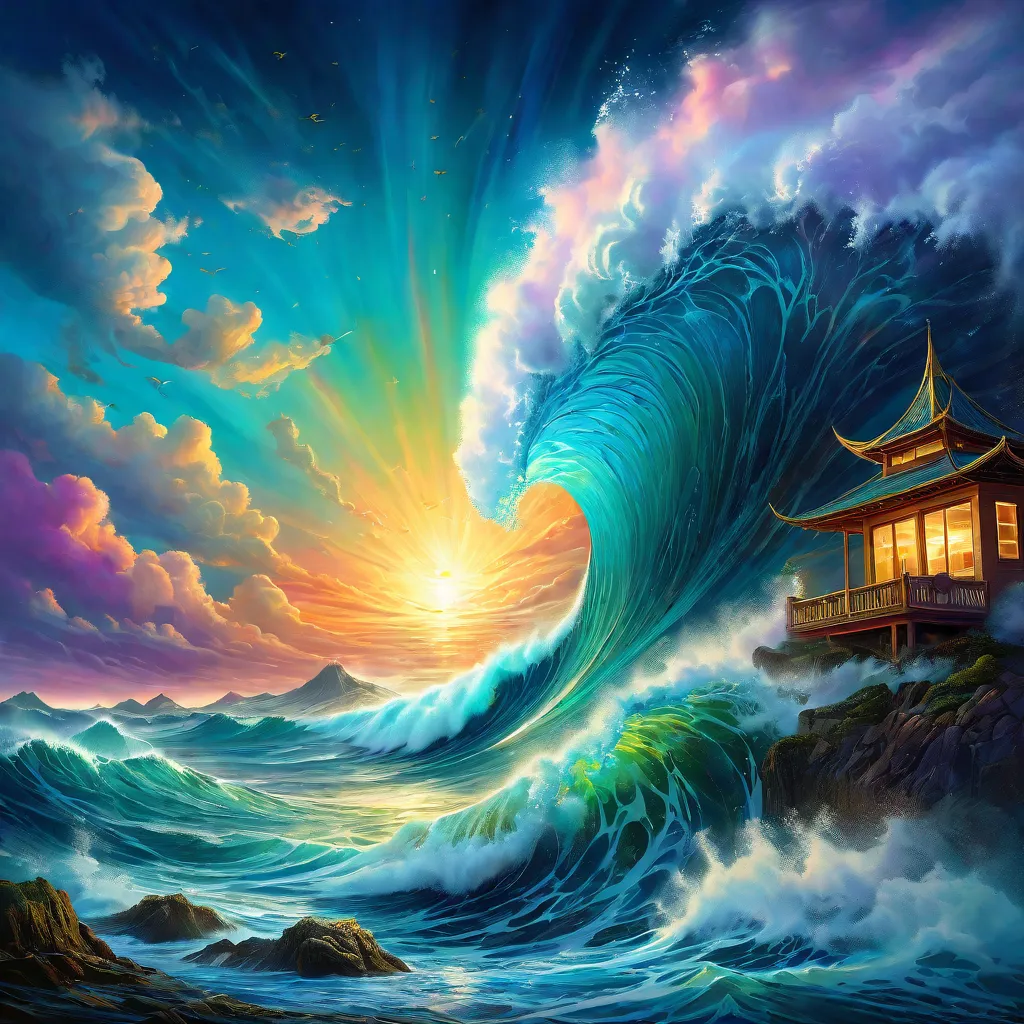
Tsunami
Jungian Archetypes
Meaning
A tsunami dream marks the moment ordinary stress stops feeling manageable and turns into a wall bearing down with no origin the dreamer can name and no way to negotiate with it. Unlike a storm that builds visibly, the wave rises out of a sea that looked flat and unthreatening only moments before, and that deceptive calm is often the dream's most telling detail: pressure has been accumulating for longer than the dream lets on. The dream is rarely about water. It is about the widening gap between how much has been absorbed in silence and how little has been said aloud, and the size of the wave is a rough measure of that gap.
Psychological Interpretation
Water in dreams routinely stands for feeling, but a tsunami specifically encodes feeling that has outgrown the dreamer's ordinary capacity to regulate it. The scale is the diagnostic detail: this is not worry held in a container, it is emotion arriving as one overwhelming event rather than a current that can be managed day to day. What the dreamer does when the wave appears carries most of the information. Freezing on the shore suggests a nervous system that has judged fighting or fleeing useless and has dropped into shutdown, a response usually reserved for situations that feel genuinely inescapable. Running suggests some residual belief that safety is still within reach. Watching from high ground suggests a dreamer who has already begun separating themselves from a crisis that used to feel all-consuming. None of these responses is a failure; each is a reading of where the dreamer's coping resources sit relative to the pressure bearing down, and the dream's use may simply be to make that pressure legible enough, at last, to act on.
Traditional Symbol Meaning
Calm water in a dream meant stable affairs to most Mediterranean and Middle Eastern interpreters; water that turned violent and rose against the dreamer meant the opposite, a reversal, a debt, or a superior's anger about to fall without notice. Because a tsunami leaves no time to prepare, these interpreters often singled it out from ordinary flood or storm imagery, treating it as a sign that the coming change would arrive too fast to negotiate and that the dreamer's task was to secure what mattered most in advance rather than to hope for warning. Coastal communities that have actually lived through tsunamis carry a more practical layer of meaning that predates and outlasts any dream dictionary. In parts of Japan and the Pacific, oral tradition around real tsunamis emphasizes one detail above all others: the sea pulling back and exposing the ocean floor is the true sign, arriving before the wave itself and easy to miss if a person is not already watching for it. Folk memory of this pattern has shaped how the image is read even outside disaster-prone regions, so that a dream tsunami often carries an implicit earlier scene, a withdrawal that went unnoticed, folded into the same moment as the wave. What persists across these older readings is the idea that a tsunami dream is less about the disaster itself than about timing, about a warning sign that was present and either seen or missed. Whether the old interpreters called that warning fate, a superior's displeasure, or the sea's own logic, the underlying instruction to the dreamer was the same: notice the recession before the surge, because it is always there, and it is always brief.
Contemporary Psychological
Tsunami dreams are a clean test case for Antti Revonsuo's threat simulation theory, which proposes that dreaming exists partly to rehearse responses to danger in a setting where the rehearsal costs nothing. A tsunami is about as close to a maximal, inescapable threat as the sleeping brain can construct, and the freeze, run, or watch responses it elicits are not noise; they are the same threat-appraisal circuitry that would fire during a real emergency, being exercised on a scenario invented for the occasion. Clinicians who work with survivors of actual tsunamis, including people affected by the 2004 Indian Ocean disaster and the 2011 Tōhoku earthquake and wave in Japan, have documented recurring wave and inundation imagery in nightmares long after the event, consistent with the broader finding that traumatic dream content tends to replay the specific sensory shape of the threat rather than a generic disaster. For dreamers who have never been near a real tsunami, the same imagery more often reflects the continuity hypothesis: waking stress load, not literal risk, supplying the raw material the dreaming brain assembles into an oceanic emergency. One detail from tsunami science maps unusually well onto the dream: coastal safety training exists specifically because the withdrawal of water before the wave is the warning sign people miss, arriving seconds before it is too late to use. A dreaming brain that keeps restaging that same sequence, calm giving way to catastrophe with almost no gap between them, may be doing exactly what the training is meant to correct for in real emergencies: teaching the dreamer to register the recession, not just the wave, as the moment that actually mattered.
Jungian / Archetypal
The tsunami belongs to a small class of dream images that behave like Trickster rather than Shadow: it does not creep in disguised as something acceptable, it simply refuses to be planned around, upending the dreamer's carefully maintained order with no regard for whether the timing is fair. Where Shadow material can often be bargained with or slowly integrated, Trickster energy of this kind announces that the old arrangement is already over, whether or not the ego has consented to that fact. What the dreamer does at the water's edge is where the second archetype enters. Facing an ordeal this disproportionate to ordinary life is structurally the Hero's descent: a trial that cannot be avoided, only met, survived, or fled. A dreamer who stands and is swept under has not necessarily failed the trial: analytical psychology treats near-annihilation by an unconscious force as frequently the price of the crossing, not evidence that the crossing went wrong. The wave's violence is not punitive so much as indifferent to the ego's readiness, which is precisely what makes it archetypal rather than personal. Read this way, the tsunami is less a verdict than a threshold: the psyche signaling that whatever compensatory pressure has been quietly building on the far side of consciousness has now reached a volume the ego's usual defenses cannot absorb piecemeal. The individuation task the dream sets is not to prevent the wave, which was never available as an option, but to find out afterward who the dreamer is on the shore that remains.
Gestalt / Parts of Self
Gestalt dreamwork asks you to stop watching the tsunami from the beach and become it. Speak as the wave: what have you been holding back, what set you moving now, and why did the person watching you rise fail to notice until it was too late to walk away. Most dreamers are startled by how easily they can answer in the wave's voice, because the flood is not a stranger, it is the part of you that has been accumulating force exactly where you stopped paying attention. The freeze response deserves the same direct address rather than analysis from a safe distance. If your legs would not move, sit with that stuck body and ask it what it was protecting you from by refusing to run. Often the answer is not cowardice but an old, accurate calculation that this particular threat could not be outrun, and that stillness was the more honest response than performing an escape that was never going to work. The scene also stages a polarity between land and sea, between the self that stands and plans and the self that surges and cannot be contained, and Gestalt work treats both halves as equally yours. The tsunami is not attacking a separate, innocent shore; shore and wave are two disowned pieces of the same person, and the dream's charge lives in the contact between them. Ask what the shore would say back to the wave if it were allowed a voice of its own, since that answer, not a strategy for building higher walls, is usually the more useful piece of unfinished business the dream is pointing toward.
Psychodynamic / Freudian
Freud, writing about a sensation Romain Rolland had described to him as an oceanic feeling, treated the boundless sea as an image the mind reaches for when it wants to represent a dissolving of the ego's normal limits, and a tsunami dream can be read as the same image turned hostile. What was once, in infancy, an undifferentiated and even pleasurable merging with something larger than the self returns here as an assault, because the ego that has since formed firm boundaries now experiences their overwhelming as a genuine threat rather than a comfort. The manifest wave typically stands in for affect the dreamer has judged too large or too dangerous to feel directly in waking life, whether that affect is grief, rage, longing, or desire. Displacement is doing familiar work here: rather than locate the source of an overwhelming feeling in a specific person or event, the dream generalizes it into an impersonal act of nature, which is easier to withstand than blaming a parent, a partner, or the self. This is also why the trigger in waking life is so often disproportionate to the dream's scale, since condensation has folded several smaller pressures into one oceanic image. The detail of the sea's calm before the surge fits a defense of denial rather than repression proper: the danger was not hidden from awareness so much as actively minimized while it built, a strategy the dream punishes by finally forcing the very confrontation that denial was designed to postpone. Object relations theory would add that how the dreamer is treated by the water afterward, whether it deposits them somewhere survivable or not, often mirrors an early experience of whether overwhelming affect, once expressed, was met with containment or further abandonment.
Cultural & Historical Origins
Flood narratives that anticipate the tsunami's totalizing force appear wherever people have lived close to unpredictable water. The Mesopotamian Epic of Gilgamesh has the god Ea warn Utnapishtim of a coming deluge meant to erase a noisy, overreaching humanity, sparing only what is loaded onto a single boat. Hindu tradition tells a structurally similar story through Matsya, the fish avatar of Vishnu, who guides the sage Manu's vessel through a world-drowning flood and preserves the seeds of the next age. Japanese coastal folklore took a more literal route: the giant catfish Namazu was long blamed for the earthquakes and tidal waves that struck without warning, pinned beneath the earth by the god Kashima, whose vigilance was the only thing standing between the coast and disaster. Each version treats the flood not as random ruin but as a force that separates what deserves to continue from what has become unsustainable, a judgment carried out by water because no smaller image would suffice.
Contextual Variations
A tsunami rising from a sea that looked calm seconds earlier
The deceptive calm is the point of this variation, not the wave itself. It suggests pressure has been building somewhere the dreamer stopped monitoring, mistaking the absence of visible trouble for the absence of trouble. The dream is less a warning about the future than a correction to a recent misreading: something was already in motion before it became undeniable.
Trying to run from the wave but your legs will not move
This is closer to a body memory than a character flaw. Dream paralysis of this kind often surfaces when waking life has presented a threat too large or too fast for any real action to have helped, and the nervous system is replaying the shutdown it chose instead of flight. The useful question afterward is not why you didn't run, but what you were right to recognize as unrunnable.
The tide pulling back and exposing the seafloor before the wave hits
This is the withdrawal phase most dreamers forget to mention, and it usually points to a warning sign that was visible in waking life and went unread. The exposed seafloor is not empty; it is evidence, briefly on display, that something was already receding before it returned as a crisis. The dream is asking what else recently went quiet right before it got loud.
Being pulled under and discovering you can still breathe
Breathing where breathing should be impossible reframes submersion as survivable rather than fatal. This often appears once a dreamer has already absorbed more emotional intensity than they expected to and found, against their own prediction, that it did not end them. It marks a shift from bracing for drowning to trusting an unfamiliar new capacity.
Frequently Asked Questions
Does a tsunami dream mean disaster is actually coming?
Why do I freeze instead of running from the wave?
Why does the water look calm right before it hits?
Is it strange that I felt calm once the wave finally arrived?
Journaling Prompts
- Think back to the last time something in your life felt like it arrived all at once. Was there a quieter build-up beforehand that you noticed but didn't act on? What would it look like to name that pressure earlier next time, before it needs a wave to get your attention?
- If your legs wouldn't move in the dream, sit with that stillness for a moment rather than judging it. What might your body have known about the situation that your mind was still arguing with? What would it feel like to trust that instinct instead of overriding it?
- Notice what you tried to save or protect as the water came in, if anything. That choice usually reveals what actually matters to you right now, compared with what you normally act like matters. Where is the gap between the two?
- If you survived the wave, picture the landscape afterward. What has to be rebuilt, and what are you relieved is finally gone? Let yourself answer honestly, even if the honest answer feels disloyal to how things used to be.
Related Symbols
Dreamed about Tsunami?
Get a personalized AI interpretation that connects this symbol to your specific life circumstances.
Interpret My Dream