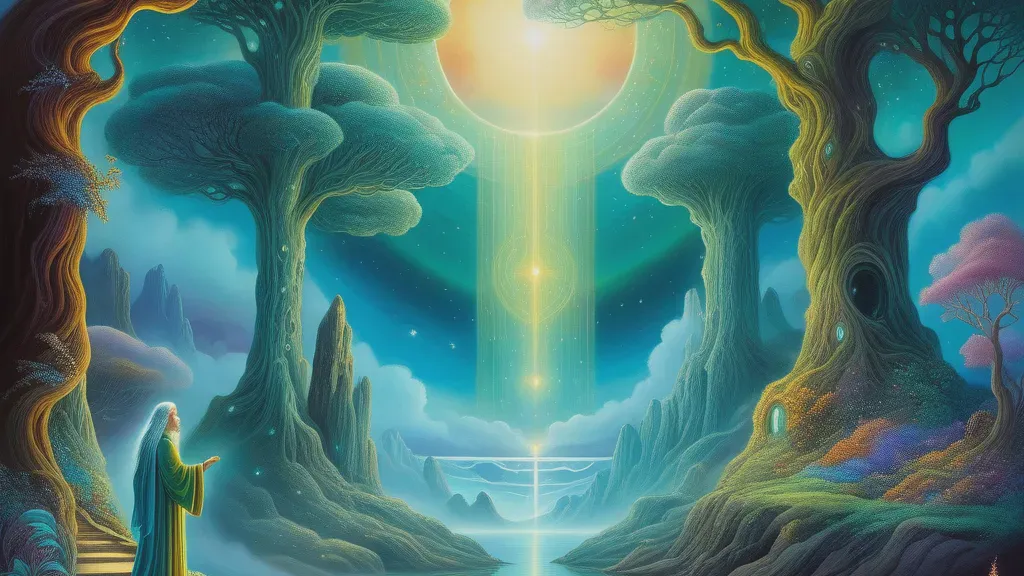
Afterlife Journey
Jungian Archetypes
Meaning
Dreaming of an afterlife journey reflects existential questions and the exploration of mortality. It symbolizes the quest for meaning beyond physical existence.
Psychological Interpretation
Jungian theory sees this as an encounter with the Self, exploring the unconscious fears of death. Cognitive psychology may interpret it as grappling with mortality, while practical psychology emphasizes coping mechanisms regarding loss and grief.
Cultural & Historical Origins
In Egyptian mythology, the afterlife journey is depicted in the 'Book of the Dead,' emphasizing the soul's passage. Dante's 'Divine Comedy' illustrates the afterlife journey through realms of the afterlife, deeply exploring spiritual themes.
Contextual Variations
You follow a dim path toward a bright opening, and along the way you meet calm figures who ask you to remember specific moments from your life. Each time you recall something, the path reshapes itself—narrow when you avoid, wider when you accept.
This can reflect your psyche processing mortality and meaning-making, using memory as an emotional “checkpoint.” The path reshaping suggests your beliefs about your past are actively changing your sense of direction and safety.
You’re on a boat with no visible driver, crossing a dark waterway. When you try to steer, your hands feel heavy, but when you stop fighting and listen, the boat moves smoothly toward a silent shore where someone calls your name.
The boat can symbolize your relationship with uncertainty and surrender—how you cope when control fails. Hearing your name suggests identity being reaffirmed: your unconscious may be asking what parts of you still deserve recognition even after major endings.
You arrive at a threshold room filled with doors labeled by emotions rather than names (e.g., “grief,” “forgiveness,” “unfinished”). You hesitate, then choose a door that feels uncomfortable but honest, and the room becomes warm instead of frightening.
Choosing the “emotion door” points to psychological integration—your mind may be turning existential questions into actionable inner work. The warmth after hesitation suggests that avoidance is what intensifies fear, while truthful engagement restores stability.
Frequently Asked Questions
Does an afterlife journey dream mean I’m afraid of death?
Why would my dream focus on specific memories during the journey?
What does it mean if I couldn’t control where I was going?
Journaling Prompts
- What specific feeling did I experience on the journey (peace, dread, curiosity, relief), and what waking-life situation echoes that feeling?
- Which moment or theme did the dream keep returning to, and what does that suggest I’m trying to integrate rather than escape?
- If the “threshold” in my dream had a message for me, what would it ask me to release or commit to?
Related Symbols
Dreamed about Afterlife Journey?
Get a personalized AI interpretation that connects this symbol to your specific life circumstances.
Interpret My Dream