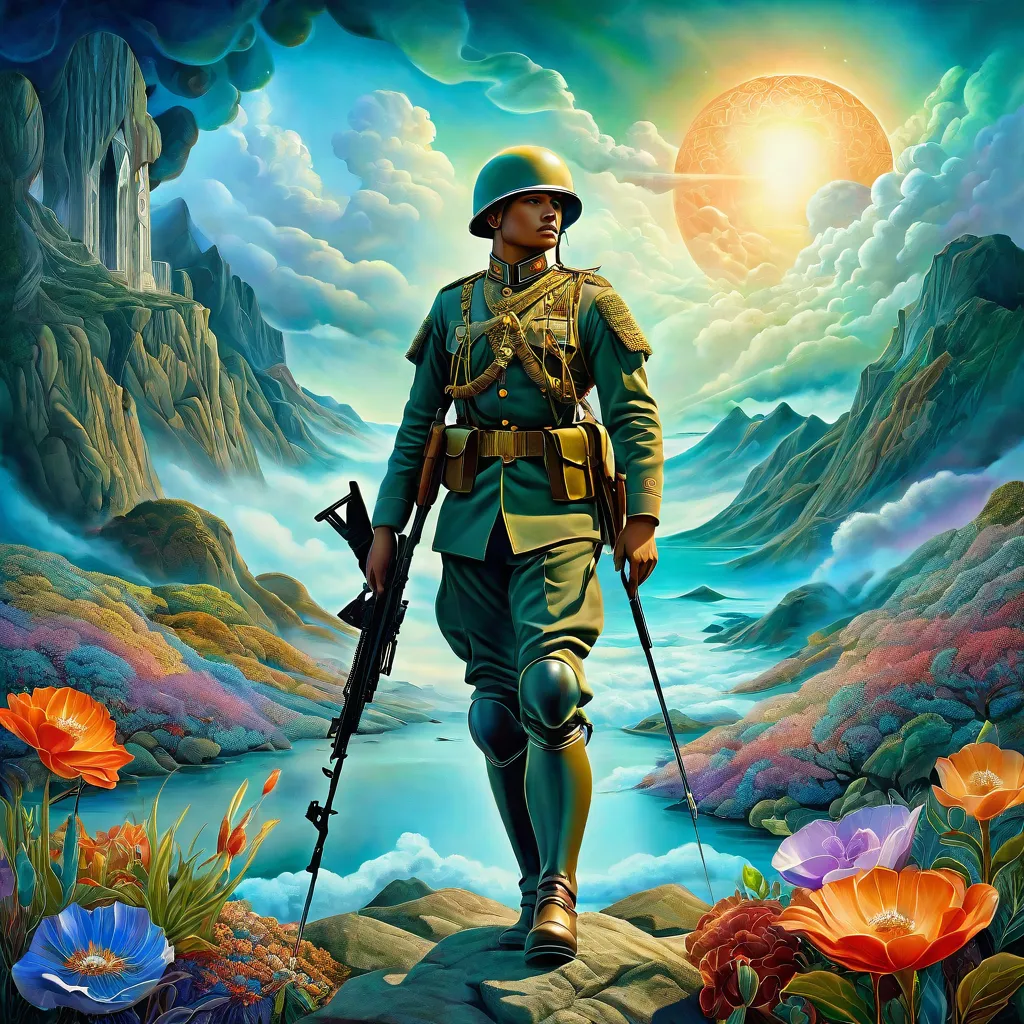
Soldier
Jungian Archetypes
Meaning
A dream soldier embodies obedience under conditions where personal judgment has been formally suspended in favor of a larger structure, which is what makes the figure useful for staging conflicts between duty and private conviction that daily life rarely allows to surface so plainly. The dream typically activates wherever the dreamer is currently following an order, a role, or a standard they have not fully examined, whether it comes from an employer, a family expectation, or an internalized rule about who they are supposed to be. A soldier's face staying composed while resentment builds underneath is the dream's most frequent tell, exposing a widening gap between compliance performed outwardly and consent that has not actually been given inwardly.
Psychological Interpretation
What distinguishes a soldier from other authority figures in dreams is the specific structure of the role: someone bound by orders that originate outside themselves, wearing an identity, the uniform, that is issued rather than chosen. A dreamer who receives orders conflicting with their own values while keeping an outwardly steady expression is usually depicting persona management in its most literal form, the visible compliance and the private disagreement occupying the same body without yet finding a way to speak to each other. A uniform that fits perfectly yet covers scars points to a protective identity built specifically to manage vulnerability, one so effective that removing it now feels dangerous even though the vulnerability underneath was the original reason the identity was built. Training a younger recruit who keeps asking why the rules exist places the dreamer on the other side of this same tension, holding both the responsibility to maintain order and the harder task of explaining that order's purpose rather than simply enforcing it, a position that often surfaces when the dreamer has recently become the one others look to for structure. Across these variations, the soldier rarely represents literal violence; it represents the specific cost of holding a role that requires the self to act on behalf of something larger before it has fully reconciled with that larger thing's demands.
Traditional Symbol Meaning
A soldier fighting bravely in a dream was, in frameworks organized around rank and dispute, most often read as an omen of coming success against rivals or opposition, while one retreating or wounded warned of setback in a current struggle, legal, financial, or otherwise personal. Because a soldier occupies a fixed place inside a chain of command, taking orders in the dream was commonly read as a comment on the dreamer's actual standing relative to a superior, a parent, or some other authority in waking life, while giving orders suggested advancement was close at hand. A related strand of older interpretation treated the soldier's wounds and uniform as carriers of meaning distinct from the fighting itself. A wound received in a dream battle was sometimes read as a warning about an area of vulnerability the dreamer should protect in waking life, the location of the wound corresponding to the kind of exposure at risk, while a uniform that fit poorly or fell apart during the dream was read as a caution about a role or reputation the dreamer had assumed without having genuinely earned it yet. What runs underneath both of these older readings, and continues to shape how the symbol is understood, is the assumption that a soldier is defined less by combat than by position, someone situated within a structure of command that both protects and constrains them. Whether the old interpreters framed this as a comment on rivalry and advancement or contemporary readers frame it as a comment on internalized duty, the soldier has always been read as a figure caught inside a larger system rather than one acting purely on personal will.
Jungian / Archetypal
The uniform does something most Persona material never does on its own: it draws a literal, visible boundary between an identity issued by an institution and whatever lies beneath it, work that usually stays invisible until this image lays it bare. A dreamer whose face stays steady while resentment builds underneath is watching their own Persona perform its function in real time, maintaining social order at a cost the conscious mind has not yet been willing to tally. Where the uniform covers scars the dreamer cannot remove without panic, the dream is pointing toward a Persona that has become load-bearing rather than merely functional, no longer just a role worn for specific situations but a structure the ego now depends on to manage genuine woundedness underneath. Analytical psychology treats this fusion as a caution rather than a failure: a persona this tightly bound to survival cannot simply be discarded, it must be loosened gradually as the underlying vulnerability finds safer ways to be held. Training a younger recruit who questions the rules stages a different archetypal task, closer to the Wise Old Man's responsibility to transmit not just authority but its purpose. A dreamer who softens toward the recruit's doubt while still maintaining necessary structure is modeling a more mature relationship to duty than pure obedience allows, one where authority remains intact precisely because it can explain itself rather than merely enforce compliance.
Gestalt / Parts of Self
Stand in formation and let the resentment under your steady face speak first, since that is the part of you the dream is actually foregrounding, not the orders themselves. Ask that resentment plainly what value of yours is being overridden right now, and notice how much clearer the dream's message becomes once you stop performing composure even inside your own imagination. The uniform that covers your scars deserves a direct conversation rather than a quick removal. Speak to it: ask what it has protected you from being seen as, and what it fears would happen if those scars were visible without it. Do not force yourself to take it off in the retelling if that still feels dangerous; simply loosen it enough to feel what is underneath, since the dream's fear was about sudden exposure, not about acknowledgment at your own pace. When you find yourself training a recruit who keeps questioning the rules, notice that the recruit's doubt is your own doubt, given a separate voice so it can finally be heard without threatening the structure you rely on. Answer the recruit as honestly as you can rather than falling back on automatic authority, and pay attention to which of your own explanations actually satisfy you and which ones you notice yourself reciting out of habit.
Psychodynamic / Freudian
The soldier's uniform offers an unusually direct route into how the mind manages conflicting demands, since it makes visible a structure psychoanalysis normally has to infer: an outward-facing compliance built specifically to contain an inward rebellion that cannot be safely expressed. A dreamer who obeys an order while resentment grows beneath a steady face is depicting a defense close to reaction formation, performing the opposite of an internal state in order to keep that state from disrupting a necessary function. Scars concealed beneath a well-fitting uniform point toward repression operating alongside identification: the dreamer has built a competent, protective identity partly by identifying with an authority or role that originally demanded the concealment of injury as a condition of belonging. The panic that arises when the uniform is removed suggests the ego fears, with some justification, that the original wound has not actually healed underneath, only been rendered invisible, and that exposure now would mean confronting damage the defense was never designed to resolve, only to hide. Training a recruit who questions authority often represents the dreamer's own earlier self, the one who once asked exactly these questions before adopting the current, more compliant role. Object relations theory would frame the dreamer's response, patience or rigid enforcement, as a reenactment of how their own early doubts were once received, met with explanation and care or shut down with pure authority, a pattern the dreamer is now positioned to either repeat or interrupt.
Contemporary Psychological
Psychiatrist Jonathan Shay, working with Vietnam veterans and drawing explicit parallels to Achilles in the Iliad, developed the concept of moral injury to describe the lasting psychological damage that follows not from fear or physical danger alone, but from betrayal of what is right by a legitimate authority, or from being made to act against one's own deep values under orders. A dream soldier obeying commands that conflict with personal conviction, face steady while resentment builds beneath it, closely mirrors the structure Shay identified, even for dreamers whose waking life involves no literal combat at all. This framework helps explain why the soldier so often appears in dreams entirely unconnected to military service: moral injury as Shay described it applies wherever someone is required by a role, a job, a family position, to act in ways that quietly violate their own sense of right conduct, and the mind may reach for a soldier specifically because the uniform makes visible a conflict between institutional obligation and personal ethics that would otherwise be harder to picture directly. The recruit who keeps questioning the rules adds a generational dimension to this same research, since Shay's later work also examined how leaders who can articulate the purpose behind an order, rather than demanding blind compliance, protect the people under them from the specific harm moral injury describes. A dreamer who softens to explain rather than simply enforce may be practicing exactly the kind of leadership Shay's research suggests prevents the wound from forming in the first place, in the recruit and in themselves.
Cultural & Historical Origins
Homer's Iliad gives the soldier archetype its oldest and still most complete portrait through Achilles, whose rage at a commander's disrespect nearly costs his own side the war, and whose eventual return to battle is driven less by duty than by grief and love for a fallen companion, making the epic as much a study of a soldier's private motivations as of combat itself. Erich Maria Remarque's novel All Quiet on the Western Front, drawn from his own service in the First World War, strips away the older heroic framing entirely, presenting soldiers as young men whose idealism is consumed by an industrialized war that offers no meaning proportionate to what it demands of them. The English poet Wilfred Owen, who died in combat a week before the war's end, gave this same disillusionment its most enduring literary voice, describing the true face of a gas attack as the antithesis of the old Latin claim that it is sweet and fitting to die for one's country. Between an ancient epic that locates a soldier's deepest struggle in personal honor and grief, and a modern literature that locates it in the gap between inherited ideals and lived experience, the archetype has consistently carried the same unresolved question: what a person owes a cause larger than themselves, and what that cause owes back.
Contextual Variations
Following an order that conflicts with your own values
A steady face over rising resentment usually reflects a live gap between visible compliance and inward consent that has not actually been given. This dream is worth treating as a direct signal that some current obligation is being followed on the surface only, and the underlying disagreement deserves acknowledgment before it hardens into something harder to name.
Wearing a uniform that covers scars you don't want seen
A protective role that conceals old injury often works well until the moment it needs to come off, at which point its usefulness turns into a trap. Panic at the thought of removing it usually signals fear that what lies underneath has not actually healed, only been rendered invisible by the role itself.
Training a recruit who keeps asking why the rules exist
This scenario often places you opposite an earlier version of yourself, one who once asked the same questions before adopting a more obedient role. How you answer the recruit, with patience or with pure authority, usually reflects how your own doubts were received long ago, and which pattern you are currently choosing to continue or break.
Standing guard alone through a night that never seems to end
An unending watch often points to vigilance that has outlasted the actual threat it was built for, a form of readiness that has become chronic rather than situational. The dream may be asking whether the danger you are still defending against is as present now as it was when this watchfulness first began.
Frequently Asked Questions
Why did I dream about being a soldier if I have never served?
Why did the uniform feel like it was trapping me?
Is a soldier dream about anger, fear, or something else?
Why was I the one training a recruit instead of following orders myself?
Journaling Prompts
- Think about an order, expectation, or rule you are currently following outwardly while privately disagreeing with it. What would it cost you to voice that disagreement to the actual source of the order, rather than only to yourself?
- If a uniform in the dream covered something vulnerable, name the specific thing it was hiding. What would it take to let one trusted person see that part of you without the role or performance around it?
- Recall a moment you were expected to enforce a rule you privately questioned. Did you explain its purpose or simply demand compliance, and which of those two approaches do you wish someone had used with you at that age?
- If you were standing guard against a threat in the dream, consider whether that danger is still active in your current life or whether the vigilance itself has outlasted its original reason for existing.
Related Symbols
Dreamed about Soldier?
Get a personalized AI interpretation that connects this symbol to your specific life circumstances.
Interpret My Dream