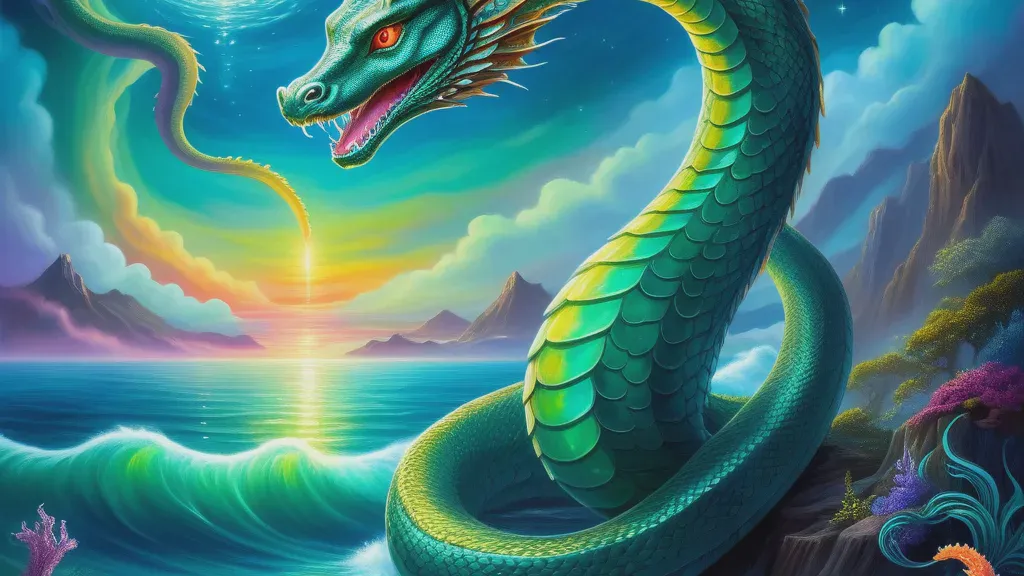
Sea Serpent
Jungian Archetypes
Meaning
A sea serpent in dreams signifies hidden fears or threats lurking beneath the surface. It represents the unconscious anxieties that need to be confronted for personal growth and transformation.
Psychological Interpretation
Jungian theory associates sea serpents with the shadow aspect of the psyche, embodying repressed fears. Cognitive frameworks may interpret it as a symbol of overcoming challenges. Practically, it signals the necessity to face inner turmoil.
Cultural & Historical Origins
In Norse mythology, Jörmungandr, the Midgard Serpent, symbolizes chaos and the unknown. In ancient Mesopotamian myths, Tiamat represents primordial chaos, illustrating the dangers associated with powerful, hidden forces.
Contextual Variations
You’re on a small boat at night, and a massive sea serpent rises near the hull, circling as if looking for a weak spot. You try to keep your balance while the water churns with the sense that something unseen is assessing you.
This often points to a fear that feels “alive” and strategic—an underlying threat your mind can’t fully name. Psychologically, the serpent can represent a threat-detection system that’s been activated too strongly, pushing you to confront what you’ve been avoiding in waking life.
You dive underwater to retrieve something valuable, but the moment you reach the object, the sea serpent appears behind you and blocks your path. You wake with your body tense, as if you were holding your breath for a long time.
The serpent here can symbolize hidden consequences of pursuing a goal—especially when the danger is tied to curiosity or desire. It reflects the psyche’s warning: “There’s more here than you think,” urging you to examine the costs you’re not accounting for.
In a storm, you see the sea serpent’s head break the surface, then it retreats as quickly as it came, leaving a trail of wreckage or torn nets. You feel both terrified and strangely informed, like you learned something in the moment.
This can indicate intermittent anxiety or recurring triggers: the “threat” appears, then disappears before you can fully process it. Psychologically, the damaged nets or wreckage suggests the mind is mapping how certain situations disrupt your safety and boundaries.
Frequently Asked Questions
Why did the sea serpent feel like it knew what I was doing?
Does seeing a sea serpent mean something bad is about to happen?
What does it mean if the serpent was calm instead of attacking?
Journaling Prompts
- Describe the sea serpent’s behavior in detail (approach, distance, speed). What real-life situation feels similarly “strategic” or watchful?
- What part of you felt most vulnerable—your body, your choices, or your sense of control? Link that feeling to a current boundary or decision you’re avoiding.
- If the serpent could communicate one message without words, what would it warn you to look at beneath the surface?
Related Symbols
Dreamed about Sea Serpent?
Get a personalized AI interpretation that connects this symbol to your specific life circumstances.
Interpret My Dream