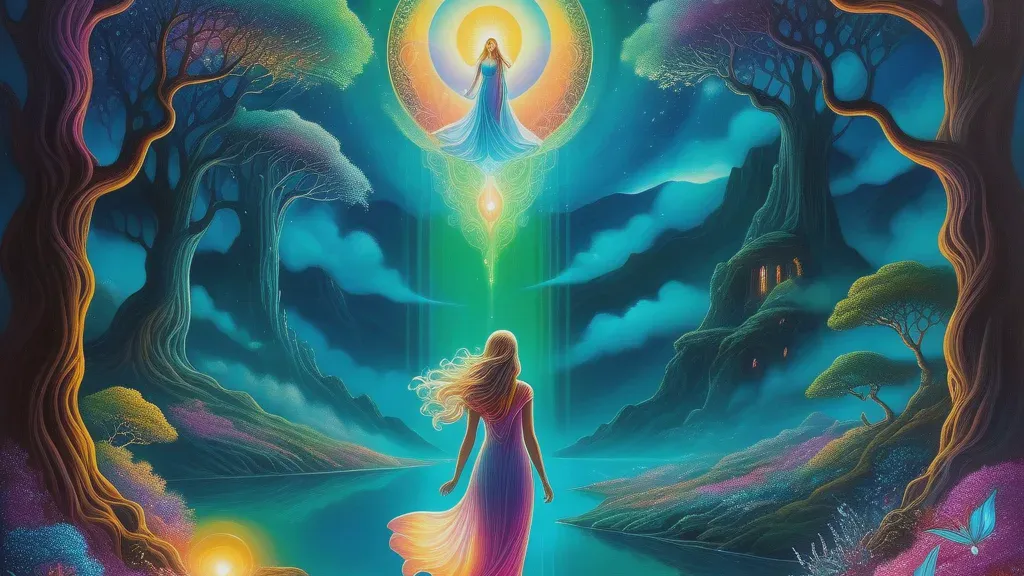
Return to Source
Jungian Archetypes
Meaning
Return-to-source dreams collapse the distance between where the dreamer currently stands and wherever they locate their own beginning, a childhood house, a body of water, a wordless origin point that can't be named but is instantly recognized on arrival. The pull in these dreams is centripetal rather than adventurous: nothing new is being sought so much as something original is being rechecked against. What the dream is testing is fit, whether the life the dreamer is currently living still lines up with whatever they privately consider their own baseline self, before roles, performances, and other people's expectations accumulated on top of it.
Psychological Interpretation
Reaching the source in a dream rarely resolves into information: no voice explains, no vision instructs. What typically registers instead is a bodily sense of correctness, a held breath released, a familiar gravity, that the dreamer trusts more than any waking argument could produce. This marks the dream apart from dreams of discovery, which introduce something unknown; the return-to-source dream instead confirms something the dreamer suspects they have known all along but has stopped consulting. The specific form the source takes, water, an old house, a childhood landscape, matters less than the felt authority it carries once reached: whatever the dreamer does immediately afterward, speak plainly, stop performing, weep, tends to name exactly what has gone missing from their waking conduct. When the return is blocked, when the dreamer cannot find the way back or the source has changed beyond recognition, the dream is usually reporting that the gap between the dreamer's current life and their sense of their own baseline has grown wide enough to require deliberate work to close, not simply a wish to close it.
Traditional Symbol Meaning
Across contemplative traditions, the language of return is treated as more advanced, not more primitive, than the language of seeking. In Taoist thought the Tao Te Ching's teaching on returning to the root positions withdrawal back to origin as the mature completion of a natural cycle, growth, flourishing, and then return, with stillness itself described as the correct name for that homecoming. A dream of return, in this frame, is not read as nostalgia or regression but as evidence that a cycle the dreamer has been living through is approaching its proper close. Neoplatonism formalized a similar structure in explicitly metaphysical terms. Plotinus described all of reality as emanating outward from a single source, the One, with the soul's highest task being a reversal of that outward movement, a return achieved through contemplation rather than travel. Mystics working in later Christian, Jewish, and Islamic frameworks each adapted this architecture to their own vocabulary of union with the divine, but the underlying shape, that the way forward is actually a way back to an origin the self never fully left, recurs with striking consistency across traditions that otherwise share little theology. Sufi poetry, particularly in the work of Rumi, returns again and again to the image of the reed cut from the reed bed, crying out for its own source, a wound Rumi treats as the origin of all longing and all music alike. Read against this backdrop, a dream that ends at water, an old house, or a wordless origin point is less a dream about the past than a dream using the oldest available grammar, cyclical return, homecoming, reversal of emanation, to describe a present-tense recalibration that these traditions long ago decided was not decline but arrival.
Jungian / Archetypal
Jung used the phrase regressive restoration of the persona to describe attempts to solve a psychological crisis by retreating to an earlier, safer version of the self rather than moving forward into a more complete one, and he considered this a temptation rather than a solution. A return-to-source dream sits close to this territory but is not identical to it: the crucial question the dream raises is whether the pull backward is regressive, an attempt to undo development that has already happened, or restorative, a genuine reconnection with material the ego abandoned too early and now needs back. Jung repeatedly described individuation as a spiral rather than a straight line, returning the individual again and again to the same core material at increasing levels of consciousness. Water, in his symbolic vocabulary, most often stands for the unconscious itself, so a dream in which the source turns out to be an ocean or river is frequently pointing directly at the collective unconscious as the actual origin being sought, rather than any literal childhood place. What the dreamer meets there is less a memory than an encounter with the deeper layer from which the personal psyche first differentiated. The Self, in Jungian terms, functions as both the starting point and the eventual goal of psychological development, which is precisely the paradox a return-to-source dream stages: arriving somewhere new that turns out to have been the beginning all along. When the dream ends in recognition rather than disappointment, that paradox has been metabolized rather than merely dreamed, an early marker that the dreamer is beginning to hold origin and destination as a single continuous process instead of two separate places.
Gestalt / Parts of Self
The source you return to in this dream is not really a place, Gestalt dreamwork would say, but a disowned quality of your own presence that you have stopped granting yourself permission to feel in ordinary life. Whatever quality met you there, stillness, clarity, an unguarded voice, belongs to you now, in the room you are sitting in, not only in the dream's landscape. The dream does not require a literal pilgrimage; it requires you to notice what you access there that you withhold everywhere else. Speak as the source, if you can locate it in memory, and let it tell you, in its own voice, what it is still waiting for you to give it. Most dreamers, once they try this, find the source asks for very little: attention, honesty, an end to performance. The gap between how small that request turns out to be and how far the dream traveled to reach it says something about how much distance has quietly built up between your everyday self and your own baseline. The polarity here runs between arrival and departure, not between two people. Notice which one your body resists more, the return itself, or the moment right after, when you have to decide whether to stay changed or slip back into how you were behaving before you fell asleep. Most of the working in this dream happens at that second threshold, not the first, because the return is easy compared to living differently once you are back.
Psychodynamic / Freudian
Freud, in Civilization and Its Discontents, took up a phrase supplied to him by the writer Romain Rolland, the oceanic feeling, to describe a sensation of limitless, boundary-dissolving connection that Rolland considered the true root of religious experience. Freud, skeptical of the claim but unwilling to dismiss the sensation itself, traced it back to an infantile state before the ego had learned to distinguish itself from the world around it. A return-to-source dream that ends in water or in boundarylessness often reactivates this early, pre-differentiated state, offering the adult dreamer brief, sanctioned access to a form of connection the ego otherwise spends its life maintaining distance from. Donald Winnicott's concept of the true self, an authentic core of spontaneous experience that develops, or fails to develop, depending on how responsively an infant's early environment met its needs, gives a more relational reading of the same material. Where a person has spent years managing a compliant false self in response to demanding or inconsistent caregiving, dreams of an original, unperformed self waiting at some source can represent the true self signaling that it still exists, however long it has been in hiding. What often distinguishes a psychologically productive version of this dream from a merely comforting one is what happens on arrival. A dream that ends in static merger, dissolving into the water, disappearing into the old house, without any return trip, may reflect a wish to escape selfhood altogether rather than to recover it. A dream in which the dreamer reaches the source and then turns back, changed, keeping their own outline intact, more often signals that the true self is being retrieved and integrated rather than used as an exit from the difficulty of having a self at all.
Contemporary Psychological
Neuroimaging research on REM sleep, including studies led by sleep researcher Eric Nofzinger, has found that the brain regions most active during dreaming overlap heavily with regions involved in self-referential thought and autobiographical memory rather than external perception. A dream oriented around returning to an original self is consistent with this architecture: the sleeping brain, largely disconnected from present sensory input, defaults to querying its own long-held self-model rather than generating anything genuinely new. Autobiographical memory research also suggests that people do not store a fixed original self the way the dream implies; memory is reconstructive, and the specific childhood scene or landscape a dreamer returns to has almost certainly been revised many times since it was first encoded. This does not make the dream's information false so much as retrospective in a particular sense: what the dreamer meets at the source is less a preserved original than a currently useful summary, assembled from whichever memories still carry emotional weight, of what feeling authentic is supposed to feel like. The felt urgency of these dreams, the sense that something must be checked against or reconnected with, is best read as a signal of self-discrepancy rather than as literal information retrieval: some current behavior or role has drifted further from the dreamer's working self-concept than they had consciously registered, and the mind is running a comparison in the background. The dream supplies the comparison point; closing the actual gap is work that has to happen with eyes open.
Cultural & Historical Origins
The image of returning to an origin point carries formal weight in several contemplative traditions rather than being a loose metaphor. The Tao Te Ching, attributed to Laozi, states directly that all things flourish and then return to the root, and that knowing this return is called stillness, treating return itself as the natural completion of a cycle rather than a regression from it. Neoplatonist philosophy, developed by Plotinus in the Enneads, describes the soul's proper movement as a return to the One, the single source from which all reality emanates, a process later Christian and Islamic mystics adapted into their own language of return to the divine origin. Islamic tradition carries a related formula, inna lillahi wa inna ilayhi raji'un, everything belongs to God and to God everything returns, recited specifically at moments of loss, which frames return to source as consolation rather than defeat. Hermann Hesse's novel Siddhartha stages this literally: its protagonist, after every failed path, ends at a river that teaches him nothing he did not already carry, a modern literary rendering of a much older claim, that the source was never elsewhere.
Contextual Variations
Finding your childhood home changed beyond recognition
A source that has visibly changed usually indicates the dreamer's own self-concept has moved further from a remembered baseline than they had consciously registered. The unsettling quality of the scene points less at loss than at a needed update: the version of the dreamer the scene expected to find waiting there may no longer be the right one to return to.
Following a river back to where it begins
A journey upstream reverses the usual direction of a dream's momentum, and that reversal is often the point: rather than moving toward an unknown future, the dreamer is tracing current behavior back to an original motive or wound. Reaching the spring or headwaters typically marks the moment a long-standing pattern finally gets connected to where it actually started.
Hearing your own voice calling from underground
A voice that is unmistakably the dreamer's own, arriving from below rather than from another person, usually signals a message the conscious mind has been unwilling to deliver to itself directly. Underground placement adds weight, this is old, buried material rather than a new thought, and the dream's insistence on hearing it, not merely recalling it, suggests the message needs to be received in full.
Trying to leave the source and finding no way out
A source that will not release the dreamer inverts the usual comfort of this dream image into something closer to a warning: whatever felt like homecoming on arrival has, by the time the dreamer wants to leave, become confinement. This variation is often less about the origin itself than about a current relationship or role the dreamer entered willingly and now cannot find a graceful way to exit.
Frequently Asked Questions
Why do dreams about returning to a childhood place feel so significant?
Why did the source in my dream feel more real than everyday life?
Is a return-to-source dream a sign I should go back to an old version of myself?
Why do I keep dreaming about the same source or origin point?
Journaling Prompts
- Describe the source you returned to in the dream in physical detail, then write one sentence about which quality of your own you associate with that place. Where in your week right now is that quality missing?
- If the source could speak and ask one honest question about how you have been living lately, what would it ask, and how would you actually answer it?
- Notice whether the dream ended with you leaving the source or staying there. What might that choice say about how ready you feel to carry that quality back into daily life?
- Think of one specific moment this week when you felt furthest from whatever the dream's source represented. What was happening right before that moment, and what would it take to close that distance today?
Related Symbols
Dreamed about Return to Source?
Get a personalized AI interpretation that connects this symbol to your specific life circumstances.
Interpret My Dream