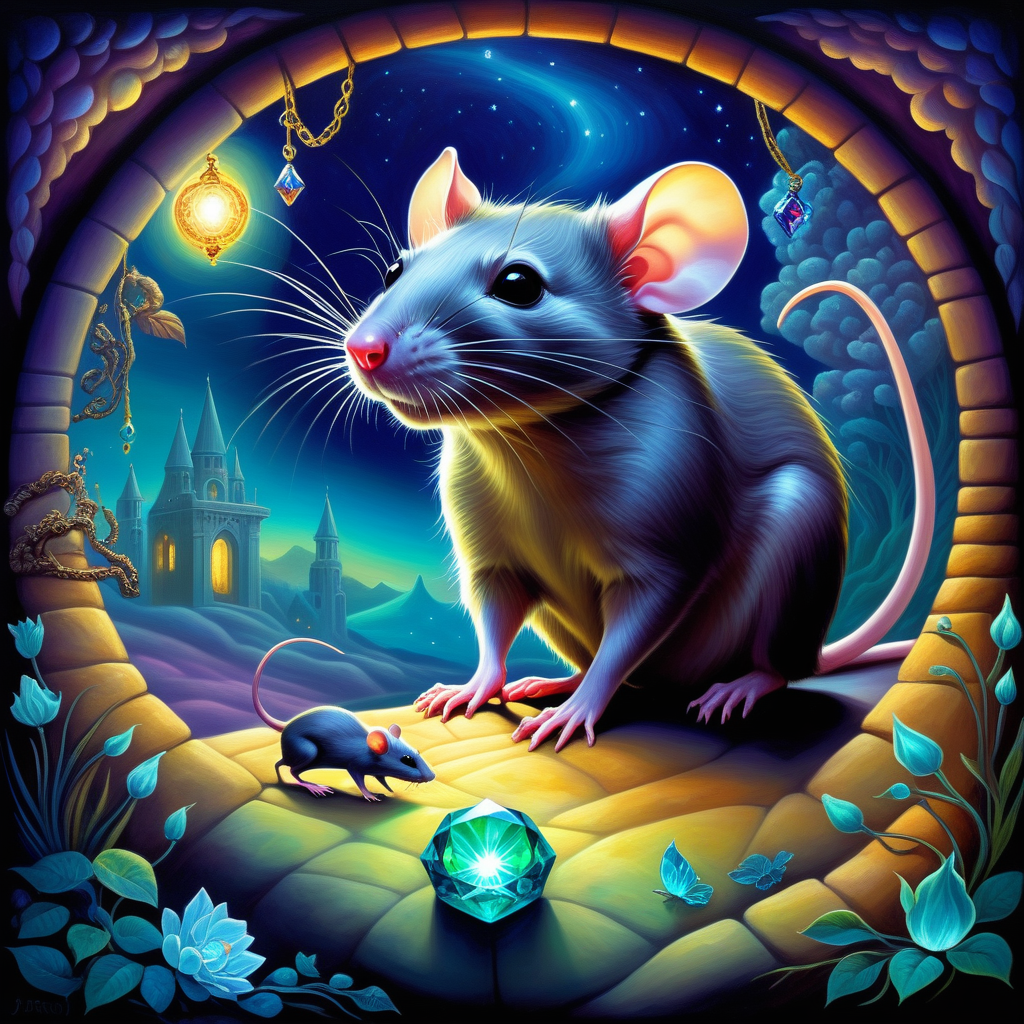
Rat
Jungian Archetypes
Meaning
The rat represents cunning, survival instinct, and the shadow aspects of intelligence. It symbolizes adaptability in harsh conditions and the ability to navigate hidden or forbidden territories.
Psychological Interpretation
In Jungian terms, the rat embodies the Shadow archetype—the disowned parts of ourselves including cunning, deception, and primal survival drives. The Trickster aspect reveals intelligence used for self-preservation and manipulation.
Jungian / Archetypal
The rat in dreams embodies the Shadow archetype—those aspects of the psyche that consciousness rejects or denies. In Jungian terms, the rat represents the instinctual, survival-driven self that operates beneath the veneer of civilized behavior. It is the part of us that gnaws, scavenges, and persists in the margins of society, carrying the collective fear of contamination, disease, and moral decay. The rat's nocturnal nature and hidden pathways through walls and sewers symbolize the unconscious itself: the realm of repressed desires, shameful impulses, and the primitive drives we dare not acknowledge in daylight consciousness. When the rat appears in dreams, it signals that the Shadow is demanding recognition—not as an enemy to be destroyed, but as a vital force requiring integration. The Trickster archetype also inhabits the rat's form. Rats are resourceful, cunning, and adaptable; they survive where others cannot, thriving in conditions of scarcity and chaos. This trickster energy represents the part of us that bends rules, finds unconventional solutions, and operates outside established hierarchies. In the individuation process, the Trickster serves as a necessary disruptor—it breaks down rigid ego structures and forces the conscious mind to question its assumptions. The rat's association with guilt and hidden activity reflects the Trickster's moral ambiguity: it is neither purely evil nor purely good, but rather amoral in its pursuit of survival. This archetype invites the dreamer to examine where they have internalized shame around their own resourcefulness, cunning, or survival instincts. From a collective perspective, the rat carries the weight of cultural projections. Across civilizations, rats have been symbols of plague, pestilence, and social contamination—repositories for the collective shadow of disease and decay. Yet in other traditions, the rat is honored as a symbol of intelligence and adaptability. This duality reflects the individuation journey itself: the integration of opposites. The dreamer who encounters the rat must confront their own relationship with survival, with the "dirty" or "base" aspects of human nature, and with the parts of themselves that operate outside social approval. The rat's presence in the dream is ultimately a call to wholeness—an invitation to acknowledge and integrate the Shadow, to recognize the Trickster's gifts, and to reclaim the instinctual wisdom that civilization has taught us to despise.
Psychodynamic / Freudian
The rat in dreams operates as a condensed symbol of repressed material pressing toward consciousness—simultaneously representing guilt, contamination anxiety, and forbidden desires that the ego cannot tolerate in their original form. At the manifest level, the rat appears as a small, invasive creature, often triggering disgust or fear; at the latent level, it embodies the dreamer's disowned impulses, shameful thoughts, or morally unacceptable wishes that have been split off and projected onto an external, despised object. The rat's nocturnal nature and tendency to gnaw or burrow mirrors the obsessional thinking patterns characteristic of guilt-ridden individuals—intrusive, repetitive, and impossible to fully suppress. Through displacement, the dreamer's anxiety about their own "dirty" or "contaminated" inner world becomes anxiety about the rat itself, allowing the ego to maintain the illusion of control while the repressed material continues to haunt the psyche. The defense mechanisms at work in rat symbolism reveal the architecture of neurotic conflict. Projection transforms internal guilt into external threat: the rat becomes the carrier of contamination, filth, and moral corruption that actually belongs to the dreamer's own repressed desires. Reaction formation often accompanies this—the dreamer's conscious disgust and revulsion toward the rat masks an unconscious fascination or identification with what the rat represents: freedom from social constraint, the ability to take what one wants, to exist in spaces society deems unclean. Condensation compresses multiple forbidden wishes into the single image of the rat: sexual desire, aggression, greed, the wish to transgress boundaries. The obsessional thinking triggered by the rat—the compulsive need to check, clean, or control—serves as a secondary defense, an attempt to manage the anxiety generated by the primary repression. Childhood origins of rat anxiety often trace to early experiences of shame, contamination fears, or parental messages about bodily functions, sexuality, or moral purity. The rat may symbolically represent the child's own body—particularly its appetitive, messy, uncontrollable aspects—as experienced through the lens of parental disgust or prohibition. Early toilet training trauma, shaming around natural bodily processes, or exposure to parental anxiety about cleanliness can crystallize into the rat as a symbol of the "bad," unacceptable self. Alternatively, the rat may embody an internalized parental figure—the harsh superego that constantly accuses the dreamer of being "dirty," "contaminated," or morally deficient. The obsessional quality of rat-related anxiety often reflects an attempt to manage the anxiety generated by this internalized critical parent through ritualistic control and vigilance. What presses toward consciousness through the rat is the dreamer's disowned aggression, sexuality, or appetite—the parts of the self that refuse to be fully civilized or controlled. The rat gnaws, invades, takes what it wants without permission; it thrives in darkness and filth. In this sense, the rat represents not merely guilt about forbidden desires, but the desires themselves, still alive and active despite the ego's attempts at repression. The contamination anxiety surrounding the rat often masks a deeper fear: that the dreamer's own repressed impulses are not actually controllable, that the boundary between the civilized self and the "rat-like" self is more permeable than the ego would like to admit. The obsessional defenses—the checking, cleaning, controlling—are ultimately futile attempts to manage what cannot be managed through suppression alone, and the rat's persistence in dreams signals that integration, not further repression, may be what the psyche actually requires.
Contemporary Psychological
Rats in dreams function as a neurobiological signal for contamination avoidance and disgust processing. From a contemporary psychology perspective, the rat activates the brain's threat detection and emotional regulation systems, particularly the insula and amygdala, which process visceral disgust responses. When the brain encounters a rat in a dream, it is often consolidating recent experiences involving contamination anxiety, boundary violations, or situations where the dreamer felt exposed to something unwanted or unclean. This is not symbolic contamination—it is the brain's literal processing of disgust as a survival mechanism, rehearsing avoidance responses and emotional regulation strategies for situations perceived as threatening to physical or psychological integrity. The threat simulation function of rat dreams involves practicing rapid detection and avoidance of contaminants or threats to bodily integrity. The brain uses the rat as a concrete vehicle for running "what if" scenarios: What if I encounter something dangerous? How do I respond? Can I escape? This rehearsal strengthens neural pathways for threat recognition and avoidance behavior, making the dreamer more cognitively prepared for real-world situations involving contamination risk, disease vectors, or boundary violations. The rat's small size, rapid movement, and association with disease and filth make it an efficient symbol for the brain's threat simulation machinery—it encodes multiple layers of survival-relevant information in a single image. Memory consolidation during rat dreams involves integrating recent learning about contamination, hygiene, or interpersonal boundaries. If the dreamer has recently encountered situations involving dirt, disease, violation of personal space, or exposure to something unwanted, the brain uses the rat dream to consolidate these experiences into long-term memory and update threat assessment protocols. The cognitive pattern visible in rat dreams is often an avoidance loop: the dreamer detects the rat, experiences disgust, and either flees or attempts to eliminate the threat. This loop reflects the brain's emotional regulation strategy—rapid detection and removal of the contaminant—and suggests the dreamer may be processing situations in waking life where boundaries need to be reasserted or contaminating influences need to be expelled. The emotional regulation function of rat dreams centers on processing and metabolizing disgust, a complex emotion tied to both physical contamination and moral/social violations. The brain uses the rat dream to safely experience and regulate disgust in the controlled environment of sleep, preventing the accumulation of unprocessed emotional material that could manifest as anxiety or avoidance behaviors in waking life. Contemporary sleep research suggests that dreams involving disgust and threat help the brain recalibrate its threat sensitivity—neither overreacting to minor contamination risks nor underreacting to genuine dangers. The rat, as a carrier of disease and filth, serves as an efficient vehicle for this emotional regulation work, allowing the brain to process contamination anxiety and restore a sense of safety and control.
Gestalt / Parts of Self
In Gestalt dream work, the rat represents the rejected, resourceful, and surviving part of the dreamer's own psyche. This is the part that has learned to navigate scarcity, to move through tight spaces, to find sustenance where others see only waste or danger. The rat is not external—it is you. It embodies the capacity to persist when circumstances are harsh, to adapt when direct paths are blocked, to survive by any means necessary. This part often carries shame or disgust in the dreamer's conscious mind, labeled as "dirty," "untrustworthy," or "base." Yet in the dream, the rat appears precisely because this survival instinct, this resourcefulness, is alive and demanding recognition. The projection happens when the dreamer attributes the rat's qualities to others—seeing others as sneaky, untrustworthy, or parasitic—while disowning these same capacities within themselves. The dreamer may judge themselves harshly for having survival instincts that feel undignified or for taking what they need in ways that don't fit their self-image. The rat in the dream is an invitation to reclaim this part: to acknowledge that you, too, are resourceful, adaptable, and capable of surviving difficult circumstances. The dialogue is between the part of you that wants to be "clean," respectable, and above such base concerns, and the part that knows how to get by, how to find what you need, how to persist when the going gets tough. Ownership of the rat means integrating this survival wisdom without shame. It means recognizing that resourcefulness is not a character flaw but a strength—the ability to make do, to find creative solutions, to move through obstacles with flexibility rather than rigidity. The rat asks: What part of your own survival instinct have you rejected? What resourcefulness are you refusing to claim as your own? Where are you trying to be "too good" or "too clean" at the cost of your own needs? The dream invites you to dialogue with this part, to ask it what it knows, what it needs, and how it might serve your wholeness rather than remaining a shadow you project onto others or onto yourself with contempt.
Cultural & Historical Origins
In Chinese astrology, the rat is the first zodiac sign, representing intelligence and adaptability. In European folklore, rats are associated with plague and death, symbolizing disease and decay. Hindu tradition links rats to Ganesha, representing wisdom and removal of obstacles.
Contextual Variations
A rat darts into your kitchen and you chase it, but every time you get close it hides in a crack in the wall.
Rats can symbolize survival intelligence that’s operating in fear. The crack hiding place suggests something you’ve been avoiding—an issue you keep “contained” rather than resolved.
You find a rat carrying shiny objects and you realize it’s hoarding things you’ve dismissed as useless.
This can point to overlooked resources—skills, memories, or feelings you minimized. Psychologically, it suggests your mind is revaluing what you once discarded and asking you to adapt creatively.
A rat sits calmly on your bed while you try to act normal, and you feel disgust but also uneasy recognition.
A calm rat can represent the persistence of a survival strategy you can’t ignore. The disgust may reflect shame or discomfort with certain thoughts, while recognition suggests you already know what needs attention.
Frequently Asked Questions
Why does a rat show up as a symbol of intelligence or survival?
What does it mean if the rat felt dirty or disgusting?
Does dreaming of a rat mean something bad is coming?
Journaling Prompts
- What “cracks in the wall” in my life am I avoiding, and what might be living there emotionally?
- Where have I adapted in ways that work but also make me feel ashamed or irritated?
- What resources have I dismissed as useless that might actually support my survival or growth?
Related Symbols
Dreamed about Rat?
Get a personalized AI interpretation that connects this symbol to your specific life circumstances.
Interpret My Dream