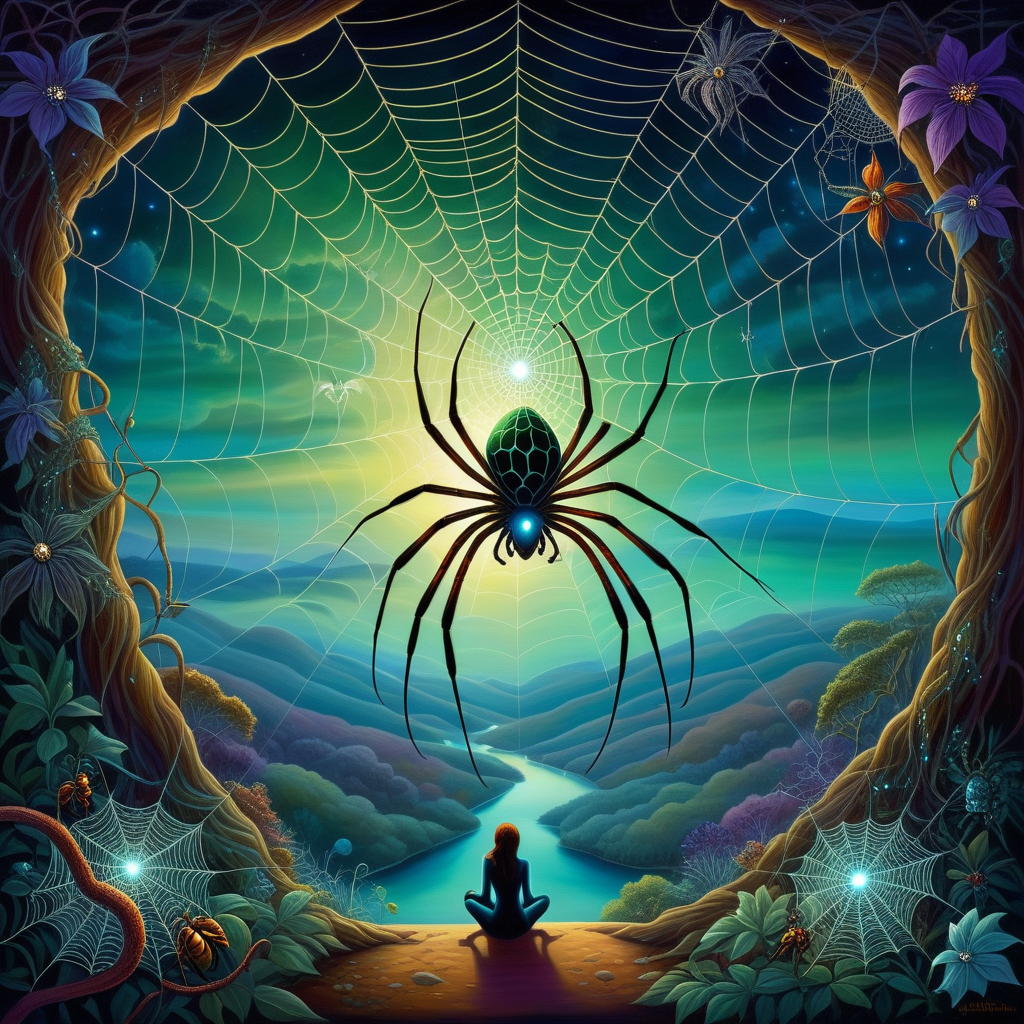
Spider
Jungian Archetypes
Meaning
Spiders in dreams often represent creativity, patience, and the intricate web of connections in your life. They can also symbolize feelings of being trapped or manipulated, especially when the spider appears threatening.
Psychological Interpretation
Jung associated the spider with the Great Mother archetype — both creative and devouring. A spider weaving its web may reflect your capacity to construct your fate, while a menacing spider could represent a controlling figure or the shadow side of feminine power.
Traditional Symbol Meaning
Across cultures, the spider has long symbolized creativity, fate, and the weaving of destiny. In many traditions, the spider is a creator figure—the one who spins the world into being. The spider's web represents the interconnectedness of all things, the threads of cause and effect, and the patterns that underlie reality. Spiders are also associated with patience, precision, and the feminine principle—the ability to create something beautiful and functional from within oneself. In some traditions, the spider is a trickster or shadow figure, representing danger, entrapment, or the hidden threats lurking in the spaces between things. The spider's eight legs connect it to infinity and the eight directions, making it a symbol of wholeness and cosmic order. Dreams of spiders often signal a time of creative potential, the need to attend to the details of one's life, or a warning about becoming too entangled in complex situations.
Contemporary Psychological
From a contemporary psychology perspective, the spider in dreams serves as a powerful symbol for the brain's emotional regulation of threat and anxiety. Spiders trigger an evolutionary arachnophobia response that is deeply wired into human neurobiology—a legacy of ancestral environments where certain arachnids posed genuine danger. When the brain encounters a spider in a dream, it is often processing accumulated anxiety or threat-related emotional material from waking life. The spider becomes a container for diffuse fears, social anxieties, or feelings of being trapped or overwhelmed. Rather than representing a specific external threat, the spider typically embodies the dreamer's internal experience of vulnerability, hypervigilance, or the sensation of being caught in an inescapable situation. This emotional processing function allows the brain to rehearse and regulate threat responses in a safe, contained environment during sleep. The threat simulation function of spider dreams is particularly significant. Evolutionary psychology suggests that dreams serve as biological flight simulators, allowing the brain to practice responses to dangerous scenarios without real-world consequences. Arachnophobia—whether innate or learned—activates this simulation machinery powerfully. A spider in a dream may represent the brain running a "what if" scenario: What if I encounter something I cannot control? How do I respond to a threat that is small but potent, visible but unpredictable? The dream may rehearse avoidance strategies, confrontation responses, or the emotional regulation required to manage fear in the presence of something perceived as dangerous. This is not irrational processing; it is the brain's adaptive mechanism for building psychological resilience and preparing the nervous system for threat encounters. Memory consolidation involving spiders often reflects recent experiences of feeling trapped, entangled in social or professional webs, or caught in complex relational patterns. The spider's web is a potent metaphor the brain uses to integrate experiences of interconnection, dependency, or being caught in systems beyond one's control. If the dreamer has recently navigated complex social dynamics, workplace conflicts, or situations where they felt their autonomy was compromised, the spider may appear as the brain consolidates these experiences into long-term memory. The web itself—intricate, sticky, and difficult to escape—becomes a cognitive representation of entanglement. This consolidation process helps the brain categorize and integrate the emotional and relational lessons of recent experiences, transforming raw experience into structured understanding. The cognitive patterns revealed by spider symbolism point to the dreamer's current state of pattern recognition and threat vigilance. Spiders are master pattern-recognizers—they detect vibrations in their webs with extraordinary sensitivity, responding to minute environmental cues. When spiders appear in dreams, they often reflect the dreamer's own heightened pattern-recognition mode: scanning for threats, detecting subtle social cues, or processing information with intense focus. This can indicate either adaptive vigilance (appropriate caution in a genuinely complex situation) or maladaptive hypervigilance (threat-detection systems running at excessive sensitivity). The dream's structure—whether the spider is distant or approaching, whether the web is visible or hidden, whether the dreamer is trapped or observing—reveals the specific cognitive loop the brain is running. Is the dreamer practicing escape? Observing from safety? Frozen in place? These narrative details illuminate the particular emotional regulation and threat-response strategy the brain is rehearsing during sleep.
Gestalt / Parts of Self
In Gestalt dream work, the spider is never an external threat—it is a part of the dreamer's own psyche seeking recognition. The spider represents the weaver within: the patient creator, the meticulous planner, the part that spins meaning from raw material and holds space for what matters. It embodies focus, intentionality, and the capacity to build something intricate and purposeful. The spider is also the part that waits, that knows timing, that understands that creation requires stillness and presence. When a spider appears in a dream, the dreamer is being invited to own this creative, patient, deliberate aspect of themselves—the part that knows how to hold multiple threads at once and weave them into something whole. The fear or revulsion often directed at spiders in dreams reveals a crucial projection: the dreamer is attributing to the spider what they have disowned in themselves. The "creepy" quality, the sense of danger, the feeling of being trapped—these are not the spider's nature but the dreamer's own discomfort with their own power to create, to hold space, to be still and observant. The spider's legs, its many-directional awareness, its ability to sense vibrations across the web—these are being experienced as invasive or threatening when they actually belong to the dreamer's own capacity for sensitivity and attunement. The web itself, often experienced as a trap, is the dreamer's own creation: the structures they build, the connections they maintain, the patterns they weave through their relationships and work. The trap is not the spider's doing—it is the dreamer's own web, and the fear of being caught is the fear of being held accountable to what they have created. The dialogue between the spider-self and the afraid-self reveals a fundamental split. The afraid part says: "You are dangerous, you trap others, you are small but sinister, you should be crushed." The spider-self responds: "I am patient, I am creative, I am sensitive to every vibration in my world, I know how to wait for what I need, I build with precision." This is not a conflict to be resolved by destroying the spider but by the dreamer recognizing both voices as their own. The fear is real—it belongs to the dreamer. The creative power is real—it also belongs to the dreamer. The invitation is to stop projecting the spider outward as something to be feared or destroyed, and instead to claim the weaver within: the part that creates, that holds space, that knows how to be still and attentive, that builds meaning through patient, deliberate action. Integration calls the dreamer to own the spider fully—not as a threat to be managed but as a necessary part of their wholeness. This means acknowledging the power to create structures, to hold others in awareness, to sense what is happening in the relational field. It means recognizing that the web is not a trap but a creation, and that being responsible for what one creates is not a burden but a sign of maturity and presence. The dreamer is invited to ask: What am I weaving? What patterns am I creating through my attention and intention? What part of my creative, patient, sensitive self have I been rejecting or fearing? The spider in the dream is not asking to be liked or made comfortable—it is asking to be claimed, integrated, and allowed to do its work of weaving meaning and connection in the dreamer's life.
Jungian / Archetypal
The spider in Jungian dream symbolism embodies the Great Mother archetype in her dual creative and destructive aspects. The spider's web represents the mandala—the sacred geometric pattern of wholeness and cosmic order—yet simultaneously expresses the feminine principle of fate-weaving, the inexorable spinning of destiny that binds all things. In analytical psychology, the spider connects to the Anima in her role as the weaver of meaning, the force that creates structure and pattern from the raw material of existence. The spider's patient, methodical construction of her web mirrors the unconscious work of individuation itself: the slow, deliberate weaving together of disparate psychic elements into a coherent whole. The Shadow often manifests through the spider as primal fear and phobia—the instinctive recoil from the feminine's power to entrap, consume, and transform. This fear frequently masks a deeper anxiety about being caught in the web of fate, of losing autonomy to forces beyond conscious control. The spider's predatory nature, her patient waiting at the center of her web, can symbolize the devouring mother who consumes her children, or the unconscious impulses that lie in wait to ensnare the ego's carefully constructed defenses. Yet this Shadow expression is not merely negative; it represents the dreamer's resistance to surrender, to the dissolution of the ego-self that true individuation demands. The fear of the spider often signals where the psyche is being called to release control and trust in a larger, transpersonal process. From the perspective of individuation, the spider symbol carries profound compensatory significance. The unconscious presents the spider to those who have become too identified with rational, linear consciousness—those who have lost touch with the cyclical, intuitive, web-like nature of psychic reality. The spider invites the dreamer to recognize that life is not a straight path but an intricate web of interconnections, where every thread touches every other. The spider's eight legs connect to the eight-fold path of wholeness in many mystical traditions, suggesting that true development requires moving in multiple directions simultaneously, holding paradox and complexity. The spider at the center of her web represents the Self—the organizing principle of the psyche—and the dreamer's potential to become the conscious weaver of their own fate rather than merely a fly caught in another's design. The collective meaning of the spider across cultures amplifies its archetypal power: the spider appears as creator-goddess in many indigenous traditions, as the weaver of reality itself. In alchemy, the spider represents the nigredo, the dark dissolution necessary before transformation. The spider's ability to create something of value from within her own body—spinning silk from her own substance—speaks to the creative potential that emerges from confronting and integrating the Shadow. When the spider appears in dreams, the unconscious is inviting the dreamer into a deeper relationship with the feminine principle of creation, patience, and interconnection, and simultaneously challenging them to face their fear of entrapment, powerlessness, and the unknown forces that shape existence. This is the spider's gift: to teach that true power lies not in resistance to the web, but in learning to move consciously within it.
Psychodynamic / Freudian
The spider in dreams functions as a condensed representation of the maternal imago—the internalized image of the mother that shapes the dreamer's earliest relational patterns. On the manifest level, the spider appears as a creature that spins, waits, and captures; these literal actions mask the latent content: the dreamer's ambivalent relationship to maternal control, nurturance, and the boundary between care and entrapment. The web itself is a masterwork of condensation, simultaneously representing the safety of maternal provision and the suffocating grip of dependency. What appears as a simple arachnid is actually a displacement of the mother's power—her ability to hold, bind, and consume the child's autonomy. The spider's patient, predatory waiting mirrors the mother's watchfulness, which in the unconscious fantasy becomes surveillance and control. The wish-defense dynamic at work reveals a fundamental conflict: the dreamer simultaneously desires maternal closeness and fears maternal engulfment. The spider symbol allows the expression of this forbidden ambivalence—the rage at maternal control and the guilt about that rage—without conscious acknowledgment. By projecting the mother onto an animal, the dreamer can express fear and revulsion without the guilt that would accompany direct anger at the maternal figure. The web represents the sticky, inescapable nature of early maternal bonds; to be caught in it is to lose oneself, yet to escape it is to face abandonment. This defense mechanism of displacement permits the dreamer to experience the terror of maternal power while maintaining the conscious fiction of maternal love and protection. The childhood origins of this symbol trace to the earliest experiences of maternal presence and absence, control and neglect. A mother who was overprotective, intrusive, or who used guilt and obligation as tools of control becomes internalized as the spider—beautiful, purposeful, but ultimately dangerous. The web becomes the network of family obligation, the invisible threads of expectation and enmeshment that bind the child to the mother's needs and desires. Early experiences of being "caught" by maternal demands, of having one's own needs subordinated to the mother's emotional requirements, crystallize into the spider image. The dreamer's own aggression toward the mother—the natural childhood rage at limitation and control—is repressed and returns as fear of the spider, a reversal in which the child becomes the prey rather than the one who resists. What repressed material does the spider surface? The forbidden wish to escape the mother, to cut the web and be free, alongside the equally forbidden rage at maternal control and the guilt about that rage. The spider dream permits the expression of these repressed contents in disguised form—the dreamer can feel fear and revulsion without consciously acknowledging the anger and the desire for separation that lie beneath. The spider's presence in dreams signals that the work of individuation remains incomplete, that the maternal imago still exerts unconscious power over the dreamer's sense of autonomy and self. The dream invites the dreamer to recognize that the mother, once necessary for survival, may now be a phantom that constrains rather than sustains—and that the web, while once protective, has become a prison from which escape is both necessary and terrifying.
Cultural & Historical Origins
In West African folklore, Anansi the spider is a trickster god of wisdom and storytelling. In Greek myth, Arachne was transformed into a spider by Athena. Native American traditions honor Spider Woman as a creator deity.
Contextual Variations
A spider weaving a web
This variation emphasizes the creative and constructive aspect of the spider. The dreamer may be in a period of active creation—building relationships, projects, or meaning. The dream suggests patience, skill, and the gradual accumulation of effort into something whole. It can also indicate the dreamer is becoming aware of the patterns they are weaving in their own life.
Being bitten by a spider
A spider bite often represents a sudden injection of poison, venom, or toxic influence. This may reflect the dreamer's fear of being harmed by someone's creative or manipulative power, or it may signal that something the dreamer has created or allowed into their life is now causing harm. The bite can also represent a wake-up call or a moment of painful awareness.
A giant spider
An oversized spider amplifies the archetypal power of the symbol. This may represent an overwhelming creative force, an exaggerated fear of feminine or maternal power, or a situation that has grown beyond the dreamer's ability to manage. The giant spider can also symbolize the dreamer's own power magnified—a call to recognize their own creative potential or their capacity to influence others.
Killing a spider
Killing a spider may represent the dreamer's attempt to destroy or suppress their own creative power, to reject the feminine principle, or to escape from a situation of entanglement. It can also reflect guilt about harming something delicate or beautiful, or a fear that destroying one threat will create others. The act may signal a moment of resistance or rebellion against something the dreamer perceives as controlling.
A spider crawling on you
This variation suggests an intimate encounter with the spider's power. The dreamer may feel invaded, touched by something they find repulsive, or they may be experiencing a moment of close contact with their own creative or predatory nature. The crawling sensation can evoke both fascination and revulsion, suggesting ambivalence about the power being represented.
Frequently Asked Questions
What does a spider mean in dreams?
Are spider dreams always about fear?
Why do I keep dreaming about spiders?
Journaling Prompts
- What was the spider doing in your dream? What did you feel watching it? What does that action or feeling remind you of in your waking life?
- If the spider represents a part of yourself, what part would it be? What does that part create, weave, or connect? How do you feel about that part of yourself?
- What web are you weaving in your life right now? What threads are you pulling together? Are you satisfied with the pattern that is emerging?
- What does the spider's patience and precision suggest to you? Where in your life do you need to slow down and attend to the details?
- If the spider represents feminine or creative power, what is your relationship to that power? Do you embrace it, fear it, or feel ambivalent about it?
Related Symbols
Dreamed about Spider?
Get a personalized AI interpretation that connects this symbol to your specific life circumstances.
Interpret My Dream