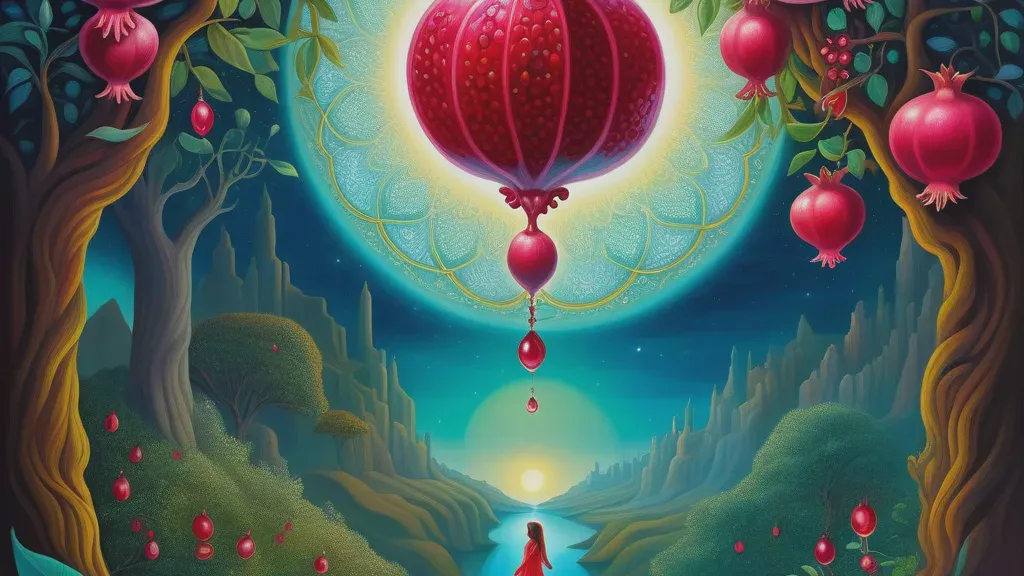
Pomegranate
Jungian Archetypes
Meaning
A pomegranate has to be broken before it gives anything. The rind is leathery and bitter, the inside is partitioned by pale membrane, and the reward is several hundred separate seeds, each sealed in its own sac of red juice, none of them large enough to matter alone. Dreams take that structure literally. The fruit stands for whatever in the dreamer's life is abundant and inaccessible at the same time, whether that is love, memory, inheritance, fertility or grief, and for the labour of opening it, which stains the hands and cannot be done neatly. Its long attachment to the underworld supplies the other half of the image: what the pomegranate offers is genuinely sweet, and eating it commits the dreamer to something.
Psychological Interpretation
The action in a pomegranate dream matters more than the fruit. Cutting one open is a different psychological event from being handed one, and both differ from finding a tree already in fruit. To open it is to take on the examination of something that will not yield to a single decision, the hundred small facts of a marriage, the countless separate memories of a person who has died, and the mess this makes belongs to the image, since the juice marks whatever it touches and does not come out of everything. To be given one, especially by a figure who offers no explanation, brings the Persephone situation into the dream: an offer that is sweet on its own terms and that quietly alters the dreamer's obligations once accepted. The second axis is fullness against emptiness, and the dream usually specifies which. A heavy fruit crowded with bright arils and a light one that opens onto dry chambers say opposite things about the dreamer's reserves. Fullness that overwhelms, with seeds spilling and refusing to be counted, tends to accompany waking conditions of too much life at once, where fertility of any kind has outrun the capacity to hold it. Dryness follows a long stretch of giving. Between those extremes sits the commonest version, a fruit that is simply good, eaten slowly, sweet with tannin behind it, which is the dream's way of saying that what is being taken in is worth having and carries a cost the dreamer has already sensed.
Traditional Symbol Meaning
The oldest layer of pomegranate lore is contractual. Persephone is taken, held, and then released on a technicality: she has eaten in the house of the dead, and the food of the other world attaches whoever accepts it. What makes the story durable is that the seed was small, and sweet, and taken willingly at the end of a captivity she did not choose. Folklore across a wide range of traditions keeps some version of the same rule, that the traveller in the other world must not eat there, and the pomegranate became its Greek instance. The traditional reading of eating pomegranate in a dream follows from this: not doom, but obligation, a tie formed by consent given inside a situation the dreamer did not fully control. Against that runs the fruit's use at weddings, which is nearly as old. The many seeds made it an obvious emblem of offspring and plenty, and the customs are practical rather than poetic: in parts of Greece a pomegranate is still smashed on the threshold at New Year and at a bride's arrival, the scattering of the seeds being the point. Turkish and Armenian marriage customs use it similarly, and Chinese decorative art gave the same idea its own formula, the burst pomegranate as a wish for a hundred sons, painted on porcelain and given at weddings. In this register the fruit is uncomplicated good fortune, and the noise of it breaking is half the charm. The funerary use is equally well attested and sits oddly beside the wedding one. Pomegranates were placed in Greek graves and in Egyptian tombs, where a silver pomegranate vessel was among the objects buried with Tutankhamun, and the fruit was carried in processions for the dead as readily as for brides. The colour did most of this work. A cut pomegranate looks like a wound and bleeds like one, and the juice was used as dye and as ink; the tannic rind was used to tan leather and to treat parasites, so the fruit sat in the household as both delicacy and medicine. Artemidorus, compiling dream interpretations in the second century, reports pomegranates signifying wounds on account of their colour and servitude on account of the mysteries, an interpretation that keeps both faces of the fruit in a single line. What holds these strands together is that the pomegranate is the one common fruit that has to be taken apart. It cannot be bitten like an apple or peeled like an orange; it is opened, scored, broken over a bowl, and the eater is repaid in hundreds of small instalments for a job that takes time and cannot be done without mess. Traditions that use the fruit for fertility, for merit, for the dead and for binding are all reading the same physical fact in different lights: abundance exists inside it, and access to that abundance requires breaking the container, staining the hands, and accepting that some of it will be lost on the way to the mouth.
Psychodynamic / Freudian
Eating is the oldest way the mind has of keeping something, and dreams about consuming a fruit reliably concern taking a person or an experience inside. Freud, in Mourning and Melancholia, described how a lost object can be taken into the ego and preserved there, so that the shadow of the object falls upon the self, and the mechanism he was describing is an oral one. A pomegranate dream in the months after a death or a separation is often doing precisely this work, and the odd detail that the fruit is full of seeds rather than being one solid thing matters: what is being taken in is not the person but hundreds of separate fragments of them, absorbed one at a time and at different speeds, which is a more accurate account of how mourning actually proceeds. Klein's model supplies the ambivalence. In her account the infant's first object is experienced in split form, nourishing and persecuting by turns, and maturation involves recognising that the good and bad versions are one thing, then grieving the damage done to it in fantasy. The pomegranate stages that recognition with unusual economy, since it nourishes and stains in the same gesture and its juice looks like blood. Dreams of gathering scattered seeds back into a broken fruit, or of trying to reassemble one, are close to what Klein called reparation, the attempt to restore an internal object the dreamer feels they have injured, and they tend to arrive alongside guilt that has no obvious external cause. Condensation is doing heavy work in the manifest image. A red fruit that must be cut open, that bleeds, that carries seeds and is associated with brides, is simultaneously a body, a wound, a birth and a meal, and the dream-work has compressed all of them into one object precisely because no single one of them could be presented directly. Reversal of agency is common alongside it: dreamers rarely dream of demanding the fruit, they dream of being offered it, which converts a wish into an event that happened to them. Where the giver in the dream resembles a parent, an analyst or a lover, that reversal is usually the most informative part of the material, and the question worth putting is not what the fruit means but who was permitted to hand it over.
Contemporary Psychological
Dreams follow waking preoccupation more closely than they follow symbolism, and food dreams demonstrate this crudely. During the Minnesota Starvation Experiment in the mid-1940s, Ancel Keys and his colleagues observed that men held on a semi-starvation diet became preoccupied with food while awake and reported it constantly in their dreams, an effect that turns up in weaker form in anyone restricting intake. Before reading a pomegranate dream as a message about mortality, it is worth checking whether the dreamer has been dieting, fasting, pregnant, or newly deprived of some ordinary pleasure. The continuity hypothesis developed from Calvin Hall's and William Domhoff's content analyses makes the same point in general terms: dream content tracks what occupies a person's daytime attention, including the trivial parts of it. What makes this particular fruit dream-friendly is sensory. Colour salience, the contrast of dark rind against wet red, and the tactile detail of separating seeds all recruit the vivid perceptual systems that stay active in REM sleep while frontal regions responsible for logical checking are relatively quiet. Imaging studies in the 1990s found reduced activity in dorsolateral prefrontal cortex during REM alongside strong activation in visual association and limbic areas, which fits the reported experience of these dreams: the fruit is hyper-real, the emotion is strong, and the seeds multiply when counted without the dreamer finding that strange at the time. The emotional pairing that gives pomegranate dreams their characteristic ache also has a research literature. Work by Matthew Walker and others has argued that REM sleep processes emotional memories, reducing their physiological charge while retaining their content, so that a difficult experience becomes rememberable without being re-lived at full intensity. Dreams that hold sweetness and loss together in one image are consistent with that kind of processing, particularly during bereavement, when studies of dreams of the dead find that many mourners report vivid, sensorily rich encounters that leave them comforted and sad in roughly equal measure. A pomegranate dream that wakes the dreamer with both feelings at once is not a contradiction to be resolved; it is a fair description of what the sleeping brain has been doing with the material.
Jungian / Archetypal
The pomegranate arrives in dreams attached to the Kore, the maiden figure Jung examined in the essays he published with Karl Kerenyi on the mythology of Demeter and Persephone. What interested him there was not the abduction as event but the pattern it describes in a psyche: an unformed, unlived part of the personality is taken down out of the daylight world and comes back changed, seasonal, no longer wholly the property of the mother or of the conscious self. A dreamer given a pomegranate in a dark place is inside that pattern. The fruit is the moment the underworld becomes theirs rather than something happening to them, and the taste of it is the first evidence that the descent has produced knowledge, not only loss. The fruit's construction gives it a second archetypal role. A pomegranate is round, crowned by its dried calyx, symmetrical from the outside, and internally divided into chambers holding hundreds of separate lives. That is the structure of a mandala with contents, and it makes the fruit an unusually apt Self image for people whose difficulty is multiplicity rather than emptiness: everything is in there, ordered, and none of it is visible from outside. Dreams that dwell on the seeds spilling or refusing to be counted usually belong to dreamers whose conscious position is that they must hold all of it together, and the dream is compensating by demonstrating that the container was designed to break. Shadow enters through the sweetness. What the pomegranate offers is not a temptation the dreamer has to resist but one they want, which is a harder problem, since the psyche has less use for prohibitions than for honest appetites. Amplification helps here: the Greek fruit is at once bridal and funerary, given to the newly married and buried with the dead, and the anima figure who holds one out in a dream is usually offering both at the same time. The dream is not warning against the offer. It is insisting that the dreamer see the whole of it before swallowing, because the thing about a pomegranate seed is that it is far too small to feel like a decision.
Gestalt / Parts of Self
Begin by refusing to treat the fruit as a symbol standing for something else. In Gestalt terms every part of the dream is a part of you speaking in a borrowed form, so take the pomegranate's place and say what it says. I am hard on the outside and crowded on the inside. I hold hundreds of things and I will not give you any of them until you break me. Notice what happens in your chest when you say the last sentence. If it comes out as a complaint, you are probably somewhere in your waking life where this is exactly what you do; if it comes out as a boast, that is worth just as much attention. Then change places. Be the rind, whose whole job is to keep things in and which nobody thanks. Be a single aril, one of hundreds, replaceable and easy to lose on the floor. Be the hand holding the knife, which has to be willing to make a mess. Each of these is a role you occupy with other people, and the dream has cast all of them at once. The polarity to work with is containment against spilling: the part of you that seals everything into its own compartment and the part that wants to be opened and emptied out onto the table, neither of which will be persuaded by argument, both of which will say more if you let them speak in turn. Retroflection is the specific mechanism worth watching. Whatever is held inside the fruit is precisely the material that never reaches another person, and if the dream had you cutting the pomegranate alone, in a kitchen, at night, the isolation is not scenery. Try the experiment of imagining someone in the room with you while you open it, and see who arrives uninvited. If it was you who was handed the fruit rather than you who cut it, put the giver in the empty chair, ask what they wanted in exchange, and answer for them out loud. The answer you invent for them is your own material and is usually more accurate than anything you would say in your own voice.
Cultural & Historical Origins
Few fruits carry as much documented symbolic freight. The Homeric Hymn to Demeter has Hades slip Persephone a honey-sweet pomegranate seed just as she is about to be released, and the eating binds her to the underworld for part of every year; Ovid's retelling in the Metamorphoses counts seven seeds and adds a witness who saw her swallow them. Hera's cult at Argos kept the fruit too, and Pausanias, describing the goddess holding a sceptre in one hand and a pomegranate in the other, says flatly that the story behind the fruit is one he may not tell. In Hebrew scripture the pomegranate is woven and cast rather than eaten: Exodus describes pomegranates of blue, purple and scarlet alternating with golden bells around the hem of the high priest's robe, and the pillars of Solomon's temple were finished with rows of them in bronze. Jewish practice keeps the fruit at the New Year, eaten with a wish that one's merits be as many as its seeds; the popular count of six hundred and thirteen, matching the commandments, is a later and botanically generous tradition. The sixteenth-century kabbalist Moses Cordovero titled his major work Pardes Rimonim, the orchard of pomegranates, taking the fruit as a figure for hidden structure. The Qur'an names rumman among the fruits of paradise. Christian painters used it for resurrection and for the many members of one body, and Botticelli's Madonna of the Pomegranate places the opened fruit in the hands of mother and child together. In Iran the fruit belongs to Shab-e Yalda, the longest night, when families eat pomegranate and read poetry until morning, the red seeds standing in for a dawn that has not arrived yet.
Contextual Variations
Cutting a pomegranate open and staining your hands red
The stain is the part of the dream doing the talking. You have opened something deliberately, and the evidence of having opened it is now on you and will not wash off quickly. This tends to accompany waking situations in which you have decided to look into something, a family history, a diagnosis, a set of accounts, a conversation you had been postponing, and have discovered that knowing changes how you are seen as much as what you know. Notice whether you hid your hands in the dream or held them up. That detail usually indicates whether the cost you are anticipating is private shame or public exposure.
A seed offered to you by someone in a dark room
Small offerings are how dreams stage large consents. A single seed is easy to accept, requires no deliberation, and commits you anyway, which is why this image tends to arrive when you are in the middle of an arrangement whose terms were never stated out loud, a new relationship, a job that keeps growing, a caregiving role you slid into. Look at what the giver wanted, and whether you could see their face. Being unable to see it usually means the obligation is one you have not let yourself name, rather than one someone has hidden from you.
Counting the seeds and losing count each time you begin
Numbers rarely behave in dreams, and this image uses that instability well. You are trying to establish how much of something there is, how much time, money, love, patience, capacity, and the answer keeps dissolving as you approach it. The frustration is real but the task was impossible from the start, which is worth taking as information about your waking method rather than about your arithmetic. Dreams like this often accompany periods of anxious inventory-taking. What they suggest is that the quantity you are trying to fix is one that cannot be settled by counting, only by deciding what is enough.
A pomegranate that opens onto dry, empty chambers
The container is intact and there is nothing in it. This is the depletion version of the image, and it usually follows a long stretch of giving in which the outward form of a life held while the inside quietly emptied: a marriage that still looks right, a job you can perform in your sleep, a friendship kept up by habit. The dream is unsentimental about it. Rather than showing you a fruit that has rotted, which would imply damage, it shows one that never filled, which points at supply. The question worth sitting with is what has been feeding you lately, and how long the answer has been nothing much.
Frequently Asked Questions
Why did a pomegranate dream feel beautiful and unsettling at the same time?
Is a pomegranate dream about fertility or about death?
Does eating the seeds in a dream mean I agreed to something?
Why do pomegranates show up in dreams after a loss?
Journaling Prompts
- Write about something in your life right now that is genuinely good and has a condition attached to it. Name the condition plainly, in one sentence, without softening it. Then ask when you accepted it and whether anyone stated the terms out loud at the time, or whether you worked them out afterwards from how things went.
- Think of a person or period you are still absorbing rather than finished with. List five separate small pieces of them that have come back to you in the last month, in the order they arrived. Which of the five would you rather not have had returned, and name the cost of keeping it where you can reach it.
- Describe the last time you opened something knowing it would be messy, a set of records, an old conversation, a box you had not looked in. What did you find, what got on your hands, and who could tell afterwards? If you have been avoiding a similar opening, name it and name what you expect to be stained by.
- Consider what has actually been feeding you this season, in the plain sense of what leaves you with more than you had. Write down three things, and be honest if one of the slots comes up empty. Then decide which single change to your week would put something real in the empty chamber before the month is out.
Related Symbols
Dreamed about Pomegranate?
Get a personalized AI interpretation that connects this symbol to your specific life circumstances.
Interpret My Dream