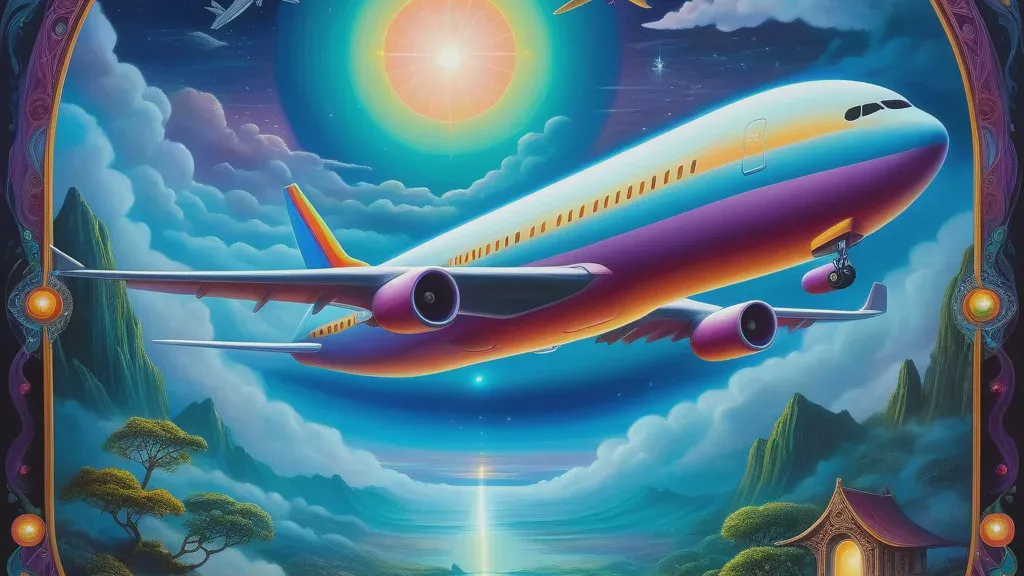
Plane
Jungian Archetypes
Meaning
There is no shoulder to pull onto in the sky, no verge to stop at, only forward motion until the flight is finished. A plane in a dream lifts the dreamer's ordinary concerns to an altitude where the ground, and the details that usually dominate daily attention, shrink small enough to lose their grip. That total commitment, once airborne, is usually the dream's real subject, arriving when the dreamer has taken on something ambitious enough that turning back midway is no longer really an option.
Psychological Interpretation
Where the dreamer sits relative to the controls sets the emotional register for everything else in the dream. Piloting the plane suggests a felt readiness to take direct responsibility for an ambitious undertaking, even while frightened of it, while riding as a passenger suggests a large life change currently being steered by someone else's decisions, timeline, or authority. Turbulence tends to name a specific worry about the manageability of a plan already in motion rather than the plan itself; the dreamer is usually not questioning whether to fly but whether the version of flying they chose can actually hold together. Takeoff and landing carry distinct emotional signatures worth separating: dread during takeoff often names anticipatory anxiety about leaving something familiar behind, while a rough or crash landing more often reflects the difficulty of coming back down from an ambitious or elevated state to ordinary life, rather than any literal fear of injury.
Traditional Symbol Meaning
Ovid's account of Daedalus and Icarus remains the governing myth behind almost every later story about the dangers of flight, and its warning is more specific than simple overreach. Daedalus, the careful craftsman, survives the same flight that kills his son, because he keeps to the safe middle altitude he was warned to hold. Icarus dies not from flying but from the intoxication of doing it well, climbing higher than caution allowed the moment the fear that should have restrained him gave way to exhilaration. For most of human history, flight belonged entirely to myth and religious vision rather than to any lived experience, which is part of why it carried such concentrated symbolic weight once it stopped being fantasy. Icarus's wax wings, angelic flight across nearly every religious tradition, and shamanic accounts of the soul leaving the body to travel great distances all share a basic structure: elevation above the ordinary world as access to a perspective, or a danger, unavailable to anyone standing on the ground. The astonishingly rapid arrival of real, engineered flight in the early twentieth century did not erase that older symbolic weight so much as attach it to a new, functional object. Antoine de Saint-Exupery's own writing, drawn from years flying remote and often perilous mail routes across the Sahara and the Andes, treats the cockpit as a place of unusual clarity and solitude precisely because it lifts the pilot briefly out of ordinary human entanglement. The twentieth century's own folklore, meanwhile, populated the machine with gremlins, small saboteurs blamed by pilots for unexplained failures, proof that even engineered flight never quite shed the older sense that the sky is not fully within human control.
Jungian / Archetypal
Jung used the term inflation for the specific danger of the ego identifying too completely with an archetypal energy that is meant to be encountered, not absorbed, and the Icarus myth remains the clearest possible illustration of that danger applied to flight. Icarus does not die because he flew; he dies because the exhilaration of flying convinced him, briefly and fatally, that ordinary limits no longer applied to him. A plane dream involving the Anima archetype, as this symbol's own tradition suggests, often stages flight as the pursuit of an ideal, a beauty, or a version of life the dreamer associates with transcending present limitation. The dream's real question is usually not whether that pursuit is worthwhile but whether the dreamer can hold it without the inflation that undoes Icarus, staying, in Daedalus's own terms, at the middle altitude rather than climbing toward a height the ego cannot actually sustain. Turbulence and rough landings, read through this lens, are less punishment than correction, the unconscious's way of returning an overextended ego to a more sustainable relationship with its own ambitions. A dream in which the dreamer lands hard but intact, rather than crashing outright, usually marks a needed course correction rather than a failure, and is worth reading as the psyche managing the descent rather than punishing the ascent.
Gestalt / Parts of Self
Gestalt dreamwork asks the dreamer to speak briefly as the plane itself: something built to leave the ground entirely, carrying others, following instruments rather than instinct alone. Notice whether the plane, given a voice, sounds confident in its own engineering or uncertain whether it can actually hold the weight and altitude being asked of it. Pilot and passenger form this dream's central polarity, and each deserves to speak in turn rather than being collapsed into a single identity. The pilot can name the private terror of holding responsibility for everyone aboard; the passenger can name the specific discomfort of being carried somewhere without any say in the route or the speed. Most dreamers will recognize themselves more strongly in one seat than the other, and that recognition is the useful part. Turbulence deserves direct address rather than dismissal as noise: ask it plainly what it is trying to disrupt, and let it answer as if it had its own agenda separate from the dreamer's plans. Often the shaking in the dream is less an obstacle than an accurate, if uncomfortable, report on how unstable the underlying plan actually feels once the dreamer stops insisting to themselves that it is fine.
Psychodynamic / Freudian
Melanie Klein's concept of the manic defense, a flight into elevated activity and a feeling of triumphant control used specifically to avoid a harder, more depressive feeling underneath, offers a precise reading of dreams in which flying produces exhilaration rather than fear. The high of piloting a plane, in this frame, may be less about the ambition itself and more about how effectively altitude lets the dreamer avoid a heavier feeling waiting on the ground. Passengers who distrust the pilot, a detail that appears often in this particular dream, tend to encode the dreamer's own doubt about their legitimacy or competence rather than any real external judgment, since the dreamer wrote both the pilot and the skeptical passengers. Scrutiny in the dream is frequently self-scrutiny wearing other people's faces because it is more bearable to imagine doubt coming from outside than to name it as one's own. A hard landing that nonetheless ends safely often marks the return of reality-testing after a period spent somewhat defended against a difficult truth, the abrupt jolt standing in for whatever adjustment waking life is currently demanding. The relief the dreamer feels at having survived the impact, rather than pure distress, is usually the more diagnostic detail, since it suggests some part of the dreamer already expected the comedown and is glad to have it finished.
Contemporary Psychological
Tore Nielsen's cross-cultural research on typical dream themes consistently finds flying, alongside falling and being chased, among the most commonly reported dream contents across widely different populations, which suggests the image draws on something closer to a shared human response to real or perceived loss of control than on any individual dreamer's specific trauma. Antti Revonsuo's threat simulation theory of dreaming, which proposes that dreaming rehearses responses to danger in a consequence-free environment, fits the anxious version of this dream unusually well: a plane places the dreamer in a situation with genuinely high stakes and very limited personal control, close to an ideal scenario for the threat-simulation system to select and rehearse, whether or not the dreamer has any real anxiety about flying itself. The dream's frequent focus on the impossibility of stopping midflight, rather than on the destination, maps onto ordinary anxiety about commitments that cannot easily be reversed once begun, and the plane dream's particular value is how cleanly it isolates that specific worry from everything else attached to the underlying decision, letting the dreamer examine the fear of no-return separately from the merits of the plan itself.
Cultural & Historical Origins
The Greek myth of Daedalus and Icarus, recorded by Ovid, gave Western culture its founding aviation cautionary tale: a father builds working wings from feathers and wax to escape imprisonment, and his son, intoxicated by the sudden power of flight, ignores every warning and climbs too close to the sun, melting the wax and falling into the sea below. The Wright brothers' first sustained, controlled flight at Kitty Hawk in 1903 turned that ancient fantasy into an engineered reality within a single human lifetime, and the astonishing speed of that transition still shapes how flight is imagined, as something recently and improbably wrested from myth. Antoine de Saint-Exupery, himself a working mail pilot, drew directly on his own flights across remote and dangerous routes for Night Flight, using aviation to explore duty, isolation, and the strange calm of solitude at altitude. Aviation folklore of the twentieth century contributed its own anxious counter-myth in the gremlin, a mischievous creature blamed by World War II pilots for unexplained mechanical failures, giving irrational in-flight fear a small, manageable shape.
Contextual Variations
Realizing mid-flight that no one is piloting the plane
An unpiloted plane in flight usually points to a situation the dreamer has entered without anyone, themselves included, feeling fully in control of the outcome. It often surfaces during a period when responsibility has quietly gone undefined, either because the dreamer assumed someone else was handling it or because they have avoided claiming the controls themselves out of uncertainty about whether they are qualified.
The plane is too small to fit everyone who needs to board
A plane that cannot accommodate everyone trying to board often reflects a real decision about who or what the dreamer can realistically carry forward into a new phase of life, whether that means relationships, obligations, or old versions of a plan. The anxiety in the dream usually centers less on the flight itself than on the guilt of choosing who gets left on the ground.
Turbulence that everyone else seems entirely calm about
Feeling shaken by turbulence that other passengers appear entirely unbothered by usually points to a private fear the dreamer suspects is disproportionate or embarrassing, something they hesitate to voice because everyone around them seems to be managing fine. The gap between the dreamer's alarm and everyone else's calm is often the dream's real subject, more than the turbulence itself.
Landing safely but in the wrong city entirely
Arriving intact but somewhere unexpected usually names a goal that has technically been reached while still feeling incomplete or misdirected, a success that does not match what the dreamer actually set out to achieve. It is worth asking honestly whether the original destination was ever realistic, or whether the dreamer quietly changed course along the way without fully registering the shift.
Frequently Asked Questions
Why do I feel dread during takeoff even though the flight goes fine?
Does a plane dream always mean I want to travel?
Why am I always a passenger instead of the pilot in these dreams?
Is it a bad sign to dream about a plane crash?
Journaling Prompts
- Think about what you were leaving behind on the ground when your dream plane took off. What specifically would you have to say goodbye to in order to actually commit to the ambition this dream is pointing toward?
- If you were the passengers in your own dream, doubting the pilot, what exactly would you be doubting? Write down the specific competence or decision you're least sure you can trust right now.
- Picture the moment of turbulence in your dream in detail. What in your waking life currently feels that unstable, and what have you been doing to convince yourself it's actually fine?
- Imagine the plane landing exactly where you hoped, without incident. What would you do in the first hour after stepping off, and does that answer tell you anything about what you're actually hoping this goal will give you?
Related Symbols
Dreamed about Plane?
Get a personalized AI interpretation that connects this symbol to your specific life circumstances.
Interpret My Dream