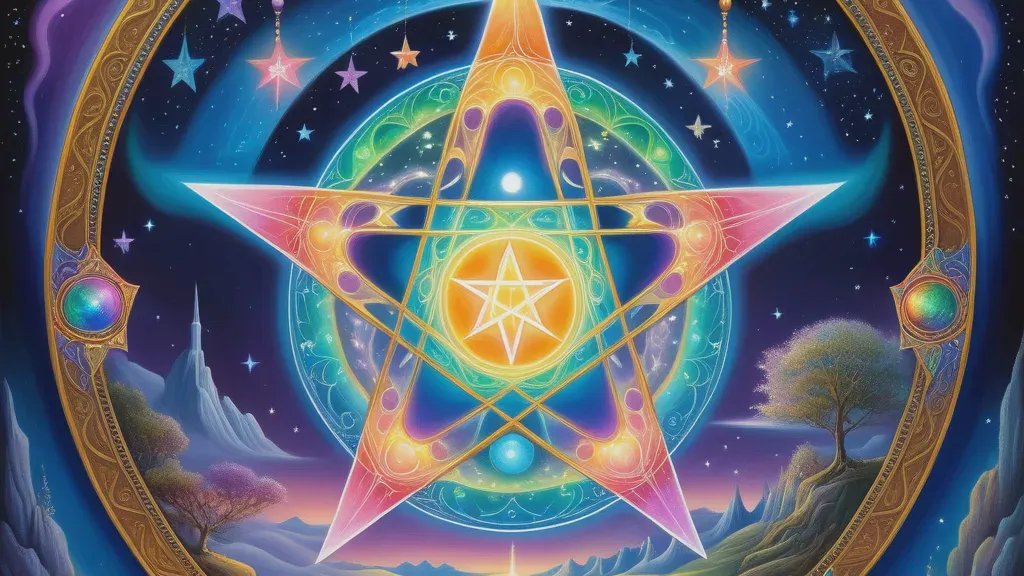
Pentagram
Jungian Archetypes
Meaning
Dreaming of a pentagram can reflect an internal struggle with duality, revealing fears of chaos or the unknown. This symbol engages cognitive dissonance, prompting individuals to reconcile conflicting aspects of their lives.
Psychological Interpretation
Jungian analysis sees the pentagram as a representation of the Self and the integration of opposites. Cognitive psychology views it as a symbol of personal belief systems, while practical approaches might interpret it as a call to balance various life aspects.
Cultural & Historical Origins
The pentagram is prominent in Wicca, symbolizing the five elements and the interconnectedness of life. In medieval alchemy, it represented the quest for harmony and the balance of opposing forces, as seen in texts like 'The Alchemical Wedding of Christian Rosenkreutz.'
Contextual Variations
You draw a pentagram on paper, but when you step back the lines rearrange into a different figure. You feel a rush of fear, then curiosity, as if the symbol is testing whether you can tolerate uncertainty.
A pentagram shifting form suggests internal conflict about rules, meaning, and the unknown. The fear-to-curiosity arc can reflect cognitive dissonance: part of you wants certainty, while another part is ready to explore complexity without forcing it into one answer.
At school or work, you notice a pentagram etched into a desk. Each time you try to cover it, the marks reappear in brighter ink, and you start wondering who placed it there and why.
Persistent markings point to a recurring mental theme you can’t “erase”—often duality, forbidden knowledge, or self-protective beliefs. The wondering who/why can mirror mistrust or the mind’s attempt to locate responsibility for confusing feelings.
You attend a small gathering where people chant around a pentagram on the floor, but you’re the only one who sees it as a compass rather than a threat. When you follow its “direction,” you find a door that leads to a calmer room.
Seeing the pentagram as a compass indicates you’re reframing dualistic thinking into guidance. Psychologically, it suggests your psyche is helping you navigate uncertainty—turning symbolic fear into purposeful orientation.
Frequently Asked Questions
Why did the pentagram feel scary in my dream?
What does it mean if the pentagram kept changing or shifting?
Is the pentagram connected to witchcraft or spirituality?
Journaling Prompts
- Where in your life are you treating something as “dangerous unknown,” and where might it actually be asking you to explore rather than avoid?
- What dualities were present in the dream (safe/unsafe, known/unknown, control/freedom), and which side feels most dominant in you?
- If the pentagram were a map, what direction would it point you toward—and what belief would you need to loosen to follow it?
Related Symbols
Dreamed about Pentagram?
Get a personalized AI interpretation that connects this symbol to your specific life circumstances.
Interpret My Dream