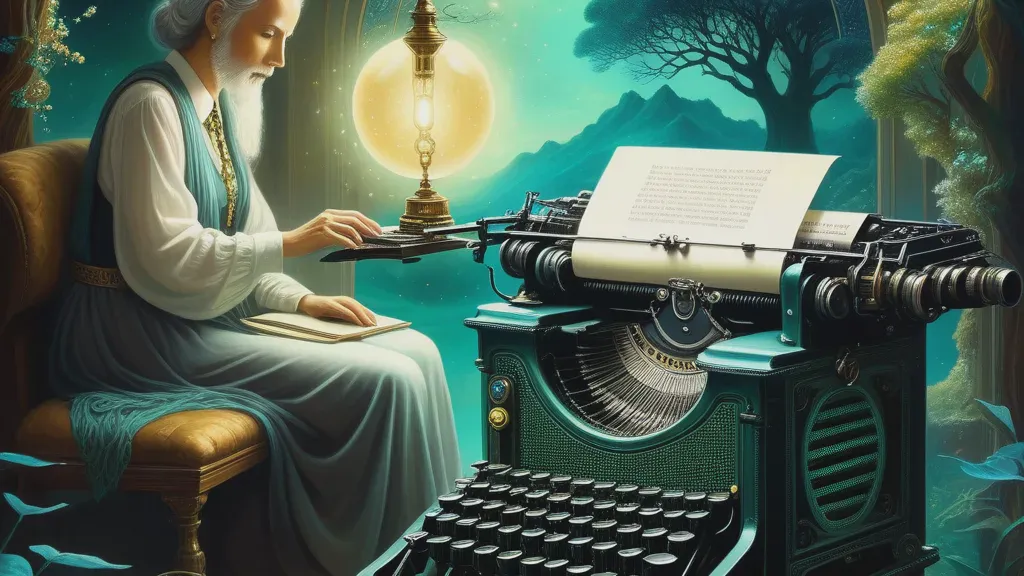
Old Typewriter
Jungian Archetypes
Meaning
An old typewriter is a machine that makes language physical and expensive. Every letter is a small hammer strike that dents the paper, nothing can be silently revised, and the page keeps a record of every hesitation and correction. When one appears in a dream, the psyche has chosen an instrument in which speaking costs something and cannot be undone, usually because the dreamer is circling words that have not been said and would change things if they were. The nostalgia these dreams carry is real but secondary. The primary charge is about commitment: a wish for expression that leaves a mark, and a fear of the mark being permanent.
Psychological Interpretation
Read the machine's behaviour before anything else, because a typewriter dream is almost always a report on the dreamer's access to their own voice. Keys that jam, a ribbon that has dried out, a carriage that will not return, a platen that shreds the paper: these describe blockage, and the specific point of failure often maps onto the specific point at which the dreamer stops in waking speech, whether that is starting, continuing or finishing. A machine that works beautifully, by contrast, tends to appear during periods when something genuinely wants to be written or told, and dreamers frequently wake from those with an unusually clear sense of a first line. Authorship is the second question. Words that appear without the dreamer typing them, letters signed by someone else, pages already covered when the dreamer sits down, all suggest material arriving from outside conscious control, and these dreams tend to be more about listening than about expression. Words the dreamer types but cannot read afterwards point to something known and not yet formulable, which is a different problem from having nothing to say. It is also worth noting who is present. A typewriter dream with an audience is usually about how the dreamer will be received; a typewriter dream alone in a room is usually about whether the dreamer can bear to hear it themselves.
Traditional Symbol Meaning
Before the typewriter, the traditional dream material belonged to the letter and to the act of writing itself. Popular dream books across Europe read the arrival of a written message as news, and the emphasis fell on whether the dreamer could read it, since illegible writing in a dream was commonly taken as a matter still undecided or knowledge withheld. Writing that vanished, faded or would not stay on the page belonged to the same family, understood as a communication attempted from one side and not completed on the other. A typewriter inherits all of this and intensifies it, because the machine makes the writing public, formal and hard to disown. Older traditions treated writing as a sacred technology rather than a convenience. Egyptian tradition credited Thoth with the invention of writing and made Seshat the keeper of records, Mesopotamian religion assigned the scribal art to Nabu, and in each case the god of writing is also the god of measurement, boundary and time. Writing was the means by which what happens becomes what is recorded, which is precisely the anxiety a typewriter dream reproduces: the sense that saying a thing on this machine will fix it, and that fixing it is not reversible. The recording of a life is the other inheritance. Jewish and Christian tradition preserves the Book of Life in which names are written, Islamic tradition describes the Kiraman Katibin, the noble recording angels who write down a person's deeds, and both make an ordinary act of writing into a judgement kept elsewhere. Dreams that involve typing a confession, an accounting, a letter one has been putting off, tend to draw on this stratum, and the emotional register is often closer to reckoning than to creativity. The unsent letter deserves its own note, because it recurs so persistently in dreams and has a long history as a practice. Writing to someone who cannot receive it, whether because they are dead, estranged or unreachable, has been a folk method of grief and repair in many cultures, and the dream version usually arrives when a relationship has ended without the last conversation being had. The typewriter suits this material perfectly. It is a machine designed to produce documents intended for someone else, and a dreamer who types page after page that will never be posted is describing, with some precision, the shape of what remains unfinished.
Jungian / Archetypal
The archetypal pairing in this symbol is unusually clean. The typewriter itself is senex, the Wise Old Man in his form as tradition, craft and inherited discipline: an object built before the dreamer, requiring a technique, imposing a rhythm, and refusing to be hurried. The voice trying to come through it belongs to the Kore, the maiden figure Jung explored with Karl Kerényi as the image of what is young, unformed and full of unlived possibility in the psyche. The dream stages an encounter between something that has form but no news and something that has news but no form. What the machine does with that encounter is the interpretive key. When the typewriter works, the pairing is functioning, and discipline is carrying freshness rather than crushing it. When it jams, senex has won and the dreamer's inner critic has become the tradition, correcting the young voice before it finishes a sentence. When the dreamer types furiously and the page stays blank, the Kore has no container, and the material dissipates as fast as it arrives, which corresponds in waking life to intense feeling that never gets made into anything. Jung would recognise the whole arrangement as the transcendent function at work, the process by which conscious and unconscious positions are brought into a genuine exchange that produces a third thing neither could have made alone. His own practice was literal about this. He recorded his visions in the Black Books and then transcribed and illuminated them in the volume published as the Red Book, treating the writing not as a record of the work but as the work itself. A dream that hands the dreamer an old machine and a blank page is generally making the same proposal: not that the material be analysed, but that it be given form, in whatever medium the dreamer actually possesses.
Gestalt / Parts of Self
Do not interpret the typewriter. Become it, and speak in the present tense: I am old, I am heavy, I make a sound when you use me, I cannot delete anything, everything you put through me leaves a dent. Then keep going and let the machine say what it wants from you. Dreamers are frequently startled by what comes out, because the object turns out to hold a very clear position, usually something like, I will not work until you mean it, or, you have been feeding me sentences you do not believe. A jam is retroflection made mechanical. Perls used the term for what happens when an impulse aimed outward is turned back against the self, and a key that strikes and sticks is an exact picture of it: the movement starts, meets a prohibition, and stops mid-stroke, with the force landing internally as tension rather than outwardly as speech. When you replay the dream, notice where in your body the jam registers, most often the jaw, throat or hands, and try saying the stuck sentence aloud to an empty chair instead of typing it. The difference between the two is worth feeling. The polarity in this dream is usually the one Perls named topdog and underdog. Topdog insists on the correct wording, the version that cannot be misread, the letter that will finally be fair to everyone. Underdog agrees with all of it, promises to try again tomorrow, and produces nothing. Retyping the same line with mounting accuracy is that argument in visible form, and it can run for years. The experiment that breaks it is deliberately crude: write the ugliest, least defensible version of what you want to say, out loud or on paper, and notice that the fear was never about the wording.
Psychodynamic / Freudian
Freud's short paper of 1925 on the mystic writing-pad is the natural point of entry, since it uses a writing device to model memory itself: a surface that can be wiped clean while the wax beneath retains every impression permanently. A typewriter is that argument in metal. Nothing typed can be quietly removed, and the dreaming mind reaches for such an object when it is working on material the dreamer would like to treat as erasable and knows is not. The contrast with a screen is part of the message, and dreamers who write daily on laptops but dream of a typewriter are usually being shown the difference between what can be deleted and what has already been recorded. The unsent letter is a compromise formation of the classical kind, in which a wish and a defence are satisfied simultaneously. The words are written, so the impulse gets expression; the letter is never sent, so the risk is avoided. Dreams that produce pages of unposted correspondence often accompany a waking relationship in which something true has been decided against saying, and the affect attached to the typing, whether relief, dread or grief, generally indicates which part of the compromise is under strain. Klein's account of reparation adds a second motive: making something for a person one has damaged or lost is a fundamental impulse, and a good deal of writing serves it. Winnicott and Bion supply the developmental frame. Winnicott located creative living in the intermediate space where play happens, and regarded the capacity to make something without an audience as evidence of a self that is genuinely one's own rather than compliant. Bion described alpha-function, the mental work by which raw, unprocessed experience is converted into elements that can be thought about and dreamed. Writing is one of the more effective external supports for that conversion, which is why a dream of a working typewriter so often follows a period of overwhelming and undigested experience: the psyche is proposing a method, not a hobby.
Contemporary Psychological
Content-analytic work on dream reports has long noted that reading, writing and arithmetic occur in only a small fraction of dreams, which makes an extended typing dream comparatively rare and probably significant when it happens. The rarity has a plausible basis in what happens to the brain during REM sleep, when regions supporting sustained language production and logical sequencing are relatively less active, and it fits the frequent report that dream text is unstable, shifting or unreadable when the dreamer looks at it twice. Illegible typing is not necessarily symbolic; it may simply be what text does under those conditions. Memory and motor systems explain the machine's presence. Typing is a highly practised motor skill supported by procedural memory, and sleep-dependent consolidation is well established for exactly this kind of learning, so a dreamer who once typed on such a machine is drawing on a deeply encoded sensorimotor routine, complete with key resistance, bell and carriage return. The choice of an obsolete device also functions as a date stamp, since memory networks laid down in a particular period tend to bring their contemporary objects with them, and the typewriter often arrives alongside other material from the same stretch of life. The practical implication has research behind it. James Pennebaker's expressive writing paradigm has repeatedly found that writing about difficult experience in a structured way is associated with measurable benefits, and the mechanism most often proposed is the conversion of diffuse emotion into organised narrative. The continuity hypothesis, developed from Calvin Hall's content analyses and extended by G. William Domhoff, predicts that a dream of a typewriter reflects waking preoccupation with expression rather than compensating for its absence, so these dreams tend to appear in people who are already, somewhere in their lives, trying to say something and not yet managing it.
Cultural & Historical Origins
The machine that shaped the modern image entered production in 1874, when the Sholes and Glidden typewriter was manufactured by E. Remington and Sons, carrying the keyboard layout devised by Christopher Latham Sholes that survives on every phone screen today. The word itself first belonged to the operator as much as the machine, and in the 1880s and 1890s a typewriter frequently meant the young woman employed to work one, an accident of language that records how the device opened clerical employment to women and changed the composition of the office. Mark Twain, an early adopter, claimed to be the first author to submit a typewritten manuscript to a publisher. Writers have supplied the rest of the mythology. Nietzsche bought a Malling-Hansen writing ball in 1882 as his eyesight failed, and in a letter to a friend remarked that our writing instruments work on our thoughts as well, a line that became foundational for later thinking about how tools shape composition. Jack Kerouac typed On the Road in April 1951 onto a continuous roll of paper so that the reel would not interrupt the sentence, producing an object now exhibited as a relic. Cormac McCarthy wrote nearly everything on a single Olivetti Lettera 32 and sold it at auction in 2009 to benefit the Santa Fe Institute, replacing it with an identical model. Stanley Kubrick's The Shining gave cinema its most quoted typewriter page, and the association of the machine with obsession, solitude and repetition has been hard to shake since.
Contextual Variations
Keys that stick until you clean them, typing words you never sent
Maintenance before output is the dream's sequence, and it is worth respecting. The stuck keys say the instrument has gone unused for a long time, and whatever cleans them, tears, oil, patience, indicates what the restoration will require. The words are described as never sent rather than never written, which is a meaningful distinction: the sentences already exist in you, complete, and what has been missing is delivery. Note who they were addressed to, because that name is usually the whole content of the dream.
A ribbon fading mid-letter so you type one line again and again
Repetition with diminishing ink is a precise image of perfectionism running out of resources. Each version is more accurate and less visible, which is what happens when the search for the right wording consumes the energy that sending it would have required. The fear that the meaning will change with the phrasing is worth taking seriously and then setting aside, because in most cases the recipient will hear the intention long before they parse the sentence. Ask what would be true if the fifth draft and the first draft said the same thing, and what you have actually been protecting yourself from by revising.
Typing on a typewriter while everyone in the room uses screens
Choosing the slower instrument in front of an audience is a statement about how you want to be heard, and the detail that the room goes quiet suggests you suspect the choice would work. Dreams like this often accompany a move away from performance and toward substance, or a growing impatience with the speed at which you are expected to respond. There may also be a defensive element worth checking, since insisting on the older method can be a way of declining a game you are afraid of losing. The useful question is whether the slowness in your waking life is producing better work or providing cover.
A page filling with typing you did not write
When the machine writes on its own, the dream has moved from expression to reception, and your task in it changes from author to reader. Material of this kind usually arrives from parts of you operating well outside conscious intention, and the appropriate response on waking is transcription rather than analysis: write down whatever you can recall of the text, however fragmentary, before deciding what it means. Pay particular attention to the tone. Whether the invisible writer sounds kind, accusatory, urgent or amused tells you a great deal about which part of you has taken the keys.
Frequently Asked Questions
Why would I dream about a typewriter when I write on a laptop?
Is a jammed or broken typewriter in a dream a bad sign?
Why could I not read the words I typed in my dream?
Does a typewriter dream mean I should be writing something?
Journaling Prompts
- Write the sentence the dream would not let you finish, in the crudest and least careful language available to you. Do not edit it for fairness or accuracy. Then read it back and mark which parts you would actually stand behind in daylight, and which were only the pressure of having held it in.
- Describe the machine in detail as though writing an inventory: its age, weight, condition, where it stood, whether it was yours. Then answer the question the description raises, which is whose voice this object belongs to. Note when in your life you first learned that some things are safer left untyped.
- Choose a person the dream pointed toward and write them a letter you have no intention of sending. Date it, address it properly, and finish it. Afterwards, write a few lines about what changed in your body between the first paragraph and the last, and whether anything in it now feels sendable.
- Think about the difference between how you speak and how you write, and describe a recent situation where one was much more honest than the other. Which version would you want the other person to have received? Write down the single sentence from the honest version that you have never said out loud.
Related Symbols
Dreamed about Old Typewriter?
Get a personalized AI interpretation that connects this symbol to your specific life circumstances.
Interpret My Dream