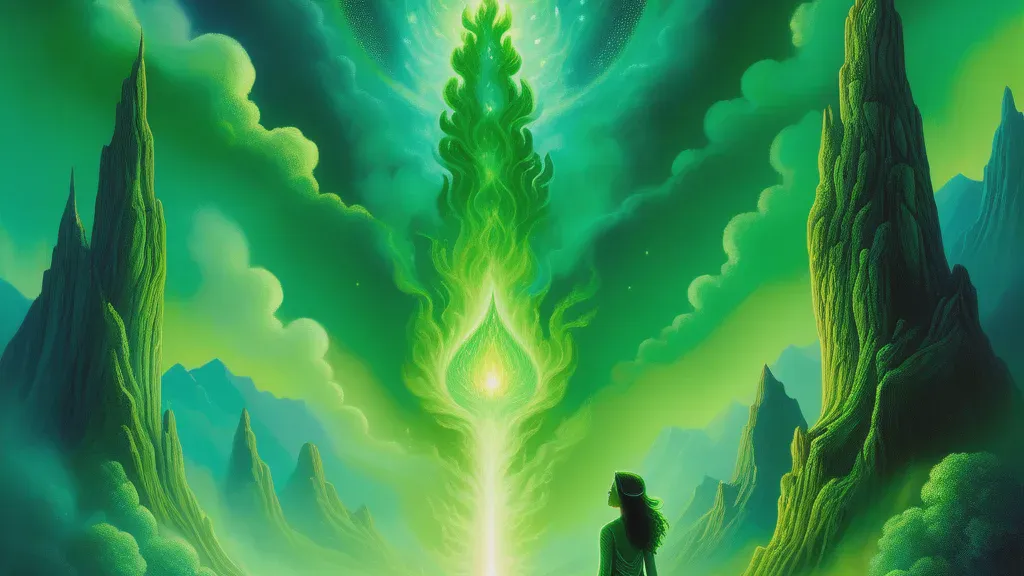
Green Fire
Jungian Archetypes
Meaning
Fire is expected to be orange, so a green flame is a fire with something in it. The chemistry is exact: flames turn green when a metal enters them, copper above all, and the colour is a signature of what is burning rather than of the burning itself. The dream keeps that structure. Green is the colour of sap, of growth, of the thing that will not catch because it is still full of water, and setting it inside a flame welds two opposites into one image: the process that consumes and the process that grows. A dreamer meets green fire when something is being destroyed and produced at once, and cannot yet tell which of the two is happening.
Psychological Interpretation
The most useful question to put to a green fire is what it leaves behind. Flames that consume and leave ash are working the ordinary destructive register, and the green is describing the fuel: something living, unseasoned, or poisoned. Flames that pass over a surface and leave it greener, or leave grass, or leave the room smelling of rain, are describing conversion rather than loss, and dreamers wake from those with a lightness unrelated to the fear the fire caused at the time. Between them lies the commonest version, in which nothing is consumed and the fire simply burns, self-sustaining and pointless, which usually maps onto an emotion that has run for months with no outlet and no object. Location does the rest of the work. Green fire in a container, a lamp, a jar, a hearth, is a transformation the dreamer believes can be managed, and the glass is worth noticing because it permits looking without contact. Green fire coming out of the body, from a wound, the hands or the chest, moves the dream into the register of symptom, and these are frequently dreams of anger or grief that the dreamer has classified as illness. Green fire in a landscape tends to arrive during large impersonal changes, and carries less panic than its scale would suggest. The reaction is the last variable and the most diagnostic: whether the dreamer tries to put it out, and with what.
Traditional Symbol Meaning
Traditional fire reading turns on control and on colour, and an unnatural colour has always meant that the fire has a visitor. Hearth fires that burned oddly were read for news; coloured or wandering flames belonged to the otherworld rather than to the household. Across Britain and Ireland the pale flame seen over marshland was understood as something with intentions, leading a traveller off the road, and the same lights doubled as death omens in the corpse-candle traditions of Wales. The consistent element is direction. Ordinary fire stays where it is put and consumes what it is given; the green light moves, chooses, and takes an interest in the person watching it. The vegetal reading sits underneath all of this and is grounded in something every fire-builder knows. Green wood does not burn. It is unseasoned, full of sap, and a green log put on a fire hisses, smokes and refuses, so that greenness is precisely the quality that resists combustion. A green flame is therefore a paradox in folk terms, the wet burning, the living thing alight, and traditions that use it deliberately are usually pointing at forced or premature transformation. Hildegard's viriditas gave the same greenness its positive charge, life as a kind of moist burning, and the two readings have coexisted ever since without resolving. Alchemy is where the paradox was made into a method. The green stage of the work was necessary rather than regrettable, and the Green Lion that devours the sun was understood as the crude corrosive matter that must dissolve the noble metal before anything can be made of it. Later readers of these texts, Jung among them, took the blessed greenness as an image of the soul's own life, the anima mundi at work inside matter. What the alchemists contributed to the symbol is the insistence that the corrosive and the generative are the same agent at different stages, which is exactly the ambiguity a dreamer of green fire wakes up holding. Modern culture has kept the colour and changed the referent. Green became the colour of poison in the nineteenth century, when arsenic-based pigments in wallpapers and dresses were making people ill; it became the colour of the intoxicating and the illicit with absinthe, la fée verte; then the colour of radiation, of the alien, and of anything glowing that should not glow. Set against this, the ecological movement made green the colour of life to be defended, and Leopold's dying green fire in the wolf's eye stands at the hinge between the two. A dream that produces green flame is drawing on both inheritances at once, which is why dreamers so often report that the fire was beautiful and that they did not trust it.
Jungian / Archetypal
Green in the alchemical texts Jung spent his later decades reading is the colour of life in matter, the benedicta viriditas, the sign that the work is animate rather than inert. Put into a flame it produces an image of the vegetative soul on fire, instinct and growth burning with the intensity usually reserved for spirit. The compensatory function is easy to read when the dreamer's waking life has become abstract or over-managed. To somebody living in plans, screens and analysis, the psyche sends a fire the colour of sap, and it does not send it politely; it puts it in a wound, in a house, in a forest, wherever the dreamer cannot look away from it. The Great Mother stands behind the vegetal side of the image, in her aspect as nature rather than as personal parent, the power that grows things and rots them with the same indifference. The Green Lion swallowing the sun is that power at its most alarming, matter devouring consciousness, and dreams of green fire spreading through a landscape carry a trace of it. This is not a hostile force, but it is a larger one than the ego, and dreams that put the dreamer in a position of trying to control it are usually asking for a different relationship, in which the fire is tended and watched rather than fought. The shadow enters through the colour's other inheritance. Green is the colour English gives envy, and the alchemical green is also the colour of corrosion and verdigris, so a green flame readily carries what the dreamer has refused to admit wanting. Fire in Jung's writing is closely bound to libido, energy available for change, and a green fire is that energy with something unassimilated in it, still tasting of its source. The work is not to extinguish it. Amplification suggests the opposite: a green flame is the beginning of an operation rather than an accident, and the psyche appears to be showing the dreamer material at the exact stage where it can still be worked.
Gestalt / Parts of Self
Be the green fire before you interpret it. Sit in it, take its posture, and speak as it in the present tense, and keep the sentences short enough to be true. I burn and nothing is used up. I am the colour of things that grow. You have been trying to put me out with the wrong thing. Whichever line makes your breathing change is the one to stay with. In Gestalt terms this flame is not an event happening to you in the dream, it is an energy of yours that has been disowned so thoroughly that it can only reappear as an element, unattached to any person, burning in a room. Look next at what you used against it, because that detail is a portrait of your coping. Water, sand, a blanket, your hands, a phone call for help, or nothing at all: each corresponds to something you actually do when feeling rises. Dreamers who throw water and watch the flames climb are usually describing suppression that amplifies, and the escalation in the dream is not a warning but a report. Try the reverse experiment in imagination. Let it burn, stay in the room, and notice precisely where in your body you go tight while you do it, since that is where the contact is being interrupted. Then the polarity, which in this image is unusually clear: consuming and growing, the destroyer and the gardener, and you are both. Most dreamers arrive owning one end. Put them in two chairs and let them speak to each other about a specific situation in your life this month, not in general. What usually emerges is that the thing you have been calling destructive in yourself, the anger, the appetite, the wish to leave, is the same energy as the thing you have been wishing you had more of. The green in the fire is the sign that it is not finished, not clean, and still full of life.
Psychodynamic / Freudian
An image this strange is a piece of dream-work showing its seams. Condensation, in Freud's account, packs several trains of thought into a single composite figure, and a green flame is a textbook composite: the meanings of fire, destruction, passion, purification, are welded to the meanings of green, growth, sickness, envy, immaturity, because they belong to the same conflict. The oddity is the signal. Where the manifest content is impossible in waking life, the latent content has usually required two incompatible ideas to be held together, and the dreamer's task is to name both rather than to choose the more comfortable one. Envy is the reading the colour invites and clinical tradition supports. Melanie Klein described envy as an attack on the good object precisely because it is good, a spoiling impulse rather than a wanting one, and distinguished it sharply from greed. A fire that ruins something valuable while looking beautiful, or that burns green in the presence of another person's success, is a serviceable picture of that process, and it commonly arrives disguised as a dream about illness or contamination, because the impulse is too unacceptable to be dreamed straight. Reversal may be doing further work in the versions where the fire is explicitly described as healing. The alternative and equally common reading is developmental. Bion described the mind's need to take in raw, unprocessed emotional experience and convert it into something thinkable, and dreams are one of the places that conversion happens; a fire burning without consuming anything is a fair image of affect that has not yet been metabolised. Winnicott's language of aliveness applies to the same dream from the healthier side, since these fires often arrive when a compliant, well-behaved surface has begun to crack and something with heat in it is pressing up underneath. Such dreams appear frequently in the middle phase of a therapy, when what was numb starts to move.
Contemporary Psychological
The colour is not incidental to the perceptual machinery. Human photopic vision peaks in sensitivity around 555 nanometres, in the yellow-green, so a green flame is close to the brightest thing the eye can build from a given amount of light, and the visual system devotes proportionally more of its resources to that region of the spectrum. Whatever the dream means, it has selected the most salient possible object. Colour in dreams has been studied directly with some interesting results, including work published by Eva Murzyn in 2008 suggesting that people who grew up watching black-and-white television report greyscale dreams at higher rates, which indicates that dream colour is constructed rather than simply given. Predictive processing accounts of dreaming offer a good fit for an image like this one. On such accounts the sleeping brain runs its generative model with little correction from the senses, recombining learned regularities, and a green flame is what happens when two strong regularities, fire is orange and living things are green, are activated together with nothing external to arbitrate. The result is a prediction violation held in place for a whole scene. That may be why dreamers so consistently remember the colour and so rarely remember what the fire was burning, since the surprising feature captures the encoding. The functional accounts fill in the timing. Sleep appears to strip some of the affective charge from experience while preserving its content, a process Rosalind Cartwright traced through dream reports during divorce and Matthew Walker has described in terms of overnight emotional processing, and vivid, elementally charged dreams cluster in exactly those periods. Fire also recruits an ancient hazard category of the kind Antti Revonsuo's threat simulation theory concerns itself with, though the low fear reported in many green fire dreams argues against reading them as rehearsals for danger. The frequent detail of smell is worth noting too, since olfactory content is reported in only a small minority of dreams, and its presence usually marks a report worth taking seriously.
Cultural & Historical Origins
Hildegard of Bingen built a whole theology on the colour, using viriditas, greenness, for the moist creative force running through plants, bodies and souls, and setting it against ariditas, the dryness of what has withered; in her writing greenness is closer to a form of energy than to a hue. The alchemists made the same association combustible. Their benedicta viriditas, the blessed greenness, marked the living stage of the work, and the Green Lion of the emblem books, shown swallowing the sun in the Rosarium philosophorum and in the Ripley scrolls, stands for a corrosive green substance that dissolves gold, destruction and generation in a single picture. Green retained sacred weight elsewhere too: Osiris is painted with green skin as the god who returns, and Islamic tradition calls the immortal guide al-Khidr the Green One. Folk tradition put green light where the living should not go. The ignis fatuus, the will-o'-the-wisp, and the corpse candles of Welsh and Irish belief were pale wandering flames that led travellers off the path or announced a death, and foxfire, the genuine greenish glow of fungus in rotting wood, gave the stories a real phenomenon to build on. The nineteenth century made the association theatrical, lighting stage ghosts and demons with coloured chemical flares, and then technological, with the greenish glow of uranium glass and radium paint turning green light into the colour of invisible harm. Aldo Leopold gave the image its finest modern use in A Sand County Almanac in 1949, describing the fierce green fire dying in the eyes of a wolf he had shot, and meaning by it the wildness in a living thing.
Contextual Variations
Green flames rising from a cut on your hand
Fire coming out of the body turns the dream into a report on symptoms. A wound that burns rather than bleeds usually belongs to an injury you have classified as damage while it is behaving like energy, most often anger at someone you are not permitting yourself to be angry with, or grief that keeps producing heat instead of tears. The hand matters: it is the part that works, makes and reaches, so the injury is attached to doing rather than to feeling in general. Notice whether the flame hurts, since dreamers frequently report that it does not, and that the absence of pain was the frightening part.
A fire that spreads greener when you throw water
The dream is describing a coping strategy and grading it. Water is the obvious remedy, and when the obvious remedy feeds the fire the image is unusually explicit: numbing, distracting, reasoning and reassurance are all making the thing larger. Green rather than orange escalation matters here, because what grows in response to suppression is a living process rather than a fire, and living processes do not stop because they have been discouraged. Consider what your actual water is, whether that is work, sleep, a drink, another person's company, and what would happen if you stopped applying it for a week.
Green fire burning inside a glass jar
Containment is the whole subject, and glass is a specific kind of container, one that lets you look without touching. Dreams like this arrive when something intense has been safely bounded, in therapy, in a diary, in a creative project, or in a decision to feel a thing only at particular times. The mood is often admiring and calm. The question worth asking is whether the jar is a stage in the work or the end of it, since a fire kept behind glass indefinitely is a feeling that has been made into an exhibit. Notice whether you want to open it, and what you believe would happen in the room if you did.
A forest where the flames leave grass behind
This is the clearest of the constructive versions and it usually follows a real ending. Fire that produces growth rather than ash matches something ecologically true, since many landscapes depend on burning to clear ground and germinate seed, and the dream borrows that logic to describe a loss that has turned out to be generative. It tends to come months rather than days after the event: a job gone, a relationship finished, a house left. Pay attention to what is regrowing and whether it matches what was there before, because it rarely does, and the difference is the message.
Frequently Asked Questions
Why was the fire in my dream green instead of orange?
Is green fire in a dream a healing sign or a warning?
Why did water make the green flames stronger?
Does green fire in a dream relate to envy?
Journaling Prompts
- Write down the feeling you have been damping for the longest, and then be specific about the method: the work, the scrolling, the second drink, the busy weekend, the reasonable explanation you give yourself. Describe one occasion in the last month when the method failed and the feeling came up anyway. What did you do in the following hour, and who, if anyone, noticed anything at all?
- Think of something that ended and that you can now see produced growth. Write what actually burned, in plain terms, and what came up afterwards in the cleared ground. Then name the thing currently burning in your life that you cannot yet read this way, and note honestly how long it has been since it started, because the difference between the two is often only time.
- Consider somebody whose good fortune has been harder to be pleased about than you would like. Write down what they have that you want, without softening it, and then what you would have to change or risk to go after it yourself. Notice which of the two is more uncomfortable to write, and let that tell you whether the feeling is envy or an ambition you have been refusing to name.
- Describe where in your body you first feel heat when something matters: the chest, the face, the stomach, the hands. Recall the most recent time it happened, what had just been said, and what you did with your face while it was going on. Then write what you would have said if there were no consequences, in the words you would actually have used rather than in a tidy version.
Related Symbols
Dreamed about Green Fire?
Get a personalized AI interpretation that connects this symbol to your specific life circumstances.
Interpret My Dream