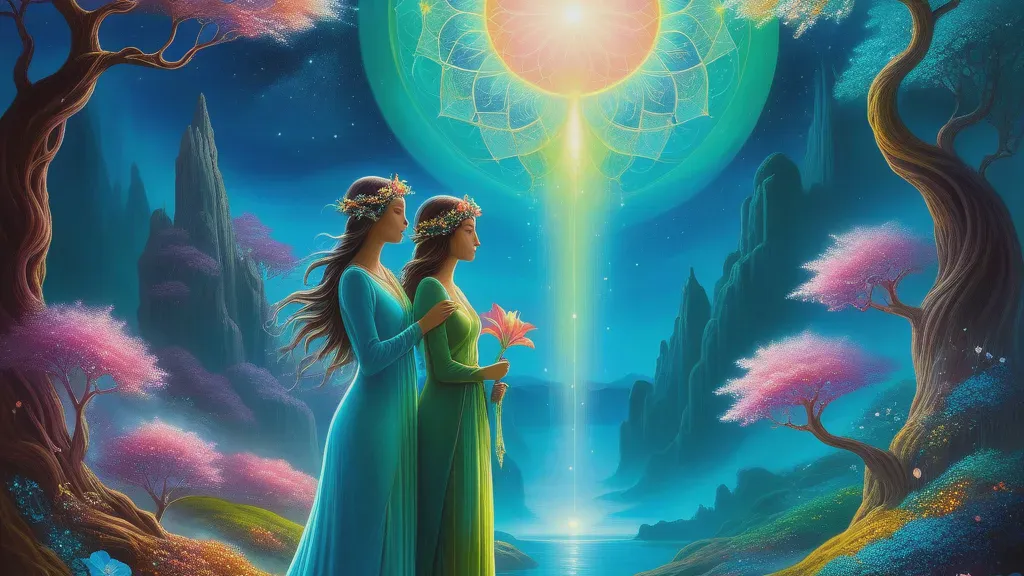
First Bloom
Jungian Archetypes
Meaning
A first bloom in a dream is the moment something that grew in the dark becomes visible: a bud splitting on a bare branch, a single flower in a garden nobody planted, a tree that has stood leafless for years finally opening. The psyche uses this image for the earliest public stage of a private change, the point at which a recovery, a talent, a love or a new sense of self can no longer be hidden and cannot yet defend itself. What separates the first bloom from a field of flowers is its singularity and its timing. It says the season has turned for one specific thing, that the dreamer is early rather than late, and that the danger now is not failure to grow but exposure before the roots are deep.
Psychological Interpretation
The dreamer who meets a first bloom is usually standing at the beginning of something they have not yet named aloud. The unconscious tends to send this image after a long dormancy: months of grief, an illness, a stalled project, a relationship that ran dry, a creative silence. The bloom announces that the dormancy was not death, that something was drawing on reserves underground, and the feeling that accompanies it in the dream is the most reliable guide to its meaning. Wonder or relief points to a change the dreamer is ready to claim. Anxiety, the urge to cover the flower, to check on it repeatedly, to keep others from seeing it, points to the vulnerability of a new state that has not yet been tested by weather. Where the bloom appears matters as much as the flower. On a childhood street it ties the new growth to old ground, an early self finally getting its season. In a garden the dreamer did not plant it suggests the change was prepared by forces outside conscious effort, a gift rather than an achievement. On a ceremonial tree with an audience it raises the question of permission and timing, the sense that others must witness the opening before the dreamer can believe in it. Across all of these the same counsel holds: a first bloom asks to be protected and not forced, admired and not picked, and the dreamer's work is to give the new thing the conditions under which second and third blooms become possible.
Traditional Symbol Meaning
Folk tradition has always read the first bloom as a matter of timing, and timing as a matter of risk. The Oneirocritica of Artemidorus, the oldest surviving dream manual in the West, treats flowers in their proper season as favourable and the same flowers out of season as a warning. English country speech still has the blackthorn winter for the cold snap that follows the blackthorn's early white flowering, and a proverb in most European languages warns that one swallow does not make a summer. Behind these sayings lies the knowledge that the first bloom is the moment a plant commits its reserves, and that a late frost can take the whole year. The second tradition is the maiden's. To be in the bloom of youth, to deflower, to come out, are all one metaphor, and the myth that fixed it is told in the Homeric Hymn to Demeter, where Kore reaches for a narcissus grown as a lure at the very moment the earth opens. The first bloom there is the threshold of adulthood, and the flower is both the girl and the thing that draws her across. The Victorians codified the idea in the language of flowers, in which the snowdrop, the first flower of the English year, stood for hope and consolation. In these readings a first bloom in a dream is an initiation, and the dreamer has entered a new estate whether or not they feel ready for it. The third tradition is the flower as an opening of the spirit. Buddhist iconography seats the awakened one on a lotus that rises from mud, and Zen tells of the Buddha wordlessly holding up a flower while only Mahakasyapa smiled. The Taoist text known in the West as The Secret of the Golden Flower describes the circulation of light within the meditator as a flower blooming at the centre of the body, and Dante ends the Paradiso before a white rose of the blessed, its petals the saints. A first bloom here is the first sign that inner practice has borne outward fruit, and the traditions agree that the sign is to be received quietly. Popular dream dictionaries kept the folk grammar alive; Gustavus Miller's 10,000 Dreams Interpreted of 1901, the kind of book sold beside almanacs, took flowers in bloom to foretell pleasure and gain, white flowers sadness, and withered flowers disappointment. Crude as those readings were, they preserved the two questions that still matter. Has the timing of this new growth matched the timing of the life around it, and what is its emotional colour, since the hopeful bud and the frightened bud are the same shape.
Jungian / Archetypal
Jung wrote about the Kore, the maiden, as a figure of the psyche caught at the instant of opening, and the myth makes the point with brutal economy: Persephone is bent over a narcissus when the ground splits and Hades takes her. A first bloom in a dream carries that double charge. It is a psychic content at its most beautiful and its most exposed, and the dreamer's fear that something will spoil it reads the archetype accurately rather than nervously. Behind the flower stands the Great Mother as soil, the vegetative ground Erich Neumann described, producing without asking and reabsorbing without grief. The Animus belongs here as the stalk, the vertical energy that lifts a bud out of the mass of leaves and holds it in the light; in a woman's dream a first bloom often coincides with that voice turning from inner critic into inner gardener. The flower is also one of Jung's images of the Self. His commentary on The Secret of the Golden Flower, the Taoist text Richard Wilhelm translated in 1929, reads the golden flower as a mandala, the circulation of light around a centre, a pattern he also traced in patients' spontaneous drawings. A first bloom is that mandala at its smallest scale, a centre just beginning to organise itself, and the dream tends to arrive under the law of compensation: to the person convinced they are barren or too old the unconscious presents a bud, and to the person forcing growth on a schedule it presents a flower that closes when touched. Individuation in this image is seasonal rather than heroic. Nothing is conquered; something ripens, and the ego's contribution is to notice that the season has changed. Amplification reaches for the dead wood that flowers. Aaron's rod in the Book of Numbers is a dry staff that overnight buds, blossoms and bears almonds, settling a dispute about legitimacy; in the Tannhauser legend the Pope's staff sprouts leaves after he has damned the knight. Both stories say that the first bloom is grace arriving after a verdict, life proving a judgment wrong. A dreamer who has passed sentence on some part of themselves, a talent, a capacity for love, a body they consider spent, may receive that correction. The Jungian task is then restraint: not to pick the flower for display, not to explain it away, but to let the small Self-image stand until the ego has learned its scale.
Gestalt / Parts of Self
Take the dream apart into its players before interpreting any of it, because each of them is you. The bud that splits open is the part of you that has decided to show itself. The frost that threatens it is you. The gardener who cannot stop walking back to check on it is you, and so is the crowd standing round the ceremonial tree. Fritz Perls would have you take each role in turn and speak in the first person, present tense: I am small, I am opening whether or not anyone is ready, I am cold and I come at night, I am the one who keeps looking to see if it has died. Said aloud, the roles reveal which one you actually live from and which ones you have handed over to the weather. The polarity in this dream is opening and closing, and most dreamers identify only with the opening. Yet a real flower closes at dusk and opens again at dawn; the closing is not failure but rhythm, contact followed by withdrawal. Ask whether you allow yourself that rhythm in waking life or whether you treat every pause as proof that the growth was never real. Retroflection often shows up as the bud that will not open: energy meant to move outward turned back on yourself, held in the jaw or the belly. Deflection shows up as the ceremony, the audience, the need for an external sign before you will let yourself feel your own readiness. The Gestalt question is how you interrupt the opening, and where in your body you feel the interruption. Put the frost in the empty chair and talk to it. Then sit in its chair and answer as the frost. Frost in these dialogues rarely turns out to be a stranger; it speaks with the voice of an earlier season in which something first opened and was cut back, a first performance mocked, a first love laughed at, a first drawing pinned up and then ignored. That is the unfinished situation the dream is trying to close, and the organism has chosen now, with a new opening in your waking life, to finish it. Stay in the present tense. Notice what your hands want to do toward the flower: cup it, pick it, hide it, hold it up. Whatever the impulse, that is the contact you are currently making with your own growth, and awareness of it is the whole of the work.
Psychodynamic / Freudian
Psychoanalysis has read the opening flower as a figure for sexual awakening since its beginnings, and on the manifest level the reading is hard to miss. Freud reproduced in The Interpretation of Dreams a young woman's dream of arranging flowers in which violets and carnations turned out, by way of the sounds of the words, to point toward violation and carnality, and ordinary language still speaks of deflowering. The latent content of a first-bloom dream, however, is seldom only erotic. More often it is the wish to be seen unfolding, an exhibitionistic wish the dreamer cannot hold openly and so dresses in botany. Reversal is common: a dream in which the dreamer fears the flower will be crushed may carry, upside down, an impulse to crush it, the envy a person can feel toward their own good fortune, or toward the sister's or the colleague's flower that opened first. Object relations sharpens the picture. Winnicott described the True Self as something that appears in a spontaneous gesture and survives only if the environment receives that gesture rather than overriding it; the flower that opens wider when the dreamer touches it is a dream of a responsive environment, and the flower that closes at a touch is a dream of one that was not. What a person expects of their first blooms is a record of what happened to their earliest ones. Melanie Klein's account of envy, the impulse to spoil the good object precisely because it is good, explains the frost that arrives on the night of opening: an internalised figure who could not bear the child's flourishing and whose spoiling the dreamer now anticipates as weather. In treatment, first-bloom dreams tend to surface when a patient begins to show something new and watches the analyst's face for a change in temperature. The repeated checking on buds in the dream mirrors the compulsion to test the transference, to find out whether this object will pick the flower, praise it to death, or leave it alone. Bion's notion of the container is exact here: growth requires a mind that can hold what is emerging without acting on it, and premature interpretation is a form of picking. The patient's fear of frost is usually a fear of the analyst's envy, projected, and it is worked through not by reassurance but by the analyst's demonstrated ability to let a small good thing exist in the room without needing to own it.
Contemporary Psychological
A lone flower in cracked pavement on a childhood street is, for the memory system, a textbook event. The hippocampus is tuned to novelty against a known background, and one new feature on an old map is exactly the mismatch it flags for consolidation, so the dream has the form of a memory being filed. Its content follows waking preoccupation, as most dream content does. A first bloom rarely appears at random; it follows a period of watching for signs, a pregnancy test, a manuscript sent out, a body in recovery, a new relationship in its first weeks, and the dream stages that anticipatory state as a single novel element in a scene the dreamer already knows. The emotional work of such a dream shows in its timing across the night. Rosalind Cartwright's studies of people going through depression and divorce found that dreams which moved toward resolution over successive REM periods were associated with better mood on waking, and a bloom that opens in the final dream before morning is the kind of image her recovering subjects reported. Ernest Hartmann argued that a dream organises itself around a central image that pictures the dominant emotion; a bud opening is a near-perfect picture of fragile hope, while the frost variant pictures the anxiety that hope provokes. Sleep's known role in re-encoding emotional memory suggests why the same image can be soothing one night and frightening another: the brain is returning to an uncertain investment with a little less charge each time. Predictive processing offers the cleanest frame. A bud is a prediction, the organism's forecast of a flower, and the dreaming brain is a generative model rehearsing outcomes for the interval between effort and result. The dreamer who keeps walking back to the buds is running that interval, testing what it feels like to wait when the outcome cannot be hurried. The choice of botanical imagery may itself be regulatory. Roger Ulrich's 1984 study found that surgical patients with a window view of trees recovered faster than those facing a brick wall, and attention restoration research since then has associated natural scenes with lower physiological arousal. A first bloom is the mind dressing an anxious forecast in the imagery it finds most calming, which is why the image is worth returning to on purpose when the waiting is hard.
Cultural & Historical Origins
The first flower of the year has been watched, dated and celebrated for as long as people have farmed. In Japan the cherry front, the sakura zensen, is still forecast each spring, and the court poets of the tenth-century Kokin Wakashu were already turning the brief opening of blossom into the sensibility that Motoori Norinaga would later name mono no aware, the ache in transient things; the full-flowering dates of Kyoto's cherries have been reconstructed from diaries and chronicles back to the ninth century, one of the longest phenological records on earth. In China the plum blossom, which opens while snow is still on the ground, was the first bloom par excellence, praised by the Song poets Lin Bu and Wang Anshi as the flower that endures cold to announce spring. In Greece the return of Kore from the underworld, told in the Homeric Hymn to Demeter, was the mythic form of the same event, and Rome kept the Floralia for the goddess Flora at the end of April; Ovid in the Fasti has Flora recall how the nymph Chloris was transformed into her, the scene Botticelli painted in the Primavera with flowers spilling from Chloris's mouth. The Song of Songs marks spring with the line that the winter is past and the flowers appear on the earth, and in Persian poetry the rose that opens for the nightingale is the central image of Hafez's love lyrics. In England the Marsham family began recording the first flowering of plants at Stratton Strawless in 1736, a record naturalists still consult.
Contextual Variations
A single bud opening on a tree that has stood bare for years
A tree that has been bare for years is a part of your life you had written off: a friendship that went silent, a skill you stopped practising, a body you assumed would not recover. When one bud opens on it, the dream is correcting the verdict rather than promising a full canopy. Notice which tree it is and where it stands, since the location usually names the domain. The single bud also warns against overreach: the roots have only just begun to draw again, and the right response is to water and wait, not to announce a harvest.
Frost arriving on the same night the first flower opens
Frost on the night of opening is the dream of someone who has learned that good things get punished for appearing. The flower is real and so is the cold; the question is where the frost comes from. Often it arrives on the timetable of someone you expect to react: the phone call to a parent, the announcement to a rival, the first time a colleague sees the work. Sometimes it is your own hand, the impulse to cut back a new thing before anyone else can. Protecting the bloom may mean not telling that person yet, rather than not blooming.
A flower that opens wider each time you touch it
A flower that responds to your touch is a dream about being met. Something in you is opening in direct proportion to the attention it receives, and the psyche is showing you an environment, or one person in it, more responsive than you had known. This is often a dream of the early weeks of a good relationship, a good therapy, or a good teacher. It carries one caution: a flower that needs touch to open can become dependent on the toucher. Check whether the opening also happens when you step back.
A crowd waiting for a ceremonial tree to put out its first blossom
When the opening needs an audience and a ceremony, the dream is about permission. You are waiting for an external sign that it is time, and the relief that floods you when the blossom appears is the relief of being told you may begin. Ask who is in the crowd, because they are the internalised judges whose consent you are seeking, and ask whether the tree actually needed them. The dream does not condemn the wish for witnesses, but it suggests you have outsourced your sense of readiness.
Frequently Asked Questions
Why did I dream of only one flower opening instead of a whole garden?
Is dreaming of the first flower of spring a good omen?
Why did I feel anxious rather than happy when the flower bloomed in my dream?
I dreamed a flower bloomed and then closed again. Is that a bad sign?
Journaling Prompts
- Name the one thing in your life that has just become visible after a long stretch of growing in private. Describe it as if it were the flower in your dream: what colour, how large, on what kind of ground, in what weather. Then write what you would need to do this week to keep it alive for seven more days, nothing grander than that.
- Write the month ahead as a gardener's forecast for your new growth rather than as the plant's fear: what cold is likely, from where and on what dates, what shelter already exists, what you would move under cover and what you would leave out. Then mark which of those threats are current and which are remembered from another season.
- Work out, as exactly as you can, when the thing your dream's flower stands for began growing out of sight, and what was happening in your life then. Compare how long it spent underground with how long it has been visible. Then write what those months of hidden growth were feeding on, and whether that source is still available to it now.
- List the people who were in the dream, or who you imagine would see the flower if it were real. Beside each name, write whether their seeing it would make it more real to you or more fragile. Then write what it would feel like to let this one thing grow for a month before anyone else knew about it.
Related Symbols
Dreamed about First Bloom?
Get a personalized AI interpretation that connects this symbol to your specific life circumstances.
Interpret My Dream