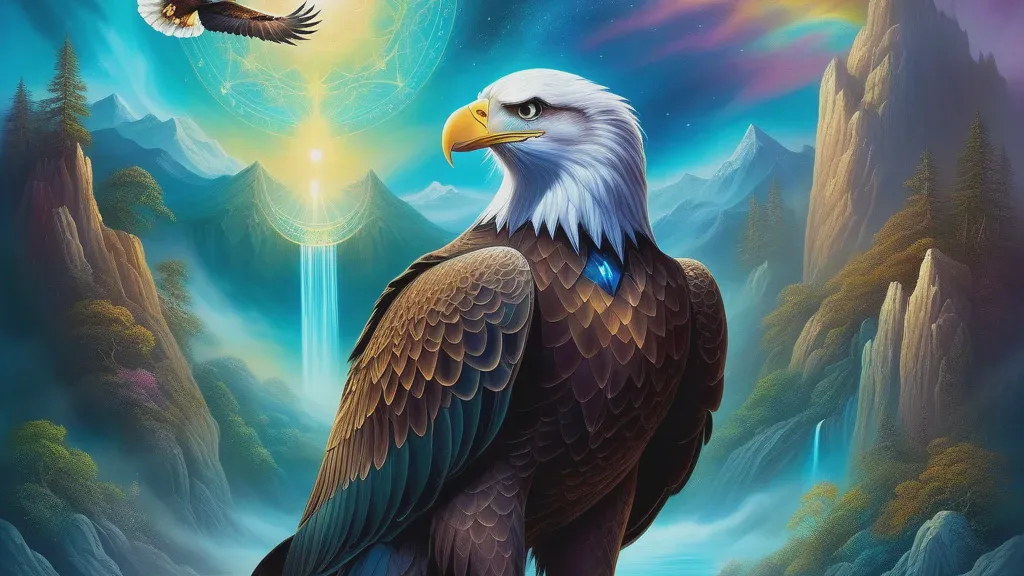
Eagle
Jungian Archetypes
Meaning
The eagle represents vision, wisdom, spiritual elevation, and the ability to see the bigger picture. It symbolizes freedom, transcendence, and the perspective that comes from rising above earthly concerns.
Psychological Interpretation
In Jungian psychology, the eagle embodies the Hero archetype—the courageous seeker of truth and higher consciousness. It also represents the Wise Old Man, offering perspective, wisdom, and guidance from a higher vantage point.
Gestalt / Parts of Self
The eagle in dreams represents the part of self that claims sovereignty—the capacity to rise above the fray, to see the whole landscape from a vantage point of clarity and power. In Gestalt work, the eagle is not a symbol of something external to own or achieve; it is an aspect of the dreamer's own psyche that is already present, waiting to be reclaimed. When the eagle appears, it often signals that the dreamer has disowned this elevated perspective, this ability to see with detachment and authority. The dreamer may have relegated this part to the realm of fantasy or impossibility, treating it as something that belongs to heroes, leaders, or others—anyone but themselves. The projection of the eagle is particularly revealing. Many dreamers encounter the eagle as a distant, untouchable figure—soaring beyond reach, belonging to the sky rather than to the ground where the dreamer stands. This distance is the projection itself. The dreamer is attributing their own capacity for clarity, perspective, and command to an external symbol, keeping it safely "out there" where it cannot demand anything of them. To own the eagle is to acknowledge: I am the one who can see from above. I am the one who has sovereignty over my own life. I am capable of the clarity and detachment this bird embodies. The dialogue between the grounded self and the soaring self becomes urgent—the grounded part may fear the isolation of that height, the responsibility of seeing too much, or the vulnerability of exposure. The eagle part may grow impatient with the limitations of earthbound perspective. Integration of the eagle means reclaiming the capacity to step back, to survey one's situation without being consumed by it, to make decisions from a place of authority rather than reactivity. It is not about becoming cold or detached from life, but about developing the flexibility to move between immersion and perspective as needed. The dreamer who owns their eagle learns to access that elevated viewpoint at will—not as an escape, but as a resource. This is the part of self that knows what matters, that can distinguish the essential from the trivial, that refuses to be diminished by circumstance. When the eagle is truly owned, it no longer appears as a distant vision; it becomes a lived capacity, a way of being that the dreamer can inhabit and return to whenever clarity and sovereignty are needed.
Jungian / Archetypal
The eagle in dreams embodies the Self archetype and the Hero's highest aspiration—the transcendent perspective that rises above the fragmented ego to perceive the totality of existence. As a solar masculine figure, the eagle represents the conscious will, clarity of vision, and the capacity to soar beyond earthly limitations. In Jungian terms, the eagle is the psyche's messenger between the conscious and unconscious realms, carrying the dreamer toward individuation by demanding a higher vantage point from which to view one's life. This bird of prey symbolizes sovereignty—the authority to claim one's authentic power and dominion over one's own psychological territory. The eagle's appearance in dreams often signals a confrontation with the Shadow's opposite: the tendency toward inflation, grandiosity, or spiritual bypassing. While the eagle's vision is divine and penetrating, the Shadow lurking beneath this archetype may manifest as the dreamer's fear of their own power, their reluctance to take the "highest perspective," or their unconscious identification with victimhood rather than mastery. The individuation process demands that the dreamer integrate both the eagle's transcendent vision and the grounded, embodied awareness of the earthbound self—neither soaring into dissociation nor remaining trapped in limitation. Collectively, the eagle carries millennia of archetypal weight: the divine messenger of Zeus, the symbol of spiritual ascension in shamanic traditions, the emblem of sovereignty and empire across cultures. When the eagle appears in the dream, it activates this collective reservoir of meaning, calling the dreamer to recognize their capacity for vision, courage, and transformation. The eagle does not merely observe from on high; it dives with precision and purpose, suggesting that true individuation requires both transcendent perspective and decisive action grounded in reality. The eagle's presence ultimately invites the dreamer into a paradox central to Jungian psychology: the Self is both infinitely vast and intimately personal, both transcendent and embodied. To dream of the eagle is to be summoned toward wholeness—to claim the visionary power that belongs to the mature, individuated psyche while remaining rooted in the human condition. This is the eagle's gift and its demand: see clearly, act decisively, and integrate the heights with the depths.
Psychodynamic / Freudian
The eagle in dreams manifests as a powerful symbol of the ego ideal—the internalized representation of paternal authority, ambition, and the superego's highest aspirations. At the manifest level, the eagle appears as a majestic, soaring creature, commanding the sky with strength and vision. Yet at the latent level, the eagle embodies the dreamer's wish to transcend ordinary limitations, to achieve mastery, and to identify with paternal power. This is fundamentally a wish-defense dynamic: the dreamer's aggressive impulses—the desire to dominate, to rise above others, to claim authority—are sublimated into the noble image of the eagle. Rather than expressing raw aggression directly, the psyche transforms it into vision, aspiration, and the pursuit of excellence. The defense mechanism at work is sublimation itself, wherein primitive aggressive and competitive drives are channeled into socially valued, even admirable pursuits. The eagle also operates through displacement and projection. The dreamer's own ambitions and power-seeking impulses are displaced onto the eagle, which becomes the container for these desires. Through projection, the dreamer attributes to the eagle the qualities they secretly wish to possess or fear they lack—clarity of vision, fearlessness, dominion over the landscape below. Condensation may occur as well, with the eagle simultaneously representing the father figure (or internalized paternal imago), the dreamer's own ego ideal, and the superego's demand for achievement and superiority. This compression of multiple meanings into a single symbol reflects how the unconscious works: one image carries the weight of multiple conflicts and wishes. Childhood origins of the eagle symbol typically trace to early identifications with the father or father-figure—the one who seemed powerful, distant, commanding respect. The dreamer may have internalized a paternal message: "Be strong, be superior, rise above weakness." If the father was idealized or emotionally unavailable, the eagle becomes the fantasy of merger with that idealized power. Alternatively, if paternal authority was experienced as threatening or dominating, the eagle may represent both the wish to escape that dominance and the unconscious identification with it—a defense against the anxiety of powerlessness. The repressed material pressing toward consciousness is often the aggression itself: the rage, envy, or competitive fury that the dreamer has learned to disown, transforming it instead into the noble pursuit of greatness. The eagle's flight carries particular significance—it represents the fantasy of transcendence, of rising above the earthbound conflicts and dependencies of human relationship. This upward movement defends against feelings of groundedness, vulnerability, or entrapment. Yet the very need to soar suggests what is being defended against: the fear of being ordinary, of being subject to others' authority, of remaining earthbound and dependent. The eagle thus reveals a fundamental psychodynamic tension: the dreamer's simultaneous wish for power and fear of the aggression required to claim it, resolved through the sublimated image of noble, solitary mastery.
Contemporary Psychological
The eagle in dreams functions as a neurological representation of elevated cognitive processing and spatial perspective-taking. From a contemporary psychology standpoint, the eagle embodies the brain's capacity for metacognition—the ability to step back from immediate emotional or situational details and perceive patterns from a higher vantage point. When the brain generates eagle imagery during sleep, it is often consolidating experiences that required or are requiring this kind of overview processing: integrating fragmented information into coherent understanding, recognizing patterns across disparate experiences, or practicing the mental shift from being immersed in a problem to observing it from a distance. This elevated perspective serves an emotional regulation function by creating psychological distance from overwhelming or threatening material, allowing the dreamer's brain to process difficult content without the full intensity of immediate emotional engagement. The eagle also relates to threat simulation and mastery rehearsal. The bird's predatory nature and commanding aerial view suggest the brain is rehearsing scenarios of control, dominance, or the ability to anticipate threats from a position of advantage. In memory consolidation terms, eagle dreams often accompany periods when the dreamer is integrating new skills, knowledge, or competencies—the brain is literally practicing the neural patterns associated with mastery and expert-level perception. The eagle's sharp vision and swift decision-making mirror the cognitive patterns of rapid assessment and decisive action, suggesting the dreamer's brain is consolidating experiences where these capacities were demanded or are being developed. Cognitively, the eagle represents the brain's executive function systems at work—the prefrontal networks that manage planning, perspective-taking, and the coordination of complex information. When eagles appear in dreams, they often signal that the dreamer's brain is actively engaged in higher-order problem-solving, strategic thinking, or the integration of abstract concepts. The emotional regulation happening here is sophisticated: rather than processing raw emotion, the brain is practicing the mental stance of the observer, the strategist, or the expert—positions that inherently create emotional distance and a sense of agency. This cognitive pattern is particularly active during periods of learning, professional development, or when the dreamer is working through situations that require both emotional processing and intellectual mastery.
Cultural & Historical Origins
In Native American traditions, the eagle is a sacred messenger between the physical and spiritual worlds. In Greek mythology, the eagle is Zeus's sacred bird, representing divine power and authority. In Christian symbolism, the eagle represents St. John and spiritual vision.
Contextual Variations
Eagle soaring or flying high
Spiritual elevation, gaining perspective, or achieving higher consciousness
Eagle diving or hunting
Focused vision and the ability to seize opportunities with precision
Frequently Asked Questions
What does an eagle dream mean?
Is an eagle always positive in dreams?
Journaling Prompts
- What higher perspective am I gaining in my life?
- How can I rise above my current challenges like an eagle?
Related Symbols
Dreamed about Eagle?
Get a personalized AI interpretation that connects this symbol to your specific life circumstances.
Interpret My Dream