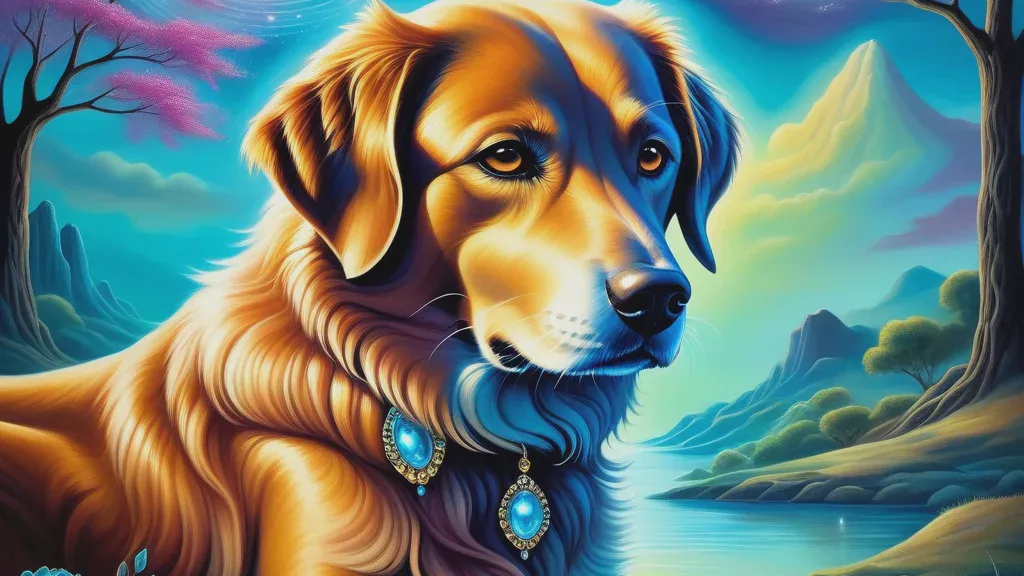
Dog
Jungian Archetypes
Meaning
The dog is the animal that chose to live with humans, and in dreams it carries the whole history of that arrangement: instinct that has agreed to serve, loyalty that asks nothing back, a guardian at the door and a mouth full of teeth. A dreamed dog usually stands for the dreamer's own instinctual life in its domesticated form, the part of the psyche that knows who is a friend before the mind has decided and senses a threat before any argument for it exists. How the dog behaves is the message. A dog that greets, follows, guards, bites, dies or fails to recognise the dreamer maps the present state of trust between conscious intention and bodily knowing, and between the dreamer and the people they have allowed close.
Psychological Interpretation
A dog is the most relational animal the dreaming mind produces, and the reading begins with three questions: whose dog is it, what is it doing, and how does the dreamer respond. A known dog, especially a pet from childhood, brings its whole period with it, the house, the family, the version of the dreamer who was loved by it, and its appearance often marks the return of that era's unfinished feeling. An unknown dog is more purely the dreamer's own instinct, and its manner is a report on how that instinct is faring: a dog that leads is instinct that knows the way, a dog that hangs back is instinct that has been ignored too long to trust the ego. The biting dog is the most searched and the most misread. Instinct turns on the dreamer when the dreamer has turned on it, when a decision, a relationship or a way of living betrays what the body knows to be right, and the bite is the refusal of that betrayal. It can also stand for a specific person whose loyalty has turned, and the dreamer usually knows which. A lost dog says that the faculty of loyalty to oneself has been mislaid; a dead dog announces the end of a form of protection, a mourning, or an outgrown fidelity. Because so many traditions gave the dog the job of walking the dead across the threshold, dog dreams also cluster at transitions, moves, bereavements and endings, where the dreamer is being escorted somewhere and has not yet noticed the escort.
Traditional Symbol Meaning
In the dream lore of antiquity the dog was read by its manner. Artemidorus, writing in the second century, took fawning household dogs as friends and servants, barking and biting dogs as enemies, and hunting dogs setting out as business that would prosper, and much of the later European dream-book tradition repeated him with small variations: a strange dog was a stranger's intentions, a mad dog was slander, and a dog that followed the dreamer home was a friendship not yet recognised. Later popular dream-books tended to read a black dog as sorrow, echoing the melancholy that Samuel Johnson and later Winston Churchill each called their black dog. The threshold reading runs deeper than the omen reading. Across Egypt, Greece, India, Mexico, Scandinavia and Wales the dog stands where the living cross to the dead, and the reasoning is consistent: the dog smells and hears what people cannot, so it perceives the arrivals and departures that human senses miss. Zoroastrian ritual made this explicit in the sagdid, the rite in which a dog is brought to gaze on a corpse. European folk belief held that a dog howling at night foretold a death in the house, and East Anglia's Black Shuck, whose appearance at Bungay in a storm of 1577 was described in a pamphlet by Abraham Fleming, is the same threshold dog in a fearful form. A dreamed dog that leads the dreamer somewhere has this whole inheritance behind it. Fidelity and contempt were assigned to the dog in almost equal measure. The dog at the feet of medieval tomb effigies signified faithfulness, the Chinese zodiac dog is the sign of loyalty and honesty, and the stories of Argos, Hachikō and Greyfriars Bobby made the dog the emblem of a devotion that outlasts its object. Yet the Hebrew Bible uses dogs chiefly as scavengers, the Iliad has Helen call herself dog-faced in her shame, and in most schools of Islamic law the dog is ritually impure even while the Sura of the Cave honours one. Medieval bestiaries praised the dog as the most sagacious of beasts and in the same breath quoted the proverb of the dog returning to its vomit as the image of the relapsed sinner. This double status is exactly what a dream inherits: the dog can be the truest companion in the dream, or the creature the dreamer is ashamed to have been.
Psychodynamic / Freudian
Freud kept chows, and his dog Jofi lay in the consulting room during sessions; in a footnote to Civilization and Its Discontents he suggested that human ambivalence toward the dog comes from its refusal to hide what humans have learned to hide, its excretions and its sexuality. The dog in a dream is the id living in the house. The manifest content is a pet, a stray, an attacker; the latent content is an instinctual wish, for aggression, for closeness, for unashamed need, that the dreamer keeps on a leash by day. Displacement is the commonest mechanism: hostility toward a person who cannot be attacked becomes the dog that attacks. Condensation is the second: a single dreamed dog frequently fuses a real pet, a particular person and a wish, and the dreamer's associations to each strand separate them. Object relations gives the dog its second life as an attachment figure. Bowlby built attachment theory on ethology, and later research showed that dogs themselves display attachment behaviour toward their owners in the Strange Situation procedure devised for infants. For many people the family dog was the first relationship that was reliably warm, doing much of what Winnicott's transitional object does, bridging the gaps in the parents' attention. In Klein's terms the friendly dog is the good object and the biting dog the bad, and the peculiar horror of being bitten by one's own dog is the horror of the good object turning bad, which is the exact emotional shape of a betrayal by someone trusted. Dreams of forgetting to feed a dog carry the superego's reproach, usually for neglecting some dependent part of the self or someone who depends on the dreamer. The dog's gaze is a mirror. Heinz Kohut described the mirroring selfobject, the other whose admiring attention makes the self feel real, and a dog offers that regard without conditions; people who did not receive it in childhood often dream of dogs looking at them. Dreams of a dead dog returning are mourning work as Freud described it in Mourning and Melancholia, the slow withdrawal of feeling from a lost object, and they tend to recur until the withdrawal is complete. In treatment, the dog that waits at the door is frequently the analyst who waits, and the dog that will not come when called is the patient's own reluctance to trust what waits. The question to hold is which person in the dreamer's life the dog is standing in for, and what that person's loyalty has cost.
Contemporary Psychological
Dogs are among the most frequent animals in adult dream reports, in the normative data collected by Calvin Hall and Robert Van de Castle, and the continuity hypothesis explains part of that plainly: people who live with dogs dream about them. The rest is attachment biology. Takefumi Kikusui's group showed in 2015 that mutual gaze between a dog and its owner raises oxytocin in both, the same hormonal loop that binds parents to infants, which means the dog has been admitted to the brain's attachment circuitry. In REM sleep the amygdala and the limbic system are among the most active regions, so the attachment system's contents, who is safe and who is not, are prime material, and a dreamed dog is often the sleeping brain's compact way of representing a person's trustworthiness. Attacking dogs belong to Antti Revonsuo's threat simulation account. Animal attack is an ancestral danger, and children's dreams, in David Foulkes's longitudinal studies, are populated by animals to a degree adult dreams are not; the biting dog of adult nightmares is the brain's most convenient predator template, still in use. The simulation rehearses freezing, fleeing and fighting, and the dog that bites and will not let go is characteristic of people facing a present and continuing threat rather than a past one. Dogs are also dreamers themselves, with REM sleep like ours; Michel Jouvet's cats, freed from REM paralysis by a lesion, stalked and pounced at nothing, which is as close as science has come to watching an animal's dream. Matthew Walker's account of REM as overnight therapy and Rosalind Cartwright's finding that dreaming a loss with emotion predicts better adjustment both bear on the commonest emotional dog dream, the dead pet returned. Such dreams are grief being consolidated, and their gradual softening over months is the process working. A dog that fails to recognise the dreamer points the other way, to a prediction failure: the brain's model of being known and belonging has stopped matching the world, which is typical after a move, a divorce or a change of role. The practical reading is that the dog dream is a status report on safety and belonging, and that a change in the waking situation, not in the dream, is what changes the report.
Jungian / Archetypal
Marie-Louise von Franz observed that in fairy tales the helpful animal must be obeyed: the hero who follows the fox or the dog succeeds, and the one who ignores or mistreats it is destroyed, because the animal stands for instinct that knows the way where the ego does not. The dog in a dream is that helper in its most domestic and therefore most available form. When a dreamer is led by a dog through a forest, a hospital or an unfamiliar city, the unconscious is showing that a route exists and that it will be found by following rather than by planning; Anubis, the psychopomp who knows the way through the underworld and back, is the archetypal image behind it. The Hero belongs here as well: Cú Chulainn takes his name from the hound he killed and whose place he agreed to fill, and in many hero stories the hero is the one who takes over the dog's task of guarding the threshold. The dog carries the wolf inside it, and that is where the Shadow enters. A dreamed dog that attacks is instinct turned hostile, and Jung's rule for such reversals was compensation: the unconscious becomes an enemy when consciousness has ignored or betrayed it. The dreamer who lives against their own nature, in a job, a marriage or a moral posture that the body rejects, will sooner or later be bitten by their own dog. The black dog that follows at a distance is the Shadow's guardian, not yet hostile, waiting to see whether the ego will look at it. Francis Thompson's poem The Hound of Heaven gives the other face of the pursuing dog: a Self that will not let the ego escape, whose pursuit is love mistaken for threat. And Argos, who recognises Odysseus beneath the beggar's rags when no human does, is the instinct that knows the true Self behind the persona. In the work of individuation the state of the dreamer's dog is the state of the relation between ego and instinct. A well-fed dog that walks at the dreamer's side is instinct integrated; a chained or kennelled dog is instinct locked in the yard of a too-civilised life; a lost dog is a search the dreamer has not consciously begun; a dead dog marks the end of one form of instinctual service, often at a threshold, a move, a death in the family, a change of life stage, where the old guardian is no longer adequate to the new territory. The practical counsel is the fairy tale's: follow the dog. In active imagination, let the dreamed dog lead and note where it goes, because it goes to what the ego has been walking around.
Gestalt / Parts of Self
You are the dog. Not the dog's owner, not the person it bit: the dog itself, with its nose, its wag, its growl and its unembarrassed wanting. Speak as it in the present tense and something usually shifts within a sentence or two. I am loyal to what I love and I bite when I am cornered. I wait at the door for someone who does not come. I follow at a distance because I am not sure I am wanted. Most dreamers project the dog's unconditional warmth and loyalty outward because they cannot own those qualities as their own, or cannot own the teeth that come with them, and the dream is the projection asking to be taken back. The question underneath is where you are faithful, to whom, and whether that faithfulness serves you or a master who has done nothing to deserve it. The polarities are built into the animal. There is the leash and the hand that holds it, the bark and the voice that hushes it, the dog that comes when called and the one that will not. A dog biting your own hand is retroflection, anger meant for someone else turned back on yourself, and the dream shows the wound so that you will look for the original target. Put the dog in the empty chair and talk to it: ask what it wants, why it bit, why it left. Then change chairs and answer as the dog, in the dog's voice, without softening. The topdog who says a good person does not growl and the underdog who has been growling in silence for months are both yours, and the exchange between them is the work. Dogs are contact animals; they approach, sniff, lean, and make contact without shame. Where the dream dog stands in relation to you is a diagram of your own contact and withdrawal: ahead, it is leading; behind, it is following; at the door, it is guarding a boundary you have not named; at a distance, it is contact refused, by you or by it. A dead pet that returns is unfinished business with a loss, the goodbye that was cut short, and the Gestalt experiment is to finish it, aloud, in the present, saying what was not said. Notice what your body does when you speak to the dog: the throat, the hands, the impulse to kneel. The dog in the dream is you making contact with yourself, and the dream ends when that contact is allowed.
Cultural & Historical Origins
The dog's oldest roles are guard of the threshold and guide of the dead. Anubis, the jackal-headed embalmer of Egypt, presides over the weighing of the heart in the Book of the Dead; Cerberus, fifty-headed in Hesiod's Theogony and three-headed in later art, keeps the gate of Hades; the two four-eyed dogs of Yama in the Rig Veda watch the road the dead must travel; in Aztec belief the dog-headed Xolotl guides souls across the river of the underworld, and hairless Xoloitzcuintli dogs were buried with the dead to do the same. Garmr howls at Ragnarök in the Prose Edda, and the Cŵn Annwn hunt through the Welsh Mabinogion. Against these stands the dog of fidelity: Argos in the Odyssey, who alone recognises the disguised Odysseus after twenty years and dies having seen him; the dog that travels with Tobias in the Book of Tobit; the dog of the Sleepers in the Qur'an's Sura al-Kahf, lying with its paws stretched at the cave's threshold. Healing belongs to the dog too: temple dogs at Epidaurus licked the wounds of Asclepius's patients, and Saint Roch was fed by a dog while sick with plague. Diogenes of Sinope embraced the insult and called himself a dog, giving philosophy the word Cynic, and the Dominicans became, by a Latin pun on a dream of Dominic's mother, the hounds of the Lord. Hachikō waited at Shibuya station for a dead master until 1935, and a dog was buried beside two humans at Bonn-Oberkassel some fourteen thousand years ago, the earliest clear grave of its kind.
Contextual Variations
A dog biting your hand and refusing to let go
The hand is the part of you that acts, and a bite that will not release is a refusal that has attached itself to your agency. Something you are doing, or are about to do, is being rejected by your own instinct, and the rejection holds rather than passes. Ask what your hands have been busy with lately: a signature, a message, a person you keep reaching for. If the dog is one you know, the bite comes from that relationship and says its loyalty has been strained past politeness. If it is a stranger's dog, the bite is yours, and the question is what you keep making yourself do that the body refuses.
Your childhood dog waiting at the door as if it had never died
This is one of the gentlest dreams the psyche makes and one of the most precise. The dog brings the house it lived in and the person you were when it loved you, and its waiting at the door means that period has something to give back: a safety you knew, a way of being wanted without earning it. It arrives most often when present life has become conditional, when love must be worked for, and the dream restores the unconditional for a night. It can also be mourning finishing itself, a goodbye you did not get to say, offered again. Say it, then ask what the dog guarded then that nothing guards now.
A black dog that follows you at a distance but never comes closer
A dog that keeps its distance is contact refused, and a black one is the Shadow's guardian keeping pace. It does not attack and does not approach; it waits to see whether you will turn and look. This is the dream of something you know about yourself, a mood, a capacity for anger, a grief, that you have decided not to face and cannot quite outwalk. The black dog has long been a name for a low mood that follows a person around, and the dream may be marking one you have not admitted to. Stop, turn round, and let it come; what approaches is a part of you that has been walking alone.
Losing your dog in a crowd and calling its name
The lost dog is a lost loyalty, and calling its name in a crowd is the search for a faithfulness, yours or someone else's, that has gone missing among too many people and demands. If it is your real dog the dream may be simple worry, but even then the crowd matters: something you love and are responsible for slipped away while you attended to everyone else. If the dog is unknown or long dead, the search is for your own instinct, the part that knew what you wanted before other people's wants filled the room. Not finding it says the search has not begun in waking life.
Frequently Asked Questions
Why did my dead dog come back in my dream?
Is a dog attacking me in a dream a warning about someone I trust?
I dreamed I forgot to feed my dog and woke up feeling guilty. Why?
Do dog dreams mean something different if I am afraid of dogs?
Journaling Prompts
- Describe the dog exactly: breed, size, colour, whether you have met it before. Then write down the first person it reminds you of, without censoring. That person's loyalty to you, or yours to them, is the subject of the dream. Write what you owe each other and what you have stopped saying.
- Was the dog loose, on a leash, behind a fence, or chained? Write about who holds the leash in your life at the moment and what it is fastened to. Then describe one place where you keep your own instinct on a short lead because someone once flinched at it, and what would happen if you let out a metre of slack this week.
- If the dog bit or threatened you, describe what you did in the dream in the seconds afterwards: fought it, froze, ran, tried to soothe it, apologised to it. That reflex is how you handle refusal when it comes from someone close. Write about the last time a person you trusted turned on you, what you did in the first minute, and what you wish you had done instead.
- Think of a period of your life when you were loved without having to earn it, by a person or an animal. Write what that felt like in the body. Then write what in your present life is conditional that once was not, and one thing you could do this week to be less on trial.
Related Symbols
Dreamed about Dog?
Get a personalized AI interpretation that connects this symbol to your specific life circumstances.
Interpret My Dream