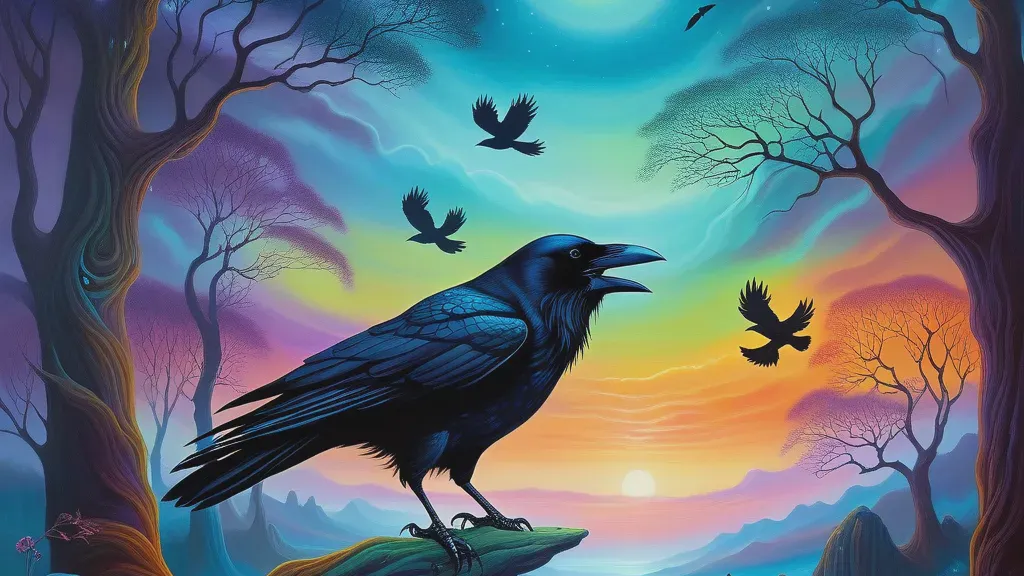
Crow
Jungian Archetypes
Meaning
Crows in dreams symbolize mystery, intelligence, and the shadow self. They represent transformation through confronting darkness and the ability to see beyond surface appearances. Crows often signal the need to embrace hidden truths or navigate complex situations with wisdom.
Psychological Interpretation
The Shadow archetype in the crow represents the parts of ourselves we deny or repress, inviting integration and wholeness. The Trickster aspect reveals cunning, adaptability, and the power to transform through unconventional means. Dreams of crows suggest the importance of acknowledging your shadow and using intelligence to navigate life's mysteries.
Contemporary Psychological
When crows appear in dreams, they often reflect the brain's processing of cognitive flexibility and adaptive problem-solving under pressure. From a contemporary neuroscience perspective, the crow symbolizes the activation of executive function networks—the prefrontal cortex systems responsible for planning, working memory, and behavioral adaptation. Dreams featuring crows frequently emerge during periods when the dreamer is consolidating new learning about how to navigate complex social or environmental challenges. The brain appears to be integrating recent experiences of having to think quickly, adjust strategies, or read subtle social cues, using the crow's known intelligence and adaptability as a metaphor for these cognitive operations. The threat simulation function of crow dreams often involves rehearsing scenarios where quick thinking and social awareness are survival advantages. The crow's reputation for intelligence and its ability to solve novel problems make it an ideal vehicle for the brain to practice threat assessment and adaptive response patterns. When someone dreams of crows, they may be running simulations of situations requiring them to outthink obstacles, navigate social hierarchies, or detect deception—all cognitive tasks that activate the same neural systems engaged during waking problem-solving. This is particularly common when the dreamer faces real-world situations demanding flexibility, strategic thinking, or the ability to read others' intentions accurately. Memory consolidation involving crows typically reflects the integration of recent experiences with social cognition and adaptive behavior. The brain may be processing lessons learned from interactions where intelligence, observation, or quick adaptation proved valuable. Crows in dreams can signal that the dreamer's brain is strengthening neural pathways related to pattern recognition, social learning, and behavioral flexibility. This consolidation often occurs after periods of intellectual challenge, social navigation, or situations where the dreamer had to rely on their wits rather than predetermined responses. The emotional regulation dimension of crow symbolism centers on managing feelings of uncertainty and the need for cognitive control. Dreams featuring crows may reflect the brain's attempt to regulate anxiety about situations requiring quick thinking or social navigation by rehearsing competence and adaptive capacity. The crow's intelligence becomes a reassurance mechanism—a way for the dreaming brain to process and metabolize concerns about whether the dreamer possesses sufficient cognitive resources to handle upcoming challenges. This emotional work is particularly active when the dreamer is facing novel situations, social complexity, or environments where traditional responses won't suffice.
Gestalt / Parts of Self
The crow in dreams represents the dreamer's own capacity for cleverness, resourcefulness, and the ability to navigate complexity with intelligence and adaptability. In Gestalt work, the crow is not a separate entity but a disowned part of the self—the part that is quick-witted, observant, and willing to operate in the shadows or margins where others fear to tread. This is the part of the dreamer that sees what others miss, that can move fluidly between worlds, and that possesses a kind of dark wisdom born from necessity and survival. When the crow appears, it is an invitation to recognize and claim this intelligence as one's own. Often, the crow is projected outward as something external, threatening, or morally ambiguous. The dreamer may see the crow as "other"—clever but untrustworthy, dark but fascinating, adaptable but unprincipled. This projection masks a disowning: the dreamer has not yet claimed their own capacity for cunning, their own comfort with ambiguity, or their own willingness to operate outside conventional boundaries. The crow asks: what part of your own intelligence, your own adaptability, your own ability to thrive in difficult circumstances, have you rejected or hidden away? The dialogue between the dreamer and the crow is a dialogue between the part that wants to be "good" or "safe" and the part that knows how to survive, how to be clever, how to see through pretense. The crow does not judge; it simply observes and acts. It represents the dreamer's own pragmatism, their own capacity to make difficult choices, their own willingness to take what they need. Ownership of the crow means integrating this intelligence—not becoming ruthless or amoral, but acknowledging that cleverness, adaptability, and the ability to navigate gray areas are legitimate parts of a whole self. Integration of the crow invites the dreamer to ask: where in my life am I being called to be more clever, more observant, more willing to adapt? Where have I been too rigid, too trusting, too willing to follow rules that don't serve me? The crow's dark wisdom is not evil; it is the wisdom of survival, of seeing clearly, of moving with intelligence through a complex world. To own the crow is to reclaim a part of yourself that is neither good nor bad, but simply alive and capable.
Jungian / Archetypal
The crow in Jungian psychology embodies the Trickster archetype—a figure of paradox, boundary-crossing, and sacred transgression. Unlike the Hero who conquers through strength or the Sage who illuminates through knowledge, the Trickster operates through cunning, deception, and the violation of established order. The crow's intelligence, its ability to use tools and solve problems through unconventional means, marks it as a psychopomp—a guide between worlds. In the collective unconscious, the crow carries the capacity to navigate liminal spaces: between life and death, order and chaos, the conscious and unconscious mind. This is not malevolence but rather the necessary function of disruption that forces growth and transformation. The crow also represents the Shadow—those aspects of the psyche that consciousness rejects or denies. Its association with death, carrion, and decay speaks to the unconscious material we avoid: mortality, decay, the parts of ourselves we deem unacceptable or "unclean." Yet the Trickster-crow does not merely embody what we fear; it reveals what we need to integrate. In the individuation process, encounters with the crow signal a call to acknowledge shadow material—the repressed instincts, forbidden desires, and authentic impulses that consciousness has disowned. The crow's blackness is not evil but rather the fertile darkness of the unconscious itself, pregnant with potential. As a keeper of sacred law and a death messenger, the crow occupies a position of authority despite its association with transgression. Many indigenous traditions recognize the crow as a guardian of mysteries and a teacher of transformation. In Jungian terms, this reflects the paradox that the Shadow and the Trickster, though dangerous and disruptive, serve an essential function in the individuation journey. The crow's magic lies in its ability to see what others cannot, to move between worlds, and to transform death into renewal. When the crow appears in the dreamscape, it announces that the dreamer stands at a threshold—a moment where old structures must break down, where the unconscious demands recognition, and where authentic transformation becomes possible through the integration of what has been rejected or hidden. The crow's presence in dreams and mythology thus signals both danger and opportunity: the danger of being consumed by shadow material, and the opportunity for genuine psychological growth through confrontation with the unconscious. Its intelligence and adaptability suggest that the path forward requires not rigid adherence to conscious values but rather the flexibility and cunning of the Trickster—the willingness to break rules, to see from unexpected angles, and to embrace the paradoxes that consciousness cannot resolve. In this way, the crow becomes a guide toward wholeness, not through denial of the shadow but through its integration into a more complete and authentic self.
Psychodynamic / Freudian
The crow in dreams operates at the intersection of manifest and latent content, where the surface image of a dark, scavenging bird masks deeper anxieties about mortality, forbidden knowledge, and the dreamer's own capacity for cunning or transgression. Manifest content presents the crow as a literal creature—present, observable, often ominous—yet the latent content reveals what the crow truly represents: the dreamer's repressed awareness of death, the pull toward knowledge that society or the superego forbids, and the shadow aspects of the self that must feed on what others discard. The crow's scavenging behavior becomes a metaphor for the psyche's own work of rummaging through repressed material, pulling up what has been buried or denied. The wish-defense dynamic at play involves a paradoxical movement: the dreamer simultaneously wishes to acknowledge mortality and forbidden truths (the crow's knowledge), yet defends against this acknowledgment through the very image of the crow itself—by externalizing death anxiety onto the bird, the dreamer can observe it from a distance rather than feel it directly. Displacement operates powerfully here; the fear of death, the guilt about forbidden desires, or the shame about one's own cunning are all displaced onto the crow, which becomes the container for what cannot be consciously owned. Condensation also occurs, as the single image of the crow compresses multiple repressed contents—death, sexuality, aggression, the forbidden—into one symbolic form. The crow's blackness itself may condense the darkness of the unconscious, the shadow self, and the void of non-being. Childhood origins often trace to early encounters with death, loss, or the discovery that the world contains danger and decay that adults do not fully explain. The crow may echo a parent's warning ("don't go near that"), a sibling's cruelty, or the child's own first witnessing of something dead or dying. In some cases, the crow represents an internalized parental voice—the superego as a dark, judgmental presence that scavenges through the child's impulses, picking apart what is "wrong" or "unacceptable." The bird's intelligence and cunning may also reflect the child's own early recognition that survival sometimes requires deception, manipulation, or the willingness to take what others have abandoned—a capacity the child learned but then repressed as "bad" or "shameful." What presses toward consciousness through the crow is the dreamer's need to integrate mortality, to acknowledge the shadow self's cunning and hunger, and to recognize that forbidden knowledge—about death, sexuality, aggression, or one's own capacity for transgression—is not inherently dangerous but rather a necessary part of psychological maturity. The crow invites the dreamer not to fear the repressed material but to recognize it as part of the self, scavenging and surviving in a world that is neither wholly safe nor wholly knowable. In this sense, the crow becomes a guide to the unconscious, a psychopomp that leads the dreamer toward integration rather than denial.
Cultural & Historical Origins
In Celtic mythology, crows are associated with the goddess Morrigan and represent prophecy and battle wisdom. Native American traditions view crows as messengers between worlds and symbols of transformation. In Japanese culture, crows (karasu) are considered omens and symbols of divine intervention.
Contextual Variations
Crow flying overhead
Gaining perspective on a situation; receiving messages from the unconscious or higher wisdom
Crow attacking
Confronting shadow aspects or difficult truths that demand acknowledgment and integration
Frequently Asked Questions
Are crows always negative symbols in dreams?
What does a murder of crows mean?
Journaling Prompts
- What shadow aspects of yourself is the crow inviting you to acknowledge?
- How can you use the crow's intelligence and adaptability to navigate current mysteries?
Related Symbols
Dreamed about Crow?
Get a personalized AI interpretation that connects this symbol to your specific life circumstances.
Interpret My Dream