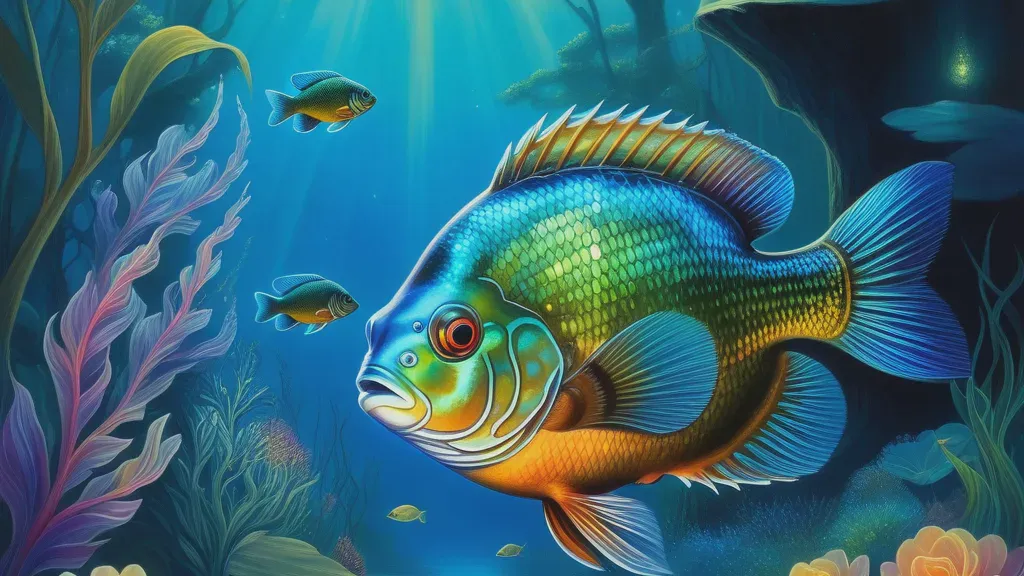
Bluegill
Jungian Archetypes
Meaning
The bluegill is a small, round, hand-sized sunfish of North American ponds and lake margins, the fish most people catch first and the one they are taught not to boast about. It lives in the shallows, bites almost anything, and is famous for being abundant rather than impressive. In dreams it therefore carries a very particular charge: the modest catch, the ordinary abundance, the thing readily available that the dreamer has been trained to discount because it is not the trophy. It also carries water and childhood together, since for many dreamers the bluegill belongs to a specific pond, a specific relative and an age before ambition. When it surfaces at night the psyche is usually raising a question about what counts as enough.
Psychological Interpretation
The dream turns on the gap between what is caught and what was wanted. A bluegill on the line is a success by any honest measure, food, skill, a fish that fought, and yet the usual response is mild disappointment, because the imagination was fishing for something larger. That reflex is the material. A small fish on the hook is generally examining a habit of dismissal the dreamer applies far more widely, to their work, their affections, their body, their own steady competence. The bluegill is not asking to be admired; it is asking why what is available keeps failing to register as real. The setting carries as much as the fish. Bluegill live in shallow water near the bank, in the zone between land and depth, and a dream that puts the dreamer at that edge describes a relationship with their own unconscious that is close, accessible and unheroic. Nothing here requires a boat or an ocean. What comes up comes up easily, a rebuke to the belief that self-knowledge must be dredged from somewhere deep and expensive. Attention matters more than equipment, and dreamers who fish well in these dreams describe quiet watchfulness rather than effort. If there is a companion, and there very often is, they carry most of the emotional weight: bluegill fishing is an inherited activity, and the fish arrives already attached to whoever first put a rod in the dreamer's hands.
Traditional Symbol Meaning
Fish have been read in dreams for as long as dreams have been written down. Artemidorus devotes a section of the second-century Oneirocritica to them, sorting fish by kind and size rather than treating them as a single sign, which is itself a useful precedent: the interpreter is expected to notice which fish it was. Gustavus Hindman Miller's Ten Thousand Dreams Interpreted of 1901 takes fish seen in clear water as favour from the rich and powerful, dead fish as the loss of wealth through calamity, and fishing as energy and economy, adding that to fish and catch nothing means efforts toward honour and wealth will be futile. Neither book has an entry for the bluegill, and the small-fish reading has to be inferred from their logic: a modest catch is a modest gain, money or luck that comes in steadily and does not last, which is a fair statement of exactly what a bluegill is. Water and the boundary at its edge carry meanings of their own. The bank is the one place a person can stand with feet in one element and head in another, and the fisherman of story is the figure who works that line: the poor man in the Grimms' tale who catches the enchanted flounder and is undone by his wife's escalating wishes, or Hemingway's Santiago, whose skill is mostly the ability to wait without disturbance. The fish that comes to the hook was not summoned; it was received. Read that way, angling dreams turn on the dreamer's conduct at the water rather than on the outcome, and greed, noise and hurry are the elements that spoil a catch. The abundance of small fish gave them a distinct place in religious imagery. The gospel accounts of feeding a crowd from a few loaves and a couple of small fish made the modest fish an emblem of unexpected sufficiency, and the early Christian use of the fish as a sign of Christ, from the Greek word ichthys, layered a second meaning onto the same humble creature. Neither tradition treats the small fish as a lesser version of a big one. In both, its smallness is the point, since the story concerns provision that arrives in a form nobody would have chosen. North American angling practice added its own rules, largely practical and largely about restraint. Size limits and the etiquette of catch and release mean the fish too small to keep goes back into the water, and a child's first catch is photographed, measured and talked about for years; between them, the returned fish and the remembered one are among the few rituals of restraint and of marking that survive in ordinary secular life. The bluegill sits at the centre of both, because it is the fish most often caught and most often thrown back. To dream of catching one is, in that idiom, to dream of a gain whose value depends entirely on whether the dreamer recognises it as one.
Jungian / Archetypal
Jung devoted the long central study of Aion to the fish as a symbol, tracing the Christian ichthys and its astrological setting to argue that the fish stands for a content of the unconscious that can become a symbol of the Self. What matters for the dreamer is the mechanism rather than the scholarship: fishing is an image of the ego at the surface, drawing up something that lives below and cannot be seen until it arrives. A bluegill is what comes up when the water is shallow and the psyche is not being asked for anything spectacular. The sunfish shape is worth noticing in this context, a bright compressed disc named for the sun, which is as close to a small mandala as a living animal gets, and a dreamer who is shown a round golden fish in clear water has been handed an image of wholeness in a deliberately unimpressive package. The archetypal figures around this dream are the Maiden and the Hero, and they pull in opposite directions. The Maiden belongs to first things, the beginning of a relationship with the world before it is graded, and a bluegill dream often restores that attitude by placing the dreamer at an age or in a scene where catching anything at all was sufficient. The Hero wants the big fish. Jung understood heroic inflation as the ego's tendency to identify with archetypal greatness, and the disappointment that so often accompanies a small catch is inflation showing itself in miniature: the dreamer's standard for a worthwhile life has been set by a figure who requires marvels. Compensation is the likely function. A person driving themselves toward some large achievement dreams of the pond behind the house, and the dream's smallness is corrective rather than dismissive. Behind the water stands the Great Mother, in her aspect as the pond that keeps producing, unspectacular and inexhaustible. Bluegill are proverbially abundant, and abundance of a low and constant kind is precisely the maternal ground that the heroic attitude overlooks in its search for the exceptional. A dream that sets a child, a grandparent and a shoal of small fish in the same scene is describing a chain of provision the dreamer inherited without noticing. There is a shadow figure in the species too. Bluegill males that mimic females in order to slip past the guardian belong to the trickster end of the psyche, and dreamers who feel like impostors in their competence may find the unconscious has chosen a startlingly exact animal to say so.
Gestalt / Parts of Self
Every part of this dream is a part of you, so take them one at a time and speak as each. I am the bluegill: I am small, I am everywhere, I take the hook readily and nobody photographs me. Notice what rises while you say it. For many people that sentence lands hard, because it names their private account of themselves, capable, available, and not the sort of thing anyone brags about. Then be the one holding the rod, and say what you were hoping for. Then, and this is the one people skip, be the water, which has been holding everything in the dream without being noticed at all. The polarity is obvious and worth working properly: small against big, enough against impressive. Stand and say I am enough as I am, then say I want something larger than this, and pay attention to which sentence your body supports and which one it merely tolerates. Most dreamers discover that they can defend either position intellectually while only one has any weight, and the split is where the work is. Then look at what you did with the fish. Keeping it, releasing it and being disappointed by it are three different relationships to your own ordinary competence, and the dream chose one of them. If you threw it back automatically, ask what else you dispose of without pausing, and try saying to the fish, before it goes, I caught you and you count. If someone was fishing beside you, do not treat them as a memory. Put them in the chair opposite and speak to them, then move over and answer as them. The person who taught you to fish is now an internal figure, and what they say in that chair is your own voice using their face, which is why the exchange is often more direct than anything that was said at the time. Finish with contact and withdrawal, the rhythm Gestalt watches for, because fishing is made of it: attention out to the water, then back to yourself, then out again. Ask where in waking life you have got stuck at one end of that cycle, either watching the float without ever feeling your own hands, or so full of your own concerns that nothing outside you registers at all.
Psychodynamic / Freudian
Manifest content here is a pond and a fish, and the latent content is almost always a relationship. The scene of learning to fish is one of the standard settings in which a child is initiated by a parent or grandparent into patience, competence and the acceptable handling of aggression: a hook is put in a living thing, the child is permitted this, and the permission is given with affection. Freud's concept of the screen memory is useful for the vividness such dreams often have, since a bright and apparently trivial recollection can hold the charge of something less easy to picture. Sublimation belongs here too. Angling converts a predatory impulse into a sport with rules, a waiting game with etiquette, and a dream that returns to it may be examining how the dreamer currently handles the wish to take. The fish itself has a long analytic association with what is small, alive and hard to hold, and the act of catching one has an unmistakable ambivalence: it is triumph and injury at once. Melanie Klein's account of reparation, the wish to restore the object one has damaged, appears with striking literalness in the ritual of unhooking a small fish and returning it to the water, and dreamers often wake from that moment with more feeling than the scene appears to warrant. Klein's envy is available in the same dream from the other side, in the reflex that spoils the catch by declaring it too small to matter, since spoiling what one has received is a defence against depending on it. Winnicott's transitional space is the third frame: the bank of a pond, absorbed and unhurried, is nearly a definition of play, and adults dream of it when the capacity has been squeezed out of their days. There is a defensive use of nostalgia worth naming. A dream that returns repeatedly to a childhood pond may be regression in the service of rest, which is legitimate, or it may be a retreat from a present conflict into a period when the dreamer's worth was not in question. The test is what happens at the edges of the dream. Adult concerns leaking into the scene, an obligation, a phone, a person from now, suggest the psyche is working rather than hiding. If the person fishing beside the dreamer is someone who has died, the dream is likely doing the work of mourning in its ordinary form, restoring the lost figure in a scene of shared competence, and such dreams tend to recur around anniversaries and around the age at which the dreamer's own children reach the age they were then.
Contemporary Psychological
Dream content research provides the frame. The continuity hypothesis, supported by decades of content analysis in the tradition of Calvin Hall and developed by William Domhoff, holds that dreams carry on the settings, people and concerns of waking life, and that individuals show remarkable consistency in what they dream about over years. Childhood locations recur in adult dreams far more than the passage of time would predict, and a well-remembered pond is exactly the sort of durable setting the sleeping brain reuses. Memory consolidation research supplies a mechanism: hippocampal and neocortical systems reactivate experience during sleep, blending recent material with older schemas, and dreams are one of the places where that blending becomes visible. The bluegill in the dream is usually not last week's fish. It is a template built from many days at the water, recruited to think about something current. Nostalgia has been studied directly, and the results argue against dismissing these dreams as sentimental. Work by Constantine Sedikides, Tim Wildschut and colleagues has found that nostalgic reflection tends to increase feelings of social connectedness, self-continuity and meaning in life, and that it is often triggered by loneliness or by periods of change rather than by simple idleness. A dream that returns an adult to a childhood bank with someone who taught them something is producing that effect at night, and the useful waking question is what has recently made continuity feel uncertain. The affective tone matters more than the content, and dreamers should note whether they woke comforted or bereft. The activity itself is worth a line of its own. Angling is a well-known example of the attentional state Mihaly Csikszentmihalyi called flow, a task with clear feedback and a manageable challenge that quiets self-referential thinking, and the ease many people feel in these dreams may be the brain rehearsing a state it can no longer reach on demand. Emotional processing during sleep, described by Rosalind Cartwright and Matthew Walker as the overnight softening of a memory's charge while its content is kept, gives a further reason why the small, calm, slightly sad fishing dream appears during difficult periods. It is not an escape from the difficulty. It is the mind treating the difficulty in a setting where the dreamer once felt competent, which is the same tactic a good therapist would choose.
Cultural & Historical Origins
The bluegill, Lepomis macrochirus, is a sunfish of the family Centrarchidae, native to eastern and central North America and known regionally as bream, brim, sunny or copperbelly. Its cultural position was fixed by twentieth-century farm-pond management, in which extension services across the American Midwest and South recommended stocking bluegill together with largemouth bass, the small fish feeding the large one and both feeding the family, so that generations of children learned to fish on a species placed there for them. That is the source of its association with beginnings: the cane pole, the bobber, the worm, the grandparent on the bank. The fish has a stranger international history. In 1960 the visiting Crown Prince Akihito of Japan was presented with fifteen bluegill in Chicago; the fish were taken home, given to a fisheries laboratory and eventually spread through Japanese lakes and rivers, where they became one of the country's most damaging invasive species. In 2007 the Emperor publicly expressed his sorrow at the consequences. Biologists know it for another reason. Mart Gross's work in the early 1980s made the species a standard example of alternative male reproductive strategies: alongside the large males who build and guard nests are small sneaker males who dart in to fertilise eggs, and satellite males who imitate the appearance and behaviour of females in order to be tolerated there. Few animals offer a more literal image of the impostor who succeeds by being underestimated.
Contextual Variations
Catching one small bluegill after another and keeping none
Steady success that you refuse to bank is the whole statement here, and the dream repeats it until it is unmissable. Each fish is a real catch, and each one goes back. Ask where you do this awake: the compliment you deflect, the piece of work you finish and do not count, the day that went well and left no impression. Notice the feeling at the moment of release, since boredom, virtue and a faint contempt are three quite different diagnoses. This dream tends to visit people who are competent and unsatisfied, and its suggestion is not to try harder but to let one ordinary success actually land.
A bluegill guarding a round nest in shallow water
Male bluegill sweep circular nests in the shallows and defend them fiercely, and a dream that shows you this is showing you protection at a small scale. The nest is round, exposed and close to the bank, which makes it a fair picture of anything valuable you are keeping in plain sight: a project, a child, a routine that holds you together, a boundary you maintain without ceremony. Ask whether you were the guard or the intruder. Guarding usually points to something you are giving more energy than you have admitted; approaching the nest points to a place where you are testing someone else's limit and know it.
Bluegill nipping at your legs while you stand in the shallows
Small aggression from something you consider harmless is a precise image. The dream is registering irritations of a size you would be embarrassed to complain about, the repeated demands, the remarks, the minor claims on your time that individually do not justify a response and collectively wear you down. Notice that you stayed in the water. Ask whether what keeps you there is patience, politeness or a belief that nothing this small should bother you. The nipping continues precisely because you have decided it is not worth addressing.
Fishing for bluegill beside a relative who has died
Dreams that restore a lost person to a scene of shared competence are one of mourning's commonest forms, and this one chose an activity rather than a conversation. What was passed to you at that water was a skill and a way of being quiet with someone, and the dream returns it intact, hands on the rod, nothing needing to be said. Notice whether the relative seemed to know they had died; the figure who knows and fishes anyway is usually the psyche giving you leave to carry on without them. Notice also what you caught: a fish landed in their company is your own competence, taught by them and now yours.
Frequently Asked Questions
Why did I dream about catching a small fish like a bluegill?
Is dreaming of a small fish a bad sign?
Why do childhood fishing dreams come back years later?
Does a bluegill dream mean I should settle for less?
Journaling Prompts
- List three things you accomplished in the past month that you have not counted as accomplishments, and beside each one write the reason you discounted it. Then choose the smallest and write about it as though it were the only thing you had done, describing it in full, giving it the attention you would give a trophy, and notice what resists while you write.
- Describe the bait you were using in the dream and what took it. Then write about what you put on the hook in waking life to get a response, the charm, the competence, the availability, the willingness to say yes, and what tends to bite. Ask whether the fish you keep catching is the one you were fishing for, and what a different bait might bring up from the same water.
- Write down who taught you to fish, or who taught you the equivalent, the first skill handed to you by someone with more patience than you had. Describe what they actually said and what you learned that they never put into words. Then write about what you are currently teaching someone else, and whether you are passing on the patience or only the technique.
- If the dream involved keeping or releasing, write both endings. First describe keeping the fish, taking it home, using it, letting the catch matter. Then describe releasing it and walking away empty-handed. Read the two versions and mark which one you wrote more easily, then write a paragraph about what that ease is telling you about how you treat what comes to you.
Related Symbols
Dreamed about Bluegill?
Get a personalized AI interpretation that connects this symbol to your specific life circumstances.
Interpret My Dream