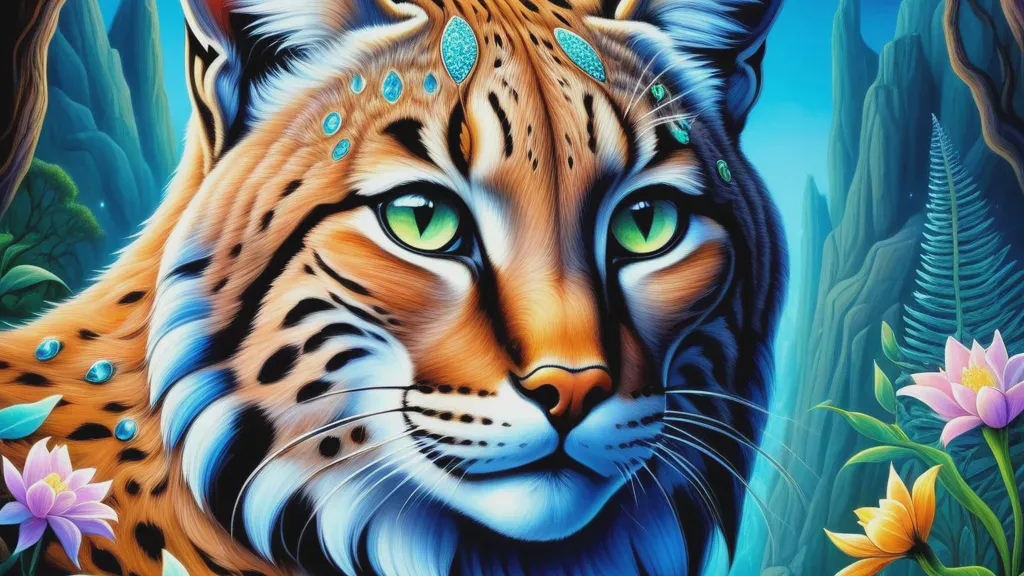
Bobcat
Jungian Archetypes
Meaning
The bobcat is a wild predator that lives closer to people than almost any other and is almost never seen: a cat twice the size of a house cat, ranging from southern Canada to central Mexico, hunting the hedgerows and drainage ditches of suburbs whose residents never know it is there. In a dream it carries the same combination of nearness and invisibility. It is instinct that was never domesticated but has learned to live beside domestication, watchful, territorial, economical with its energy, unwilling to be handled. The dreamer who meets one is usually being shown something in themselves that keeps its own hours and its own counsel, and that has been surviving at the edge of a managed life without asking permission.
Psychological Interpretation
Almost everything in a bobcat dream is carried by distance and by who moved first. The animal is rarely an attacker; it avoids people so successfully that most waking encounters last seconds at forty paces, and in dreams it keeps that behaviour, holding still at the treeline, crossing a road ahead of the car, sitting on a fence post and looking at the dreamer before it goes. What frightens is not danger but appraisal: something wild has taken the dreamer's measure and reached a conclusion. The dream tends to arrive when a person is being watched, by a manager, a family, a diagnosis, or by their own surveillance of themselves. The cat's condition matters as much as its behaviour. A sleek, unbothered bobcat is instinct in working order, hunting on its own schedule and not asking to be admired. A thin or wounded one accompanies a stretch in which the dreamer has been overriding their own signals, working through exhaustion, staying where they cannot feed themselves. A bobcat that will not leave, that returns night after night to the same window, points at a boundary that has been discussed rather than enforced. Because this animal is so seldom anything to fear on one's own land, the dread in the dream usually belongs to the dreamer, projected onto a creature that would rather not be there at all.
Traditional Symbol Meaning
The old dream dictionaries contain no bobcat, because they were written in Europe and copied from one another for centuries before anyone thought to add an American animal. What they hold instead is the cat and the wild beast, and the bobcat inherits both readings. Artemidorus, writing the Oneirocritica in the second century, took wild animals in dreams to stand for enemies and illnesses in proportion to their own nature, so a small, solitary, unpredictable predator would signify a small, solitary, unpredictable adversary rather than a catastrophe. Gustavus Hindman Miller's Ten Thousand Dreams Interpreted (1901) reads the cat as a sign of treachery and false friends, and folk lore agreed that a strange cat indoors meant a rival was already inside the walls. A bobcat dream lands on that inherited layer: not the lion's grand danger, but the smaller, closer, more personal kind. Rural North American belief added its own material, most of it shaped by the impossibility of seeing the animal. Bobcats scream in the breeding season, and the sound, high and almost human, was blamed for generations on women, ghosts and panthers; families who had farmed the same land for a century knew the cat by its voice and its tracks rather than by sight. Trappers passed on that it doubles back along its own trail and circles a bait before taking it, which made it the type of the patient adversary who never comes straight at its target. Because a sighting was rare, a bobcat crossing the road ahead of a traveller was treated as a marked event, worth telling and worth reading. Indigenous traditions across the continent, which differ from each other far more than outsiders usually allow, tend to place the cat among beings whose power is real and whose boundaries are respected rather than tested. Anishinaabe accounts of the water lynx describe a presence that must be given its due before a crossing; Plateau and Great Basin storytellers grant Wildcat the dignity of a figure Coyote cannot outwit, only rearrange. Read side by side, what survives is less a doctrine about spotted cats than an ethic: the animal is a neighbour with its own claims, not an omen to be extracted for human use. Across all these strands the tradition says one thing about the bobcat dream. The cat saw the dreamer first. Whatever the meeting meant, it began before the dreamer knew it had begun, and the counsel in the older material is always the same: find out what has been watching, find out how long it has been there, and settle the matter at a distance of one's own choosing rather than one chosen by the watcher.
Contemporary Psychological
Antti Revonsuo's threat simulation theory proposes that dreaming rehearses the recognition of and response to danger, and predator encounters are the ancestral case such a system would have been built around. What is notable about most bobcat dreams is that the simulation stops early: the animal is detected and nothing else happens. Detection, not escape, is what gets practised, which suits a brain that has decided vigilance is currently the relevant skill. It is worth holding on to the mismatch. A bobcat is not dangerous to an adult human, attacks on people are vanishingly rare, and the fear the dream produces is therefore out of proportion to the animal, which is precisely what marks it as psychological rather than practical. The continuity hypothesis accounts for who gets these dreams. Content analysis in the tradition of Calvin Hall and Robert Van de Castle finds animals in a small minority of adult dreams and far more often in the dreams of children, and the species that appear are usually those a dreamer has some contact with, in the landscape, on a trail camera, in a neighbour's photograph. Overnight memory consolidation supplies the mechanism: a recent trace, the cat glimpsed on a road or a screen, is bound to an older emotional theme that is looking for an image, and the pairing is what surfaces. Recurrence is informative in the same way, since a scene that repeats unchanged usually reports a waking situation that has not moved. Work on emotional regulation in sleep, from Rosalind Cartwright's studies of dreaming through difficult periods to Matthew Walker's account of REM sleep as reducing the charge carried by a memory, suggests the dream is processing rather than warning. Predictive processing adds the perceptual half: the brain resolves ambiguous input by proposing an agent, and a sense of being watched is one of the cheapest explanations it can generate for unexplained arousal. The practical reading follows from all of this. Track the vigilance rather than the cat, note what in the waking week has the quality of being observed or of observing, and expect the dreams to change when that does.
Jungian / Archetypal
Jung treated the animal in a dream as the instinctual psyche itself, the part of a person that obeys its own law and cannot be argued into behaving otherwise, and he considered its condition in the dream a fair report on how the conscious attitude has been treating it. The bobcat is a particular kind of animal to receive. It is not the lion of heroic myth or the tiger of overwhelming instinct; it is a small, unshowy, local predator that feeds itself competently and is almost never noticed. As an image of the Self it argues for a wholeness conducted at ordinary scale, self-regulating rather than triumphant, and it tends to appear to dreamers who have been looking for their own depths in large gestures while the real thing has been living in the scrub behind the house. In its most common form the bobcat sits at the edge of the clearing and watches, which is the classic posture of the Shadow: near, unhurried, in no way asking to be let in. Where the dreamer has organised a life around being useful, agreeable and available, the excluded material takes exactly this shape, a creature that needs nothing from them and does not apologise for its appetites. Jung also noticed that a judging or driving inner figure sometimes arrives in animal form before it can appear as a person, and a bobcat with the animus's quality of unnegotiable verdict, watching without speaking, is a complex still close to instinct, not yet human enough for the dreamer to argue with. The task is not to tame it but to learn what it wants, which is usually territory. Amplification lands on figures who keep company with wild animals rather than conquer them: Artemis in the hunting country with her creatures, the lynx of European learning whose eyes were held to see through walls, the Wildcat of Plateau story whom Coyote can only rearrange. Compensation explains the timing. A dreamer whose days are scheduled, explained and observed is sent the neighbour who lives entirely outside all three. The dream's counsel is not to bring the cat indoors but to grant it its range: individuation here means conceding that part of the personality will always live outside the schedule, and that the ego's job is to know where it hunts rather than to fence it.
Gestalt / Parts of Self
In Gestalt work the bobcat is not a visitor and not a symbol; it is you, sent out into the dream landscape because you could not hold it as yourself. Take the image and speak from inside it, in the present tense: I am at the edge of your yard. I have been here for an hour. You did not see me and I saw everything. I am not coming closer and I am not leaving. Keep going until a line arrives that you recognise as your own, and notice which part of you spoke it, the one who watches, the one who waits, or the one who has decided this ground is theirs. The polarity here is not the familiar topdog and underdog Fritz Perls described but tame and wild, the one who lives in the house and the one who lives at its edge. A cat that watches you for the whole dream and never moves is a good picture of retroflection: the pounce is fully assembled and turned back on itself, so that the energy you might use to close a distance or refuse a demand is spent instead on holding still. Set two chairs. In one, be the cat and say plainly what is yours and what you will not share. In the other, be the person at the window and say what you are afraid of. Then swap, and swap again, until the two are speaking rather than staring. Contact and withdrawal are the real subject. The bobcat is a master of withdrawal, and if you are someone who is chronically in contact, answering, available, present at everyone's request, the dream is showing you the function you exiled in order to be reachable. Owning it means being able to say I am the one who leaves without explaining, and to feel where that sentence catches in your body. The experiment is small and can be done this week: choose one boundary, mark it the way the cat marks, without argument or announcement, and stay with what rises when nobody is given a reason.
Psychodynamic / Freudian
The psychodynamic question is never the cat but what the cat has been recruited to carry. Freud's account of Little Hans turned on displacement, a fear of the father relocated onto a horse the boy could avoid, and the animal in a dream still works this way, offering a form that can be dreaded safely because it has no name and sends no messages. The Wolf Man's famous dream, of white wolves sitting motionless in a tree and staring at the child through the window, gave Freud a further mechanism: he read the wolves' intense looking as a reversal, the dreamer's own act of looking handed to the figures in the tree. A bobcat that holds the dreamer's gaze from the treeline is a strong candidate for the same reversal, and the useful question becomes what the dreamer has been watching, and whom. Object relations reads the animal as a piece of the internal population. Melanie Klein described the persecutory object formed when a child's own aggression is put outside and met again as a threat, and the stalking predator that never attacks has that structure: hostile in the way it is felt, harmless in what it does. Winnicott offers the warmer reading. His remark that it is a joy to be hidden and a disaster not to be found describes the bobcat's life exactly, and for a dreamer who built a compliant self early, the unfound cat in the brush is the true self, intact, competent, and never yet come upon by anyone who mattered. Wish and defence are both legible in the animal's independence. The wish is for a self-sufficiency that needs nobody, feeds itself, and cannot be reached by the people who have made claims; the defence is the withdrawal that makes such a life possible, affect held at a distance where it cannot be provoked. In treatment the figure can appear once the analytic relationship has begun to matter, sometimes just before a cancelled session or a silent hour. The patient who arrives, reveals nothing and observes the analyst closely is doing the bobcat's work in the room, and naming it gently is usually more productive than trying to close the distance.
Cultural & Historical Origins
The bobcat's meanings arrive from two directions: the lynx family's European reputation for hidden sight, and the traditions of the land it actually inhabits. Pliny the Elder repeats an older claim, found also in Theophrastus, that the lynx buries its urine out of envy and that it hardens underground into the gem lyncurium, a creature defined by what it conceals. The same eyes gave Europe the adjective lynx-eyed, the constellation Lynx that Johannes Hevelius set in the northern sky in the 1680s, remarking that only the lynx-eyed would pick out its faint stars, and the Accademia dei Lincei of Rome, founded in 1603, which counted Galileo among its members and took the animal's sight as the emblem of scientific looking. In North America the animal has its own stories. Anishinaabe tradition knows Mishibizhiw, the horned water lynx of the Great Lakes, a being of deep water and copper painted on the rock at Agawa on Lake Superior, not to be offended. Versions of a story told across the Plateau and Great Basin explain the bobcat's flat face and short tail as Coyote's work, done while Wildcat slept, with Wildcat waking to stretch Coyote's nose in return. American English took the animal's other name for anything unlicensed: wildcat banks in the 1830s, wildcat wells, wildcat strikes called without the union. The most recent layer is popular animal-symbolism literature: Jamie Sams and David Carson's Medicine Cards (1988) gave the lynx the keeping of secrets, and much of today's online bobcat lore descends from it.
Contextual Variations
A bobcat watching you from the edge of the yard
The edge is the whole image. The cat is neither in your house nor away in the wild but at the line where the mown grass stops, which is where half-domesticated things wait. To be watched from there is to be appraised by something that owes you nothing and is not afraid of you. The dream turns up when someone in your waking life has that quality, or when part of you has been standing at the boundary of your routine keeping its own hours. Notice whether you wanted it to come closer or to go. Wanting it gone is a wish to keep the yard exactly as it is.
Following bobcat tracks in snow that stop at nothing
Tracks are evidence of a presence you missed, and a trail that simply ends says the thing you are tracking got past you. This dream comes to people assembling proof, of an affair, an illness, a decision someone else has already taken, who cannot get the evidence to resolve into a fact. Bobcats do double back and circle, which is why the trail feels deliberate. Ask whether you are following the cat or being led by it, and consider that what you want to know may only arrive when you stop walking and let it come back to look at you.
A bobcat asleep on your bed
A wild animal asleep in the most private room of the house is an image of trust and of an intrusion so complete you did not wake for it. If the feeling was warmth, something that lives outside your ordinary personality has come in and made itself at home, which tends to follow a period of finally saying what you want. If the feeling was alarm, ask who has been given access to your bed, your rest and your unguarded hours without your having decided to grant it. A sleeping cat is not dangerous. That it got in is what the dream is showing you.
A bobcat caught in a leg-hold trap
An animal built for withdrawal, held in place. This is the most painful form the dream takes, and it arrives when your own capacity to leave has been removed: a contract, a mortgage, an illness, a caretaking duty you cannot put down. The fury in the trap is the part of you that has not accepted the situation, and dreamers often wake more shaken by that fury than by the injury. Notice what you did. Freeing it says you are ready to pay for your release; standing there unable to touch it says you have not yet decided the trapped thing is yours.
Frequently Asked Questions
Is a bobcat in a dream a threat or a guide?
Why did the bobcat in my dream watch me without attacking?
Is dreaming of a bobcat different from dreaming of a lion or a house cat?
Why do I keep dreaming about a bobcat near my home?
Journaling Prompts
- Draw the edge of your own territory the way the dream drew it, at the line where the cut grass ends. Then write down who is standing there at the moment, close enough to be seen and not close enough to be dealt with, and what you have been telling yourself about why that line has not moved in either direction for months.
- Bobcats hunt at dusk and dawn, in the light that belongs to nobody's schedule. Write down which hour of your day is yours in that way, what you would do with it if no one knew, and what has quietly been claiming those hours instead. Name the claim exactly, and name who makes it.
- A bobcat spends almost nothing it does not need to: it waits, takes one animal, eats, and rests. Account for yesterday hour by hour and mark each entry as hunting, resting or performing for an audience. Then write what the cat would have cut from the day, and what you are afraid would happen if nobody saw you working.
- The bobcat's tail is short and the animal balances anyway. Name something in you that was cut off early, an education, a friendship, a talent, a stretch of childhood, and write about the adaptation rather than the loss: what you learned to do instead, how well it has worked, and what keeping it up has cost you.
Related Symbols
Dreamed about Bobcat?
Get a personalized AI interpretation that connects this symbol to your specific life circumstances.
Interpret My Dream