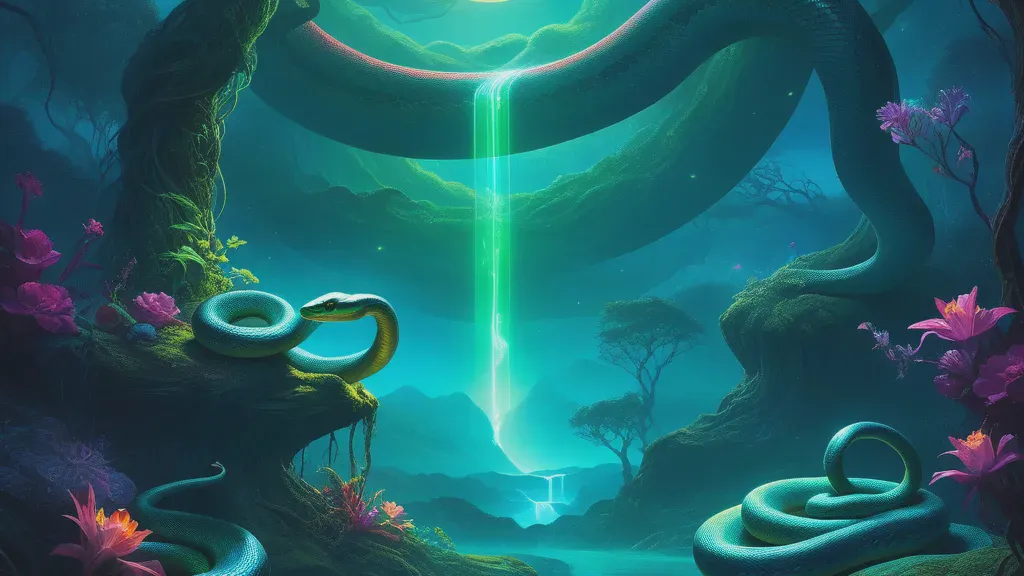
Snake Dreams
Dreams featuring snakes are among the most common and symbolically rich dream experiences. They may involve encounters with snakes in water, forests, or homes, and can range from peaceful to threatening scenarios.
Psychological Interpretation
Snakes in dreams often represent transformation, healing, and renewal due to their shedding of skin. They can also symbolize hidden threats, wisdom, or aspects of yourself that you find difficult to acknowledge or integrate.
Had this dream?
In a home, forest, or water, is a snake calm beside you or lunging from hiding? Tell us what happened and get a personalized interpretation of your own dream.
Interpret My DreamPersonal Meaning
In the personal-meaning framework, a snake that appears in a dream is often a symbol of a hidden or suppressed aspect of the dreamer’s inner life that is beginning to surface. The image of a slithering creature can tap into the dreamer’s own sense of vulnerability, especially when the snake is perceived as threatening, but it can also point to a source of vitality and transformation if the dreamer feels curiosity rather than fear. Psychologically, the snake activates the brain’s threat-detection circuitry while simultaneously engaging the part of the mind that registers change, because snakes shed their skin and reappear renewed. The emotional pattern that typically accompanies such a dream is a tension between anxiety about loss of control and a subtle attraction to the unknown, a push-pull that mirrors the dreamer’s waking struggle with a situation that feels both dangerous and potentially liberating. People experience snake dreams when an unresolved conflict, a repressed desire, or a looming decision has been lingering beneath conscious awareness. The dream’s vividness often spikes when the dreamer is faced with a choice that requires letting go of an old habit, belief, or relationship, and the subconscious uses the snake as a metaphor for the necessary shedding of the old self. A practical insight is to treat the snake as a diagnostic prompt: ask oneself what in current life feels “coiled” or “constricting” and what would happen if that tension were released. Reflective questions might include: What recent event has made me feel both threatened and intrigued? Which part of my daily routine feels stale, and what would it look like if I allowed it to change? How do I typically respond when something unexpected appears—do I retreat, or do I observe with curiosity? By answering these questions, the dreamer can map the snake’s symbolic charge onto a concrete waking-life issue and begin to negotiate the balance between fear and growth.
Contemporary Psychological
A snake appearing in a dream often signals the brain’s effort to integrate a lingering emotional charge that has not been fully processed during waking life. Contemporary neuroscience suggests that during REM sleep the limbic system, especially the amygdala, reactivates memories that carry strong affective weight, while the prefrontal cortex attempts to contextualize them. When a sleeper has recently encountered a situation that feels deceptive, unpredictable, or threatening—such as a conflict at work, a betrayal in a personal relationship, or an unresolved fear of loss—the neural circuitry may select the archetype of a snake because its visual and kinetic qualities efficiently encode the dual sensations of danger and intrigue. The dream’s vividness reflects the amygdala’s heightened arousal, whereas the narrative surrounding the snake—whether it is chased, killed, or coiled harmlessly—mirrors the brain’s ongoing attempt to reconcile the threat with existing schemas. The repeated emergence of snake imagery can therefore be understood as a threat-simulation mechanism that allows the sleeper to rehearse coping strategies in a safe, simulated environment. By confronting the symbolic predator, the mind tests emotional responses, updates predictive models, and consolidates the memory into a less volatile form. This process is especially pronounced when the individual’s waking concerns involve power dynamics, hidden motives, or a sense of vulnerability. A practical insight drawn from this perspective is to treat the dream as a diagnostic cue: after waking, the person should note what specific feelings the snake evoked—fear, fascination, disgust, or calm—and then examine recent real-world events that might have triggered those feelings. By mapping the dream’s emotional tone onto current life stressors, the individual can identify which threat perception remains unresolved and consciously address it through dialogue, boundary-setting, or therapeutic reflection, thereby reducing the need for the brain to replay the scenario during sleep.
Jungian / Archetypal
In Jungian analysis the snake functions as a potent archetypal image that emerges from the collective unconscious, embodying the dual nature of danger and renewal. Its sinuous form and capacity to shed skin link it to the archetype of the Great Mother and the process of individuation, where the old self is discarded in order to reveal a more integrated personality. At the same time the snake’s association with venom and hidden movement activates the shadow, the part of the psyche that contains repressed instincts, fears, and impulses that the conscious ego has not yet acknowledged. When a dreamer encounters a snake, the symbol often signals that an unconscious content—whether a suppressed desire, a latent aggression, or an unprocessed trauma—is seeking conscious recognition, urging the individual to confront the aspects of self that have been kept out of awareness. The emotional pattern that accompanies snake dreams typically involves a mixture of fascination, dread, and a visceral sense of being watched or threatened, reflecting the tension between the desire for transformation and the fear of the unknown. People experience this dream when the psyche is negotiating a transitional phase—such as a career change, a relationship shift, or a personal crisis—where the old patterns must be released. The snake’s appearance can be interpreted as a warning that the shadow material is becoming too powerful to remain hidden, and that integration is required to prevent it from manifesting destructively. A practical insight for the reader is to treat the snake not merely as a frightening figure but as an invitation to examine what in their life feels “tight” or “constricted,” and to consciously engage with that material through reflection, journaling, or therapy, thereby turning the unsettling image into a catalyst for personal growth.
Gestalt / Parts of Self
From a Gestalt standpoint a snake that appears in a dream is understood as a fragment of the dreamer’s own organism that has been split off and cast onto an external figure. The sinuous, often threatening quality of the animal signals a part of the self that feels dangerous, hidden, or uncontrollable, yet it is still a living, feeling element of the dreamer’s total field. When the snake coils around the body, slithers across a path, or bites, the dream is dramatizing the way this disowned segment is trying to make itself known, demanding attention that the conscious mind has been denying. The emotional texture that accompanies the snake—tightness in the chest, a surge of fear, a simultaneous fascination—reveals the tension between the urge to protect the self and the impulse to acknowledge the vitality that the excluded part holds. The psychological significance of this projection lies in the way it mirrors an unresolved internal conflict. The dreamer may be avoiding a feeling of sexuality, aggression, or transformation that feels too potent to integrate, so the mind externalizes it as a snake, a symbol that can be both alluring and threatening. This externalization creates a pattern of avoidance: the dreamer watches the snake from a distance, feels a spike of anxiety, and then wakes with a lingering sense of unease, reinforcing the split. The recurring presence of the snake indicates that the underlying issue remains unprocessed, and the dream serves as a repeated invitation for the self to reclaim the disowned fragment. A practical insight is to treat the snake not as an ominous omen but as a cue to pause, notice the bodily sensations it elicits, and ask what personal quality—perhaps a repressed desire, a suppressed anger, or a latent capacity for renewal—might be trying to surface. By consciously acknowledging and naming this part, the dreamer can begin the process of reintegration, allowing the snake’s energy to be channeled into conscious awareness rather than remaining a hidden, projected threat.
Psychodynamic / Freudian
In the psychodynamic view a snake that appears in a dream is the manifest content that the sleeper reports, but the latent content lies in the symbolic associations the unconscious has attached to the animal. The snake’s sinuous shape, its potential to strike, and its historical link to both danger and renewal allow it to stand in for repressed wishes or conflicts that the ego cannot acknowledge directly. When the dreamer is startled by a coiled snake, the anxiety that surfaces often reflects a displaced fear of an unacceptable impulse—perhaps a sexual desire, an aggressive urge, or a longing for change that the conscious mind has suppressed. The unconscious may employ defense mechanisms such as projection, casting the dream’s own hostile or erotic energy onto the snake, or displacement, allowing the dreamer to experience the feeling in a less threatening form. The wish-fulfillment aspect can be paradoxical: the dream may grant a safe arena in which the sleeper can confront the forbidden content, yet the snake’s threatening appearance keeps the ego from fully integrating the wish, maintaining the tension between desire and repression. The psychological significance of recurring snake dreams lies in the pattern of emotional avoidance and the need for transformation. The dreamer’s repeated encounter with the reptile signals that a core conflict—often related to intimacy, power, or personal growth—remains unresolved, and the unconscious repeatedly offers the snake as a metaphorical messenger. The emotional pattern typically includes a mix of fascination and dread, indicating that the individual is both drawn to and repelled by the underlying material. Experiencing such dreams suggests that the ego is employing a defensive posture to keep the repressed material at bay, yet the vividness of the snake points to an increasing pressure for integration. A practical insight for the reader is to notice moments in waking life when a feeling of “tightness” or “slithering” arises in response to a situation that feels both alluring and threatening; by naming that feeling and exploring what desire or fear it may be masking, the individual can begin to loosen the defensive grip and allow the latent content to be processed rather than projected onto an external symbol.
Stress & Emotional Patterns
Seeing a snake in a dream often surfaces when the mind is trying to map a hidden, lingering tension onto a vivid symbol. The slithering movement, the sudden strike, or the feeling of being watched can mirror the way anxiety coils around daily responsibilities, making the stress feel both immediate and elusive. For many, the snake’s appearance coincides with periods of high workload, relationship strain, or unresolved conflict, where the subconscious flags a threat that is not overtly visible in waking life. The dream may amplify feelings of vulnerability, as the snake’s unpredictable nature reflects a perception that something in the environment could “bite” at any moment, even if the actual source of pressure is a looming deadline, a financial worry, or an unspoken expectation. In this way, the dream functions as an emotional barometer, signaling that the dreamer’s nervous system is operating on high alert and that the mental load is approaching a tipping point. A practical, grounded response begins with acknowledging the snake as a metaphor rather than a literal omen, then gently exploring what in the waking world feels “snaky” – perhaps a situation that feels slippery, deceptive, or out of control. Journaling the emotions that arise during the dream, noting whether the snake is feared, fascinated, or even protected, can reveal whether the stress is being externalized (a hostile work environment) or internalized (self-criticism, perfectionism). From there, concrete steps such as setting clear boundaries around the identified stressor, breaking large tasks into manageable chunks, or scheduling brief “reset” moments (deep breathing, a short walk, or a grounding exercise) can reduce the physiological arousal that fuels the dream’s intensity. If the snake repeatedly appears despite these adjustments, it may be helpful to talk with a therapist or trusted confidante, using the dream as a starting point to unpack deeper anxieties and develop coping strategies that restore a sense of safety and agency.
Frequently Asked Questions
What does a snake dream usually mean?
Snake dreams typically relate to transformation and change in your life. They may indicate that you're shedding old patterns or beliefs, or that you need to pay attention to something hidden or dangerous that requires your awareness.
Is a snake dream always negative?
Not necessarily. While snakes can represent danger or deception, they also symbolize healing, wisdom, and positive transformation. The overall feeling and context of the dream determine whether the message is cautionary or encouraging.
Related Symbols
Had this dream?
Get a personalized AI interpretation that connects your dream to your specific life circumstances.
Interpret My Dream