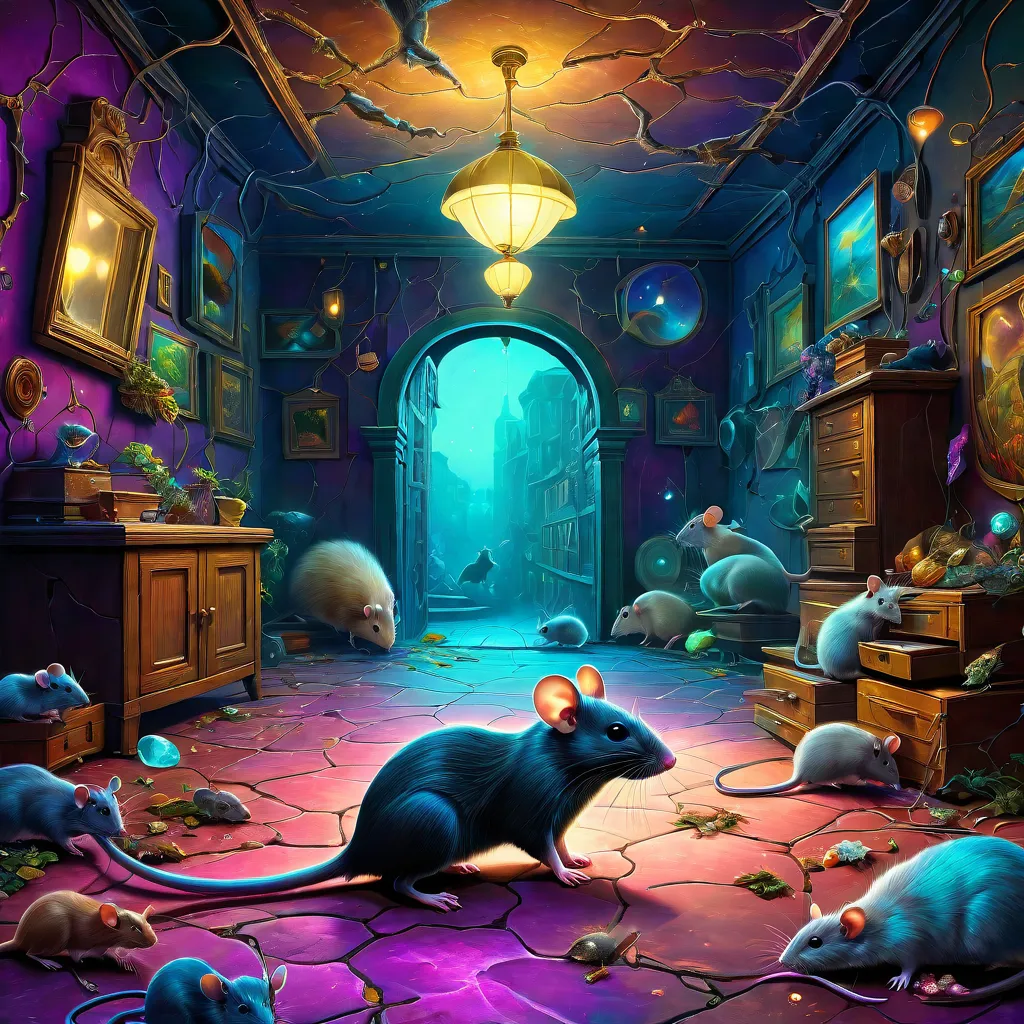
Rats & Mice
Dreams of rats and mice often unfold in dim, cluttered spaces where the small rodents scurry across the floor, sometimes gnawing at objects or disappearing into cracks. The dreamer feels a sudden prickling of unease, a cold draft, and a heightened awareness of tiny movements.
Psychological Interpretation
You may be sensing hidden anxieties about something that feels invasive or out of control in your waking life. These dreams frequently arise when you are dealing with minor but persistent stressors—financial worries, workplace politics, or strained relationships—that seem to gnaw at your peace of mind. The presence of rats or mice can also point to a need to confront overlooked details or to clean up neglected aspects of your environment.
Had this dream?
Are rats or mice scurrying through a cluttered room, gnawing at things, or vanishing into cracks? Tell us what happened and get a personalized interpretation of your own dream.
Interpret My DreamPersonal Meaning
When rats or mice appear in a dream, the mind is often surfacing a sense of contamination or intrusion that has been lurking in the background of daily life. In the framework of psychodynamic analysis, these small, quick-moving creatures can symbolize parts of the self that feel sneaky, hidden, or morally ambiguous—behaviors or thoughts that the dreamer has tried to keep out of conscious awareness. The emotional tone that accompanies the animal—whether it is disgust, fear, curiosity, or even a strange affection—reveals how the dreamer is currently coping with the tension between the desire to control the environment and the fear that something unwanted is gnawing at the foundations of that control. The recurrence of this theme often stems from situations where the dreamer feels their personal space, values, or routines are being subtly eroded. It may be a workplace where petty politics or unnoticed ethical compromises are spreading, a relationship where small betrayals or unspoken resentments are festering, or an internal habit such as procrastination that feels like a quiet pest. To connect the dream to waking life, the dreamer can ask: What recent events have left a lingering feeling of unease that is hard to name? Which aspects of my daily routine feel “infested” by habits I wish I could eliminate? When I think of the rats or mice, do I focus on their movement, their sound, or the mess they leave behind, and what does that focus tell me about what I consider most threatening right now? A practical step emerging from this interpretation is to isolate one concrete area that feels compromised and design a small, measurable intervention to reclaim it. For example, if the dreamer identifies a cluttered desk as a physical manifestation of mental clutter, setting a timer for ten minutes each evening to clear a single drawer can restore a sense of order and reduce the feeling of being overrun. By turning the vague anxiety sign by the dream into a specific, actionable task, the dreamer creates a feedback loop that diminishes the subconscious alarm and reestablishes a feeling of agency over the “pests” that have been silently proliferating.
Contemporary Psychological
Dreams about rats and mice often emerge when the brain’s threat-simulation system, which is most active during rapid-eye-movement sleep, flags subtle sources of danger that have been ignored during waking hours. The amygdala and hippocampus jointly replay recent emotional memories, and the presence of small, quick-moving rodents can be a neural shorthand for feelings of contamination, betrayal, or loss of control that are too minor to dominate conscious thought but still register as a low-grade alarm. In this context the rodents act as a proxy for social or environmental stressors that are perceived as sneaky or hidden—such as a coworker’s passive-aggressive behavior, a lingering guilt about a minor transgression, or an unaddressed health worry. The brain’s default mode network stitches these fragments into a narrative that preserves the emotional charge, allowing the sleeper to rehearse a response to a threat that is not overtly threatening but nonetheless unsettling. The psychological significance of these dreams lies in their role in emotional regulation and memory consolidation. When a person repeatedly encounters rats or mice in sleep, it often signals that the limbic system is still trying to integrate a specific affective experience—perhaps a feeling of being “chewed up” by circumstances that seem insignificant but are persistent. The disgust or fear evoked by the rodents can amplify the salience of the underlying memory, strengthening its encoding in the hippocampal-cortical dialogue that occurs during REM. Consequently, the dream serves as a rehearsal that can either reinforce avoidance patterns or, if the sleeper becomes aware of the symbolic content, provide an opportunity to reframe the emotional response. A practical insight is to notice the specific context in which the rodents appear—whether they are scurrying through a kitchen, hiding in a wall, or being chased—and to map that setting onto a current life domain. By identifying the real-world “nook” where a small but persistent stressor resides, the individual can take a concrete step—such as setting a boundary, addressing a lingering worry, or cleaning up a literal cluttered space—to reduce the brain’s need to simulate the threat during sleep.
Jungian / Archetypal
In Jungian terms the appearance of rats or mice in a dream is often a manifestation of the shadow archetype, the portion of the psyche that contains material that has been denied, suppressed, or deemed unacceptable by the conscious ego. These small, nocturnal creatures are associated with the underworld of the unconscious, where they scurry in the hidden corners of the mind, gnawing at the foundations of one’s sense of safety and order. Within the collective unconscious, rats and mice have been cast as both pestilence and tricksters, embodying the paradox of destruction and survival; they remind the dreamer that the psyche possesses a primal, instinctual layer that can surface when the conscious mind is preoccupied with rational concerns and neglects its deeper, animalistic currents. The emotional pattern that typically accompanies this dream motif is a mixture of anxiety, disgust, and a feeling of being invaded or contaminated. The dreamer may experience a sensation of loss of control, as if something small yet persistent is eroding boundaries, which often mirrors real-world situations where the individual feels overwhelmed by minor but relentless stressors—financial worries, interpersonal tensions, or health concerns that have been pushed aside. The presence of rats or mice signals that the ego is being called to acknowledge the parts of itself that have been relegated to the “dark,” such as selfish urges, shame, or a fear of being unclean, and that these neglected elements are beginning to assert themselves in the symbolic language of the dream. A practical way to work with this symbol is to treat the rat or mouse as a messenger rather than a monster, observing what it is doing in the dream scene and asking what aspect of the self it might be representing. If the creature is scurrying through a kitchen, the dreamer might explore feelings of being “eaten away” by concerns about nourishment, both literal and emotional; if it is hiding in a wall, the image may point to suppressed thoughts that are building pressure. By consciously naming the shadow content that the animal embodies and allowing it a place in the waking narrative—through journaling, dialogue, or symbolic action—the individual begins the process of integration, moving a step closer to individuation and reducing the recurring anxiety that the dream reflects.
Gestalt / Parts of Self
In a Gestalt framework the presence of rats or mice in a dream is taken to signal that the dreamer is confronting a fragment of the self that has been split off and relegated to the unconscious. The tiny, often furtive rodents embody qualities such as resourcefulness, survival instinct, or a sense of being unwanted, and the dream projects these qualities onto the animal rather than recognizing them as part of the dreamer’s own personality. By visualizing the creature as an external entity, the mind creates a temporary boundary that allows the dreamer to observe the disowned aspect without having to immediately own it, thereby keeping the larger self-structure intact while still offering a glimpse of the hidden material. The emotional tone that accompanies the rat or mouse—whether it is fear, disgust, curiosity, or a strange affection—reveals the underlying pattern of avoidance or denial that has been at work in waking life. A feeling of revulsion may indicate that the dreamer has been suppressing a need for self-preservation or a willingness to scavenge for resources, while a more neutral or even compassionate response can suggest an emerging willingness to acknowledge the value of those survival strategies. The dream often arises when the individual is faced with a situation that threatens their sense of control, prompting the psyche to externalize the disowned part as a creature that is both small enough to be manageable and capable of slipping through cracks in the conscious awareness. A practical step that emerges from this interpretation is to treat the rat or mouse as a symbolic messenger and to ask, in a calm waking moment, what specific ability or feeling the animal might be pointing to. By naming the quality—such as “my capacity to be adaptable in tight circumstances”—and consciously allowing it to enter the narrative of the self, the dreamer can begin the process of reintegration, turning a previously rejected fragment into an accepted resource that supports a more cohesive sense of identity.
Psychodynamic / Freudian
In a psychodynamic reading the overt image of rats or mice scurrying through a house, a kitchen, or a field is the manifest content of the dream, while the latent content often points to a cluster of repressed impulses related to feelings of contamination, loss of control, or unacknowledged aggression. The small, quick, and often hidden nature of these rodents can symbolize an instinctual drive that the dreamer has pushed out of conscious awareness because it conflicts with their self-image or social expectations. The dream may function as a disguised wish fulfillment: the unconscious mind allows the dreamer to confront a threatening, yet familiar, element in a symbolic form that is less threatening than the actual source of anxiety, such as a hostile relationship, a fear of being overwhelmed by responsibilities, or a suppressed sexual or aggressive urge. By presenting the threat as a harmless animal, the psyche can briefly grant the dreamer a sense of mastery over the underlying conflict while keeping the true source of tension concealed. The emotional pattern that typically accompanies these dreams includes a lingering sense of disgust, fear, or irritation that persists after waking, reflecting the underlying defensive processes of repression and displacement. The dreamer may unconsciously employ mechanisms such as reaction formation—presenting an exaggerated calm or even affection toward the rodents—to mask the deeper dread they provoke, or projection, attributing the unpleasant qualities of the rodents to other people in their waking life. The recurrence of rat or mouse imagery often signals that the individual is avoiding a situation that feels invasive or uncontrollable, and the dream serves as a symbolic alarm that the repressed material is demanding attention. A practical insight for the reader is to notice moments in daily life when small, seemingly insignificant irritations—like a nagging thought, a minor conflict, or a habit that feels “creepy”—are being dismissed; acknowledging these as possible expressions of the same underlying tension can begin to dissolve the defensive barrier and reduce the need for the dream to repeat the rodent motif.
Stress & Emotional Patterns
Dreams of rats or mice often surface when the mind is trying to flag a persistent sense of being “invaded” by small, hard-to-control worries. The tiny, scurrying creatures can symbolize the many minor stressors that accumulate—tight deadlines, interpersonal frictions, or health concerns—that feel insignificant on their own but together create a feeling of overwhelm. Because rodents are associated with hidden spaces and nocturnal activity, the dream may be pointing to anxiety that lives in the background, perhaps in a part of life the dreamer has not fully acknowledged, such as an unspoken conflict at work or a lingering self-criticism that keeps resurfacing. The emotional tone of the dream—whether it is disgust, fear, or a strange fascination—offers clues about how the dreamer is coping: disgust or fear suggests a defensive stance, while fascination may indicate a subconscious curiosity about the very issues they are trying to suppress. A supportive way to address this imagery is first to pause and name the “rats” in waking life, turning vague pressure into concrete items on a list. Practicing a brief body-scan before bed can reveal where tension is held, and a simple grounding exercise—such as naming three things you can see, hear, and feel—can help the nervous system settle, reducing the likelihood that the mind will dramatize stress as a swarm of rodents. If the dream recurs, keeping a short journal of the emotions felt during the dream and the events of the day before can uncover patterns, allowing the dreamer to take targeted action, like setting boundaries, delegating tasks, or seeking a brief conversation with a trusted colleague or therapist. Over time, as the underlying stressors are addressed and the dreamer learns to acknowledge rather than avoid them, the rats and mice lose their symbolic power and the sleep experience becomes calmer and more restorative.
Related Symbols
Had this dream?
Get a personalized AI interpretation that connects your dream to your specific life circumstances.
Interpret My Dream