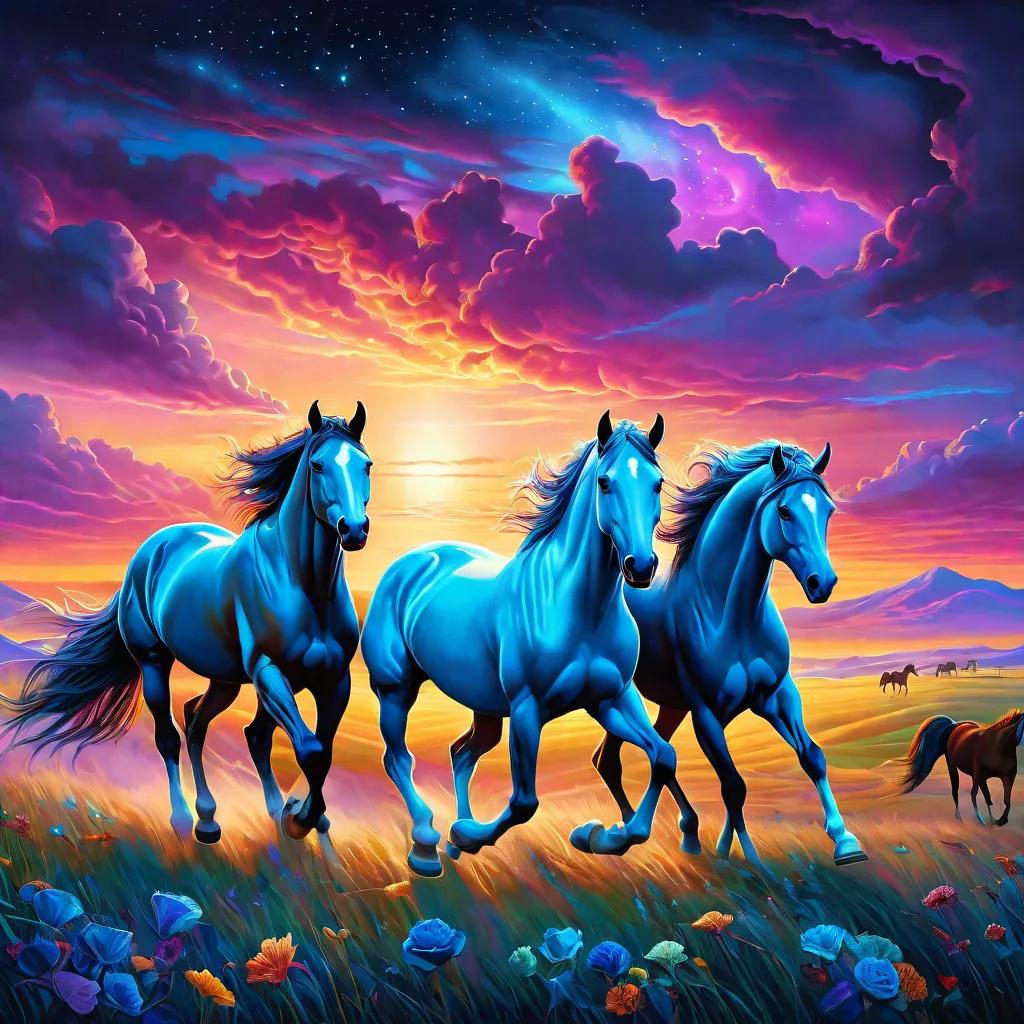
Horses
Dreams of horses often place the dreamer in a wide, open field or a bustling stable, feeling the thrum of hooves and the wind against their skin as the animal gallops or stands still. The scene feels vivid, with the scent of hay or the echo of distant thunder amplifying a sense of power and freedom.
Psychological Interpretation
You may be confronting a surge of personal drive or a need to harness untamed energy in your waking life, especially when work or relationships demand swift action. This dream can surface during periods of transition, urging you to channel confidence while staying aware of the risks of reckless haste.
Had this dream?
Are horses thundering across an open field, or are you standing quietly among them in a stable? Tell us what happened and get a personalized interpretation of your own dream.
Interpret My DreamContemporary Psychological
In contemporary dream research, the appearance of horses is often interpreted as a neural echo of the brain’s effort to integrate recent experiences of bodily vigor, social interaction, and environmental movement. The hippocampal-cortical dialogue that consolidates memory during sleep can replay the kinetic sensations of riding, running, or handling a horse, especially when those sensations have been salient in waking life. Because horses are large, fast, and socially attuned animals, their representation in REM sleep can activate the amygdala’s threat-simulation circuitry, allowing the mind to rehearse scenarios of pursuit, escape, or cooperation without real-world risk. The brain’s predictive coding mechanisms thus treat the horse as a high-impact stimulus that tests the sleeper’s capacity to regulate arousal, coordinate action, and negotiate social hierarchy. From a psychological standpoint, dreaming of horses frequently signals a tension between the desire for unrestrained energy and the constraints imposed by current responsibilities. When the dream horse is wild and untamed, the sleeper’s limbic system may be expressing unresolved impulses toward autonomy, whereas a calm, domesticated horse can indicate a sense of partnership and trust in one’s own abilities. The emotional tone of the dream—whether exhilaration, fear, or melancholy—mirrors the underlying affective state that the brain is processing, such as excitement about a new project, anxiety about losing control, or grief over a diminished sense of vitality. The prevalence of horse imagery across cultures suggests that the brain leverages a familiar, evolutionarily relevant archetype to rehearse coping strategies for both approach and avoidance motivations. A practical takeaway for readers is to pause when a horse appears in a dream and note the bodily sensations that accompany it—tightness in the chest, a surge of adrenaline, or a feeling of lightness. By linking those somatic cues to current life domains—career ambitions, relationship dynamics, or health goals—the individual can identify whether the dream is urging a release of pent-up energy, a reassessment of personal boundaries, or a reinforcement of collaborative confidence. This embodied reflection can guide concrete actions, such as scheduling a physical activity that mirrors the horse’s motion, setting a boundary that restores a sense of control, or seeking a trusted partner to share a challenging endeavor.
Jungian / Archetypal
In Jungian terms a horse that appears in a dream is often an image of the instinctual energy that lies in the collective unconscious, a living embodiment of the “animus” or “anima” depending on the dreamer’s gender, and a symbol of the untamed, vital force that drives the psyche toward growth. The horse’s power, speed, and freedom point to the raw, primal impulses that have been repressed or domesticated in everyday life, while its behavior—whether it is wild and unbridled, obedient and harnessed, or wounded and stumbling—reveals how the dreamer is relating to those inner currents. When the horse is strong and spirited, it signals a surge of creative vitality that is ready to be integrated; when it is frightened or out of control, it marks a conflict between the conscious ego and the shadow aspects that fear loss of mastery or surrender. The emotional pattern behind the horse dream often involves a tension between the desire for autonomy and the fear of being overwhelmed by one’s own power. The dreamer may be experiencing a life transition—such as a career change, a new relationship, or a personal crisis—that awakens the need to harness inner strength while confronting the anxiety of losing control. The collective unconscious supplies the horse as a universal archetype of freedom and power, allowing the individual to externalize internal struggles and to recognize that the same energy can be both constructive and destructive depending on how it is integrated into consciousness. A practical insight that emerges from this interpretation is that the dreamer should observe the horse’s condition and relationship to the rider, if any, as a mirror of how they are currently managing their own drive. If the horse is resisting or bucking, the individual might benefit from practices that bring awareness to suppressed impulses—such as journaling, movement, or creative work—to negotiate a healthier partnership between ego and instinct. By consciously “riding” the horse rather than being dragged by it, the dreamer moves a step closer to individuation, aligning personal ambition with a deeper, more balanced sense of self.
Gestalt / Parts of Self
In Gestalt terms a horse that appears in a dream is rarely a random animal; it is a fragment of the dreamer’s own psyche that has been split off and projected onto the external scene. The horse carries the qualities of raw power, unmediated movement, and instinctual drive, so when it shows up the mind is signaling that a vital, energetic part of the self is being denied a place in conscious awareness. The dreamer may see the horse galloping freely, being ridden, or standing still, each posture reflecting a different way the disowned element is being negotiated—either as a force that wants to be harnessed, as a wild impulse that resists containment, or as a dormant strength waiting for acknowledgment. The emotional pattern behind this projection often involves a tension between the desire for control and the yearning for spontaneous expression. A person who feels constrained by responsibilities, social expectations, or an overly rational self-image may experience the horse as a symbol of the suppressed vitality that threatens to erupt. The dream therefore becomes a rehearsal of the inner conflict: fear of being overwhelmed by the horse’s power, excitement at its freedom, or guilt for wanting to indulge in its energy. The psychological significance lies in the fact that the horse is a concrete embodiment of the part of the self that has been relegated to the background, and the dream forces the mind to confront the cost of keeping that part disowned. A practical step for the reader is to treat the horse as a dialogue partner rather than a mere image. When the dream ends, the dreamer can ask, “What does this horse want from me?” and notice the feeling that arises—whether it is exhilaration, anxiety, or curiosity. By acknowledging the horse’s presence and allowing a small, safe expression of its energy—such as a brief burst of physical activity, a creative improvisation, or a moment of unplanned spontaneity—the individual begins the process of reintegrating that disowned fragment, turning the projected horse into a owned, embodied aspect of the self.
Psychodynamic / Freudian
In a psychodynamic reading the manifest content of a horse dream—whether the animal is galloping across a field, being ridden, or standing still—serves as a symbolic veil for latent wishes and conflicts that have been pushed out of conscious awareness. The horse, a creature associated with raw power, speed, and primal vitality, often stands in for the dreamer’s own instinctual drives that have been repressed by societal or parental expectations. When the dreamer watches a horse run freely, the latent content may be a wish for unrestrained expression of sexuality or ambition that has been denied in waking life; when the horse is being controlled or restrained, the latent meaning can reflect an internalized authority that forces the individual to suppress those same urges. Defense mechanisms such as displacement—shifting anxiety about a threatening situation onto the animal—and projection—attributing one’s own aggressive impulses to the horse—help keep the uncomfortable affect from entering consciousness, allowing the dream to present a vivid yet indirect narrative. The emotional tone that accompanies the horse imagery reveals the underlying psychological significance. A sense of exhilaration or awe suggests that the repressed energy is being acknowledged, albeit indirectly, and may be a sign that the ego is beginning to tolerate the presence of previously disavowed impulses. Conversely, fear, panic, or a feeling of being trampled can indicate that the latent content threatens the dreamer’s self-concept, prompting the mind to employ repression or denial to maintain equilibrium. People who repeatedly dream of horses often have unresolved conflicts between a desire for autonomy and the constraints imposed by external responsibilities, relationships, or internalized moral standards; the dream becomes a rehearsal space where the psyche negotiates these opposing forces. A practical insight derived from this perspective is to attend to the specific feelings that arise when the horse appears and to ask what aspect of one’s own vitality or desire for freedom those feelings might be signaling. By naming the emotion—whether it is a yearning for unbridled creativity, a fear of losing control, or a suppressed sexual impulse—the individual can begin to integrate the latent content into conscious awareness, reducing the need for the dream to act as a covert outlet and allowing more authentic choices in daily life.
Personal Meaning
Dreams about horses often surface when the dreamer’s inner sense of power and movement is demanding attention. In a personal-meaning framework the animal can be read as a living metaphor for the dreamer’s own drive, stamina, and the tension between the desire to move forward and the fear of losing control. The emotional tone of the scene—whether the horse is galloping freely, being tamed, or charging aggressively—reveals whether the dreamer feels empowered, restrained, or threatened by the forces that propel daily life. The psychological significance lies in the way the horse embodies instinctual energy that the conscious mind may be trying to organize, offering a glimpse into how the dreamer negotiates ambition, responsibility, and the need for autonomy. When a horse appears, it usually signals that the dreamer is wrestling with an area of waking life where momentum is either accelerating beyond comfort or stalled by self-imposed limits. Reflective questions that can illuminate the personal relevance include: what was the horse doing when it entered the dream, and how did you react—did you try to ride it, watch it from a distance, or feel chased by it? Which current projects, relationships, or goals feel like a powerful, untamed force that you are either harnessing or resisting? What emotions—excitement, anxiety, pride, or dread—accompanied the horse, and how do those feelings map onto your day-to-day experience? By tracing these answers back to concrete situations, the dreamer can recognize where latent energy needs a healthier outlet. A practical insight is to create a small, intentional ritual—such as a brief daily walk or a focused breathing exercise—that allows the dreamer to acknowledge the horse’s vigor, then deliberately channel that vigor into a specific, manageable task, thereby turning the dream’s raw power into purposeful action.
Stress & Emotional Patterns
Seeing horses in a dream often surfaces when the mind is trying to sort out a surge of energy that feels both powerful and untamed. The animal’s size, speed, and the sense of being ridden or chased can mirror the dreamer’s internal sense of being propelled forward by obligations, expectations, or emotions that feel too large to control. When the horse is wild, bucking, or out of control, it can be a metaphor for anxiety that feels unmanageable, suggesting that the dreamer is experiencing a flood of responsibilities or pressures that are hard to rein in. Conversely, a calm, well-trained horse may indicate that the dreamer has found a rhythm or coping strategy that lets them harness that energy, yet even in this scenario the presence of the horse can be a reminder that the underlying drive is still present and needs regular attention to avoid burnout. From a wellbeing standpoint, the horse dream can serve as a barometer of how the dreamer is handling their emotional load. If the horse appears threatening or the dream ends in a tumble, it may signal that the individual is feeling overwhelmed, perhaps neglecting self-care or ignoring warning signs of chronic stress. A supportive approach involves first acknowledging the feeling of being “ridden” or “chased” without judgment, then exploring concrete ways to create boundaries—such as scheduling brief, intentional breaks, delegating tasks, or practicing grounding techniques that bring the body back into a sense of steadiness. Visualizing a gentle, steady walk with the horse, rather than a frantic ride, can help reframe the energy into a purposeful pace, encouraging the dreamer to cultivate routines that balance ambition with rest, and to seek connection with trusted friends or professionals when the sense of being out of control persists.
Related Symbols
Had this dream?
Get a personalized AI interpretation that connects your dream to your specific life circumstances.
Interpret My Dream