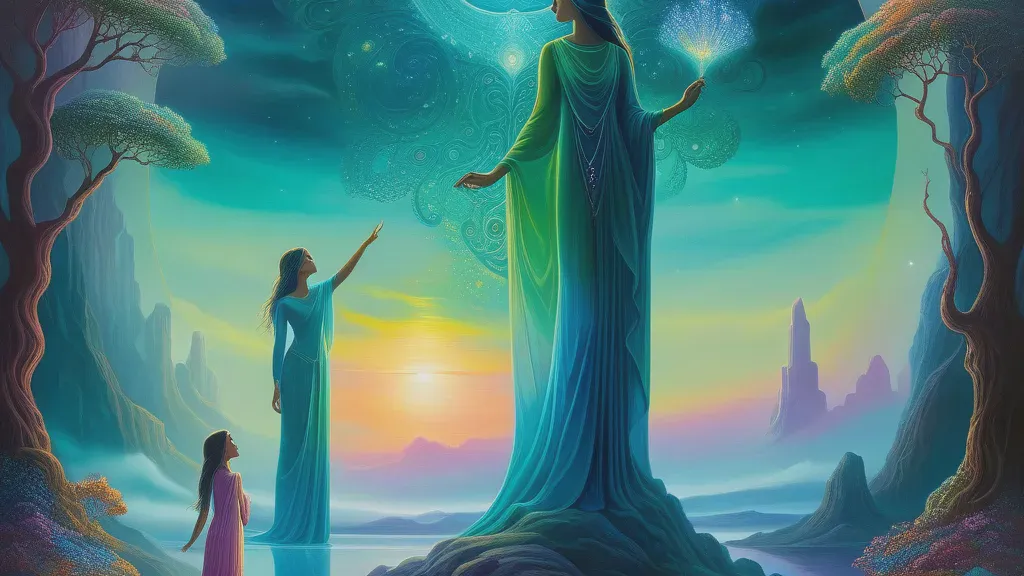
Metaphor
Jungian Archetypes
Meaning
Dreams involving a Metaphor express complex emotions and thoughts symbolically. Psychologically, it indicates the mind's attempt to process experiences and convey deeper meanings, revealing insights into the dreamer's psyche.
Psychological Interpretation
Jungian analysis sees metaphors as manifestations of the unconscious, providing clues to hidden conflicts. Cognitive psychology views them as cognitive shortcuts for understanding, while practical psychology encourages using metaphors for clearer self-expression.
Cultural & Historical Origins
In literature, Shakespeare's use of metaphor enriches themes, such as in 'Romeo and Juliet'. The Buddhist tradition emphasizes metaphorical language to convey spiritual truths, illustrating how symbols express profound concepts.
Contextual Variations
You read a note in your dream where every sentence is written as a metaphor (e.g., “Your heart is a locked suitcase”), and you realize you’re avoiding the literal meaning of what someone is trying to say.
Your psyche may be translating feelings into indirect language because direct confrontation feels unsafe. The dream often points to an emotion you understand intellectually but haven’t named emotionally.
In a conversation, you respond with metaphors to everything, and the other person keeps asking, “What do you mean exactly?” but you can’t find a straightforward answer.
This can reflect a pattern of emotional buffering—using symbolism to keep distance from vulnerability. Psychologically, it suggests you may be ready to replace “coded” feelings with clearer self-expression.
You watch a movie scene in your dream where a character’s actions are obviously symbolic, and you suddenly “get it” and feel relief as the hidden message clicks.
The metaphor functions like your mind’s internal translation system, offering insight after confusion. It often appears when your subconscious is finally organizing complex emotions into a coherent meaning.
Frequently Asked Questions
Why do I keep dreaming in metaphors instead of literal events?
Does a metaphor in a dream always point to one specific meaning?
How can I interpret a metaphor I don’t understand in the dream?
Journaling Prompts
- Write down the exact metaphor phrase or image you remember, then list the literal topic it might be hiding (relationships, work, grief, boundaries, identity).
- What emotion did you feel while the metaphor was happening—avoidance, awe, confusion, or certainty—and what would that emotion require from you in waking life?
- Where in your day do you communicate indirectly (jokes, hints, “it’s fine,” or symbolism), and what you might be trying not to risk by being direct.
Related Symbols
Dreamed about Metaphor?
Get a personalized AI interpretation that connects this symbol to your specific life circumstances.
Interpret My Dream