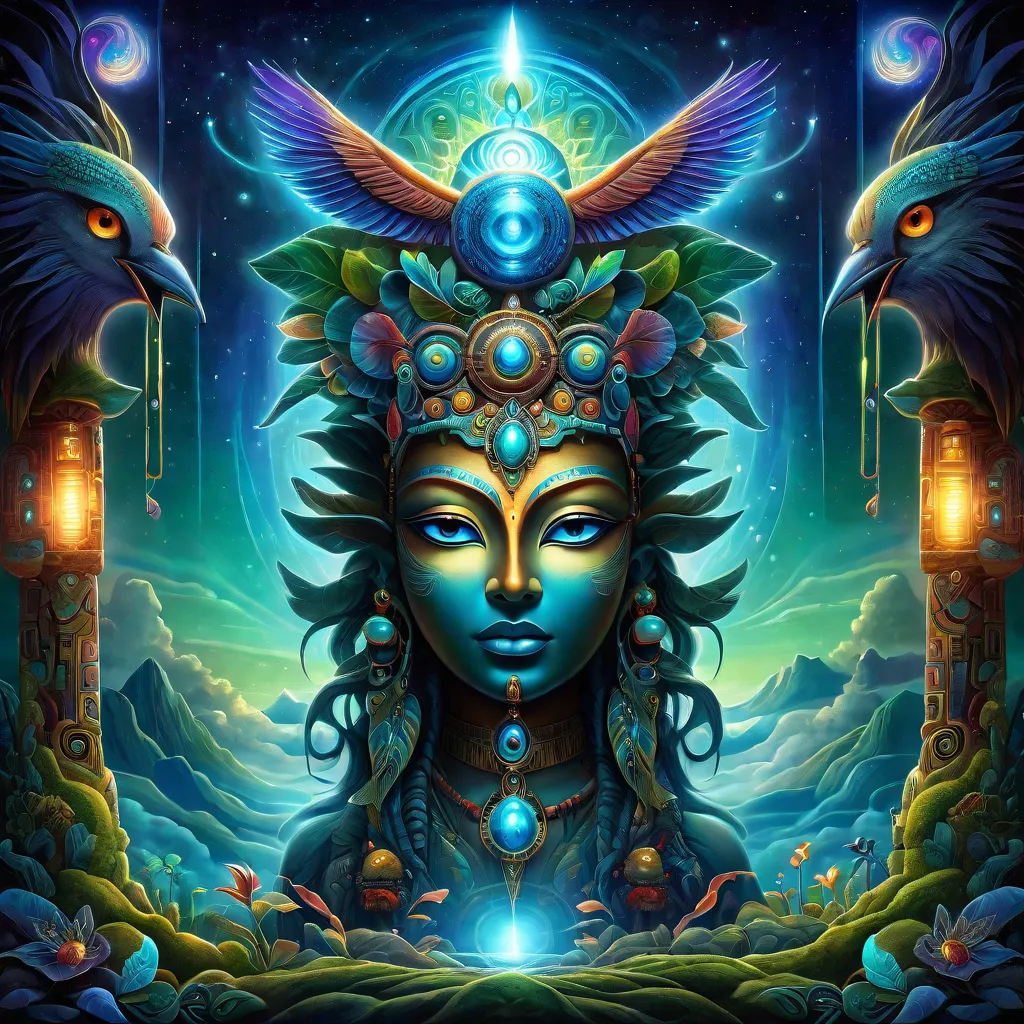
Totem Spirit
Jungian Archetypes
Meaning
A totem spirit gives the dreamer an ally rather than only a symbol: an animal or spirit figure that carries continuity with something larger than a single life, ancestry, instinct, an inherited sense of belonging, and offers guidance precisely because it is not human and therefore not bound by the dreamer's usual hesitations. Its appearance tends to mark a moment when identity itself, rather than any single decision, is the thing under active construction, and the dream reaches for a nonhuman figure because no single human relationship in the dreamer's life currently holds the same weight.
Psychological Interpretation
Totem spirit dreams frequently unfold as a sequence rather than a single encounter, a trail, a series of tests, repeated meetings with a figure that keeps changing shape, and the sequence itself matters more than any one moment inside it. A totem that shifts form under scrutiny, refusing to settle into a single fixed animal or appearance, tends to describe an identity still actively forming rather than a confused or unstable one, resisting premature closure rather than failing to cohere. An offering made to the totem, time, attention, an object surrendered, usually represents investment the dreamer is willing to make toward belonging or guidance, and the totem's response to that offering, acceptance, a warning, a returned gift, tends to clarify whether that investment is currently being asked of the right source. A totem that appears protective but also issues a warning, about a relationship, a boundary, a choice, is rarely being contradictory; protection and warning are, in this figure, generally the same message delivered from two directions at once.
Traditional Symbol Meaning
Among the Ojibwe and related Great Lakes peoples, clan membership traced through a specific animal ancestor carried real, practical consequences: it shaped which other clans a person could marry into, what obligations they held toward clan members they had never personally met, and which stories and responsibilities were considered theirs to carry forward. Totemic identity in this original context was inherited rather than chosen, and it connected a person to a lineage stretching well beyond their own individual lifetime. Freud and Durkheim, writing only a year apart and drawing on much of the same ethnographic material, arrived at strikingly different explanations for why totemism exists at all. Freud located its origin in a specific, ambivalent family drama projected outward, guilt and reverence toward a paternal figure displaced onto an animal that could be safely both protected and, ritually, consumed. Durkheim rejected any such individual, psychological origin, arguing that what a clan actually experiences and calls sacred in its totem is nothing other than the force of its own collective life, a society effectively worshipping a symbolic image of itself without recognizing that fact. Lévi-Strauss's later intervention reframed the entire debate. Rather than treating totemism primarily as an expression of buried emotion, whether individual guilt or collective feeling, he argued it functions above all as a system of classification, a way of thinking clearly about difference and relationship by mapping the distinctions found among animal species onto the distinctions between human social groups. Read across all three accounts, a totem is never merely decorative; it is doing structural work, whether that work is emotional, social, or conceptual, binding a person's individual identity to something considerably larger and more enduring than themselves.
Jungian / Archetypal
The Trickster archetype accounts well for a totem that changes shape whenever the dreamer tries to pin it down into one correct form, since the Trickster's function is precisely to resist premature fixing, mocking the ego's demand for a stable, final answer before the material is actually ready to settle. A shifting totem is less evasive than instructive, refusing a label the dreamer is not yet entitled to assign. Jung used the term psychopomp, borrowed from the Greek for guide of souls, for figures that lead the dreamer across a psychological threshold rather than simply appearing within a static scene, and a totem encountered along a trail, at each stop offering a different feeling to name, functions in exactly this way, escorting the dreamer through a sequence of emotional territory rather than delivering a single static message. Each named feeling along the trail typically marks a piece of the self being consciously claimed rather than left unspoken. The Shadow is present here as well, since a totem this powerful, capable equally of protecting and warning, carries instinctual force the dreamer has likely not fully owned in waking life. Accepting the totem's guidance without pretending it is only gentle or only fierce, holding the animal's full range rather than a flattened, purely benevolent version of it, is closer to genuine integration than treating the totem as a mascot rather than a force with its own will.
Gestalt / Parts of Self
Gestalt dreamwork asks the dreamer to speak as the totem before speaking about it, since the guidance it offers is understood as the dreamer's own disowned knowledge temporarily given an animal's voice rather than external wisdom arriving from elsewhere. Asked directly why it keeps changing shape, the totem in these dreams often answers with something like because you keep trying to finish deciding who you are, and that answer is usually more useful than any fixed interpretation of the animal itself. The offering scene deserves its own embodiment as well. Speaking as the object being given, whatever it is in the dream, frequently reveals whether it is being offered from genuine generosity or from an anxious need to secure belonging through a kind of transaction, and the totem's reaction, accepting, declining, returning it, usually reflects back exactly which of those two motives the dreamer was actually operating from. When the totem issues a warning, it is worth becoming that warning directly rather than only the self being warned, since Gestalt practice treats even a caution as a disowned protective function rather than an external threat. Speak as the warning and ask what boundary it exists to defend; the answer tends to name, with unusual precision, exactly where belonging is currently being extended to someone who has not yet earned the access being offered.
Psychodynamic / Freudian
Freud's account in Totem and Taboo describes an ambivalence he considered central to totemism: the totem animal is simultaneously protected by strict prohibition, forbidden to be killed or harmed under ordinary circumstances, and ritually consumed in a ceremonial totem meal that Freud read as a symbolic reenactment of an original act of violence against a paternal authority, followed by collective guilt and the institution of taboo as a way of managing that guilt going forward. A dream totem that is treated with both reverence and unease carries a similar ambivalence, suggesting the figure stands in for an authority the dreamer both depends on and resents, rather than one felt only as safe. The exogamy rule Freud associated with totemic systems, the prohibition against marrying or forming intimate relationships within one's own totem group, adds a further layer worth considering: a totem in a dream may be marking a boundary around which relationships are, psychologically, too close to a formative identification to be safely entered into, a warning about repeating a pattern too similar to an original family dynamic rather than a literal genealogical concern. What makes a totem dream psychodynamically rich is the coexistence of dependence and defiance within a single relationship to the same figure, wanting its protection while also, at some level, wanting to test or defy its authority. That tension, rather than being a flaw in the dream's logic, usually reflects an authentically ambivalent internal relationship to whatever the totem has come to represent, whether an actual family figure, a cultural inheritance, or an internalized standard.
Contemporary Psychological
The psychologist Dan McAdams has argued that identity in adulthood is built largely through an internalized, evolving life story, a narrative the person continually revises to make sense of who they have been and who they are becoming, rather than through any single fixed trait or belief. A totem spirit that reappears across a dream trail, offering a different piece of emotional vocabulary at each stop, closely resembles this narrative process in miniature, each encounter functioning like a chapter being drafted rather than a separate, unrelated symbol. McAdams's framework also helps explain why a totem's insistence on shifting shape rather than settling into one identity feels less like instability and more like ordinary developmental work once it is reframed this way. A life story under active revision naturally produces provisional, changing self-descriptions before a more settled version is reached, and a dream that resists giving the dreamer a single final answer about who or what the totem is may simply be modeling how identity actually gets built, in successive drafts rather than one finished statement. Viewed this way, a recurring totem dream is worth treating less as a message to be decoded once and filed away and more as an ongoing collaborator in a story still being written. Paying attention to which specific quality or warning the totem emphasizes during a particular period of life often reveals which chapter of the dreamer's larger self-narrative is currently receiving the most active revision.
Cultural & Historical Origins
The English word totem entered the language through the Ojibwe term odoodem, meaning roughly his kinship group, and became widely known in the eighteenth century through traders and travelers working among Ojibwe communities around the Great Lakes, where clan membership and identity were traced through a specific animal ancestor. Sigmund Freud's 1913 book Totem and Taboo proposed that totemism originated in a primal act of parricide within an early human group, with the totem animal afterward serving as a substitute object for the ambivalent reverence and guilt the group continued to feel toward the murdered father. The sociologist Émile Durkheim, studying Australian Aboriginal clan systems in his 1912 work The Elementary Forms of Religious Life, argued instead that the totem represents the clan's own collective identity, worshipped in symbolic, displaced form rather than standing in for any individual figure. The anthropologist Claude Lévi-Strauss later challenged both readings in his 1962 study Totemism, arguing that totemic systems function primarily as tools for organizing thought about relationships between social groups and the natural world, a claim he summarized by saying totemic species are chosen because they are good to think rather than because they are good to eat; the carved heraldic poles associated with Pacific Northwest peoples such as the Haida and Tlingit represent a related but formally distinct tradition of ancestral crest display rather than totemism in this stricter, clan-descent sense.
Contextual Variations
A trail of totems each demanding a different name for the same feeling
Being asked to name one underlying feeling in several different ways as you move along the trail suggests the dreamer is developing a more precise emotional vocabulary rather than simply repeating the same insight. Each totem's version of the feeling usually highlights a slightly different context in which it shows up, work, family, solitude, helping the dreamer recognize a pattern that had previously seemed like several unrelated experiences.
A totem that dissolves into static when you try to photograph it
Refusing to be captured in a fixed image suggests the guidance being offered resists being reduced to a tidy takeaway or a single memorable image to hold onto afterward. The dream is generally asking the dreamer to stay in relationship with the totem's presence and meaning over time rather than extracting one static lesson and considering the encounter finished.
Leaving an offering that a totem quietly returns to you
A gift declined and handed back, without hostility, usually indicates that what the dreamer is trying to trade for belonging or guidance is not actually what is being asked of them. The returned offering is worth examining closely, since it often represents an old strategy, over-giving, appeasement, proving worth through effort, that the totem is gently refusing to reward this time.
A totem pole where your own face replaces the topmost carving
Finding your own likeness at the top of an ancestral structure suggests a growing recognition that you are not only a recipient of inherited identity but an active contributor to it, someone whose choices will themselves become part of what gets carried forward. This image often surfaces during a period of stepping more fully into a role, whether within a family, a tradition, or a community, that had previously felt like it belonged only to those who came before.
Frequently Asked Questions
Why did the totem spirit in my dream keep changing shape?
Why do I sometimes offer something to a totem in a dream?
Is a totem spirit dream a sign that I am protected from something?
Why do totem spirits often appear as animals from cultures or traditions I don't personally belong to?
Journaling Prompts
- If your totem spirit changed shape more than once, list each form it took and the feeling attached to each one. What pattern connects those feelings once you see them lined up together?
- Think about the last offering, literal or figurative, you made in pursuit of belonging somewhere. Was it accepted, and if it were returned to you instead, what would that be telling you?
- Recall the specific warning your totem gave, or imagine one it might give if it appeared tonight. What boundary in your current life is that warning actually trying to protect?
- Where in your life are you currently both an inheritor of something older than you and a contributor shaping what gets passed on next? What is your specific part in carrying that forward.
Related Symbols
Dreamed about Totem Spirit?
Get a personalized AI interpretation that connects this symbol to your specific life circumstances.
Interpret My Dream