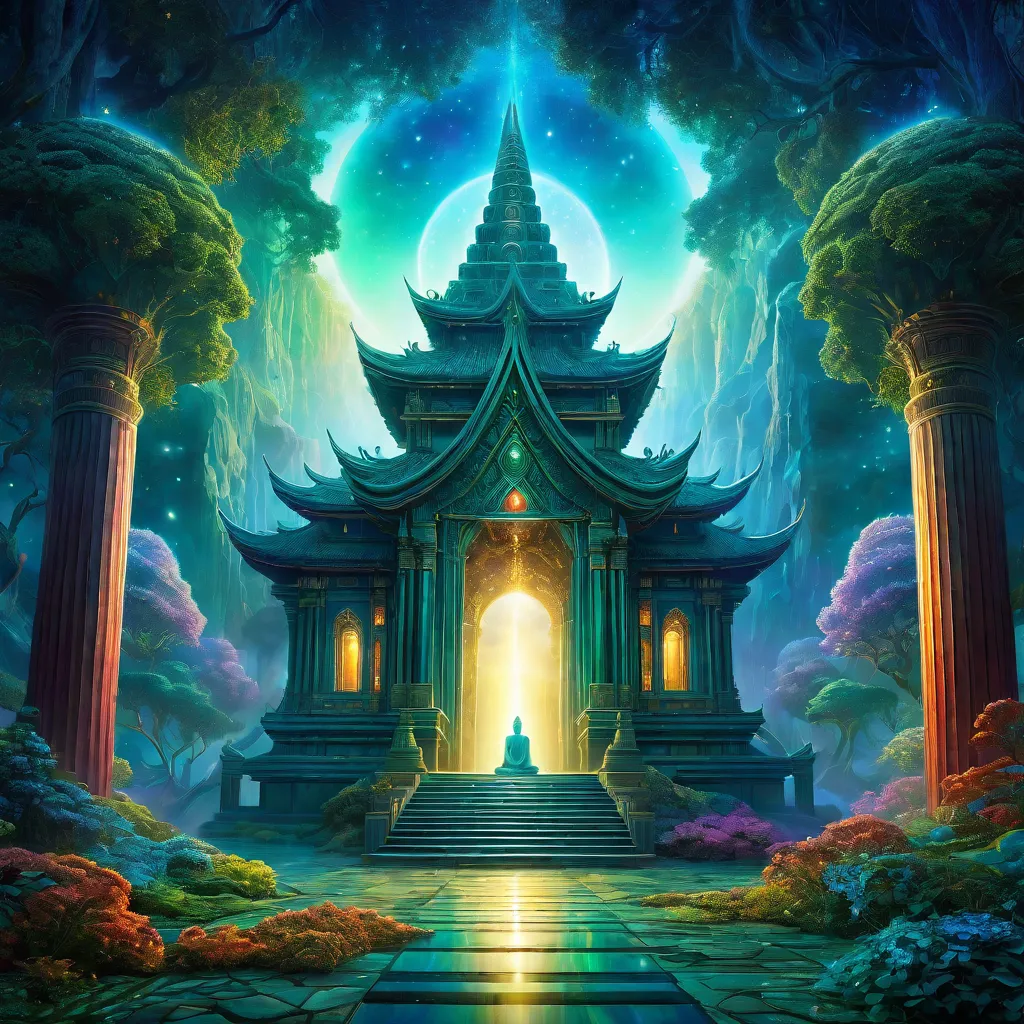
Temple
Jungian Archetypes
Meaning
A temple in a dream marks off a space the dreamer has set apart from ordinary life as worthy of special care, whether or not that space has anything to do with organized religion. What happens at its threshold — welcomed in, locked out, granted access only after some condition is met — usually reveals more about the dreamer's current relationship to their own values than anything said or performed once inside. The temple asks less what the dreamer believes than what they currently treat as non-negotiable.
Psychological Interpretation
Locked doors and restricted access are the detail most worth examining in temple dreams. A temple the dreamer cannot enter often reflects a felt sense of unworthiness or unreadiness regarding something they consider genuinely important — a value, a relationship, a version of themselves they aspire to but have not yet claimed. A temple entered easily and found unexpectedly quiet or empty can suggest that a belief or practice the dreamer assumed would feel significant currently feels hollow, worth investigating rather than mourning. Cleaning, repairing, or clearing dust from an altar typically points to preparation already underway — the dreamer making room, consciously or not, for a commitment or a form of sincerity they have been circling without yet naming. Where the temple responds to the dreamer, through sound, warmth, or a presence rather than silence, the dream is usually signaling that whatever the dreamer brought to it, however uncertain or provisional, has been received rather than judged.
Traditional Symbol Meaning
Hindu temple architecture is built around the garbhagriha, literally the womb chamber, a small, deliberately dark inner sanctum housing the temple's central deity image, reached only after passing through successive halls that grow progressively narrower and more restricted. The design enacts the pilgrim's approach as a form of gradual, physical initiation rather than simple arrival — access to the sacred is structured, layer by layer, and never granted all at once. The Parthenon, completed under Pericles' building program in fifth-century BCE Athens, occupied its city's acropolis as a statement that the sacred and the civic were never fully separate categories for the Greeks: the temple honored Athena while also serving as a treasury and a monument to Athenian identity itself. Its ruined, still-standing form has since become a broader emblem of the ambition to build something durable enough to house a civilization's idea of itself. The Second Temple in Jerusalem, destroyed by Roman forces in 70 CE, left behind a loss so significant to Jewish religious life that mourning its absence became a fixed part of the liturgical calendar, observed annually on the fast of Tisha B'Av, and the Western Wall, one of its few surviving remnants, remains a site of pilgrimage and prayer to this day. A temple that can be lost, and whose loss continues to be actively grieved centuries later, suggests something the dream version already seems to know: a sacred structure is never only a building, but a container people keep returning to rebuild, in memory if nowhere else, once it is gone.
Jungian / Archetypal
A temple's basic architecture — a boundary separating sacred interior from ordinary exterior — mirrors what Jung called the temenos, a protected psychic enclosure within which the difficult, sacred, or otherwise overwhelming contents of the unconscious can be safely approached. Dreaming of a temple, particularly one with a clearly defined threshold, can indicate that the dreamer's psyche is currently occupied with distinguishing what is central and inviolable to their identity from what is peripheral and negotiable. The Anima frequently appears connected to temple imagery as the capacity for reverence and feeling-based meaning-making, in contrast to purely rational or transactional engagement with life. A dreamer drawn toward a temple, especially one who approaches it with unexpected tenderness or awe, may be reconnecting with this feeling function after a period of relying too exclusively on logic or achievement to organize their sense of worth. Whatever the dream excludes from the temple, or keeps locked outside its doors, belongs to the Shadow in this context: aspects of the self considered too impure, too ordinary, or too shameful to bring into contact with what the dreamer holds sacred. Jung would treat a locked temple less as a verdict on the dreamer's worthiness than as a snapshot of a boundary the psyche has drawn for now, one that individuation may eventually ask the dreamer to reconsider.
Gestalt / Parts of Self
A locked door in a dream is never just an obstacle; in Gestalt work, become the door as readily as you become the person standing outside it. The temple, its threshold, and whatever waits past it are all yours to claim. Rather than asking what the temple represents in some abstract sense, ask what in your own life you currently treat with this much reverence, and what you keep separate from it as unworthy or unclean. Speak as the temple itself for a moment. What are you protecting, and from what? Sacred spaces in dreamwork usually aren't arbitrary; they're guarding something the dreamer considers genuinely precious, and the guarding itself deserves respect even when it's inconvenient. If the door was locked, become the lock. What would it take for you to open, and who gets to decide that? Notice whether the answer that comes is about readiness, safety, or worthiness, since each of those points to a different piece of work. And if you were let in freely, become the space itself and ask what it actually needed from the visitor who entered — attention, honesty, or simply presence, rather than performance.
Psychodynamic / Freudian
In The Future of an Illusion, Freud argued that religious belief often originates in an early, universal helplessness that first found its answer in a protective parental figure, and later gets projected outward onto a divine order once the child recognizes the limits of actual parents. A temple, as the architectural home of that projected protection, can appear in dreams during periods when the dreamer feels this same early helplessness reactivated — a situation genuinely beyond their control, prompting a search for a larger, more reliable source of order than they currently feel they possess themselves. Whether Freud's broader claim about religion holds, the narrower observation is useful independent of it: a locked or inaccessible temple in a dream often coincides with a period when the dreamer feels excluded from a source of comfort or certainty they badly want access to, while a welcoming temple often coincides with periods when that same need feels, at least temporarily, met. The specific ritual gestures performed inside the temple carry their own psychodynamic weight. Cleaning an altar or preparing a space before anyone arrives often represents unconscious anticipatory work — readying the self for a commitment, confession, or change the dreamer has not yet consciously decided to make, but is already, quietly, behaving as though they will.
Contemporary Psychological
Research on awe, associated with psychologists including Dacher Keltner, describes the emotion as arising specifically from an encounter with something vast that the mind cannot immediately fit into its existing categories — a description that maps closely onto how sacred architecture is deliberately built to feel: high ceilings, controlled light, scale designed to dwarf the individual visitor. A dream temple that produces genuine awe rather than mere recognition may be manufacturing, internally, the same expansive and self-diminishing feeling that physical temples were designed to produce in waking life. Some awe researchers have proposed that this emotion functions partly to encourage a shift away from self-focused concerns toward a sense of connection with something larger, whether a community, a tradition, or an idea. A temple dream arriving during a period of narrow, anxious self-focus may reflect the dreaming mind reaching for exactly this corrective, offering a scale of experience the dreamer's waking life has not recently made room for. Sleep and dream researchers more broadly note that emotionally significant settings from a person's own history, religious or otherwise, tend to resurface during periods of major transition or decision-making, functioning less as literal belief statements than as the most emotionally weighted architecture the dreamer's memory has on hand for representing what currently feels most at stake.
Cultural & Historical Origins
Japanese Shinto shrines mark their boundary with a torii gate, a threshold that announces the transition from ordinary ground to a space considered sacred well before a visitor reaches any actual building. Ancient Greek religious sites designated a temenos, a sacred precinct cut off from surrounding land and dedicated specifically to a god, establishing legally and physically that some ground was categorically different from the rest. Herod the Great's first-century expansion of the Second Temple in Jerusalem made it one of the ancient world's largest religious structures before its destruction by Roman forces in 70 CE, a loss still mourned annually in Jewish liturgical tradition. Hindu temple design carries the same logic of graduated sacredness inward, culminating in the garbhagriha, the small dark sanctum where the temple's central deity resides.
Contextual Variations
Finding the temple's doors locked from the inside
A temple locked from within suggests the barrier to whatever you consider sacred isn't circumstance but your own hesitation. Something in you may be guarding against a change or a commitment you're not fully certain you're ready to make. Consider whether breaking the lock or waiting is the more honest response for where you currently stand.
Cleaning dust from an altar no one else can see
Private, unwitnessed preparation like this usually reflects real inner work happening ahead of a commitment you haven't announced or maybe even admitted to yourself yet. The dust suggests neglect that predates your current attention; cleaning it is less about appearance and more about finally taking the space seriously again.
Praying and hearing your own words answered
A temple that responds to you directly usually signals that you already trust your own instincts more than you consciously acknowledge, since the answer is coming from somewhere inside your own dreaming mind. Pay attention to what the response actually says, since it may be the most honest counsel you're currently able to give yourself.
Discovering the temple is smaller or plainer than you expected
A temple that turns out modest rather than grand often signals that a belief or commitment you assumed needed to be impressive to matter is actually simpler and more available than you thought. This can be a relief once you stop measuring your own spiritual or ethical life against an inflated standard.
Frequently Asked Questions
Why would I dream of a temple if I'm not religious?
Why did the temple in my dream feel tense or frightening instead of peaceful?
Is it a bad sign if I'm not allowed inside the temple?
Is it significant if I find the temple abandoned or in ruins?
Journaling Prompts
- What do you currently treat as sacred or non-negotiable in your life, whether or not it has anything to do with religion? How has it been tested lately?
- If a temple in your dream kept you out, what condition do you think you're waiting to meet before you'd feel ready to go in? Is that condition one someone else set, or one you quietly set for yourself?
- Think of something you've been quietly preparing for without announcing it to anyone. What would it mean to admit, out loud, that you're getting ready?
- What belief or commitment of yours currently feels more modest or plain than you'd like it to be, and is that actually a problem, or just an inflated expectation?
Related Symbols
Dreamed about Temple?
Get a personalized AI interpretation that connects this symbol to your specific life circumstances.
Interpret My Dream