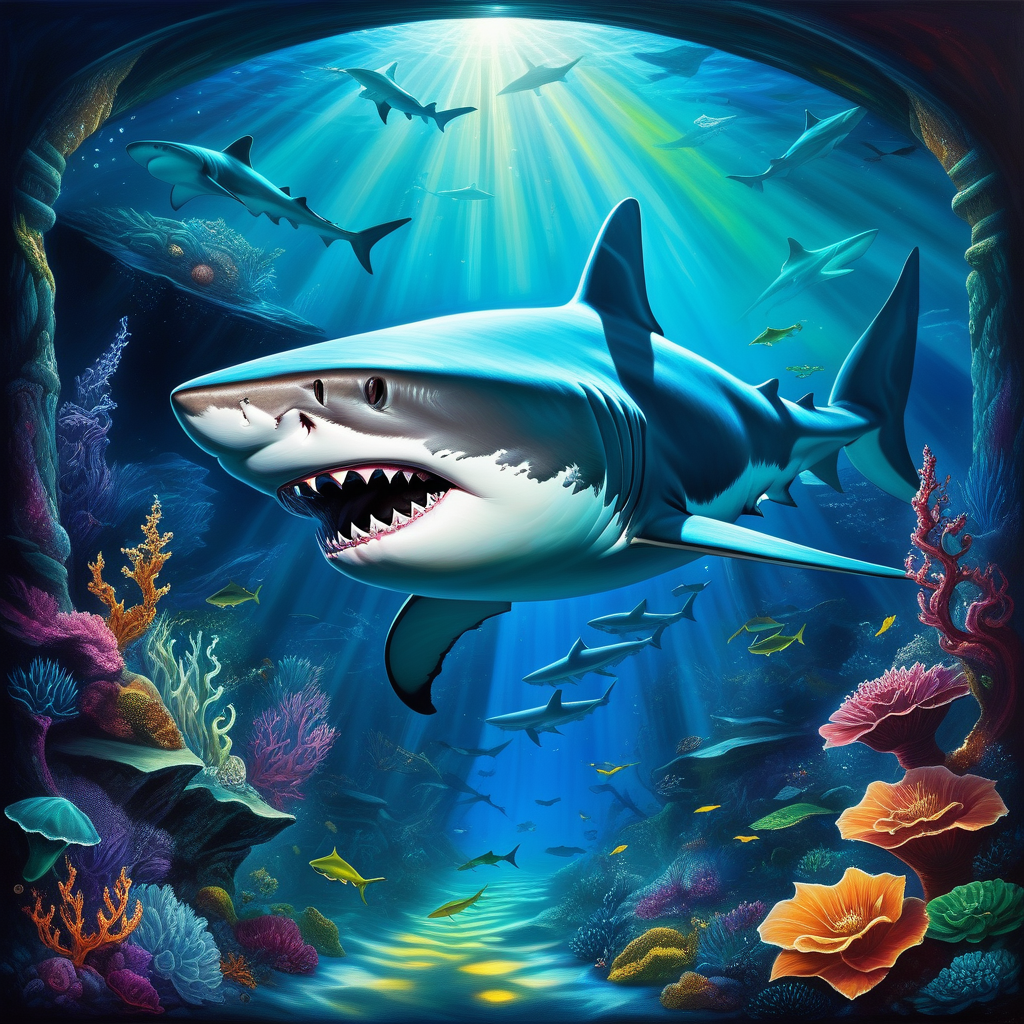
Shark
Jungian Archetypes
Meaning
The shark represents primal power, danger, and the predatory instincts lurking in the depths of the unconscious. It symbolizes aggression, dominance, and the raw forces of nature that demand respect and caution.
Psychological Interpretation
In Jungian psychology, the shark embodies the Shadow archetype—the dangerous, predatory aspects of the psyche that we fear or deny. As a Threshold Guardian, it protects the boundary between conscious awareness and the dangerous depths of the unconscious.
Contemporary Psychological
Sharks in dreams function as threat simulation scenarios rooted in evolutionary psychology. The shark represents a predatory threat that operates in an environment where the dreamer has limited visibility and control—the aquatic setting amplifies the sense of vulnerability. From a contemporary neuroscience perspective, shark dreams activate the brain's threat-detection systems, particularly the amygdala, which processes fear-relevant stimuli. This activation serves a functional purpose: the brain is rehearsing responses to hidden or unpredictable dangers in waking life. The shark's predatory nature and the water's opacity create a perfect simulation of a threat that cannot be fully anticipated or controlled, allowing the dreamer's nervous system to practice emotional regulation in the face of uncertainty. The threat simulation function of shark dreams often reflects the dreamer's processing of real-world anxieties about hidden dangers or threats that feel imminent but not fully visible. These might include social threats, professional uncertainties, or interpersonal conflicts where the dreamer feels they lack complete information. The shark's movement through water—silent, efficient, potentially sudden—mirrors cognitive patterns of hypervigilance or anticipatory anxiety. The brain is essentially running a "what if" scenario: what if the threat emerges suddenly? How do I respond? This rehearsal strengthens neural pathways for threat detection and emotional regulation, preparing the nervous system to handle similar situations in waking life with greater resilience. Memory consolidation in shark dreams may involve integrating recent experiences of vulnerability, loss of control, or exposure to unpredictable stressors. The aquatic environment itself can represent the unconscious mind or emotional depths—the shark emerging from these depths symbolizes the surfacing of previously unprocessed fears or anxieties. The dream's narrative structure often involves either avoidance, confrontation, or escape, each representing different cognitive strategies for managing threat. These patterns reveal how the dreamer's brain is consolidating emotional learning: which coping strategies feel effective, which trigger panic, and how the nervous system calibrates its threat response. The repetition of shark dreams suggests ongoing emotional regulation work—the brain returning to this scenario until it achieves a sense of mastery or acceptance of the underlying uncertainty. Cognitively, shark dreams reveal patterns of threat-focused attention and the brain's attempt to impose predictability on inherently unpredictable situations. The dreamer's emotional state during the dream—whether paralyzed, fighting, fleeing, or adapting—indicates their current capacity for emotional regulation under stress. Contemporary dream research suggests that these threat simulations serve an adaptive function: they allow the brain to process fear in a safe environment, strengthening emotional resilience without real-world consequences. The shark symbol, grounded in evolutionary history as a genuine predatory threat, taps into ancient neural systems that remain highly responsive to danger signals. This makes shark dreams particularly potent for emotional regulation work, as they engage both modern cognitive concerns and deep evolutionary fear responses, creating a comprehensive rehearsal of how the dreamer manages vulnerability and uncertainty.
Gestalt / Parts of Self
The shark in dreams represents the dreamer's own predatory instinct—the part of self that hunts, pursues, and takes what it wants without hesitation or moral deliberation. In Gestalt work, the shark is not an external threat but an owned capacity: the ruthless efficiency, the single-minded focus, the willingness to move through resistance. When a dreamer encounters a shark, they are meeting their own power to act decisively, to bite through obstacles, to survive by taking action rather than waiting for permission. This is the part of self that many people disown because it contradicts their self-image as kind, gentle, or accommodating. The projection happens when the dreamer attributes the shark's aggression entirely to the external world—seeing others as predatory while denying their own predatory impulses. A dreamer might fear being attacked by a shark while simultaneously refusing to acknowledge their own capacity to be aggressive, competitive, or self-serving. The shark becomes the "bad one out there" rather than a disowned part of the dreamer's own psyche. This projection protects the dreamer's preferred self-image but at the cost of fragmentation: the predatory energy doesn't disappear; it simply operates unconsciously, often emerging as passive aggression, resentment, or self-sabotage. The dialogue between parts invites the dreamer to ask: What does my shark want? What does it protect? What would happen if I claimed this ruthlessness as mine—not to become cruel, but to reclaim my own power to act in my own interest? The shark's hunger, speed, and focus are not inherently evil; they are survival capacities. The integration being called for is not to become a shark, but to own the shark within—to acknowledge that you contain both the capacity for gentleness and the capacity for aggression, and that both are necessary. When the dreamer stops projecting the shark onto others and instead asks "What part of me is this?", the shark becomes not a threat to be feared but a resource to be understood and, when appropriate, mobilized. Ownership of the shark means recognizing that you are capable of ruthlessness, that you have predatory instincts, and that these instincts are not shameful—they are human. It means distinguishing between the impulse (which is neutral) and the action (which carries choice). A dreamer who owns their shark can choose when to be aggressive and when to be gentle, when to pursue and when to retreat. Without this ownership, the shark remains split off, operating in the shadows, and the dreamer remains fragmented, unable to access their full range of power and presence.
Jungian / Archetypal
The shark in dreams embodies the Shadow archetype—the primal, instinctual forces that consciousness seeks to deny or repress. In Jungian terms, the shark represents the devouring aspect of the unconscious, the predatory impulses that lurk beneath the surface of civilized behavior. It is not evil in itself, but rather the raw, amoral power of nature that exists within the psyche. The shark's appearance in dreams signals that something dangerous, something the ego has tried to suppress or ignore, is demanding recognition. This creature moves silently through the depths, much like the Shadow moves through the unconscious—present, powerful, and largely invisible until it surfaces. The shark's ruthlessness and hunger speak to the individuation process, the journey toward wholeness that requires integrating all aspects of the self, including those we find threatening or unacceptable. The dreamer who encounters a shark is being confronted with a choice: to continue fleeing from these primal energies, or to acknowledge them as legitimate parts of the psyche that possess their own wisdom and necessity. The shark's predatory nature is not a flaw but a function—it survives, it acts decisively, it does not hesitate or apologize. In this sense, the shark becomes a teacher, showing the dreamer what happens when instinct is honored rather than suppressed. The hidden danger beneath the surface that the shark represents speaks to the collective human fear of the unknown and the uncontrollable. Water in dreams often symbolizes the unconscious itself, and the shark moving through it is the unconscious made manifest and threatening. Yet this threat is also an invitation. The shark as emotional predator suggests that feelings—rage, hunger, desire, aggression—have been denied or pushed down, and they are now circling, demanding to be felt and integrated. The individuation journey requires the dreamer to descend into these depths, to face what swims there, and to reclaim the power and authenticity that comes from accepting the full spectrum of human nature, including its predatory, devouring aspects.
Psychodynamic / Freudian
The shark in dreams manifests as a predatory force that embodies the latent content of oral aggression and devouring anxiety—the fear of being consumed, annihilated, or swallowed whole by a more powerful entity. At the manifest level, the shark is simply a dangerous animal; at the latent level, it represents the dreamer's unconscious terror of being overwhelmed by forces beyond control, often rooted in early experiences of maternal engulfment, paternal dominance, or the primal fear of being devoured by authority figures. The shark's teeth and mouth become the primary symbolic vehicle for this anxiety, condensing multiple threats into a single image: the threat of oral incorporation, the loss of autonomy, and the annihilation of the self. The wish-defense dynamic at work in shark dreams reveals a complex interplay between repressed aggression and the fear of retaliation. Beneath the surface terror lies an unconscious wish to devour, to consume, to assert dominance—the very aggression the dreamer fears in others. Through displacement, the dreamer's own oral aggression is projected outward onto the shark, transforming the internal threat into an external one. This defense mechanism allows the dreamer to avoid recognizing their own destructive impulses while simultaneously experiencing them as a threat from the environment. The shark becomes the repository for disowned aggression, a way of saying "I am not the devourer; I am the devoured." Condensation further compresses multiple sources of anxiety—fear of authority, fear of sexuality, fear of one's own power—into the single, streamlined form of the predator. Childhood origins of shark anxiety often trace to experiences of oral deprivation or oral excess: a parent who was emotionally unavailable (leaving the child feeling starved), or conversely, a parent whose presence felt suffocating and all-consuming. The shark may also represent the castrating father—the threatening male authority who punishes curiosity, sexuality, or assertion. In Freudian terms, the shark embodies the superego's punitive force, the internalized voice of paternal prohibition that threatens to destroy the ego if it transgresses. Early experiences of being silenced, controlled, or made to feel small in the presence of a dominant figure crystallize into the image of the predator that cannot be escaped. The dream's anxiety signals the ongoing struggle between the dreamer's need for autonomy and the internalized fear of punishment for claiming it. What presses toward consciousness in shark dreams is the repressed recognition that the dreamer possesses the very aggression they fear in others. The shark is not merely an external threat but a mirror of disowned power—the capacity to bite, to consume, to dominate. The dream's anxiety is the ego's alarm system, signaling that repressed material is surfacing: the wish to assert dominance, to take what one needs, to refuse to be consumed by others' demands. The therapeutic work lies not in eliminating the shark but in integrating it—recognizing that oral aggression, properly channeled, is necessary for survival, for setting boundaries, for claiming one's place in the world. The shark's terror becomes, paradoxically, an invitation to reclaim the power the dreamer has disowned.
Cultural & Historical Origins
In Hawaiian culture, sharks are revered as 'aumakua (ancestral guardians). In Aboriginal Australian mythology, the shark represents power and protection. Polynesian cultures view sharks as spiritual guides and protectors of the ocean realm.
Contextual Variations
You’re swimming and notice a shark circling beneath you, never fully surfacing. You don’t see teeth, but you feel the pressure of being hunted, and you can’t tell how close it is.
This dream often symbolizes primal threat perception—aggression and dominance felt as an underlying pressure rather than a visible event. Psychologically, it may reflect fear of being targeted, exposed, or overridden by someone’s power.
In a coastal town, you watch a shark break the surface in the distance while people continue their normal routines. You feel a split response: part of you wants to warn everyone, and part of you feels frozen.
The shark’s presence alongside denial suggests you may be sensing danger that others minimize. Psychologically, it can indicate your intuition is picking up on predatory dynamics, even if you’re unsure whether to act.
You’re in a research tank and the shark responds to your movements—turning when you flinch, accelerating when you hesitate. You realize your fear is changing its behavior, and you try to stay calm to regain control.
This scenario points to a feedback loop between your threat response and perceived power. Psychologically, it may highlight how your own anxiety can amplify a sense of being “at the mercy” of dominance.
Frequently Asked Questions
Does dreaming of a shark mean someone wants to hurt me?
Why does the shark feel more dangerous when I can’t see it clearly?
What does it mean if I try to stay calm in the dream?
Journaling Prompts
- Where in my life do I feel “circled”—watched, evaluated, or pressured without clear rules?
- What quality does the shark represent for me: dominance, aggression, competition, or survival?
- If the shark were a message instead of a threat, what action would it ask of me?
Related Symbols
Dreamed about Shark?
Get a personalized AI interpretation that connects this symbol to your specific life circumstances.
Interpret My Dream