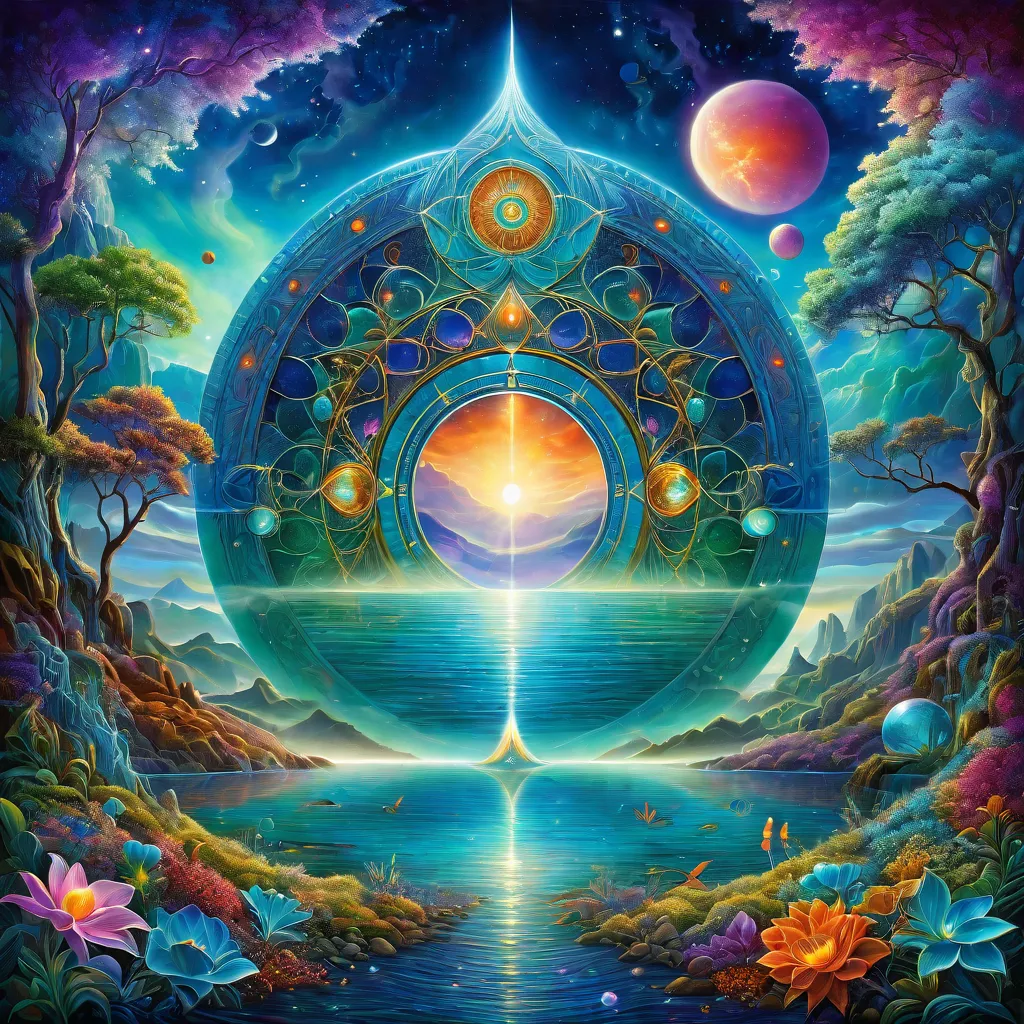
Sacred Time
Jungian Archetypes
Meaning
Sacred time is the dream's way of marking an hour as different in kind from the hours around it — not merely important but set apart, the way a ritual or a threshold is set apart from ordinary duration. The dreamer may notice a clock that will not advance, a ceremony that seems to have been going on forever, or a single moment stretched wide enough to hold a whole decision. This is chronos giving way to something older: an interval measured by significance rather than minutes. The image tends to surface when the dreamer stands at a real crossing — a birth, a death, a vow, an ending — and the psyche insists that this particular passage deserves to be lived with full attention rather than absorbed into the blur of ordinary days.
Psychological Interpretation
A dream that slows, loops, or otherwise separates one stretch of time from the rest is doing something specific: it is telling the dreamer which moment in waking life actually matters. The Animus often appears alongside sacred time as the figure who names what the hour requires — a decisive word, a ritual gesture, a boundary finally drawn — while the surrounding dream logic behaves as though the ordinary rules of consequence have been suspended. When the same hour repeats without resolution, the dream is less a warning than an unfinished rite: something has been begun in the psyche that has not yet been completed, and repetition is the mind's method of insisting on completion. A trickster figure who resets the clock or changes its terms points to resistance against a fixed outcome, an unwillingness to let the moment close cleanly. Read this way, sacred time is not about mysticism but about attention: the dream is drawing a frame around one experience and asking that it be treated as consequential rather than skimmed.
Traditional Symbol Meaning
Long before dream psychology had a vocabulary for it, ritual traditions had already worked out that time is not uniform — that some hours carry weight the surrounding hours do not, and that a society or a person needs a way to step into those hours deliberately. Eliade's account of archaic religion rests on exactly this claim: sacred time is not a metaphor but a repeatable return to a founding moment, re-entered through festival, rite, or vow so that the participant is not commemorating an origin but briefly living inside it again. Jewish practice keeps this distinction alive in ordinary life through Shabbat, where the boundary is not symbolic decoration but a real change in what may be done and how time may be used; the week's momentum is interrupted on purpose, and rest itself becomes a form of consecration. A comparable instinct shaped the Christian liturgical calendar, which divides the year into seasons so that believers re-enter the same sacred sequence annually rather than experiencing time as flat repetition. The Greek separation of chronos from kairos supplied a second vocabulary for the same intuition: some moments are simply next in line, and others are the moment, arriving once and asking to be recognised before they pass. Aboriginal Australian cosmology offers a still more radical version of the idea, describing an order of time in which the age of creation never fully recedes into the past but continues alongside ordinary duration, accessible through ceremony, song, and story. A dream that behaves like this — repeating an hour, refusing to let a scene end, treating one encounter as though it belongs to a different order of time than the rest of the night — draws on the same intuition every one of these traditions independently arrived at: that meaning sometimes requires its own kind of time, separate from the clock.
Jungian / Archetypal
Jung had little directly to say about clocks, but his account of the Self as an organizing center that occasionally interrupts the ego's ordinary business maps closely onto a dream that suddenly declares one hour sacred. The interruption is the point. Ordinary ego-time is sequential and forgettable; when the unconscious marks a moment as set apart, it is usually signalling that this particular content belongs to the individuation process rather than to the day's routine, and should not be allowed to dissolve into the general flow of forgotten dreams. The Animus frequently officiates in these scenes, less as a romantic figure than as an inner authority who names what the moment requires — a decision, a vow, an act that cannot be taken back. Its presence suggests that the dreamer's habitual way of deciding things, drift and postponement, is being confronted by a firmer inner voice insisting that some choices cannot be made on the dreamer's usual terms or at the dreamer's usual pace. When this figure also carries Trickster qualities — resetting the hour, changing the rules mid-ceremony — the dream is dramatizing the ego's own resistance: something in the dreamer keeps reopening a question that another part has already tried to close. Repetition within sacred time, in this reading, is not stagnation but a rite the psyche has not yet been permitted to finish. Individuation proceeds through completed passages, not through moments perpetually deferred, and a dream that keeps returning to the same charged hour is asking the dreamer to let one particular threshold actually close, so that whatever waits on its far side can begin.
Gestalt / Parts of Self
In the Gestalt reading, sacred time is not a property of the clock but a stance you are taking toward one part of your own experience, and the dream is showing you exactly how selective your attention already is. You do not treat every hour as equal in waking life either; you simply do not usually notice the choosing. The dream exaggerates the process by stopping the clock altogether, and the invitation is to ask what you are doing, right now, that deserves the same undivided treatment the dream hour receives. Sit with the repeating or frozen moment and speak as it. Name what the hour is still waiting to receive. Often the answer is something quite ordinary dressed in dramatic clothing — an apology, a decision, a goodbye — that you have kept postponing by treating it as one more item in an endless list rather than as the discrete, closable event it actually is. The dream's insistence that this hour is different from the others is your own insistence, disowned and projected onto the shape of time itself. If a trickster figure resets the moment before you finish it, ask what you get from the reset. Some part of you may prefer the safety of an unfinished ritual to the risk of a completed one — as long as the ceremony keeps looping, no verdict has been reached, and nothing has to change yet. Naming that preference honestly, out loud, in your own voice, is usually enough to let the loop close.
Psychodynamic / Freudian
A dream in which time itself becomes strange rarely announces its latent content directly; distortion of the frame is often how the mind signals that the frame itself is under strain. An hour that will not end, or that must be repeated, functions economically the way a compulsion does in waking life: a piece of unfinished psychic business is discharged in small, disguised installments because it cannot yet be faced whole. The repetition compulsion described in classical psychoanalytic thought is a useful lens here — not because the dreamer wants to relive the hour, but because something in the hour was never adequately processed the first time, and the mind returns to it seeking a different outcome. The Animus figure who appears to preside over the ceremony can be read as a displaced authority — a parental or internalized judging presence relocated onto a ritual official so that the anxiety of being assessed can be tolerated at one remove. A trickster who alters the hour's terms often stands in for ambivalence about the outcome itself: part of the dreamer wants the matter settled, another part keeps changing the conditions so it cannot be. This is less deception than self-protection, a way of keeping an anxiety-laden decision permanently in draft form. Object relations theory adds a further dimension: early experiences of time being reliable or unreliable — a caregiver who arrived when promised, or did not — often resurface precisely as distortions of duration rather than as recognisable memories. A dream that treats one hour as sacred, immovable, and different from the rest may be reaching back toward an early template for what trustworthy time once felt like, or did not.
Contemporary Psychological
Sleep researchers have long known that the brain's sense of elapsed time is unreliable during REM sleep, and dream reports of hours that stretch, freeze, or repeat are consistent with this: the internal clock that tracks duration in waking life is largely offline, while the systems that tag experience as emotionally significant remain fully active. The result is a state well suited to producing exactly this image — an event marked heavily for importance with almost no reliable sense of how long it actually took, which the waking mind then narrates as time behaving strangely rather than as time simply not being tracked. This pairs naturally with what memory research calls the emotional salience effect: material tagged as highly significant is prioritized for consolidation regardless of its actual duration, so a brief but charged exchange can be re-experienced in a dream as though it lasted an hour, while genuinely long stretches of uneventful time compress to nothing. A repeating dream-hour is a plausible signature of consolidation still in progress — the brain returning to material it has flagged as unresolved rather than filing it away, much as it revisits an unfinished task more readily than a completed one. None of this requires ritual language to be useful. It simply relocates the same intuition traditional systems already had — that some experiences are not equivalent to others — into the mechanics of a nervous system that tags significance independently of the clock, and then hands the dreamer an image strange enough that it cannot be ignored the next morning.
Cultural & Historical Origins
The historian of religion Mircea Eliade built an entire framework around this distinction, arguing in The Sacred and the Profane that traditional societies live in two kinds of time at once: profane duration, which simply passes, and sacred time, which is periodically re-entered through ritual and experienced as a return to origin rather than as more elapsed time. Jewish observance gives this a weekly rhythm through Shabbat, in which the ordinary week is suspended and time itself is treated as consecrated rather than spent. Ancient Greek thought split time along the same seam, distinguishing chronos, sequential and countable, from kairos, the opportune or decisive moment that cannot be measured by a clock because its value lies in timing rather than duration. Aboriginal Australian traditions describe a different but related order sometimes rendered in English as the Dreaming, an eternal time of creation that underlies and periodically breaks through ordinary time rather than preceding it once and receding. Across these traditions the pattern is consistent: certain hours are not simply lived through but entered, and a dream that treats time this way is borrowing a very old grammar for marking what counts.
Contextual Variations
A clock that shows the same hour no matter how much time passes
A frozen clock in a dream usually marks unfinished business rather than a stopped life. The dreamer's mind has flagged one hour as unresolved and keeps returning the display to it, refusing to let ordinary time resume until whatever the hour represents — a decision, an apology, a goodbye — actually concludes. The frustration of watching the numbers hold still is often proportional to how long the real decision has been avoided.
A ceremony that seems to have been happening forever
An interminable ritual usually reflects a process in waking life that has outgrown its intended shape — a negotiation, a mourning period, a transition that was meant to have an end point and no longer seems to. The dream is not criticizing the process itself but registering the strain of its open-endedness. Attention returns here because some part of the dreamer wants the ceremony to be allowed to finish, even if finishing means an outcome that cannot be controlled.
Reliving one hour with a small change each time it repeats
A looping hour that alters slightly with each pass is the mind auditioning different endings for the same unresolved event. Each variation tests a different choice or a different tone, and the persistence of the loop suggests that no version has yet felt complete enough to be filed away as settled. The detail that changes from one repetition to the next is usually the exact hinge point the waking situation is still turning on.
Time speeding up so fast that a whole event is missed
Time that suddenly accelerates past an important event often reflects the fear of missing a window that will not reopen — a chance to speak, to arrive, to choose, before the moment closes on its own terms. Rather than warning of literal lateness, the dream usually points to a decision the dreamer has been leaving until circumstances force it, and the accelerated clock dramatizes how little real control that strategy leaves behind.
Frequently Asked Questions
Why does my dream keep repeating the same hour instead of moving forward?
Does dreaming of sacred or ritual time mean something spiritual is happening to me?
Why does a trickster figure disrupt the sacred moment in my dream?
Why did time feel slow and stretched instead of rushed in my dream?
Journaling Prompts
- Think of one hour in the past year that still feels unfinished, the way the repeating hour in the dream refuses to close. What exact decision or conversation would need to happen for that hour to finally feel complete?
- If a trickster figure in your dream keeps resetting the ceremony, ask what you gain by not letting it finish. What outcome are you protecting yourself from by keeping the matter open a little longer?
- Describe the difference between a day that passed without leaving a trace and a single hour from this year you can still recall in detail. What made that hour different, and how does that difference reveal what you actually value?
- If you could mark one upcoming hour in your life as sacred, set apart from the ordinary rush around it, which hour would you choose, and what would you need to do differently to actually treat it that way?
Related Symbols
Dreamed about Sacred Time?
Get a personalized AI interpretation that connects this symbol to your specific life circumstances.
Interpret My Dream