Painting
Jungian Archetypes
Meaning
To paint in a dream is to give form to something the dreamer has not yet found words for. Unlike writing or speaking, painting works through color, gesture, and texture before meaning is pinned down, which makes it dream logic's natural medium for feelings still too raw or unformed to be argued about literally. What ends up on the canvas, and how much control the dreamer has over it, matters more than any specific image painted, since the act itself is already doing the psychological work of moving something from formless feeling into visible shape.
Psychological Interpretation
A dream centered on the act of painting is usually less about the finished image than about the dreamer's degree of authorship over their own experience in that moment. Painting with confident, deliberate strokes suggests the dreamer currently feels able to shape a difficult situation rather than simply endure it, while a brush that will not cooperate, colors that run together against intention, or a canvas that resists the image being placed on it points to material harder to give form to than the dreamer expected. Painting over an existing image, again and again, until nothing of the original remains, dramatizes active revision of a personal narrative, a willingness to keep reworking an interpretation of events rather than accepting the first version as final. Being painted by someone else shifts the dynamic entirely, since the dreamer becomes the subject of another's interpretation rather than the author of their own; whether the resulting portrait feels accurate, flattering, or uncomfortably revealing usually says a great deal about how the dreamer suspects they are actually seen. A painting that begins moving on its own, independent of the dreamer's hand, suggests emotional material that has gathered enough force to act without waiting for conscious permission.
Traditional Symbol Meaning
Painting is very likely the oldest form of deliberate image-making practiced by humans. The animals rendered on the walls of caves such as Lascaux and Chauvet in France, tens of thousands of years old, are generally believed by archaeologists to have served a purpose beyond decoration, tied to hunting, ritual, or an attempt to influence forces the painters could not otherwise control. Whatever their exact intent, these images establish that painting has functioned from its earliest known instances as a way of acting on reality symbolically when acting on it directly was not possible. Orthodox Christian tradition treats the act with a formality that ordinary painting rarely receives elsewhere: an icon is traditionally described as written rather than painted, and iconographers are expected to prepare through prayer and fasting before beginning, since the finished image is understood not as an artist's invention but as a window through which the divine subject becomes present to whoever views it. The distinction matters psychologically as much as theologically: the painter's own ego is meant to recede as far as possible from the process. A far more recent development gave the act an explicitly therapeutic identity. The British artist Adrian Hill coined the term art therapy in 1942 while recovering from tuberculosis, having noticed that encouraging fellow patients to paint seemed to ease their distress regardless of any artistic skill involved. That insight, that the act of painting could process feeling even when the result had no aesthetic value at all, remains close to how dreams tend to use painting: the making matters more than what gets made.
Jungian / Archetypal
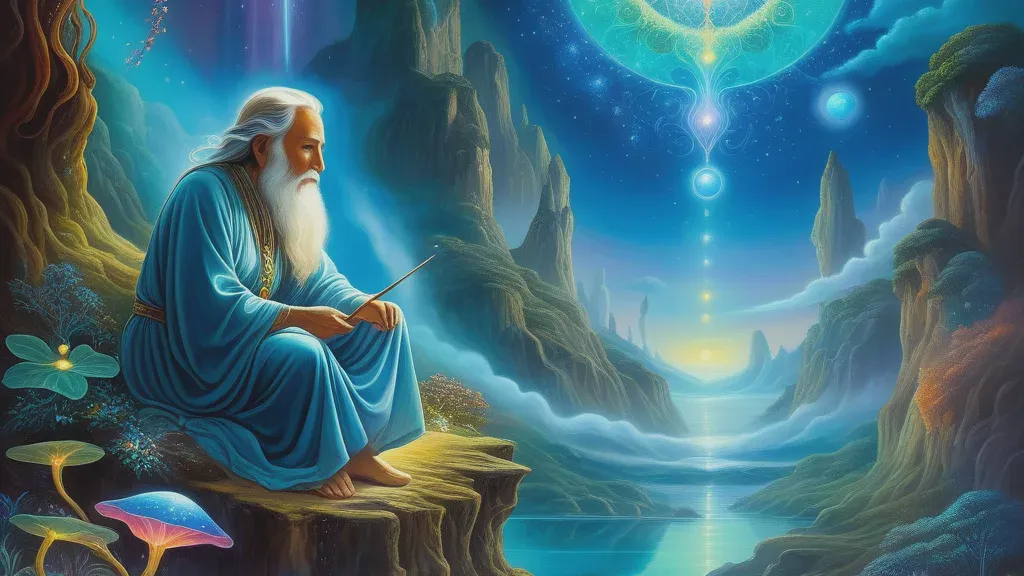
Jung did not merely theorize about painting; he practiced it as a clinical and personal technique he called active imagination, filling notebooks and eventually the illuminated pages of what became known as his Red Book with images meant to give unconscious material a form the conscious mind could then examine and dialogue with. A dream in which the dreamer paints something they do not consciously understand, and feels compelled to keep painting until it resolves into a coherent image, is doing precisely this kind of work: using the hand and the eye to let unconscious content arrive before the intellect has decided what it should look like. Jung associated the capacity to produce spontaneous, emotionally charged images with the Anima, the psychic function that mediates between conscious awareness and the deeper, imagistic layer of the unconscious. A dream painting that arrives with unusual emotional force, colors that feel more vivid than waking life, a scene that seems to paint itself faster than the dreamer's hand can follow, often marks the Anima actively at work, translating material that has not yet found, and may never need, verbal expression. Occasionally the dream supplies a guide: a teacher, an old master, an unnamed figure who shows the dreamer a technique or corrects a stroke without being asked. This is classic Wise Old Man territory, unconscious wisdom presenting itself through instruction rather than direct revelation, offering the dreamer not an answer but a method for finding one. Following such a figure's guidance in the dream, rather than resisting it, often marks a genuine willingness to be taught by parts of the psyche that see further than the conscious ego currently can.
Gestalt / Parts of Self
Gestalt work asks you to become the painting rather than simply describe it. Sit with whatever appeared on the canvas and speak from inside the image: I am the shape you made before you had the words for it. I am not finished because you are not finished with what I am showing you. Speaking as the painting rather than about it turns the dream from a report on artistic skill into direct contact with a part of you that communicates in color and shape because it has not yet been permitted to communicate any other way. A frequent polarity in these dreams sits between what you intended to paint and what actually appeared under your hand. Give the plan a chair and the result a chair, and let them argue. The plan usually insists it knew what the picture was supposed to be. The result usually insists that something truer got through anyway, whether or not it was welcome. Dreams that dwell on this mismatch are rarely reporting failure; they are showing you a moment when a more honest impulse overrode a more careful intention, and asking which one you actually trust. Whether you keep painting, stop, or cover the image over says a great deal about your current relationship to what is surfacing. Continuing to work on it, even uncertain of the outcome, is contact: staying engaged with material that is still forming. Painting over it immediately, or waking yourself up rather than looking at what is emerging, is withdrawal, and it is worth asking, plainly, what about that particular image felt like too much to sit with a moment longer.
Psychodynamic / Freudian
Freud considered artistic creation one of the clearest available examples of sublimation, the process by which drive energy that cannot be expressed or satisfied directly is redirected into a socially valued and psychically tolerable activity instead. A dream in which painting arrives with unusual urgency, a need to keep working past exhaustion, a compulsion to finish before waking, often suggests that whatever energy is being channeled onto the canvas was pressing for outlet with more force than ordinary daily life currently allows it. Being painted by someone else in a dream introduces a different dynamic, closer to transference: the dreamer becomes the object of another mind's interpretation, and the resulting portrait carries that painter's projections as much as any objective likeness. A portrait that feels unflattering, exaggerated, or strangely more honest than the dreamer would have chosen for themselves often reflects a suspicion about how a specific person in waking life, a therapist, a parent, a partner, actually perceives the dreamer, filtered through that person's own unconscious material rather than delivering a neutral verdict. Painting a person who is absent, estranged, or dead often functions as a private, symbolic act of mourning, giving continued visible form to a relationship that can no longer be maintained directly. Rather than pathological attachment, this kind of dream frequently marks active grief work, an attempt to hold the internal image of someone steady on canvas precisely because it can no longer be held any other way.
Contemporary Psychological
The psychologist Mihaly Csikszentmihalyi developed his influential concept of flow, a state of complete absorption in an activity, partly by observing painters at work, who would frequently continue past the point of hunger or fatigue and then, curiously, often lose interest in a finished piece almost immediately once it was done. That detail maps closely onto how painting functions in dreams: the psychological benefit tends to come from the sustained, absorbed act of making rather than from the finished image, which is why a dream painting rarely needs to result in anything the dreamer could actually hang on a wall to have done its work. Dream research has also found that visual imagery during sleep, including color, tends to be reported as unusually vivid or saturated compared with ordinary waking perception, likely reflecting how visual cortex activity during REM sleep is internally generated rather than shaped by the constraints of actual incoming light. A dream painting whose colors feel more intense or strange than anything the dreamer could mix while awake may be a fairly direct readout of this difference in how the sleeping brain constructs visual experience in the first place. Painting in a dream also engages a specific kind of imagined motor sequence, the felt sense of a hand moving, a brush loading with color, a line extending across a surface, distinct from simply watching an image appear. Research on motor imagery suggests that the brain recruits overlapping circuitry whether a movement is actually performed or only vividly imagined, which may explain why dream painting so often carries a strong bodily, almost muscular quality rather than the detached sense of merely viewing a picture.
Cultural & Historical Origins
Renaissance painting treated the act as something close to a sacred office: Michelangelo's ceiling frescoes for the Sistine Chapel were understood by patrons and public alike as a mortal hand attempting to render divine subjects visible, elevating the painter from craftsman to something closer to an intermediary between worlds. A very different but equally sacred use of the act developed independently among Aboriginal artists of Australia's Western Desert, where the dot painting movement associated with the Papunya Tula collective, formed in the early 1970s, translated ancestral Dreaming stories about land, kinship, and creation into a visual language that could be shown publicly while still protecting more restricted layers of meaning known only within the community. Oscar Wilde's The Picture of Dorian Gray inverted the act's usual promise entirely: rather than revealing truth, the painting in his novel absorbs its subject's moral decay so completely that the canvas ages and rots while the man himself remains outwardly untouched, making the act of being painted a way of hiding the truth rather than exposing it.
Contextual Variations
Painting the same picture over and over
Repeating the same image across multiple attempts in a dream suggests an experience or feeling that has not yet found a form the dreamer finds accurate enough to stop revising. Rather than signaling failure, the repetition usually indicates active processing still underway, each version getting closer to something the dreamer can finally recognize as true. The moment the dream painting suddenly feels finished is often a genuine marker of emotional resolution, not just aesthetic satisfaction.
Being painted by a stranger
Sitting for a portrait by someone unfamiliar in a dream puts the dreamer in the position of being interpreted rather than interpreting, and the stranger's identity is worth noting even when it feels arbitrary. The resulting portrait, whether flattering, distorted, or startlingly accurate, usually reflects an anxiety or curiosity about how the dreamer is perceived by people who do not yet know them well. Discomfort during the sitting often points to a specific audience the dreamer is currently trying to read.
A painting that moves on its own
A painted image that begins to shift or animate without the dreamer's involvement suggests emotional material that has gathered enough independent force to act without waiting for conscious direction. Fascination alongside unease is the most common combination in this variation, reflecting genuine curiosity about material finally becoming visible mixed with a real loss of control over its behavior. The dream is less a warning than a signal that something is ready to be engaged with directly rather than only observed.
Running out of paint mid-picture
Running out of a needed color or material before a picture is finished points to a resource, emotional, practical, or simply time, that feels inadequate to complete something the dreamer has already committed to. The specific color missing can matter: a lack of red might point to missing intensity or courage, a lack of a background color to missing context. The dream is often less about the picture than about whether the dreamer trusts they will be resourced enough to finish what they have started.
Frequently Asked Questions
Why do I keep painting the same image over and over in my dreams?
Does being painted by someone in a dream mean they see me a certain way?
Why would a painting suddenly come alive in a dream?
Is it significant if I run out of paint before finishing a picture in a dream?
Journaling Prompts
- Think of something in your life you have tried to explain several times without quite getting it right. If you painted it instead of describing it in words, what would the very first brushstroke need to be?
- Imagine someone who does not know you well painting your portrait today. What would they likely emphasize, and how far is that from the portrait you would paint of yourself?
- Recall an image, memory, or feeling that keeps resurfacing in slightly different forms. What has changed between the most recent version and the one before it?
- Picture yourself finishing a picture you have been working on for a long time, actual or emotional. What would you need to feel true before you were willing to call it done?
Related Symbols
Dreamed about Painting?
Get a personalized AI interpretation that connects this symbol to your specific life circumstances.
Interpret My Dream