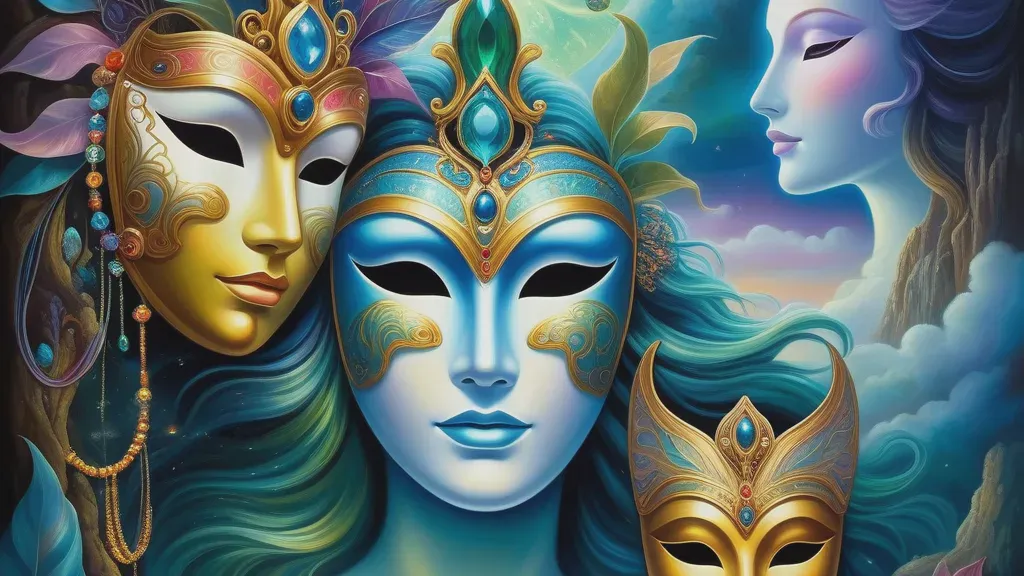
Mask
Jungian Archetypes
Meaning
A mask in a dream separates the face a person shows from whatever is happening underneath it, and the gap between the two is the real subject of the dream. Where a hat announces a role from above, a mask goes further and replaces the face itself, so what surfaces is rarely simple deception but a more urgent question about safety: something in the dreamer needs the protection of not being fully seen right now. The specific expression fixed onto the mask, calm, fierce, joyful, often says less about the dreamer's actual feeling than about what feeling currently seems safe to display in its place.
Psychological Interpretation
Dreams involving masks tend to organize themselves around one central tension: how much distance exists between the face being shown and the feeling underneath it, and whether that distance is chosen or imposed. A mask that fits comfortably and can be removed at will usually reflects a conscious, temporary strategy, a performance the dreamer knows they are giving and can end when it stops serving them. A mask that will not come off, that fuses to the skin, or that begins to feel like the dreamer's only face signals something more troubling: a persona that has outgrown its original purpose and started to replace, rather than protect, the self underneath. Cracks, slippage, or a mask that a stranger can suddenly see through function as the dream's release valve, the moment concealed material finally starts to leak into view whether or not the dreamer is ready. Dreams of other people wearing masks shift the question outward: whose true feelings does the dreamer suspect they are not being shown, and how much does pretending not to notice actually cost the dreamer over time.
Traditional Symbol Meaning
Many masking traditions treat the object as considerably more than costume: the wearer is understood, at least ritually, to become what the mask represents rather than merely portray it. Yoruba Gelede masquerades, performed to honor spiritual authority attributed to women and elder mothers known collectively as the Mothers, use masks and elaborate headdresses to make that power visible and approachable within the community, turning concealment into a form of respectful address rather than simple disguise. Dan communities in West Africa likewise hold that certain masks carry a spiritual presence of their own between performances, requiring the mask itself, not only the performer, to be treated with ongoing ritual care. European theater took the mask in a more secular direction. Commedia dell'arte, flourishing in sixteenth-century Italy, assigned each stock character a fixed half-mask, the scheming Arlecchino, the miserly Pantalone, so that a single glance told an audience exactly which social type, and which flaws, they were about to watch play out. The mask's fixed features did psychological work an actor's face alone could not: guaranteeing that a type, rather than an individual, was on stage. Funerary tradition points to the same object serving an opposite function: fixing a face permanently rather than concealing it temporarily. The gold mask found over Tutankhamun's mummified remains, and the beaten gold mask Heinrich Schliemann uncovered at Mycenae and controversially named for Agamemnon, were both crafted to give the dead an idealized, unchanging face to carry into whatever came next, a mask worn not to hide the self but to preserve it past the point where the living face could hold it.
Jungian / Archetypal
Jung used the Latin word persona deliberately, and a dream mask puts his choice on full display: the question is never simply whether the dreamer is hiding something, but whether the mask has become a tool the ego uses or a wall the ego has been trapped behind. A mask that can be lifted at will, examined, and set aside belongs to healthy Persona function, a necessary adaptation to a given social role. A mask that has fused to the skin, or that the dreamer cannot recall putting on in the first place, suggests the adaptation has calcified into something closer to a second, false skin, one the individuation process will eventually need to work loose. The Hero archetype supplies a particular version of this problem: heroic action in myth is regularly performed by a figure who must appear stronger, calmer, or more certain than they privately feel, and the dream mask can externalize exactly this split. A dreamer who must wear a composed, capable face through a difficult undertaking, in the dream as in life, is drawing on genuinely heroic energy, but the mask also marks the precise boundary the Hero archetype cannot cross alone: fear or doubt kept out of sight does not disappear simply because the performance succeeds. Where the mask cracks, slips, or reveals a second face underneath, softer or more tender than the one on display, the dream is often bringing forward material Jung would associate with the Anima: the inner emotional and relational life a more armored persona has been keeping at a protective distance. Mirrors are common companions to this variation, since seeing both faces at once, the composed one and the vulnerable one, is usually the psyche's way of insisting the dreamer register the split directly rather than continue managing it unconsciously.
Gestalt / Parts of Self
Speak as the mask in this dream rather than about it: I am the face you show when your own does not feel safe enough to use. I can be calm when you are not, brave when you are not, pleasant when you are anything but. Said aloud in the mask's own voice, the dream stops being about deception and becomes an honest report from a strategy you rely on constantly: a disowned skill for managing how much of yourself gets shown at any given moment. The dream sets up a clear polarity between the face on display and the face underneath, and Gestalt work asks you to let both speak rather than immediately siding with the one that seems more honest. Give the mask a chair, and give the hidden face a chair across from it. The mask likely argues that some situations simply are not safe for the raw version to appear in. The hidden face likely argues that it is tired of waiting for permission. Neither is lying; the dream is asking you to stop treating this as a contest and start treating it as a negotiation between two parts that both belong to you. Whether you put the mask on yourself or find it already fused to your face changes the meaning considerably. Choosing to wear it, adjusting it, deciding when to take it off, is contact: a deliberate, examined use of concealment. Waking up inside a mask you cannot remove, or finding your own hand keeps replacing it whenever it slips, is withdrawal that has become automatic, and the more useful question is not what the mask hides but why removing it now feels more dangerous than keeping it on.
Psychodynamic / Freudian
A dream in which the mask feels indispensable, something the dreamer could not imagine functioning without, often points to a defense working so smoothly it no longer registers as effort. The psychoanalyst Joan Riviere described a related phenomenon in adults who had achieved real competence or authority: a performed, exaggerated ordinariness or agreeableness worn specifically to offset anxiety about possessing power that felt, on some unconscious level, dangerous to show directly. A dream mask that hides confidence or capability behind a more modest face can be doing exactly this work, managing anxiety about being seen as too much rather than concealing a deficiency. Reaction formation offers a second, related reading: a mask that displays the opposite of what the dreamer actually feels, warmth where there is resentment, calm where there is fear, can indicate that the true emotion has been judged too dangerous to express even to oneself, and has been converted into its opposite before it ever reaches the mask's surface. The tell is usually in the dream's physical detail; a smiling mask that feels tight, hot, or difficult to breathe through is the body's way of registering the cost of a feeling that does not match what lies underneath it. Where the dream features someone else's mask slipping, rather than the dreamer's own, it is often safer to place suspicion about deception outward before turning it toward the self. A dreamer who becomes fixated on what a particular person in the dream might be concealing is frequently circling a discomfort about their own concealment, using another figure's mask as a rehearsal space before the question can be asked more directly.
Contemporary Psychological
Social psychology has directly studied what happens when a face is covered rather than merely imagined. Early research on what is called deindividuation, including experiments by Philip Zimbardo in which anonymity was manipulated using hoods and masks, found that concealing identity tended to loosen ordinary social restraint, sometimes increasing behavior a person would not otherwise engage in when identifiable. A dream in which a masked figure, the dreamer or someone else, acts with unusual boldness or cruelty may be drawing on this same logic: the mask functioning as genuine psychological permission rather than only visual concealment. There is also evidence that facial expression is not purely a readout of feeling but can influence it in return, a relationship researchers refer to as facial feedback. A mask fixed into a single expression, a permanent smile, a frozen scowl, forces an expression the underlying emotion may not match, and the strain reported in many mask dreams may reflect a real, embodied mismatch between an imposed facial configuration and whatever the dreamer actually feels underneath it. The specific unease mask dreams provoke, more than most concealment imagery, may also relate to how heavily the human brain is specialized for face processing. Dedicated neural systems track subtle facial movement almost automatically, and a face that will not move naturally, or that hides its true movement behind a fixed surface, registers as a specific kind of wrong that plainer forms of disguise, a hood or a change of clothing, do not produce in the same way.
Cultural & Historical Origins
The word persona entered psychology by way of Roman theater, where it named the mask an actor held or wore, a device that literally means to sound through, since early Greek and Roman masks were built to project an actor's voice to the back rows of an amphitheater while announcing the character's identity at a glance. Japanese Noh theater developed this idea into an extraordinarily precise art form: masks such as the hannya, carved with horns and a fixed, ambiguous grimace, are designed to shift expression, appearing enraged, grieving, or strangely serene, depending only on the tilt of the performer's head, so that a single fixed object can hold more than one emotional truth at once. Venice institutionalized the mask's power to conceal for an entire city: during Carnival, laws granted anyone wearing the bauta or moretta genuine legal anonymity, allowing nobles and commoners to gamble, speak, and move through the city on equal, unidentifiable footing for weeks at a time.
Contextual Variations
A mask that won't come off
A mask fused to the skin, or one the dreamer cannot recall choosing, marks a persona that has stopped functioning as a tool and started functioning as a replacement face. The panic in these dreams usually centers less on the mask itself than on the growing suspicion that the dreamer no longer knows what lies underneath it. This variation often coincides with a role in waking life, professional or personal, maintained so consistently for so long that its removal now feels genuinely uncertain.
Watching someone else's mask slip
Catching a glimpse of what another person's mask is concealing usually says more about the dreamer's own suspicion or intuition than about that specific person. The dream may be surfacing a truth the dreamer has sensed in waking life but not yet been willing to name directly, using someone else's face as a safer place to first locate it. It can also reflect discomfort with the dreamer's own concealment, projected outward and examined at a more tolerable distance.
Choosing a mask before a masquerade
Deliberately selecting a mask, weighing which face to present before entering a social situation, points to conscious management of self-presentation rather than avoidance. This variation typically appears when the dreamer is preparing for a genuinely complex social event in waking life and is mentally rehearsing which version of themselves will serve the occasion best. The mask chosen, frightening, elegant, comic, often names the quality the dreamer feels they most need to borrow for the moment.
A mask that cracks in front of others
A mask breaking apart in public is one of the more anxiety-charged mask variations, since it removes the dreamer's control over the timing of exposure. Rather than signaling disaster, the crack usually indicates that concealed material has become too pressurized to hold indefinitely and is finding its own way out. The identity of who witnesses the crack in the dream is worth noting, since it often marks exactly whose reaction the dreamer fears most if the truth became visible while awake.
Frequently Asked Questions
Why do I dream that I can't remove a mask?
Is dreaming about masks always about hiding something bad?
Why did I see two different faces on the same person in my dream?
What could it mean if my mask cracked in front of other people?
Journaling Prompts
- Describe the face you wore today in your most demanding interaction, and the face that was actually happening underneath it. How far apart were they from each other?
- Think of a mask you have worn so long it barely feels like a choice anymore. What would you need to feel safe enough to set it down, even briefly, with one person?
- Recall a moment you sensed someone else's mask slipping. What did you see in that instant, and why do you think you were the one who noticed it?
- If you could choose one honest expression to wear for a single day without consequence, what would it be, and who would you most want to see it on you?
Related Symbols
Dreamed about Mask?
Get a personalized AI interpretation that connects this symbol to your specific life circumstances.
Interpret My Dream