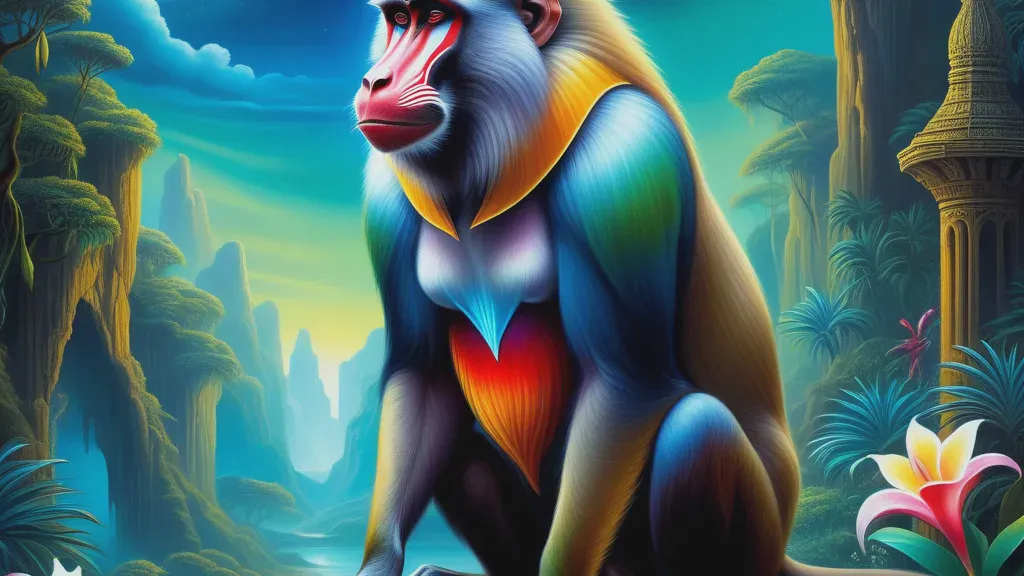
Mandrill
Jungian Archetypes
Meaning
Mandrills in dreams often signify deep emotional struggles or the need for self-assertion. They can represent repressed feelings or the call to embrace one's primal instincts and assert one's identity in social contexts.
Psychological Interpretation
Jungian analysis views mandrills as embodying the 'Hero' archetype, prompting the dreamer to confront their shadow. Cognitive psychology may interpret this as a reflection of social dynamics and assertiveness. Practical psychology focuses on the importance of acknowledging and integrating one's primal emotions.
Cultural & Historical Origins
In African folklore, mandrills are often revered as symbols of strength and protection. In the animated film 'The Lion King', the mandrill Rafiki represents wisdom and guidance, showcasing the blend of playfulness and seriousness in navigating life’s challenges.
Contextual Variations
You watch a mandrill in a social setting, noticing how it uses facial expressions to read the room. When it turns toward you, you feel both amused and exposed.
Mandrills highlight primal instincts and social signaling—your psyche may be processing how you read others or how others read you. Psychologically, it points to awareness of power dynamics and the fear/curiosity of being seen.
A mandrill tries to join your group, but it keeps changing its behavior—sometimes bold, sometimes retreating. You realize you’re mirroring it by acting differently depending on who’s watching.
This scenario reflects self-monitoring and persona performance—adapting too much can fragment your authenticity. Psychologically, the dream suggests integration: choosing when to be expressive and when to be genuine.
You’re in the wild and a mandrill leads you through a narrow path while other animals watch. You feel like you’re learning social rules from instincts rather than logic.
Leading through a narrow path points to navigating complex social terrain—knowing when to move, when to hold back, and how to handle attention. Psychologically, it suggests your instincts may be a reliable guide for group dynamics.
Frequently Asked Questions
Why did the mandrill’s facial expressions feel so important?
What does it mean if I felt exposed when the mandrill looked at me?
Is mandrill symbolism about aggression or about social strategy?
Journaling Prompts
- Where am I adjusting my behavior based on who’s watching, and what part of me feels most “performed”?
- What social signals am I noticing lately, and how accurate do I feel my interpretations are?
- If my instincts had a “social rulebook,” what would it say about when to approach, retreat, or speak up?
Related Symbols
Dreamed about Mandrill?
Get a personalized AI interpretation that connects this symbol to your specific life circumstances.
Interpret My Dream