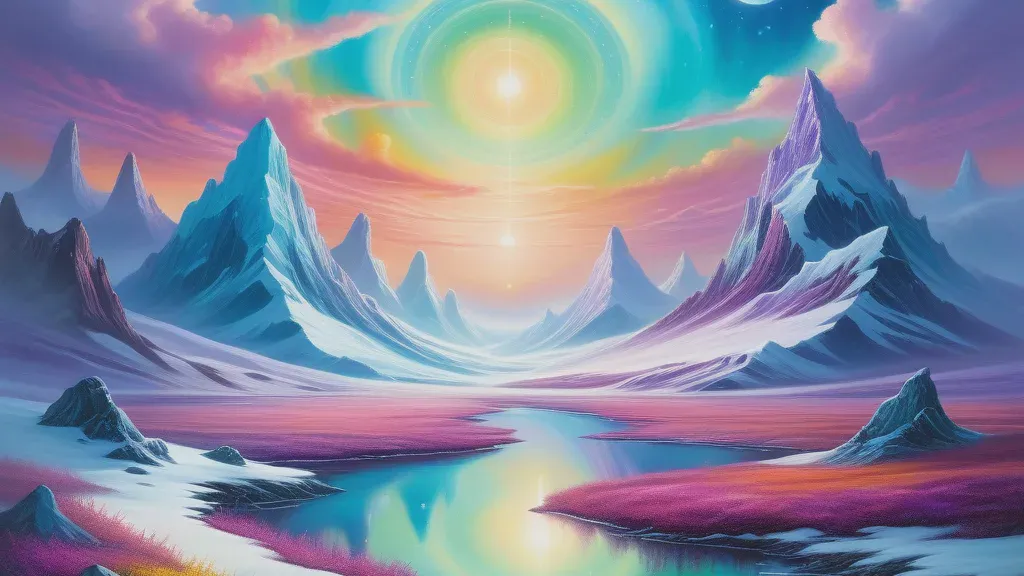
Magical Tundra
Jungian Archetypes
Meaning
Tundra is land that has been reduced to essentials: no trees, a shallow living layer over ground that never thaws, light that travels a long way because nothing interrupts it. A magical tundra is that same austerity with something added, an aurora, a voice, a warmth that should not be there, a landscape that behaves as though it is aware of the dreamer. The addition is the point. Emptiness in dreams usually reads as loss, but this image insists that a stripped condition can also be charged, that the place where very little grows is where a person can finally see the horizon. Dreams set here belong to periods of austerity, isolation or endurance in which something has begun to feel significant rather than merely bleak.
Psychological Interpretation
The first thing to establish is whether the dreamer is passing through the tundra or living in it. A crossing is a dream about a defined stretch of hardship, a treatment, a separation, a season of work with an end date, and its detail concerns supplies, pace and the distance to shelter. Being resident, having a life there, points at something longer and more structural: a marriage gone quiet, a role that has emptied out, years of caretaking in which the dreamer's own weather stopped being consulted. What the cold does to the body in the dream refines this further. Cold that hurts means the situation is still being felt, and that is better news than cold the dreamer has stopped noticing, which is the image of an adaptation that has gone too far. The magical element is the part most dreamers underplay when they retell it, and it usually carries the message. An aurora overhead, a light on the snow, an animal that waits, a figure who speaks in a familiar voice: these are the psyche insisting that the emptiness is inhabited. Ground is the other detail worth recovering. Walking on frozen ground that holds is a different dream from walking on ice that creaks, and something visible under the ice, an object, a face, an animal, means the dream is about what has been preserved rather than what has been lost. The tundra keeps things. Nothing rots there, which is why the past arrives intact.
Traditional Symbol Meaning
Older dream interpretation had no entry for tundra, but it had a great deal to say about the elements the image is made of, and those readings still colour how the dream feels. Snow was generally favourable in the dream books, standing for a difficulty that would pass with the season, and for a covering that hid what was underneath without destroying it. Ice was less kind. It stood for coldness between people, for a footing that could not be trusted, and for enterprises undertaken at the wrong time of year, and the surviving idiom about thin ice preserves the sense exactly. Barren ground was the harshest of the three, read as a period of no yield, and the old interpreters were careful to distinguish land that was resting from land that had been ruined. The wasteland motif in medieval romance gives that distinction its most useful form. In the story of Perceval as Chretien de Troyes left it, the land lies waste because a question was not asked, and it is not a curse to be broken by force but a condition waiting on someone finding the nerve to speak. A dreamer standing in an enormous frozen emptiness is inside that narrative shape. The traditional reading would not ask how to escape the plain, but what has gone unsaid at the centre of the situation the plain describes. Arctic cultures contributed a practical ethic that dreams borrow directly. On ground where shelter is scarce, hospitality is not a courtesy but an obligation, and refusing a traveller is close to killing them. Warmth in these traditions is a shared, finite substance that has to be managed rather than a mood, and the same logic governs food, fuel and company. This is why dream tundras so often stage a decision about giving warmth away, and why that decision feels weightier than the equivalent gesture would in a dream set anywhere else. The last inheritance is the ground itself. Permafrost does not decay what it holds, which is how bodies, seeds and whole animals have come out of it thousands of years later looking recent. Folk sense in the far north has long treated the frozen earth as a keeper rather than a grave, and the psychological transfer is immediate. What has been frozen has not been processed, and it returns in the same condition it went in, which is precisely what dreamers report when a preserved face or object appears under the ice.
Jungian / Archetypal
Landscape in a dream is a statement about the condition of the psyche rather than a backdrop for one, and a tundra states it in the plainest available terms: the vegetation is gone, the horizon is uninterrupted, and whatever moves out there can be seen from a long way off. Jung read the alchemical sequence of colours as stages of psychological work, and the whitening that follows the black phase is the closest fit for this image. The albedo is not yet warmth or fruit; it is a cold, lunar clarity that arrives after something has been thoroughly broken down, and its characteristic mood is exactly what dreamers describe here, a bleakness that is somehow clean. Read that way the tundra dream is not a report of failure. It is a report of a stage. The figure who appears in the cold decides the rest of the reading. An ice-woman, a bright and remote female presence, a voice that promises stillness, belongs to the anima in her frozen aspect, the one Andersen dramatised as a queen whose kingdom is beautiful, orderly and lethal to feeling; a male dreamer under her influence is usually living a competent life with the emotional thermostat turned down. A hard, judging male figure who counts the dreamer's supplies and finds them wanting is animus in the corresponding form, the inner voice that rations. Neither is an enemy. Both are asking to be met rather than obeyed, and the dream typically supplies the meeting place, a fire, a shelter, a companion animal. The aurora is the Self's signature on the scene, and it explains the word magical in the slug better than anything else in the dream. A ring or arc of moving light above a dreamer standing alone at the centre of a flat plain is a mandala drawn on the largest possible canvas, and it appears when the psyche is trying to demonstrate that the emptiness has an order. Jung's compensation principle predicts who receives this dream: people whose waking lives are crowded, sociable and busy tend to be sent the tundra, and people who are genuinely deserted tend to be sent the aurora over it. The desert fathers went out to such country deliberately, and the tradition they founded says what the dream says, that solitude of this kind is an instrument and not a punishment.
Gestalt / Parts of Self
Take the least human part of this dream first, because it is the one carrying your disowned material. Be the frozen ground and speak as it: I grow nothing on my surface, I hold everything that has ever fallen into me, and I hold it exactly as it was. Say that out loud and notice what your body does. Then be the aurora, which is the opposite claim: I move constantly, I am visible from very far away, I keep nothing and touch nothing. Most dreamers discover that they have been living as the ground and long to be the light, or the reverse, and that the two have not spoken to each other in years. Work the polarity of warmth and cold as a dialogue rather than a diagnosis. The cold end of you will have reasons, and they will be good ones: it conserves, it prevents further loss, it makes you unavailable to people who take. The warm end will complain about what conservation has cost. Let both make their case in the empty chair without arbitrating, and pay attention to which one you defend more fluently, because fluency here marks the side you have already chosen. If a figure appeared in the cold, put them in the chair too and ask what they came out that far to say. Gestalt takes withdrawal seriously as a phase of the contact cycle rather than as a failure of contact, and this dream is largely a study of it. Contact costs energy, and after a period of sustained meeting a person is entitled to go out onto the plain and be met by nothing. The question is whether you are at rest there or stuck there, and there is a bodily test: rest feels wide, stuckness feels thin. Try the experiment of standing in an empty room and saying, I am not available at the moment, and then, I want someone here, and see which sentence you can finish without your voice changing. Whatever you cannot say is the work.
Psychodynamic / Freudian
A frozen landscape is one of the most legible defensive structures the dreaming mind produces, and the mechanism it pictures is isolation of affect: the content of a difficult experience is retained while the feeling attached to it is separated off, so the dreamer can describe a devastating year in a level voice. The scene renders that separation as geography. Everything is present and nothing is warm. What makes the image clinically interesting is that it is stable rather than distressing, which is exactly the appeal of the defence, and why dreamers often report the tundra with a shrug and only later notice it was the most striking thing they saw all week. Fairbairn and his colleague Harry Guntrip described the schizoid position in terms that fit the setting closely: a withdrawal of the self to a place where relationships cannot reach it, adopted because contact once proved dangerous or disappointing, and maintained at the price of feeling unreal. John Steiner's account of psychic retreats adds the crucial detail that such a place is organised and comfortable, a refuge that offers relief from anxiety in exchange for staying out of contact. Winnicott's contribution runs the other way and is more hopeful. He described a true self kept hidden and preserved rather than destroyed, and he distinguished the ordinary capacity to be alone, developed in the presence of someone trusted, from the loneliness of having no one. A dream tundra that feels serene is closer to the capacity; one that feels endless is closer to the retreat. Whatever is visible under the ice deserves the most attention, because the frozen ground behaves precisely like an ungrieved loss. Freud's distinction between mourning and melancholia turns on whether the lost object is relinquished or kept alive inside the self, and permafrost is the perfect image for keeping: nothing decays, nothing is metabolised, and the thing comes back intact after decades. Dreamers who see a face, an animal or a familiar object preserved beneath the surface are usually carrying a specific unfinished bereavement, sometimes not of a person but of a version of their life. The dream is not asking for excavation by force. Thaw in these dreams is seasonal, and the analytic equivalent is a relationship warm enough that the ground can give the object up on its own schedule.
Contemporary Psychological
Dream settings are not arbitrary, and content analysis in the tradition of Calvin Hall and William Domhoff finds them tracking the emotional environment of waking life with some consistency. Ernest Hartmann's work sharpens the point for images like this one. He argued that a dream tends to picture the dominant emotion in a single central image whose intensity tracks how strongly that emotion is felt, and offered the tidal wave of terror as his standard example. A vast, silent, frozen plain is a central image of the same order, but for a different state: emotional flatness, depletion, or the numbness that follows a period of too much feeling. Dreamers reliably produce it during bereavement, burnout, long caregiving and the aftermath of a decision that cost them something. There is a physiological contribution that is easy to overlook. Thermoregulation is largely suspended during rapid eye movement sleep, when shivering and sweating responses drop away and body temperature drifts toward the temperature of the room, which makes the sleeping brain unusually sensitive to ambient cold at precisely the stage that generates vivid dreams. A cold bedroom, an uncovered shoulder or an open window can supply the raw sensation the dream then builds a landscape around. This does not explain the meaning away. Incorporated sensations are given the shape of whatever the dreamer is currently working on, which is why one person's cold room becomes an arctic crossing and another's becomes a hospital corridor. The light in these dreams connects to a broader finding about season and mood. Reduced daylight in winter shifts sleep timing, alertness and mood in a substantial minority of people, and studies of populations at high latitude have examined both the burden of the dark months and the strategies used to live well through them. A predictive processing account explains the sparseness of the scene: with little sensory input to constrain it, the sleeping brain generates a low-detail environment and fills it with whatever model is currently dominant, which is why so much of the tundra is empty and one or two elements are hyper-real. The practical implication is modest and worth taking. When the same barren setting recurs, treat it as a reading on emotional supply rather than as a prophecy, and check the ordinary inputs first: light, contact, rest and food.
Cultural & Historical Origins
The word itself comes north from the Kildin Sami term for treeless high ground, borrowed into Russian and then into English, and it carries that original sense of a place defined by the absence of trees. Inuit thought offers the closest traditional equivalent of the dream's magic in the concept of sila, usually rendered as air, weather or breath but understood as an intelligence pervading the environment rather than an inert climate; a person on the land is inside something that can be offended, addressed and heeded. Greenlandic tradition adds the figure of the qivittoq, the one who leaves the settlement to live alone in the interior and becomes strange, gaining powers and losing humanity in equal measure. The aurora is where the enchantment is most explicitly recorded. In several Inuit traditions the lights are the dead at play, and there are widespread reports of taboos against whistling at them or mocking them, since attention drawn from that quarter is not necessarily benign. Sami tradition names the aurora as light that can be heard and treats it with comparable caution. Norse cosmology supplies the harsher northern imagination in Niflheim, the world of mist and cold, and in the Fimbulwinter, three winters running together without a summer before the ending of the world. Hans Christian Andersen gave European literature its enduring cold-country psychology in The Snow Queen of 1844, where a splinter of enchanted mirror in the eye makes everything beautiful look mean.
Contextual Variations
Walking a treeless plain with the aurora directly overhead
This is the version dreamers wake from feeling oddly steadied, and the combination is the reason: nothing on the ground and everything in the sky. It usually arrives when a period of loss or reduction has stopped being an emergency and become a landscape you live in, and the psyche is registering the first sign that the emptiness has an order to it. Note where the light sits in relation to you, since a ring that surrounds you means something different from a glow at the far edge. Dreams like this often precede a decision, and they tend to make it feel smaller and clearer than it did the day before.
A frozen lake showing your face and another beneath it
Ice makes a mirror that is also a window, and this dream uses both properties at once. The face under the surface is a version of you that has been kept rather than lived: a younger self, an abandoned ambition, an aspect of your character that was set aside when circumstances demanded a colder competence. The instinct is to break through, and dreams that go well rarely reward it. Look instead at how the two faces are arranged, whether they are aligned, whether one is speaking, and whether the ice between them is thinning. Recognition, in this image, does more work than force.
Something alive and perfectly preserved under the permafrost
Frozen ground does not decompose what it holds, and the dream is using that fact precisely. Whatever you find down there has not aged, softened or been worked through, which means it will surface with its original charge intact, and this is the signature image of an unfinished grief or an unmetabolised event. Notice whether it is looking back at you. Dreamers often feel guilt at this point, as though the preservation were a failure of theirs, when it is closer to a strategy that once made survival possible. The useful question is what conditions would have to exist around you now for a thaw to be safe.
Giving away your last warmth to a stranger in the cold
Northern traditions treat warmth as a finite substance and hospitality as an obligation, and your dream has staged the collision between the two. Giving it away and finding the cold bearable says one thing about you; giving it away and freezing says something quite different, and both are common in people who care for others professionally or at home. Ask who the stranger resembles, because the figure is frequently a disowned version of the dreamer, the part that has gone unfed while everyone else was warmed. Generosity here is real, but the dream is asking you to count what is left in your own store.
Frequently Asked Questions
Why do my dreams keep putting me in an empty frozen landscape?
Is dreaming of a cold, barren place a bad sign?
Why did the tundra in my dream feel beautiful rather than frightening?
Why am I calm and alone in the dream but anxious when I wake up?
Journaling Prompts
- Describe the ground you walked on in the dream: whether it held your weight, whether it creaked, whether anything was visible under it. Then write the same description about the situation you are currently standing on in waking life, keeping the same words wherever they fit and noticing which ones stop being metaphors.
- Write down what warmth means in your life at the moment, in specifics rather than abstractions: which people, which hours, which rooms, which foods. Then write an honest inventory of where it goes and whether the amount coming back has changed in the last year. If the balance has tipped, name the single transaction you would alter first.
- Something in the ice was preserved, and it went in at a particular temperature on a particular day. Write about the season of your life when the freezing happened, without judging it, and describe what it was protecting you from at the time. Then describe what would have to be true around you now for a thaw to be survivable.
- The dream contained one thing that did not belong to a barren landscape: a light, a voice, an animal, a warmth. Write about it in detail before you interpret it, and then finish this sentence three different ways: the reason it came out this far was.
Related Symbols
Dreamed about Magical Tundra?
Get a personalized AI interpretation that connects this symbol to your specific life circumstances.
Interpret My Dream