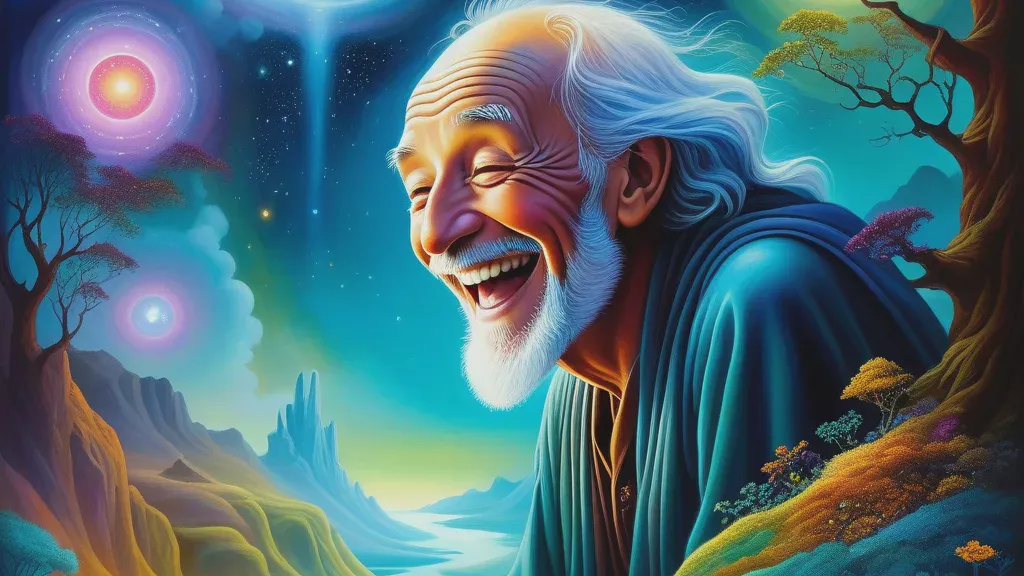
Laughing
Jungian Archetypes
Meaning
Laughter in a dream is rarely simple happiness; it is the psyche's most involuntary sound, breaking through before conscious judgment can approve or forbid it. Because laughing overrides ordinary self-control, a dream that makes the dreamer laugh, especially somewhere laughter would be inappropriate or even cruel, exposes what has slipped past their usual censorship. The laughter's target says as much as the laughter itself: relief laughs release tension that has finally found an exit, while laughter aimed at another figure's misfortune surfaces an appetite for triumph the dreamer would never admit to while awake.
Psychological Interpretation
What matters most in a laughing dream is rarely whether the laughter felt pleasant, but what triggered it and whether the dreamer could stop. Laughter that arrives without a rememberable joke, the dreamer simply finds themselves laughing, often marks relief discharging faster than the mind can track its source, as though some inner argument resolved itself off-screen. Laughter that will not stop, that turns compulsive or slightly frightening, suggests an emotion too large for its container; the body keeps producing the sound after the original feeling has already been spent. Laughing during a scene that should call for fear or grief is one of dreaming's more unsettling signatures, and it rarely means the dreamer is heartless: it more often means two incompatible responses, dread and release, are being generated at once, and laughter is the one the body let through. Hearing others laugh, rather than laughing oneself, shifts the reading toward exposure, since a dream built around being laughed at usually concerns the gap between how the dreamer wants to be seen and a fear of how they actually are seen.
Traditional Symbol Meaning
Few corners of world folklore treat laughter as a deliberate tool rather than a background mood, but the figures who do recur across strikingly different traditions. Anansi, the spider trickster of West African and Caribbean storytelling, is the clearest case: his tales again and again turn ridicule into strategy, letting a smaller, weaker creature outwit stronger rivals by making them look foolish rather than by matching their strength. Communities that told and retold Anansi stories were transmitting a specific piece of practical wisdom, that laughter aimed correctly is itself a form of power available to those who have no other kind. The Sufi tradition preserves a gentler but equally purposeful version of the same idea in Nasreddin Hodja, the wise fool of Middle Eastern and Central Asian folklore whose stories nearly always end in a joke that turns out, on reflection, to carry real instruction. Hodja plays the fool so his listeners lower their guard enough to actually hear the point being made, using laughter as a delivery mechanism for truths a direct lesson would likely have met with resistance. This pairing of foolishness and wisdom is one of the oldest patterns in world folklore, and it maps closely onto why a Wise Old Man figure in a dream might choose to speak through a joke rather than a warning. Ritual traditions push the same logic further. Among the Lakota and related Plains nations, heyoka sacred clowns behave backwards on purpose at ceremonies, riding horses facing the tail, complaining about heat in winter, deliberately provoking laughter to loosen a community's habitual solemnity and make room for something outside ordinary order. Greek religion, more ambivalently, gave laughter its own god in Momus, whose mockery of the other Olympians eventually got him expelled from their company entirely, a myth that concedes laughter's danger even while granting it divine standing. Across each tradition, laughter is treated not as an ornament to seriousness but as a distinct instrument, capable of teaching, protecting, or destabilizing depending on who wields it and why.
Jungian / Archetypal
Jung's Wise Old Man rarely arrives in a dream to lecture; when he shows up through laughter instead of solemn advice, the dream may be using humor deliberately because insight delivered with a straight face has already failed to land. A dream figure, or the dreamer's own laughing self, who finds something funny that waking judgment would call serious can be a compensatory correction, the psyche's way of loosening a perspective that has become too rigid to receive a message any other way. The Shadow enters laughing dreams through their least comfortable variety: laughter at someone else's humiliation, pain, or failure. Waking ethics generally forbid enjoying another person's downfall, so when a dream delivers that exact enjoyment without apparent guilt, it is very often surfacing an appetite the conscious personality has exiled rather than resolved. The discomfort on waking is itself useful data, marking the boundary between what the ego permits itself to feel and what it has quietly been feeling anyway. Compensation theory helps make sense of laughter that arrives with no clear cause at all. Jung held that dreams often balance a one-sided conscious attitude, and a dreamer who has spent recent waking life unusually serious, controlled, or grief-stricken may find their dreams supplying comic relief the ego would never have permitted itself deliberately. Read this way, uncaused dream laughter is less a mystery to solve than a corrective already doing its work, restoring some lightness the conscious personality has been rationing too carefully.
Gestalt / Parts of Self
In Gestalt dreamwork, the laughter itself deserves to be interviewed before anything else in the dream. Speak as the laugh: what relief are you carrying that the rest of me wouldn't let through any other way? What have you been waiting for permission to release? Treating an emotion as a character with its own voice, rather than a symptom to explain, often surfaces exactly what it was discharging. If the dream involves being laughed at, become the laughing crowd rather than only the person being mocked. Speaking from that position usually reveals a judgment you already hold about yourself, now given a face and a voice outside your own head. The crowd is not really other people; it is the part of you that has been rehearsing this exact verdict in private and has finally found somewhere to say it out loud. Laughing along with someone whose intentions you distrust asks you to own the part of yourself that goes along with things it privately questions. That part is not weak or false; it is protecting you from a confrontation your system has judged, rightly or wrongly, as too costly right now. Sit with that part directly and ask what it is actually protecting, since dismissing it as mere people-pleasing skips past the real information it's holding.
Psychodynamic / Freudian
Freud devoted an entire study, Jokes and Their Relation to the Unconscious, to the idea that laughter operates like a pressure valve, releasing psychic energy that had been used to keep a forbidden thought suppressed. A dream that provokes laughter functions on the same principle: the laughter marks the exact moment repressed material slips past the censor cheaply, disguised as amusement rather than confronted as conflict. The manifest laughter in a dream often conceals a latent aggression or forbidden wish that would be unacceptable if expressed directly. Laughing at another dream figure's misfortune, in particular, can displace hostility the dreamer cannot afford to feel toward someone in waking life onto a safer, more distorted substitute, letting the aggressive charge discharge without the dreamer having to own where it actually belongs. Uncontrollable dream laughter, laughter that exceeds any plausible cause within the dream, points to a larger backlog of suppressed affect finding an exit through the one channel the ego still permits. Because laughter reads as harmless even when it isn't, it is one of the psyche's more efficient disguises, letting real material through the door it would otherwise guard most carefully.
Contemporary Psychological
Laughter researcher Robert Provine's studies of everyday laughing found that it is overwhelmingly social: people laugh dramatically more often in the presence of others than alone, and most laughter has little to do with anything actually funny, functioning instead as a bonding signal between people. A dream in which laughter is shared, contagious, or directed at the dreamer inherits this social logic, meaning the dream may be less about a joke's content and more about who does or doesn't get pulled into the laughing group. Sleep research on emotional processing suggests dream affect often runs ahead of, or independently from, whatever narrative logic the dream provides, which helps explain why dream laughter frequently attaches to scenes that would not read as funny to anyone awake. The mismatch is not a malfunction; emotional tone and story content appear to be generated somewhat separately during REM sleep, and laughter can surface simply because a release valve opened, regardless of what image the dreaming mind happened to be running at that moment. Because laughing is one of the few dream sensations the body can produce loudly enough to interrupt sleep itself, a dream that ends in real, audible laughter is worth treating as a genuine physiological event rather than only a symbol. What woke the dreamer was an actual discharge, not a metaphor for one, and the content it attached itself to is likely closer to incidental than to the point.
Cultural & Historical Origins
Laughter has its own dedicated cast of mythic and folk figures distinct from humor in general. West African and Caribbean storytelling gives laughter its cleverest ambassador in Anansi the spider, whose tales routinely turn mockery and trickery into survival, teaching listeners that laughing at power is sometimes the only leverage the powerless have. The Sufi and broader Middle Eastern tradition preserves a parallel figure in Nasreddin Hodja, the wise fool whose jokes double as teaching stories, deploying laughter as a vehicle for insight that a straight lesson would not have carried as far. Among the Lakota and related Plains nations, heyoka sacred clowns invert ordinary behavior at ceremonies, doing everything backwards and absurdly on purpose, using deliberately provoked laughter to break a community's habitual seriousness and open space for something outside normal order. Greek religion set aside a place for laughter's darker edge in Momus, the god of mockery and satire, eventually expelled from Olympus for laughing at the gods themselves once too often.
Contextual Variations
Laughing uncontrollably and unable to stop
Laughter that won't stop past the point of comfort usually signals an emotion running past the size of the moment that triggered it. Something you've been holding down with more force than you realized may be discharging all at once, and the laughter is simply the shape that release takes. If the feeling underneath surfaces later as unexpected sadness or anger, treat that as the same event continuing, not a separate one.
Laughing while something frightening happens around you
Laughing during a dream's frightening moment usually means two responses are firing at once: real alarm, and a simultaneous, almost reflexive relief that the threat isn't quite as total as it first appeared. Rather than judging the laughter as inappropriate, consider what it points to that fear alone doesn't: some part of you may already sense you'll get through this, even while another part is still afraid.
Being laughed at by a crowd of strangers
Strangers laughing at you in a dream rarely predicts real judgment from real people; it usually externalizes a self-assessment you're already making privately. The facelessness of the crowd is the clue, since a specific critic would appear as themselves. Ask what you've recently done, said, or wanted that you suspect would look foolish if anyone actually saw it, because that private verdict is likely the true source of the laughter.
Laughing along with someone you don't fully trust
Laughing along with someone whose motives you don't fully trust can mark a real compromise: you're going along with a dynamic that unsettles you because standing apart from the laughter feels riskier than joining it. Notice whether your laugh in the dream feels genuine or performed, since a performed laugh is often the more honest signal about how safe that relationship actually is.
Frequently Asked Questions
Why do I laugh in dreams during scary or sad moments?
Is laughing uncontrollably in a dream a sign of anxiety?
Why do I dream about being laughed at by other people?
Why does my own laughter sometimes wake me up?
Journaling Prompts
- Think back to what, exactly, you were laughing at in the dream. If a stranger described that same scene to you while awake, would you still find it funny, or does the humor only work inside the dream's logic?
- Notice whether the laughter in your dream felt like relief, mockery, or nervousness. Which of these three would you say describes your general mood toward whatever is stressing you most right now?
- If a group of strangers laughing at you in a dream were actually your own private opinion of yourself wearing a crowd's face, what verdict would they be handing down?
- Recall the last time you laughed along with someone even though something about the moment didn't sit right with you. What kept you from stepping outside the laughter?
Related Symbols
Dreamed about Laughing?
Get a personalized AI interpretation that connects this symbol to your specific life circumstances.
Interpret My Dream