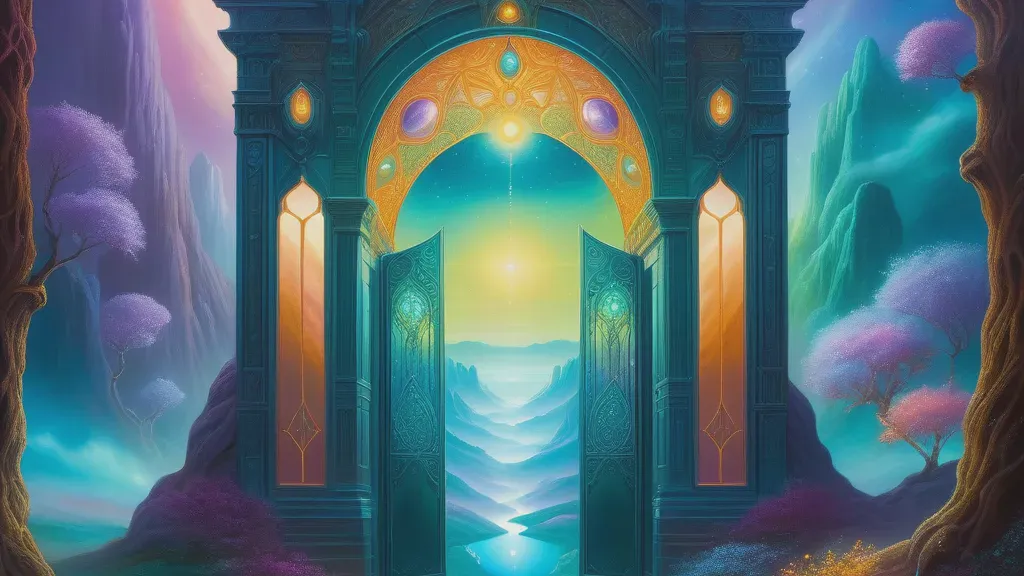
Gateway
Jungian Archetypes
Meaning
A gateway is not a door. A door belongs to a room and keeps a private life private; a gateway is set into a wall, faces outward, is usually large enough to be seen from a distance, and exists to be passed through in view of others. It admits and it excludes, and somebody decides which. In dreams it marks the point where one territory ends and another begins, and its details report on how the dreamer is handling a passage already underway: whether the gate is open, who is standing in it, whether a name or a token is required, and whether anything can be brought through. The gateway asks less about the destination than about the terms of entry and the cost of admission.
Psychological Interpretation
The most informative element is rarely the gate itself but the wall it interrupts. A gateway standing alone in open country, with nothing on either side of it, describes a threshold the dreamer is treating as decisive when nothing actually obliges them to use it: a rule with no enforcement, a permission nobody is withholding, a ceremony they have invented to make a change feel legitimate. A gateway in an unbroken wall reverses the reading and describes a genuine constraint with a single point of passage, which is why what happens at that point carries so much weight. Then there is the gatekeeper, who appears in a great many of these dreams. Being asked for a name, a document, a fee or an explanation stages the dreamer's private theory about who is entitled to move forward, and the answer given in the dream is worth recording exactly, since it is usually the sentence the dreamer would need to be able to say in waking life. Hesitation at an open gate belongs to a different pattern and is common in people whose change has already been approved by everyone except themselves. Watch also what the gate does behind the dreamer. A gateway that closes, vanishes or turns into a wall marks a passage that cannot be reversed, which the psyche often registers before the person has admitted that the old arrangement is not available any more.
Traditional Symbol Meaning
Dream tradition has consistently read the gate as an omen about permission rather than about direction. The old European dream books tended to give the same verdicts: an open gate meant opportunity and welcome, a closed or locked gate obstruction and refusal, a broken gate a household unable to protect itself, and to be turned away at a gate meant a request in waking life would be denied. The strength of these readings came from social fact. A walled town's gates were shut at dusk, and to be outside them at nightfall was a real predicament, so that the dream image carried the weight of belonging or exclusion far more directly than any modern doorway does. A second and much older stratum treats the gate as the boundary of the sacred and therefore as dangerous ground. Thresholds across many traditions must not be stood upon or trodden on, and are places where offerings are made, protective marks are painted and guardians are stationed. Gates were the place to hang iron, horseshoes, mirrors or written charms, because whatever protects a settlement must be concentrated where the wall is broken. Funerary custom extended the idea to the passage out of life, with coins for the ferryman, gates of judgement, and the widespread instruction to carry the dead out of the house feet first and by a particular opening. Dream lore inherited the caution: a gate in a dream was not a neutral piece of architecture but a place where something is decided about the dreamer. The folklore of the gatekeeper forms a third strand and is unusually consistent. The one who stands in the gap asks a question, and the passage depends on the answer rather than on force. Riddles at bridges and gates, the demand for a true name, the requirement to declare one's business, and the tests set for travellers in fairy tale all encode the same principle, which is that admission is granted to whoever can say who they are. Norse tradition names the gate of the hall of the slain, Valgrind, and describes it as fastened by an ancient bolt that few can work out; Chinese legend sends the carp up the falls at the Dragon Gate, where the fish that leaps it is transformed rather than merely admitted. What later interpreters drew from all this is the rule that still governs the symbol. A gateway in a dream concerns eligibility and transformation together, since the traditions agree that passing through is not simply arriving somewhere else. Inanna is stripped, the carp becomes a dragon, and the initiate in rites of passage described by Arnold van Gennep is separated, held in a liminal condition and only then reincorporated in a new status. Tradition therefore reads the gate dream as a question about what the dreamer will be required to leave at the entrance, and what they are willing to become on the other side.
Jungian / Archetypal
Jung borrowed the Greek word temenos, the precinct marked off around a temple, to describe the protected psychic space in which transformation can safely happen, and a gateway in a dream is where that precinct is entered. The image belongs to the vocabulary of initiation rather than of travel. What lies beyond a gate in dreams is characteristically not a place the dreamer has been but a condition they have not yet occupied, and the wall that the gate interrupts is the boundary of the known personality. Such dreams cluster at the beginnings and ends of analysis, at the point where a person first agrees to look at something, and at the moments when a familiar identity has stopped fitting. The figure in the gap is the threshold guardian, and the archetype is remarkably stable across the material Jung was drawing on and the comparative work Joseph Campbell later systematised: the sphinx with the riddle, the dog at the gate of the dead, the paired wrathful guardians of the temple entrance. Analytically the guardian is not an enemy. It embodies the psyche's own resistance, and resistance in this reading protects as much as it obstructs, holding back an initiation the ego is not equipped for. Where the guardian is a trickster, sly, ambiguous, offering two gates and refusing to say which is which, the dream is warning that the passage cannot be made by cleverness or by asking someone else to decide, and that any choice made will only reveal its meaning after it has been made. The reward for passing is often figured as a child. New life on the far side of a gate, in dreams and in mythology alike, corresponds to what Jung called the divine child motif, the fragile and numinous beginning that appears when a former attitude has been given up. This is also where his warning about premature crossing applies. Dreams of walking straight through a great gate without being stopped, questioned or slowed can indicate an inflation rather than an accomplishment, an ego that has annexed the promise of a transformation without undergoing any of it. The dream that makes the dreamer wait, pay or answer is doing better work than the one that lets them stroll in.
Gestalt / Parts of Self
Every element belongs to you, which means you are the traveller and you are also the gate. Speak as the gate first and use the present tense: I stand in a wall, I am the only way through, I am open, and I could be closed. Then be the gatekeeper: I decide who comes in, I ask for a name, I have been standing here a long time. Most dreamers find that the gatekeeper's voice is uncomfortably familiar, and that it belongs to the part of them that vets every new experience, relationship and version of themselves before admission. Ask that voice directly what it is afraid would get in if it stopped checking. The gate is the clearest available image of what Gestalt calls the contact boundary, the place where self and environment meet and where every exchange either happens or is prevented. Fritz Perls described characteristic disturbances at that boundary, and each has a gate in it. Confluence is a gate permanently open, no distinction between what is yours and what is theirs, everyone flowing through until you cannot say where you end. Introjection is swallowing whatever arrives at the entrance without chewing it, taking in rules and opinions whole. Projection sends your own material out through the gate and then meets it coming back as a stranger. Notice which of these your dream staged, because the remedy differs entirely: some people need to close the gate and some need to stop interrogating everyone who approaches it. The moment of hesitation is where the work usually is. If you stood in the gateway without moving, stay there in imagination rather than resolving it, and describe what you feel in your body while standing in the gap. Impasse in Gestalt is not a failure but the exact point where the old support has been given up and the new one has not been found, and being talked through it too quickly wastes the opportunity. Say aloud, as the gate, what you refuse to let through, and then, as the traveller, what it is costing you to stand still. The unfinished situation is usually behind you rather than ahead, which is why so many of these dreams involve looking back and finding the way you came has closed.
Psychodynamic / Freudian
Freud gave this symbol its most literal psychoanalytic use twice over. In his account of dream formation he pictured the censorship as a watchman posted between two rooms, deciding which impulses from the larger chamber may pass into the smaller one where consciousness resides and turning back those he will not admit. A dream containing a gatekeeper is therefore staging the apparatus that makes dreams, which is why interrogation at a gate so often carries the particular anxiety of being found out rather than of being delayed. He also listed openings, doorways and gates among the images the dream work uses for the female body, and the passage through a narrow entrance has an obvious relation to birth, an association Otto Rank pushed much further in his work on the birth trauma. Beneath the censorship reading is a question about eligibility that usually turns out to be an old one. The demand for a name, papers, a fee or a reason reproduces a childhood arrangement in which belonging was conditional, and the dreamer's response at the gate tends to repeat their earliest strategy: charm, documentation, indignation, apology, or turning away before anyone can refuse them. Superego material is plainly at work when the gatekeeper is severe and the dreamer's offence is unspecified. Where the guardian is instead ambiguous or teasing, the dream is often handling ambivalence about the passage itself, since a part of the dreamer wants to be refused and thereby relieved of a change they have publicly committed to. Winnicott's account of transitional space describes the other half of this symbol, the region that is neither inside nor outside and in which something new can be played into existence. A gateway dream frequently arrives during exactly such an interval: an engagement, a notice period, a pregnancy, a course of treatment, the weeks between an application and an answer. The dream figures the interval as architecture because the psyche cannot yet represent it as a story with an ending. What closes behind the dreamer deserves separate attention, since mourning is the hidden labour of every transition, and a gate that seals itself is often the psyche insisting that a loss has been taken and cannot be renegotiated.
Contemporary Psychological
The brain treats doorways as real events, and there is a well replicated laboratory finding to prove it. Gabriel Radvansky and colleagues showed that people who carry an object through a doorway remember it worse than people who walk the same distance within a room, an effect known as the location updating or doorway effect. It follows from event segmentation theory, developed by Jeffrey Zacks and others, which holds that experience is parsed into discrete events at boundaries, and that crossing a boundary flushes the current working model and opens a new one. Spatial neurons cooperate with this: hippocampal place representations remap when an animal moves between enclosures, and boundary-sensitive cells fire in relation to walls and openings. A gateway is thus one of the few dream symbols with a dedicated cognitive machinery behind it. Dream content follows waking preoccupation, the continuity finding that large content analyses of dream reports have repeatedly supported, and transitions are among the most reliable producers of this imagery. Moving house, changing job, immigration, graduation, diagnosis and separation all involve the same computational problem, which is that the model the brain has been running has to be replaced, and there is no available experience of the replacement yet. Predictive processing accounts of dreaming describe the sleeping brain generating scenarios in order to test and refine its model, and a gate is an efficient way to represent a boundary in that model where the far side has to be imagined rather than remembered. The emotional load has its own explanation. Rosalind Cartwright followed people through divorce and found that those who dreamed about the former spouse tended to be better adjusted a year later than those who did not, which fits the broader role of rapid eye movement sleep in working through emotional memory overnight; a transition that is dreamed is a transition being processed. Where the gate is guarded, threat simulation in Antti Revonsuo's sense is a plausible additional layer, since a controlled entrance is exactly the sort of social obstacle worth rehearsing. A gate that keeps reappearing is therefore best understood as a boundary the brain is still modelling, because the far side has not yet supplied any experience to model it with, and the dreamer has begun the passage without completing it.
Cultural & Historical Origins
The oldest gateway in dream literature is a matter of dreams themselves. In book nineteen of the Odyssey, Penelope tells the disguised Odysseus that dreams come through two gates, one of horn and one of ivory, and that those which pass through the sawn ivory deceive while those from polished horn come true; Virgil borrows the pair for the close of Aeneid VI. Rome kept a god for the function. Janus, who faces both ways, governed doorways, beginnings and the first month of the year, and the doors of his shrine in the Forum stood open while the state was at war. The Sumerian descent of Inanna makes the passage itself the ordeal: at each of the seven gates of the underworld the doorkeeper Neti removes another of her garments and insignia, so that she arrives before her sister stripped of everything she was above. Sacred architecture built the idea in stone. Shinto torii mark the point where ordinary ground becomes the ground of the kami, the South Indian gopuram rises over the temple entrance far higher than the sanctuary behind it, and the great Buddhist gates are guarded by paired Nio figures. Nebuchadnezzar's Ishtar Gate at Babylon led the processional way in glazed blue brick worked with bulls and dragons. The Hebrew Bible seats the elders in the city gate to give judgement, so that Boaz settles his claim to Ruth there; Matthew's Gospel commends the narrow gate over the wide one, and Dante posts an inscription over the gate of hell instructing those who enter to abandon hope. Kafka's parable Before the Law adds the modern version, in which a man waits a lifetime at a gate that turns out to have been made only for him.
Contextual Variations
A gateway with no wall on either side of it
The dream has removed the constraint and left the ceremony standing. Nothing prevents you from walking around it, and yet the gate is clearly the way through, which tells you the formality is doing something for you. Usually it is buying time, or making a change you have already made feel witnessed and official. Ask what the arch is standing in for: a qualification you have decided you need, a conversation you insist must come first, a date you have set for yourself. Then ask whether you want the ceremony or the crossing, because the dream shows you can have the second without the first.
A gatekeeper who asks for a name you cannot remember
Admission depends on identity here, not on merit, and the blank where your name should be is the whole of the message. This dream arrives during periods when the description you have used for yourself has stopped being accurate and no replacement has arrived: after leaving a profession, a marriage, a faith, a role you held for years. Try writing the sentence you would have said if the words had come, and consider that the passage you are attempting may be waiting on a self-description rather than on any external permission.
Passing through and finding the gate gone when you turn around
Irreversibility is what the dream is reporting, and it usually knows before you have admitted it. Some part of you has registered that the previous arrangement is no longer available. The feeling on waking distinguishes the two readings. Panic suggests you crossed under pressure and have not consented to the loss. Calm suggests the decision was already made and the dream is confirming it. Either way, name precisely what is on the other side of that vanished gate, and give it the weight of something ended rather than paused.
Two gateways offered by a stranger who will not say which is which
The refusal to explain is the point rather than a cruelty. A choice presented this way cannot be solved by gathering more information, because the alternatives are not comparable and no amount of analysis will make them so. Note which gate you chose and what you felt immediately afterwards, since the reaction in that first second is more reliable than the reasoning you would give in daylight. Note also whether you tried to make the stranger decide for you, and who in your waking life is being asked to play that part.
Frequently Asked Questions
Is a gateway dream always about a major life change?
Is a gate in a dream different from a door?
Why did I stop at the gateway instead of walking through?
Why do I keep dreaming about the same gate?
Journaling Prompts
- Describe the gateway in as much physical detail as you can recall: material, height, whether it was open, what stood on either side, what you could see through it. Then write which waking transition it resembles, and note in particular whether the wall it stood in was real or whether the gate was standing on its own in open ground.
- Write down the question you were asked at the gate, or the one you sensed was coming, and answer it now in full. If you were asked for your name, write the name you would give today rather than the one you have been using. Notice which parts of that answer you would be reluctant to say out loud to the people who know you.
- Name what you would have to leave outside in order to pass through: a habit, a grievance, an income, a version of your story, someone's approval. Choose the item that made you flinch as you wrote the list, and describe what your life would look like on the first ordinary Tuesday after you set it down.
- Think about the last threshold you actually crossed, however small, and write what closed behind you that you have not yet grieved. Include what was good about the arrangement you left, not only what was wrong with it, and finish by writing one sentence acknowledging that it is no longer available to you.
Related Symbols
Dreamed about Gateway?
Get a personalized AI interpretation that connects this symbol to your specific life circumstances.
Interpret My Dream