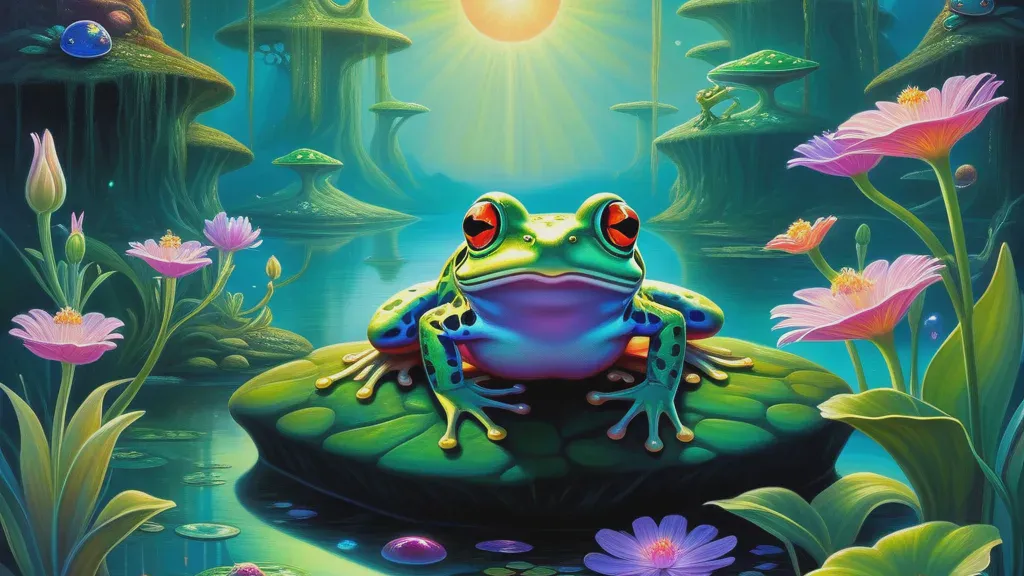
Frog
Jungian Archetypes
Meaning
Frogs in dreams represent transformation, adaptability, and the ability to navigate between different worlds. They symbolize cleansing, renewal, and the voice of the unconscious. Frogs often appear when you need to embrace change or express hidden aspects of yourself.
Psychological Interpretation
The Trickster archetype in the frog reveals the playful, unpredictable nature of the psyche and the importance of flexibility in facing life's challenges. The Child archetype represents innocence, curiosity, and the capacity for joy and wonder. Dreams of frogs suggest the need to balance seriousness with playfulness and to trust your intuitive voice.
Contemporary Psychological
The frog in dreams often represents the brain's processing of significant life transitions and the cognitive work required to adapt to new environments or circumstances. From a contemporary psychology perspective, frogs embody metamorphosis—the biological reality of radical transformation from one form to another. When the brain dreams of frogs, it may be consolidating memories of recent changes, rehearsing responses to new demands, or working through the emotional weight of adaptation. The frog's life cycle mirrors what neuroscience calls "state transitions"—moments when the dreamer's identity, role, or environmental context shifts fundamentally, requiring new behavioral patterns and emotional regulation strategies. Environmental sensitivity is central to the frog's contemporary meaning. Frogs are exquisitely attuned to their surroundings—they sense vibrations, respond to moisture and temperature shifts, and must navigate between water and land. Dreams featuring frogs often emerge when the dreamer is heightening their own environmental awareness, processing subtle social cues, or becoming more sensitive to changes in their relational or professional ecosystem. The brain may be using the frog as a metaphor for the cognitive load of constant adaptation—the exhaustion that comes from being hypervigilant to environmental demands. This is particularly relevant during periods of uncertainty, when the dreamer is learning to read new social or organizational contexts. The frog's dual nature—amphibious, existing between worlds—reflects the contemporary psychology of liminality: the psychological space between one identity and another, one life phase and the next. Dreams of frogs often signal that the dreamer is in a threshold state, not yet fully settled into a new role or circumstance but no longer entirely in the old one. The brain is consolidating the learning required to move between these states, rehearsing new responses, and regulating the anxiety that accompanies transformation. The frog's small size and vulnerability in many environments also speaks to the emotional experience of adaptation—the feeling of being exposed or underprepared as one navigates unfamiliar territory. Ultimately, the frog in contemporary dream psychology represents the brain's active engagement with change itself. Rather than symbolizing transformation in an abstract sense, the frog embodies the neurological and emotional processes of actually living through transformation—the memory consolidation, threat simulation, and adaptive learning that occur when life demands that we become something new. The presence of a frog in dreams suggests the dreamer's psyche is doing the work of adaptation, processing environmental sensitivity, and rehearsing the flexibility required to thrive across different contexts and life phases.
Gestalt / Parts of Self
The frog in dreams represents a part of the self that dwells in the liminal space between worlds—neither fully of the water nor the land, neither fully formed nor transformed. In Gestalt work, the frog is the dreamer's own capacity for metamorphosis, the part that knows change is possible but has not yet claimed it. This creature embodies the tension between what is repulsive or rejected in oneself and what is actually precious, even royal. The frog asks: what part of yourself do you find disgusting or unworthy that actually carries hidden power and potential? The repulsive quality of the frog—its slime, its croak, its alien appearance—mirrors the dreamer's own disowned shadow. We project onto the frog what we cannot bear to see in ourselves: the awkward, the wet, the amphibious nature of being caught between states. Yet in fairy tales and myth, the frog is often the prince in disguise, the royal self hidden beneath an unacceptable exterior. The Gestalt invitation is to own this paradox: the very part you find most repellent about yourself may be the gateway to your transformation. The frog is not something to be fixed or escaped; it is something to be inhabited and integrated. The liminal quality of the frog—its existence at the boundary between water and land—speaks to the dreamer's own threshold moment. You are being asked to recognize that you are in a state of becoming, not yet settled into a new form but no longer entirely in the old one. This in-between space is uncomfortable, even slimy and uncertain, but it is also where all genuine transformation occurs. The frog does not apologize for being neither fish nor fowl; it simply is, fully present in its amphibious nature. The dream invites you to stop resisting your own liminality and to claim the power that lives in the space between identities. To work with the frog in your own psyche is to practice radical self-acceptance of the parts you have deemed unacceptable. It is to recognize that your transformation does not require you to become something other than what you are; it requires you to fully own what you already are, including the wet, croaking, repulsive parts. The frog teaches that royalty and repulsion are not opposites but partners in the dance of becoming. When you can embrace the frog within yourself—the awkward, the changing, the in-between—you reclaim the power that was always yours.
Jungian / Archetypal
The frog in dreams embodies one of the psyche's most potent symbols of transformation and metamorphosis. In Jungian terms, the frog represents the individuation process itself—the journey from an undifferentiated, larval state of consciousness toward a more complete and integrated self. The tadpole-to-frog metamorphosis mirrors the alchemical transformation that Jung saw as central to psychological development: the emergence of new capacities, the shedding of old forms, and the acquisition of new modes of being. This creature's radical biological shift—from aquatic to terrestrial, from gill-breathing to lung-breathing—symbolizes the profound psychological reorganization required when the ego must transcend its previous limitations and embrace a more expansive identity. As a liminal creature dwelling between water and land, the frog occupies the threshold between the unconscious (water) and consciousness (land), making it a natural symbol of the Self as mediator and bridge. In this liminal space, the frog holds the capacity to move fluidly between inner and outer worlds, between instinct and reason, between the primitive and the evolved. This boundary-dwelling quality connects the frog to fertility and regeneration—not merely biological reproduction, but the generative power of the psyche to create new meaning, new perspectives, and new possibilities for growth. The frog's association with water links it to the cleansing and purifying functions of the unconscious, suggesting that transformation often requires immersion in the depths before emergence into new light. The archetypal motif of the frog as hidden royalty—the prince trapped in amphibian form awaiting transformation through love or recognition—speaks to the Jungian insight that within every person lies dormant potential, a "royal" or divine aspect of the Self waiting to be acknowledged and integrated. This myth suggests that what appears lowly, primitive, or contemptible in ourselves may actually contain hidden nobility and power. The frog's croak, often perceived as crude or unpleasant, becomes in Jungian reading the voice of the authentic self calling out from the depths, demanding to be heard and recognized. When the frog appears in dreams, it frequently signals that the dreamer is at a threshold of transformation, that something within them is ready to leap from one mode of existence to another, and that the seemingly insignificant or rejected aspects of the psyche may hold the key to wholeness and genuine power. The frog's remarkable sensory organs—its bulging eyes that see in all directions, its sensitive skin that absorbs both water and air—symbolize the heightened perception and expanded awareness that accompany genuine psychological transformation. In the individuation journey, the frog reminds us that growth often requires us to become more sensitive, more permeable to the environment, more attuned to subtle signals from both the inner and outer worlds. The frog's powerful hind legs, capable of extraordinary leaps, represent the dynamic energy and momentum that becomes available once transformation is complete—the ability to move swiftly and decisively in new directions. Thus the frog stands as a complete symbol of the transformative process: the courage to change form, the willingness to dwell in liminal spaces, the recognition of hidden potential, and the emergence of new power and perception.
Psychodynamic / Freudian
The frog in dreams embodies a fundamental psychodynamic paradox: the simultaneous attraction to and repulsion from something primitive, moist, and alive. From a depth psychology perspective, the frog represents a regression to earlier developmental stages—the amphibian body itself symbolizes the boundary between water (the unconscious, the womb, pre-verbal existence) and land (consciousness, separation, the symbolic order). When a dreamer encounters a frog, they are often confronting a repressed or disavowed aspect of themselves: something slimy, wet, and undifferentiated that consciousness finds disgusting precisely because it threatens the ego's carefully maintained boundaries. The disgust reaction is itself a defense mechanism—reaction formation—that masks an underlying fascination or attraction to this primitive, instinctual material. The hidden desire embedded in the frog symbol frequently relates to regression itself: a longing to return to an earlier, less differentiated state where boundaries between self and other, subject and object, were fluid and permeable. This wish often emerges when the dreamer is struggling with the demands of adult consciousness—the need to maintain control, to be rational, to be "civilized." The frog, by contrast, represents pure instinct, appetite, and transformation (the tadpole-to-frog metamorphosis). The attraction-disgust dynamic reveals an internal conflict: part of the psyche yearns for this regression, while another part recoils from it as infantile, base, or unacceptable. The frog's croak—a primitive, repetitive sound—may symbolize the return of repressed material, the voice of the id pressing against the barriers of repression. In the context of early relational patterns, the frog often connects to maternal transference and oral-stage conflicts. The frog's wet, amphibious nature echoes the maternal body—the amniotic fluid, the breast, the undifferentiated merger of infancy. A dreamer's disgust at the frog may reflect unresolved ambivalence toward the mother: the simultaneous need for merger and the terror of engulfment. Alternatively, the frog can represent the father's "otherness"—the strange, alien, non-maternal presence that disrupts the dyadic bond. The transformation potential of the frog (tadpole to frog, or in fairy tales, frog to prince) speaks to the dreamer's unconscious hope for redemption or change, yet the disgust suggests that this transformation is being resisted or denied. The frog thus becomes a container for all that the dreamer has repressed in the service of ego development: the animal body, dependency, the fear of merger, and the longing for return. The psychodynamic reading of the frog ultimately reveals the dreamer's internal struggle with integration. The frog is not simply a symbol to be decoded; it is a living representation of the tension between the civilized self and the primitive, instinctual self that refuses to remain buried. The disgust-attraction paradox is the dream's way of saying: "This part of you exists, it is alive, and you cannot simply eliminate it through repression." The frog's presence in the dream is thus a call from the unconscious—an invitation (or demand) to acknowledge and integrate the disavowed aspects of the self, to recognize that regression and progression are not opposites but necessary partners in psychological development.
Cultural & Historical Origins
In Egyptian mythology, the frog goddess Heqet represented fertility and resurrection. Native American traditions view the frog as a symbol of cleansing and emotional healing. In Japanese folklore, frogs are associated with good fortune and safe travels, particularly across water.
Contextual Variations
Frog jumping
Making progress through leaps of faith; moving forward despite uncertainty or obstacles
Frog croaking
Finding your voice and expressing suppressed emotions or truths that need to be heard
Frequently Asked Questions
What does a frog turning into a prince mean?
Why do frogs appear in dreams about change?
Journaling Prompts
- What transformation is calling to you right now?
- How can you embrace the frog's playfulness and adaptability in facing current challenges?
Related Symbols
Dreamed about Frog?
Get a personalized AI interpretation that connects this symbol to your specific life circumstances.
Interpret My Dream