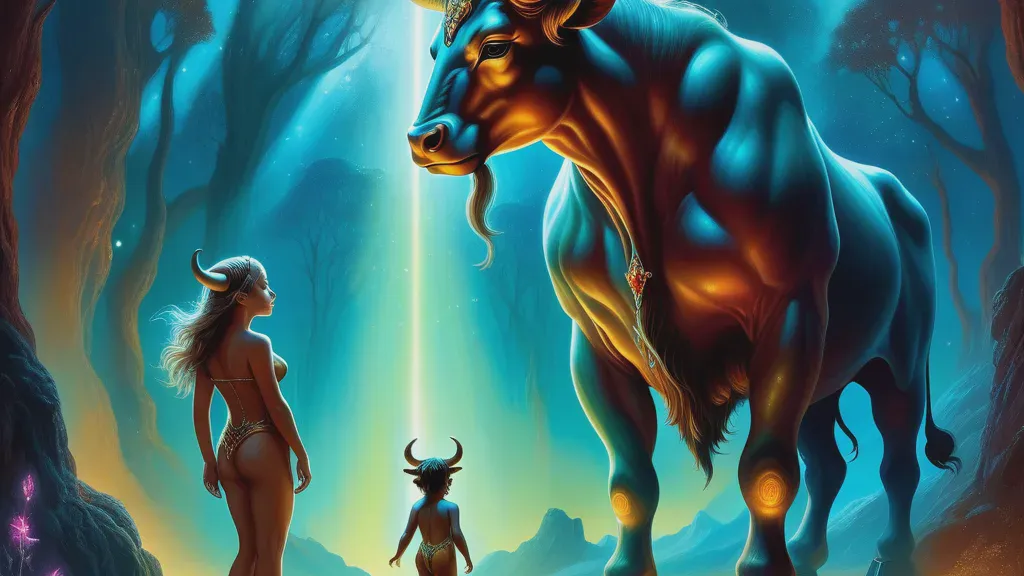
Forgotten Minotaur
Jungian Archetypes
Meaning
A forgotten minotaur symbolizes internal conflicts and the struggle with one's darker impulses. Psychologically, this represents the confrontation with fears and desires that have been repressed or ignored.
Psychological Interpretation
Jungian theory views the minotaur as a representation of the Shadow, necessitating integration for personal growth. Cognitive psychology might interpret it as a manifestation of anxiety, while practical psychology emphasizes the importance of facing one's inner beast for resolution.
Cultural & Historical Origins
The Minotaur from Greek mythology represents a labyrinthine struggle between chaos and order, as told in the myth of Theseus. Similarly, in Minoan culture, bull symbolism reflects strength and fertility, highlighting a complex relationship with power.
Contextual Variations
You enter a labyrinth and the Minotaur waits behind a gate, breathing slowly. Each time you try to run, the walls shift, but when you stop and listen to your own fear, the path becomes clear and the Minotaur lowers its head.
A forgotten Minotaur symbolizes internal conflict with darker impulses—anger, desire, envy, or survival instincts—kept behind barriers. Listening rather than rushing suggests the conflict can be metabolized when you acknowledge what it’s protecting.
You’re offered a choice between two doors: one leads to comfort, the other to a hard truth. You pick comfort and the Minotaur grows; you pick truth and it becomes smaller, like it was fueled by avoidance.
This scenario shows how avoidance feeds the conflict system. The Minotaur shrinking after truth implies that confronting the core issue reduces the intensity of the impulse.
You try to negotiate with the Minotaur by offering it a symbol—your phone, your schedule, your need to be perfect. It declines, but when you offer your honest vulnerability, it turns into a protector that guides you out of the maze.
Negotiation with the Minotaur suggests you’ve been trying to manage impulses with control strategies. The protector transformation indicates that vulnerability can convert conflict into wise guarding—an integrated self that knows how to keep you safe.
Frequently Asked Questions
Why does the maze feel impossible in my dream?
What does it mean if the Minotaur is calm instead of violent?
Does the Minotaur mean I’m acting on my darker impulses?
Journaling Prompts
- What impulse or emotion have I been treating as unacceptable, and what might it be protecting in me?
- In the dream, what changed the labyrinth (listening, choosing truth, offering vulnerability), and what is the waking-life equivalent?
- Where do I use control to manage discomfort, and how could I integrate the impulse instead of fighting it?
Related Symbols
Dreamed about Forgotten Minotaur?
Get a personalized AI interpretation that connects this symbol to your specific life circumstances.
Interpret My Dream