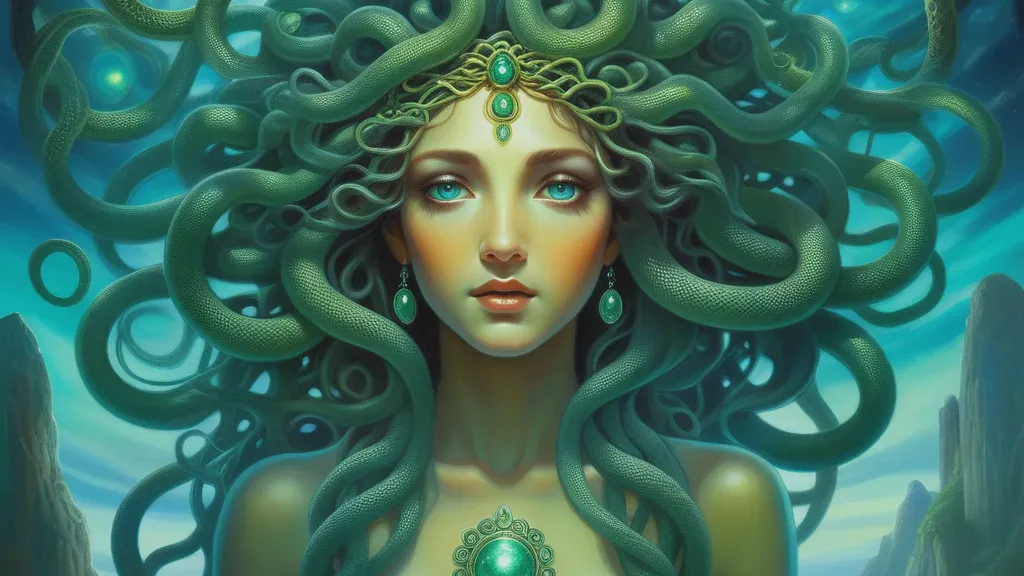
Forgotten Medusa
Jungian Archetypes
Meaning
Medusa turns whoever meets her gaze to stone, and a forgotten Medusa is that same power left somewhere the dreamer stopped visiting: a covered statue, a storage room, a mask fallen face-down with dust caught in its snakes. The qualifier changes the whole encounter. This is not the Gorgon hunting the dreamer through a dream landscape; this is the Gorgon abandoned, still holding an injury nobody stayed to witness and still able to freeze anyone who wanders in. Such dreams usually mark a rage or a terror that formed at a particular moment, was managed by being put out of mind, and was never disarmed. Something in waking life has walked back into that room.
Psychological Interpretation
The dream turns on a reversal: the dreamer is not being hunted, the dreamer is the one who forgot. Medusa waits in a place that was sealed rather than settled — a shed, a museum wing after closing, a childhood room now used for boxes — and the weather around her is neglect rather than emergency. That neglect is the information. A petrifying figure kept in storage is usually a protection built at the time of a wound: the flat stare that made a hostile household survivable, the fury that could not be shown and so was given a face and locked away. It still works, which is why the dreamer stiffens at odd moments in waking life, and it has never been told that the danger it was built for has passed. What the dreamer does with her is the detail worth keeping. Uncovering her, brushing the dust off, speaking to her, or meeting her eyes reads very differently from backing out and pulling the door shut. Dreams of this kind tend to arrive when a present situation has begun to rhyme with the original one: a colleague who criticises in the old cadence, an intimacy that asks the dreamer to stand unarmed. Whether stone spreads through the body in the dream, and how far it gets, usually tracks how much of the old story is still running under the current one. Where the gaze meets and nothing hardens, the psyche is reporting that the threat and the defence have finally come apart.
Traditional Symbol Meaning
Before Medusa had a biography she had a face, and that face was used as a guard. Gorgon masks glare from the west pediment of the temple of Artemis at Corfu, from hoplite shields, from roof tiles, from painted pottery and from small amulets worn against the evil eye. The logic is blunt and very old: a hostile gaze is met with a worse one. Anyone reading a dream of a neglected Gorgon should notice that in the tradition this face was never decorative and never welcome company. It was hung at a threshold precisely so that it could be left there, staring outward, while the household got on with its life behind it. The myth is unusually specific about how she may be approached. Perseus never looks at Medusa directly, only at her reflection in the polished shield while Athena guides his hand; winged sandals carry him in and the cap of Hades makes him invisible. Everything about the equipment is indirect. After the killing, the head goes into a bag, the kibisis, and this is the traditional detail that speaks hardest to a dream of a Medusa left in storage: bagged, severed and out of sight, the head keeps working. Perseus uses it against Atlas and against Polydectes long after the fight is over. In the older narrative logic, putting the terrible face away is not the same as ending its power. Her remains are ambivalent rather than simply lethal. Euripides has Creusa describe two drops of Gorgon blood given to Erichthonius, one that kills and one that heals, and Apollodorus records that Asclepius received blood from her veins with the same double property — from one side a poison, from the other a draught that could raise the dead. From the wound in her neck rose Pegasus, the winged horse later associated with the springs of poetry. What the myth keeps insisting is that the frightening figure is also the source of the cure and of flight, and that both come out of the injury rather than in spite of it. Later ages kept re-hanging the mask for their own reasons. Cellini's bronze Perseus, unveiled in Florence in 1554, holds the dripping head above a public square as an emblem of state power. Caravaggio painted her on a ceremonial shield around 1597, catching the head in the instant of its own astonishment. Victorian retellings made her a lesson in monstrous femininity; the last fifty years have read her instead as a woman punished for what was done to her. A dreamer who finds her forgotten under a sheet is standing at the end of that long line of people deciding what to do with a face that frightened them.
Psychodynamic / Freudian
Freud devoted a short 1922 note to Medusa's head, reading the severed head and its snakes as a condensed image of castration anxiety in which the horror carries its own reassurance. Whatever one makes of that reading, the myth performs a defensive manoeuvre that is easy to recognise clinically: a violated priestess is transformed into the monster, and the story then follows the man who kills her. Reversal of that kind — the one who was harmed appearing in the dream as the one who harms — makes the Gorgon an unusually efficient container for shame, which is why she recurs in the dreams of people who were injured and somehow concluded that they were the injury. The manifest picture is a dusty statue; the latent content is an object too dangerous to keep in awareness. Klein described the sequestering of terrifying internal figures under paranoid-schizoid conditions, and later writers on early failure — Winnicott on the compliant self that manages daily life while the unbearable is stored elsewhere, Bion on experience that could not be digested and therefore could not be thought — describe the same architecture from other angles. Forgetting here is an activity with a cost, not an absence, and the cost shows up as the flatness patients often report alongside the paralysis. Dreams of this figure cluster at moments when the defence is softening: in the early months of therapy, at the start of a relationship that asks for exposure, after a death that reopens the household of childhood. The wish inside the image is straightforward and old: to be looked at fully and not punished for what happened. In transference terms, the analyst is being invited into the room that everyone else walked past. What the work aims at is not decapitation but a slow return of feeling to material that was frozen in order to survive it.
Contemporary Psychological
The dreaming brain reaches for a face because faces are what it processes best. Human vision has dedicated circuitry for facial configuration and for the direction of another person's gaze, and direct eye contact reliably engages the amygdala, so a dream that stages a face too dangerous to meet is exploiting the most over-specified equipment in the visual system. Threat simulation theory, associated with Antti Revonsuo, proposes that one function of dreaming is the rehearsal of threatening encounters in a safe arena. A Gorgon in a locked room is an economical way for the sleeping brain to run that rehearsal with the threat contained rather than loose. Turning to stone is a fairly literal rendering of a body state. The defence repertoire includes tonic immobility, an involuntary freeze that appears when neither fight nor flight is available, and people who learned that response early tend to keep it. Since noradrenergic output falls to very low levels during REM sleep, emotionally charged material can be revisited with the alarm chemistry turned down, which is the basis of the proposal by Matthew Walker and colleagues that REM offers a kind of overnight processing of emotional memory. A dream that lets the dreamer stand in front of the figure and not run is that process visible. The derelict setting is itself data. Remote memories become schematic and lose their specifics as they are consolidated, and dream reports rarely replay whole episodes, favouring fragments and settings instead, which is close to what a dusty statue with no plaque actually depicts. The continuity hypothesis holds that dreams track waking concerns, and Rosalind Cartwright's longitudinal work on people going through divorce found that how emotionally charged figures were handled in dreams related to how well those dreamers adjusted over the following year. Recurrence points the same way: the image comes back while the situation it encodes remains open.
Jungian / Archetypal
The Gorgon belongs to what Erich Neumann, in The Great Mother, described as the terrible face of the maternal archetype: the devouring, paralysing aspect that archaic art gave a mask rather than a narrative. When such a figure turns up neglected in a dream, an archetypal image has been demoted to a private secret. The dreamer's own history supplied the occasion — a particular humiliation, a particular fury — but the charge in the figure is older and larger than the biography, which is why she does not decay in storage the way an ordinary memory would. Forgetting is not integration. The material stays intact and keeps its voltage, and the conscious personality quietly organises itself around not going into that room. A persona built on being pleasant, useful and easy to be near tends to constellate exactly this opposite: a face whose entire vocabulary is refusal. The dream compensates for a one-sided attitude by showing the dreamer what the other side has been doing in the dark, and the dust is a measurement, an image of how long the two halves have been kept apart. The myth also supplies the method. Perseus survives by refusing to look directly and using a reflecting surface instead, which is close to what analytical work asks of a dreamer: not a frontal assault on the affect but an indirect approach through image, myth and amplification, where the material can be seen without seizing the one who looks. The reward in the story is not the corpse but what comes out of the wound. Pegasus rises from the severed neck, and dreamers who finally stay in the room with the forgotten Gorgon often report an unlocking of energy that had been immobilised for years.
Gestalt / Parts of Self
In Gestalt work the covered statue is not a symbol you decode from the doorway; she is a disowned piece of you that has been standing under a sheet. Put her in the chair opposite and let her speak in the first person. I have been in this room since you were eleven. Nobody dusted me. I still know exactly who I would look at. The sentences that arrive with heat are the ones worth writing down, because the heat is the evidence that this is yours and not a stranger's. The freeze is worth examining as an action rather than an event. In Gestalt terms, paralysis in front of Medusa is often retroflection: the glare that belonged to someone else has been turned back on yourself, so instead of stopping the person who hurt you, you stop your own movement. Play both poles. Be the one who petrifies, then be the one who is petrified, and let them argue until one of them says something the other has never heard. Notice where in your body the stone starts, and whether you have felt that same hardening this week. Dust is a measure of withdrawal, not of danger. You broke contact with this part of yourself and stayed out of contact so long that you stopped noticing the door. The experiment is small and unheroic: uncover her, look for the length of one breath, say aloud what you actually see, then look away on purpose rather than by flight. Nothing here needs beheading. An unfinished situation completes when contact is made and can then be released, and what has been standing in that room is not your enemy but your unspent capacity to say no.
Cultural & Historical Origins
Medusa's oldest genealogy comes from Hesiod's Theogony, where she is the one mortal Gorgon among three daughters of Phorcys and Ceto, lying with Poseidon in a soft meadow and giving birth, from her severed neck, to Pegasus and to Chrysaor. Ovid supplies the version most people carry: in the Metamorphoses she is a beautiful young woman violated by Neptune inside Minerva's temple, and it is the goddess, not the god, who answers by turning her hair to serpents. The classicist Jane Ellen Harrison argued in Prolegomena to the Study of Greek Religion that the gorgoneion — the staring, tusked, tongue-out mask carved on temples, shields, coins and drinking cups — was older than the tale, and that the story of the monster was supplied later to explain the mask. That order matters here: the face came first, the account of why she is terrible came afterwards. Her afterlife is a long argument about whose terror she carries. Perseus hands the head to Athena, who fixes it on her aegis, so the thing that petrifies becomes the thing that guards. Freud's brief 1922 note on Medusa's head made her a psychoanalytic emblem. Hélène Cixous answered in 1975 in The Laugh of the Medusa, insisting the Gorgon was never deadly but beautiful and laughing, and that men had simply refused to look. Luciano Garbati's sculpture of Medusa holding the head of Perseus, modelled in 2008 and installed opposite a New York courthouse in 2020, completed the turn.
Contextual Variations
A statue of Medusa under a dust sheet in a back room
The sheet is the whole message. You built a covering for something in yourself that was too dangerous to have out in the open, and the covering worked so well that you stopped remembering what was underneath. Dreams stage this when a waking situation has begun to press against the cloth. Notice whether you lift it, tuck it back down, or leave the room. The dream is not asking you to destroy the figure but to establish that you know what is standing there, since the parts of us we keep covered go on acting through us at full strength.
Her severed head still speaking inside a cloth bag
In the myth the head keeps its power after it is cut off and packed away, and your dream has gone straight to that detail. Something you decided was dealt with is still issuing instructions from inside the bag: an old verdict about your worth, a rule you made at fifteen and never revisited. Because it is out of sight, you obey it without argument. Listen to what the head is actually saying in the dream, in its own words, because that sentence usually turns out to be one you still repeat to yourself in more polite language.
A neglected shrine where the Gorgon mask has fallen face-down
A mask hung at a threshold was there to guard something. Fallen and face-down, it has stopped facing outward and now stares at the ground, which often points to protectiveness that has collapsed inward and become self-directed. People dream this when the vigilance that once kept them safe has turned into a general suspicion aimed at themselves. Consider what the shrine was built to protect, whether that thing still needs guarding, and what it would take to either restore the mask deliberately or take it down and let the doorway stand open.
Meeting her eyes and finding you can still move
This version tends to arrive late, after a long stretch of dreams where the figure was avoided. Looking directly and not hardening indicates that the threat and the reflex have finally come apart in you: the fear is still legible, but it no longer commands the body. Treat it as a status report rather than a graduation. Pay attention to what you feel immediately after the gaze holds, since grief often arrives there, for the years spent in the corridor outside that room and for how young you were when you first learned to freeze.
Frequently Asked Questions
Why is Medusa dusty or abandoned in my dream?
Is a Medusa dream about my own anger?
Why am I not turned to stone when I look at her?
Should I try to destroy Medusa in a dream?
Journaling Prompts
- Describe the room she was left in, in as much physical detail as you can recall: the light, the smell, what else was stored there, how you got in. Then write down roughly when in your life that room was last used for something other than storage. Rooms in dreams are usually dated, and the date is often the more useful half of the message.
- Write the sentence you would have to say aloud to her before you could leave the room. Not a resolution or an apology, just the plainest sentence you can manage about what happened and who was actually responsible. Then read it back and notice which word you want to soften, because that word is generally where the shame is still doing its work.
- Think about the last time you froze in waking life: a meeting, an argument, a moment of intimacy where your face went flat and your body stopped. Reconstruct the ten seconds before it. Something registered as familiar just before the stone spread, and naming that resemblance is how the old defence learns that this present situation is not the original one.
- Consider what the mask was hung at the threshold to guard. Write down what it kept out successfully, with credit given, and then write down what it has also kept out that you now want back in: closeness, being seen at work, being argued with without ending the friendship. Decide which single door you would be willing to leave unguarded this month.
Related Symbols
Dreamed about Forgotten Medusa?
Get a personalized AI interpretation that connects this symbol to your specific life circumstances.
Interpret My Dream