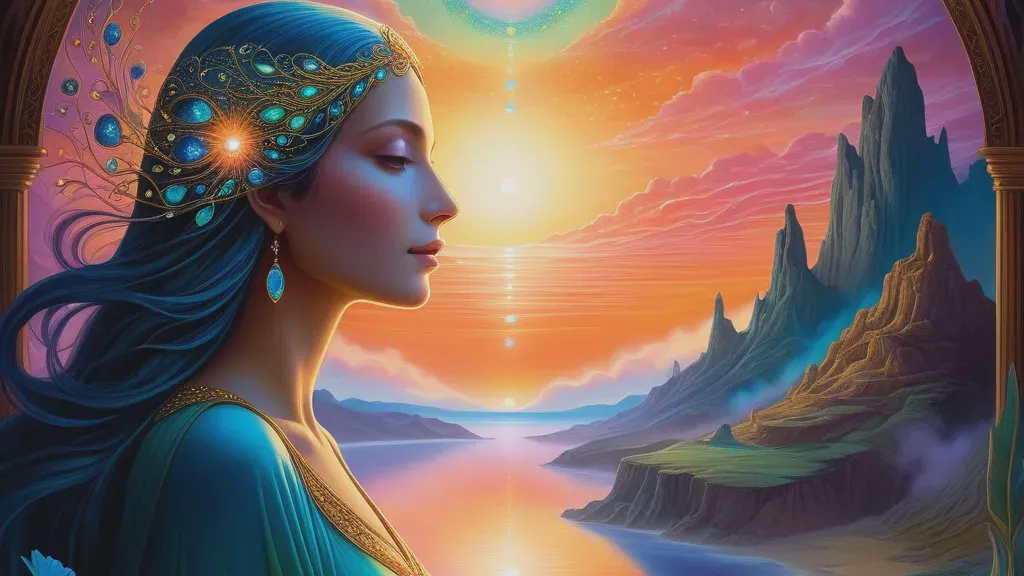
Dawn
Jungian Archetypes
Meaning
Dawn in a dream is the psyche's image of consciousness returning: the moment the dreamer's inner world turns from what cannot be seen toward what can. It is not the same as morning or full daylight. Dawn is the threshold itself, the grey and rose interval when shapes are still ambiguous and the night has not entirely let go. Dreams set at first light tend to arrive at the end of a long inner ordeal, an illness, a grief, a period of secrecy, and they mark the point where something endured in the dark can at last be looked at. The feeling that accompanies the light matters as much as the light: relief, exhaustion, awe, or a grief that only surfaces once the danger has passed.
Psychological Interpretation
When dawn appears in a dream, the useful first question is what the night contained. Dawn is a relative image; it only means anything in relation to the darkness it ends. A dreamer who has been carrying a decision, a medical result, a hidden relationship or an unspoken anger may find the dream staging the exact moment when the thing becomes visible, and the tone of the dream reveals whether the psyche greets that visibility as rescue or as exposure. A soft, widening light that reaches the dreamer where they stand suggests readiness for the new phase; a dawn watched from behind glass, or from a place the dreamer cannot leave, suggests that the renewal is real but not yet available to them. Dawn also carries the quality of inevitability. Nobody makes the sun rise, and the dream often turns on the dreamer's relationship to that fact: whether they can wait, whether they trust the turning, whether they have been straining all night to produce a light that was always going to come on its own. Dawn is also an hour of departures. In the old dawn songs lovers part at first light, and in dreams the sunrise can carry a quiet loss inside its beauty: the end of an intimacy, a vigil, or a version of the self that only existed in the dark.
Traditional Symbol Meaning
Older dream lore treated the hour of a dream as part of its meaning, and the dreams that came just before dawn were held to be the truest. Horace remarks that dreams after midnight are the true ones, and Dante, at the opening of the ninth canto of Purgatorio, describes the hour near morning when the mind, freed from the body's cares, is almost divine in its visions, and sets one of his own prophetic dreams there. The belief persisted into medieval dream manuals: the closer to daybreak, the less the dream was thought to be contaminated by digestion and the day's residue. A dream in which dawn itself appears was therefore doubly weighted, a true dream about the hour of true dreams. In folk interpretation the sunrise was almost always read as favourable. To see the day break in a dream promised recovery from illness, the lifting of a lawsuit or a debt, the return of a traveller, or the end of a period of mourning. Some traditions read dreams by contraries, so that a beautiful sunrise could warn of a coming disappointment, but dawn was one of the few images most sources agreed was good. Popular dream books of the nineteenth and early twentieth centuries, in the tradition of Gustavus Miller's Ten Thousand Dreams Interpreted, tied daybreak to good prospects and the clearing of difficulties, while a clouded or blood-red dawn was said to foretell trouble ahead. Religious tradition gave the dream its deeper grammar. Jacob wrestles with the unknown figure at the ford of the Jabbok until the breaking of the day, and it is the coming light that ends the struggle: the stranger says, let me go, for the day is breaking, and Jacob, wounded and renamed, limps into the morning. Dawn here is not a reward but a deadline, the moment by which the night's contest must be settled. The Gospel of Mark places the women at the empty tomb very early in the morning, at the rising of the sun, and Christian devotion has kept vigil for that hour ever since. In Diné (Navajo) tradition the day begins with dawn in the east, associated with white shell and with clear thought, and young people were traditionally sent to run toward the rising sun as a discipline of body and spirit. Across these traditions dawn keeps a double character that dream interpreters have always respected. It is the emblem of renewal and the hour of parting; it exposes what the night concealed; it arrives on its own schedule and cannot be hurried. A dream of dawn, in the older reading, therefore asked two questions at once: what has been ended, and what has been made visible.
Jungian / Archetypal
Jung read the daily rising of the sun as the oldest image the psyche has for the birth of consciousness out of the unconscious. In Symbols of Transformation he traces the sun-hero's night sea journey, the descent into the belly of the dark and the emergence at the eastern horizon, as the pattern behind countless myths and behind the individual's own repeated recovery of awareness from sleep, illness and depression. A dream of dawn stages the moment at which a content that has been forming in the dark, an insight, a decision, a grief that has finished its underground work, crosses the horizon into the daylight of the ego. The Great Mother stands behind the image: night is her womb, and dawn is her labour. The compensatory function of dreams explains why dawn tends to appear when the dreamer's waking attitude has hardened into hopelessness or, conversely, into a brittle, forced optimism. To the person convinced that nothing will change, the psyche shows a horizon that is already lightening; to the person who insists that everything is fine, it may show a dawn that exposes what the night had covered, wreckage in the street, a figure who was standing there all along. Jacob's wrestling at the Jabbok is the mythic form of the second case: the shadow figure must be held onto until first light and its blessing extracted before it goes, and the dreamer who lets go too early wakes with the wound but not the name. In the alchemical language Jung spent his later decades decoding, dawn corresponds to the albedo, the whitening stage that comes after the nigredo, the black stage of decomposition and despair; the alchemists' own phrase for it, aurora consurgens, shows how literally they took the image. The albedo is not the finished work; it is the first reliable light, the point at which the opposites that tore the dreamer apart in the dark can at least be seen side by side. A dawn dream at this stage of individuation asks for patience rather than action. The persona, the face prepared for the day, has not yet been put on, and for a few minutes the dreamer stands in the open between the self they were at night and the self they will present at noon.
Gestalt / Parts of Self
Gestalt dreamwork treats every element of the dawn dream as a piece of you that has been sent out into the scene: you are the sky, you are the horizon, you are the last of the dark, and you are the light that is coming whether or not anyone is ready for it. The first move is to give each of these a voice. Speaking as the light, you might find yourself saying: I come slowly, I cannot be hurried, I show everything. Speaking as the night, you might hear: I am the one who kept you company, I am the one you are about to abandon. The dialogue between the two is usually the dialogue the dreamer has been avoiding in waking life, between a part that is finished with a chapter and a part that has not yet said goodbye to it. Dawn in Gestalt terms is a figure of contact after withdrawal. Night is the withdrawal phase of the contact cycle, the retreat into the self that every organism needs, and dawn is the return of sensation and the first tentative reaching toward the world. Many dreamers who wake from this dream discover that they have been living in a prolonged withdrawal, not resting but hiding, and that the sunrise is their own excitement returning and frightening them. Notice where the light lands in the dream and where it does not. A dawn that stays on the far hills while you remain in shadow is a contact boundary you are holding: some part of you is disowning its own readiness and locating it over there, in a future, in another person, in a light you can watch but not touch. The polarity worth working here is between the one who waits and the one who moves. Sit in one chair as the person watching the horizon and say what you are waiting for, exactly, and what would have to happen before you stood up. Then move to the other chair and be the dawn, which does not wait for anything. Most people find that the waiting self has a long list of conditions and the dawn has none. The unfinished business the dream points to is rarely the big transition itself; it is the small refusal to let the night be over, the wish to be given permission for the morning rather than to take it. The gestalt closes when the waiting self can say, out loud and with no condition attached, that the night is over.
Psychodynamic / Freudian
Freud called the dream the guardian of sleep and cited dreams that weave an alarm clock or the morning light into their story so that the sleeper can stay under a little longer, and a dream of dawn is often partly this: the sleeper's brain registering the paling window and converting it into narrative. But the latent content tends to be richer than the physiology. Dawn is the hour the infant wakes and discovers whether the world is still there, and the earliest experiences of morning, a face arriving or failing to arrive, warmth or cold, being met or left to cry, lay down a template that adult dawn dreams reactivate. The wish underneath the dream is frequently the simplest one there is: that the night will end and someone will be there when it does. In Kleinian terms the movement from night to dawn maps onto the movement from the paranoid-schizoid to the depressive position. The dark is the world split into persecutors and hidden good; dawn is the grey, ambivalent light in which the same objects can be seen whole, damaged and repairable. Dreams of sunrise that carry tears rather than joy are often dreams of reparation, the moment the dreamer stops fighting a figure and starts mourning what was done to it, or by it. Winnicott's environment mother, reliably present without being noticed, is the felt quality of a good dawn dream, and her absence is the felt quality of the sunrise that never quite comes: an expectation of holding that was disappointed early and is being tested again. Defences shape how the image is delivered. Displacement lets the whole charge of a life change attach to the sky rather than to the person or the decision it concerns; the dreamer can weep at a sunrise who could not weep at a leaving. Reversal is common in the darker versions: the dreamer who fears exposure dreams of light as a threat, a dawn that shows the flooded street, or one that comes up in the wrong direction, a cue that something known is being disavowed. In the transference, the dawn dream frequently arrives at a turning point in treatment, when the patient begins to experience the analyst not as a night figure to be got through but as a reliable morning presence, and the dream is the first evidence that the internal object has been revised.
Contemporary Psychological
Sleep architecture gives dawn dreams a physiological setting before any symbolism is added. REM periods lengthen across the night and are longest and most intense in the hours before waking, when core temperature is rising, cortisol is climbing toward its morning peak and the light-sensitive cells of the retina begin to register the paling room. Dreams generated in this window are more vivid, more narrative and more likely to be remembered, and the most likely to incorporate the real approach of morning. A dream of dawn is often the brain's way of folding an actual sensory signal, growing light and sound outside, into a scene that keeps sleep going a little longer. Rosalind Cartwright's studies of people going through divorce found that those whose mood recovered showed a pattern within a single night: early dreams carried the negative emotion, later dreams toward morning had worked it into something calmer and more resolved. Matthew Walker has described REM sleep as a kind of overnight therapy in which the emotional charge of memories is dialled down while their content is retained. A dawn dream at the end of a difficult night may be the felt version of exactly this process, the dreamer's own experience of an emotional weight lifting before the story is over. The continuity hypothesis adds that dream content follows waking preoccupations, so the person dreaming of first light is usually someone whose days already contain a change that has not yet been fully processed. Predictive processing offers a further angle. The sleeping brain is not idle; it is rehearsing models of the day to come, and dawn is the boundary its predictions are all pointed at. A dream in which the sun rises easily suggests a model of the coming day as manageable; a dream in which the light stalls, or arrives over a ruined landscape, suggests a model that predicts exposure, effort or loss. Antti Revonsuo's threat simulation theory would treat the second kind as rehearsal for a threatening situation, and the resolution of a chase at first light as the brain simulating escape. The practical implication is useful: the emotion of the dawn dream is a readout of the dreamer's current forecast for their own life, and forecasts, unlike sunrises, can be examined and revised.
Cultural & Historical Origins
Homer gave dawn its most enduring epithet, rhododaktylos Eos, rosy-fingered Dawn, who opens almost every new day in the Iliad and the Odyssey and whose love for the mortal Tithonus ended in the cruel gift of immortality without youth. The Vedic hymns to Ushas, daughter of the sky, are among the most lyrical in the Rigveda: she is the one who uncovers, who drives out the darkness and wakes every creature to its work, ancient and yet born young again each morning. In Egypt the sun's rebirth at the eastern horizon was personified as Khepri, the scarab who rolls the solar disc up out of the underworld after Ra's night journey through the Duat. The Shinto myth of Amaterasu, the sun goddess who withdrew into a cave until the other gods lured her out with laughter and a mirror, is a dawn story on a cosmic scale. Christian liturgy fixed the hour in Lauds and in the Easter Vigil, which in its oldest form ran through the night to daybreak, and Psalm 30 gave the West its shortest theology of dawn: weeping may last for the night, but joy comes in the morning. The medieval Occitan alba, the dawn song in which a watchman warns lovers that the light has come, survives in Shakespeare's Romeo and Juliet, where the lark and the nightingale are argued over at the window. In alchemy the albedo, the whitening that follows the black nigredo, was imagined as a dawn, and the medieval treatise Aurora Consurgens, the Rising Dawn, which Marie-Louise von Franz edited as a companion to Jung's late work, takes its name from that moment.
Contextual Variations
A sunrise that stalls on the horizon and never fully arrives
The stalled dawn usually belongs to someone who has done the work of a hard period and is waiting for the promised relief. The light is real, but it will not come the last distance to where you stand, and that last distance is the useful detail: it is the gap between a change that has been decided and a change that is being lived. Look for the one thing that remains undone, the signature, the conversation, the boxes still packed, and notice that the dream sets the sun exactly on that line. Until it is crossed, the morning stays where you can see it and not where you are.
Dawn breaking over a flooded or ruined city
Light here is not a comfort but a revealer. The night hid the damage, and the sunrise makes it undeniable: a relationship, a bank balance, a body, a plan that has been through a storm. The dream is showing you that the worst of the event has already happened and that the next phase is inventory rather than survival. Water suggests the damage was emotional and widespread rather than local; ruined buildings suggest structures, roles or routines that will not be put back as they were. Something in you is ready to look.
Reaching a summit just as the sun comes up
The night climb and the summit dawn together form an image of effort rewarded at the exact moment it was about to become unbearable. This version tends to appear to people finishing something long, a degree, a treatment, a recovery, a piece of work done in secret. Notice who is with you and who is not; the summit dawn is often solitary, and the dream may be acknowledging that the achievement cost you company. If the view is vast and empty, the psyche may also be asking, gently, what you intend to do with the daylight now that you have it.
A cold, colourless dawn with frost on the ground
Not every sunrise is warm. The grey dawn over frozen ground is the dream of a change that has come without the feeling that was supposed to accompany it: the divorce is final, the move is made, the news is in, and you feel only exposure and cold. This is often grief that has been accepted in the head but not yet felt; the frost is the numbness that got you through the night. The light is there, the day will warm, and the dream shows where you are in the process, not where you will end up. Give the thaw time, and do not mistake numbness for failure.
Frequently Asked Questions
Is dreaming of dawn a good sign?
Why did I wake up crying after a dream about a sunrise?
Why do I keep dreaming that the sun will not rise?
Does a dawn dream mean a new beginning is coming?
Journaling Prompts
- Describe the night that came before the dawn in your dream, even if the dream did not show it. What had you been waiting out, hiding from or enduring? Now name the waking situation that has that same shape, the ordeal that may already be closer to its end than you have admitted.
- Who was with you when the light came, or was the dawn something you watched alone? Write down who you would have wanted beside you at that moment and who you were quietly relieved was absent. Then consider whether the waking change this dream marks is one you have told those people about, and what has stopped you if not.
- Recall your body at the moment the sun came up: shoulders, breath, throat, hands. Did you soften, brace, or feel nothing? Write a few lines from the point of view of that bodily reaction, as if it could speak, and let it tell you what it believes about the safety of the coming day.
- The sun rises without anyone's permission. List the things you are currently waiting to be allowed to do, and beside each one write who you imagine is withholding the permission. Then choose the smallest of them and describe what taking it this week, unasked, would actually look like.
Related Symbols
Dreamed about Dawn?
Get a personalized AI interpretation that connects this symbol to your specific life circumstances.
Interpret My Dream