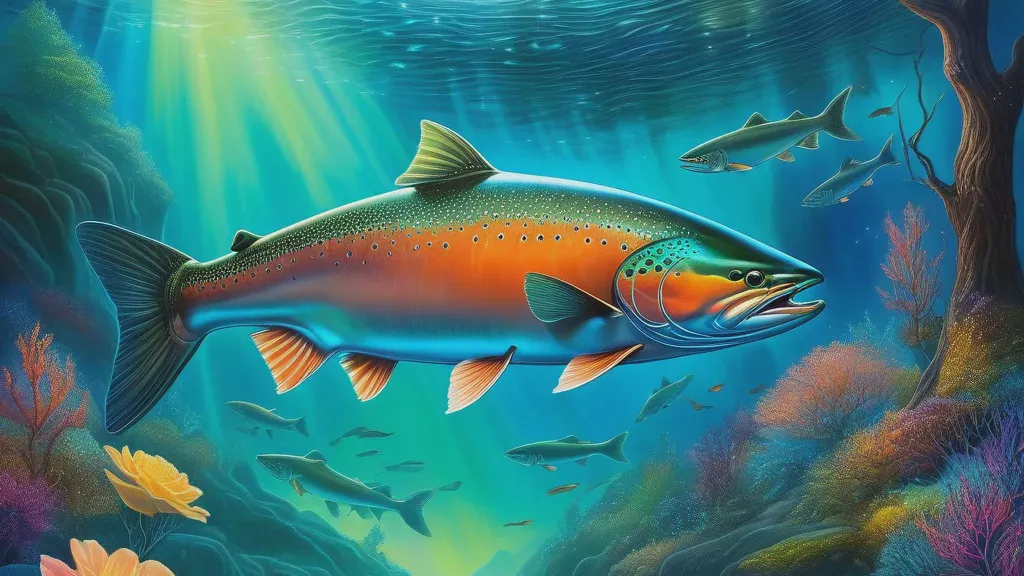
Chinook Salmon
Jungian Archetypes
Meaning
A Chinook salmon in a dream is the salmon at its heaviest and most consequential: the king of the Pacific runs, a fish that spends years in the open ocean and then turns back toward the gravel where it hatched, climbing rivers it has not seen since it was the length of a finger. The dream brings a single, physical idea of purpose. Whatever the dreamer is doing in waking life, the psyche is showing it as a return against a current, made by a body that grew strong in unfamiliar waters. Because the run ends in spawning and death, the image also carries the weight of completion, of a life given entirely to one act. The fish surfaces when a long-deferred homecoming has begun to pull with the force of instinct rather than choice.
Psychological Interpretation
The condition of the Chinook decides what the dream is asking. Ocean-phase fish are bright silver, fast and feeding; river-phase fish stop eating, darken to bronze and maroon, and the males grow a hooked jaw as the body reorganises around one purpose. The silver fish in deep water shows expansion, the years of gathering range and appetite before any obligation to return. The darkened fish in a shallow stream shows the second half of a task, when the psyche stops taking in and starts giving out. The dreamer's position matters as much as the fish: watching from the bank suggests someone who feels the pull of a homecoming but has not entered the water; swimming beside the salmon, or being it, suggests the return is underway and the dream is measuring its cost in fatigue and bruised flanks. Hooking the fish, or being towed by it, turns the dream toward a relationship with something larger than the ego: a vocation, an inheritance, a debt to the place one came from. The dream rarely promises success; what it insists on is orientation. A Chinook finds its natal stream by the smell of the water, a memory laid down in its first weeks, and the dream borrows that fact to say that the direction the dreamer strains toward was imprinted long ago, and the body remembers it even when the mind has forgotten why.
Traditional Symbol Meaning
On the Northwest Coast the salmon was never merely food, and the Chinook, first and largest of the spring runs, was the fish that decided whether a village would eat through the winter. The traditional understanding is one of kinship and reciprocity: the salmon are people who put on fish-skin to visit, and they return only if they are treated with respect, spoken to properly and given back to the water. A run that failed was read as a moral event, the consequence of waste, insult or broken agreements. Within that world a dream of a great Chinook was closer to a visit from a relative than to a sighting of an animal, and the dreamer's conduct toward the fish had consequences for the whole community. European tradition read the salmon through age, secrecy and hidden knowledge. The Salmon of Knowledge that Fionn tastes by accident makes wisdom something acquired not by study but by handling the creature that has fed at the source. The Welsh oldest-animals sequence places the salmon beyond the stag, the owl and the eagle as the one being that remembers furthest back, and Irish heroic literature admired the fish's leap so much that a warrior's spring over an obstacle was called the salmon-leap. Medieval Christian imagery folded the salmon into the general symbolism of the fish as the soul, and nineteenth-century dream dictionaries filed it in the practical register that fish occupy there: a caught salmon meant gain, a lost one a missed chance, a leaping one sudden good fortune. The modern lore of the Chinook is largely natural history, and it has become a tradition in its own right. The run against the current is now the standard proverb of perseverance, so common that the phrase swimming upstream needs no gloss. Biology has added a darker and richer layer: the Chinook does not eat once it enters fresh water, it lives on stored fat, and after spawning it dies where it was born. Research by Tom Reimchen and colleagues on the British Columbia coast has traced nitrogen from salmon carcasses, carried into the forest by bears, into the growth rings of Sitka spruce, so that the returning fish feeds the trees that shade the stream its offspring will hatch in. When the Elwha River dams in Washington were removed between 2011 and 2014, Chinook reached the water above the old dam sites within the first seasons, and their return became a public image of a wrong undone. Taken together, these traditions give the dream Chinook four durable meanings: the homecoming that instinct enforces, the effort a return demands, the sacrifice in which one generation feeds the next, and a reciprocity between the individual and the place that made it. Where a trout dream might be about a passing pleasure, a Chinook dream is about the arc of a life.
Psychodynamic / Freudian
The manifest content is simple, a large fish in a river, and the latent content is one of the oldest wishes in the psychodynamic canon: to go home. The Chinook returns to the water it was born in, and in Freud's terms the river is the maternal body, the natal gravel the place before separation, the run a regression toward origin under the disguise of an animal's instinct. Freud listed fish among the sexual symbols of dreams and read entering or emerging from water as a figure for birth; the Chinook's spawning, a reproductive act followed immediately by death, binds the sexual wish and the death drive into a single image with the economy that Beyond the Pleasure Principle describes. A dream of the spent, darkened fish can carry a wish for rest that the dreamer would never admit while awake. Object relations sharpens the picture. Klein's infant experiences the mother both as the abundant source and as the place where it is depleted, and the Chinook's river is exactly that double object: the origin that calls the fish back and the water in which it starves and dies. Ambivalence toward the family, the home town, the parents who gave everything and asked for everything, is often the real subject. Winnicott's holding environment appears in the way the river carries the fish; Bion's container and contained appears in the question of whether the water can hold what the fish brings back from the sea, which is to say whether the dreamer's family of origin can receive the person the dreamer has become. Margaret Mahler's rapprochement, the toddler's need to return to the mother after venturing out, is replayed at the scale of a whole life. The defences show in the dreamer's role. Displacement puts an admired or feared father, the king of the family, into the king of salmon; condensation lets the same fish stand at once for that father, for the dreamer and for the child the dreamer wishes to produce or protect. Reversal is common: the dreamer who feels caught by circumstance dreams of hooking the fish, and the dreamer who holds all the power dreams of being towed. In treatment, a Chinook dream frequently arrives when the patient is being pulled back toward material about home that they had declared finished, and the pull of the fish on the line is a fair picture of the transference, a force that comes from the water rather than from the person holding the rod.
Contemporary Psychological
Dream research since the 1990s has favoured the continuity hypothesis associated with G. William Domhoff: dreams draw on the dreamer's waking concerns and knowledge rather than on a universal code. A Chinook salmon therefore appears most in the dreams of people who fish for it, live along Pacific rivers, work in fisheries or conservation, or have recently absorbed its story from a documentary. The brain's generative model, in the predictive-processing account, reaches for a well-known creature whose life cycle already encodes goal pursuit against resistance and uses it as a compressed simulation of whatever effortful return the dreamer is contemplating. The fish is not a message from elsewhere; it is the mind's best available model of a particular kind of task. The Chinook's most famous ability, finding its natal stream by scent, makes it an apt figure for what the sleeping brain is doing. Arthur Hasler's experiments established that young salmon imprint on the chemical signature of their home water and follow it back years later. The hippocampus in sleep replays spatial sequences learned during the day, a finding from Matthew Wilson and Bruce McNaughton's recordings in rodents that has since been extended to human memory consolidation. A dream of a fish retracing a route it learned in infancy is, at the level of mechanism, a picture of the consolidating brain itself, tying a present journey to an early memory. Dreamers in the middle of a move, a return to a home region or a career reorientation often report such dreams, and the exhaustion of the upstream image tracks the cognitive load of the reorganisation. Emotion regulation completes the account. Rosalind Cartwright's studies of people going through divorce found that those whose dreams worked through the stressful situation in narrative form recovered better, and Matthew Walker has described REM sleep as an overnight processing of emotional memory in which the charge is reduced while the content is kept. The Chinook's run is a narrative of effort with a built-in ending, which makes it a good vehicle for feelings about persistence, obligation and finishing. Antti Revonsuo's threat-simulation theory accounts for the bears, nets, dams and shallows that surround the dream fish. When the dreamer wakes as the darkened salmon dies in the shallows, the brain has simulated completion and loss in one stroke, and if the dream recurs, that emotional work is not yet done.
Jungian / Archetypal
For Jung the pattern of a whole life could appear in a single dream image, and the Chinook's circuit is such an image. The fry leaves the natal gravel, descends to the ocean, roams for years in waters it could not have imagined, and then turns back toward the exact stream of its origin, transformed in colour and shape, to give itself to the next generation. That is a picture of the Self, the totality that includes the ego's outward adventure and its eventual return. Jung described the first half of life as expansion into the world and the second as a turning toward meaning and mortality, and the Chinook's two phases, silver and feeding in the sea, dark and fasting in the river, map onto that division with unusual exactness. Which phase the dreamer's fish is in usually reveals which phase the psyche believes the dreamer has reached. Amplification supplies the fish's connection with the Anima and the Child. In the Fenian cycle the Salmon of Knowledge has fed on the hazelnuts of the well at the source of the Boyne, and the boy Fionn receives its wisdom by accident, burning his thumb while cooking it for his master. The wisdom comes from the source, is carried by a creature of the depths, and is given not to the learned poet but to the child who touches it. The salmon is the soul-image that knows the way back to the origin, and the Child archetype is the part of the dreamer that still lives in the gravel of the first stream. The Salmon Boy stories of the Northwest Coast make the same point in reverse: the child taken by the Salmon People comes home knowing their laws. In both, contact with the fish is an initiation by the unconscious. Compensation depends on the dreamer's one-sidedness. A person whose waking life is all ocean, all expansion and forward drive, tends to dream the darkened river fish with its hooked jaw and worn tail, and the dream insists that some of that strength is owed elsewhere and that completion has a cost. A person who has narrowed their life to a single channel dreams the silver fish in open water, and the dream corrects in the other direction. The death at the end of the run is what the ego fears most, but the Self reads it differently: the fish does not fail, it finishes. Part of the ego's ambition will be spent on something that outlives it, and that expenditure, not any reward, is what the second half of life asks.
Gestalt / Parts of Self
In Gestalt dreamwork the Chinook is not a symbol of you; it is you, or rather a part of you that you have handed to a fish because it was easier to admire it swimming than to own it standing up. Begin by becoming it. Speak in the present tense, in the first person: I am heavy. I have stopped eating. I am bruised along both sides and I am still moving. I know the smell of the water I am looking for, though I have not been here since I was small. Notice which of those sentences catches in your throat, because that is where the disowned material lives. For many dreamers the alien part is the fish's refusal to be distracted; for others it is its willingness to be used up. The dream is built on polarities, and the work is to inhabit both poles rather than choosing one. The ocean Chinook eats, roams and grows; the river Chinook fasts, narrows and returns. Take the chair of each and let them argue. The roaming self may accuse the returning self of throwing away a good life for an obligation nobody imposed; the returning self may answer that the roaming self has been avoiding the only thing it was ever for. Then be the current, which is usually the most neglected character in the dream. The current does not oppose the salmon out of malice. Ask what in your life is playing the current, and whether your exhaustion comes from the water or from fighting it in the wrong place. Contact and withdrawal are the heart of the Gestalt reading. The Chinook withdraws from nourishment entirely once it enters fresh water and lives on what it stored at sea. If you have been all output, all obligation, all return, the dream may be showing you a fasting body that has forgotten it was allowed to feed. If in the dream you stand on the bank, ask what keeps you out of the water and speak as the bank. If you are the angler fighting the fish, take both roles, because the line between them is a contact boundary, and the tension on it is the exact measure of how much of your own purpose you are still holding at a distance.
Cultural & Historical Origins
The fish takes its name from the Chinookan peoples of the lower Columbia River, whose villages Lewis and Clark passed through in 1805 living almost entirely on the runs. Among the Coast Salish, Chinookan, Nuu-chah-nulth and other Northwest Coast nations, the First Salmon Ceremony receives the first fish of the season as a visiting chief: its flesh is shared and its bones are returned to the river so that the Salmon People, who in Haida, Tlingit and Kwakwaka'wakw tellings live in villages beneath the sea, will send their relatives again. The story of Salmon Boy, told along that coast in many versions, follows a child who mocks the fish, is carried off to the Salmon People's country, learns their laws and comes back changed. In British Columbia a Chinook over thirty pounds is still called a tyee, the Chinook Jargon word for chief. Across the Pacific, the Ainu of Hokkaido have honoured salmon as kamuy cep, the fish of the gods. Celtic literature gives the salmon its most explicitly psychological role: in the Fenian cycle the Salmon of Knowledge, fattened on hazelnuts fallen into the well at the source of the Boyne, is caught by the poet Finnegas and cooked by the boy Fionn mac Cumhaill, who burns his thumb on its skin and receives all wisdom. The Welsh tale Culhwch and Olwen names the Salmon of Llyn Llyw the oldest of living creatures, and in the Prose Edda Loki hides from the gods by turning himself into a salmon in a waterfall, only to be caught in a net modelled on one he had invented himself.
Contextual Variations
Hooking a huge Chinook salmon that nearly pulls you into the river
The fight with a king salmon is a fight with something that has more purpose than you do. When the fish is winning, the dream is showing a force in your life, a vocation or a long-postponed return, with more momentum than your conscious plans and close to taking you with it. Whether you feel exhilaration or panic on the line matters more than whether you land the fish: exhilaration suggests you are ready to be moved, panic that you are trying to hold with your arms what needs to be followed with your whole body. Notice who taught you to fish in the dream; the rod is often an inheritance.
A Chinook salmon leaping again and again at a dam it cannot clear
Real Chinook batter themselves against dams until a fish ladder or exhaustion decides the outcome, and the dream borrows that image for a return blocked by something built, not grown. The dam is usually a structure in your life, a policy, a family rule, a decision made by someone upstream years ago, that stands between you and where instinct tells you to go. The repeated leaping is the important detail: your psyche is showing persistence that has become injury. The dream asks whether the way through is another leap, a ladder someone else must build, or a different river altogether.
A dark, spawned-out Chinook salmon dying in shallow water
This is the end of the run, and it is often misread. The darkened, ragged fish lying in inches of water is not a casualty; it is at the end of the only journey it was built for, and its body is about to feed the stream it was born in. If you woke grieving, the dream may be marking the completion of something you gave yourself to entirely, a role, a project, a season of caring, that now must end. If you woke afraid, the fish may be your own fear of being used up by an obligation. The dream asks you to tell apart exhaustion that means you are lost from exhaustion that means you have arrived.
Swimming alongside a silver Chinook salmon in the open ocean
In the ocean phase the Chinook is bright, fast and still feeding, years from any obligation to return. Swimming beside it places you in the expansive half of a life cycle: gathering strength and range in waters far from home. This dream often comes to people being pressured, by family or by their own conscience, to come back too early to something they have not finished growing away from. Notice whether you can keep up with the fish, whether it lets you near, and whether some part of you is already scanning the coast for a river mouth. That glance is the first stirring of the return.
Frequently Asked Questions
Is dreaming of a Chinook salmon different from dreaming of any salmon?
Why did the salmon in my dream turn dark red and die?
I caught a huge king salmon in my dream and let it go. Was that a mistake?
Does a salmon swimming upstream in a dream mean I am going the wrong way?
Journaling Prompts
- Think of the Chinook's two phases: the bright ocean years of feeding and growing, and the dark river weeks of fasting and returning. Which phase are you in right now, honestly, and which phase did the fish in your dream appear to be in? If the two do not match, write about what the dream might be telling you about timing.
- The fish in your dream knew its way by something older than thought. Describe a place, a person or a kind of work that you recognise in your body before your mind catches up. What would it mean to trust that recognition as navigation rather than treating it as nostalgia?
- The salmon in your dream met some kind of resistance: a current, a dam, a net, an angler, shallow water. Name the resistance in your waking life that most resembles it. Then write two paragraphs, one in which the resistance is simply the condition of the journey and one in which it is a sign to change rivers. Which paragraph felt truer while you wrote it?
- After spawning, the Chinook dies and its body feeds the forest along the stream. Write about something you are giving yourself to that you will not personally see the fruit of: a child, a project, a piece of land, an institution, a student. How do you feel about being used up by it, and what in the dream suggested whether that feeling is grief, fear, or a kind of peace?
Related Symbols
Dreamed about Chinook Salmon?
Get a personalized AI interpretation that connects this symbol to your specific life circumstances.
Interpret My Dream