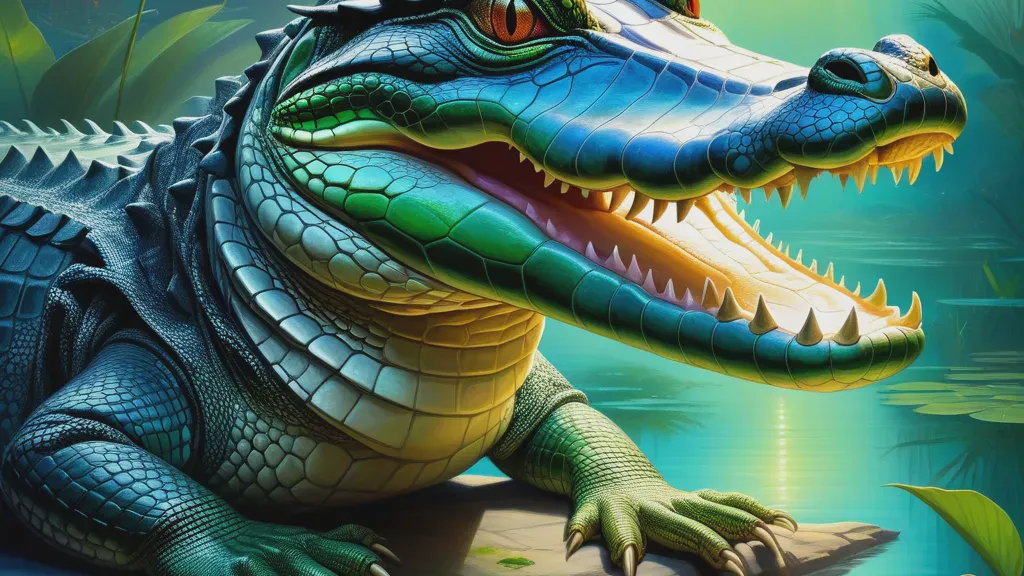
Chinese Alligator
Jungian Archetypes
Meaning
Dreaming of the Chinese alligator may indicate a need for transformation or adaptability, reflecting psychological themes of resilience. They can symbolize the balance between aggression and introspection, highlighting the duality of one's personality.
Psychological Interpretation
Jungian theory may interpret this symbol as a representation of the animus, embodying repressed masculine qualities. Cognitive psychology could see it as a metaphor for coping mechanisms, while practical psychology suggests it points to the importance of change and adaptability.
Cultural & Historical Origins
In Chinese mythology, the alligator represents strength and protection, often associated with water deities. They appear in ancient texts like the 'Classic of Mountains and Seas,' symbolizing the power of nature and the balance between life and death.
Contextual Variations
You watch a Chinese alligator in a pond that’s half-dry, half-wet. The alligator changes position to stay safe, and you realize you’ve been trying to force one environment instead of adapting.
This dream often symbolizes transformation through resilience—adjusting your approach as conditions shift. Psychologically, the alligator’s movement suggests you may be learning to survive uncertainty by changing tactics rather than insisting on one outcome.
In the dream, the alligator opens its mouth near your hand, but it never bites; it just tests the distance. You step back and then find a safer path around the edge of the water.
A non-biting test can reflect boundaries and self-protection—your psyche checking whether you’ll respect limits. It may indicate you’re learning when to engage and when to retreat to preserve energy and safety.
You’re tasked with caring for the Chinese alligator in a controlled enclosure, but the enclosure keeps changing. You keep adjusting the setup—temperature, water level—until the alligator becomes calm.
This can represent managing yourself through change—staying flexible while taking responsibility for your internal environment. Psychologically, it suggests you’re building the skill of adaptation: meeting yourself where you are instead of demanding stability that life doesn’t provide.
Frequently Asked Questions
What does it mean if the Chinese alligator doesn’t attack?
Why is the environment changing around the alligator?
Is this dream about fear or about strength?
Journaling Prompts
- Where am I trying to “force” stability when the situation is actually fluctuating, and what would adaptation look like instead?
- What boundary did the alligator test in the dream—physical distance, emotional access, or effort—and what boundary do I need now?
- What internal environment (sleep, routine, communication, solitude) could I adjust to help me feel safer and more capable?
Related Symbols
Dreamed about Chinese Alligator?
Get a personalized AI interpretation that connects this symbol to your specific life circumstances.
Interpret My Dream