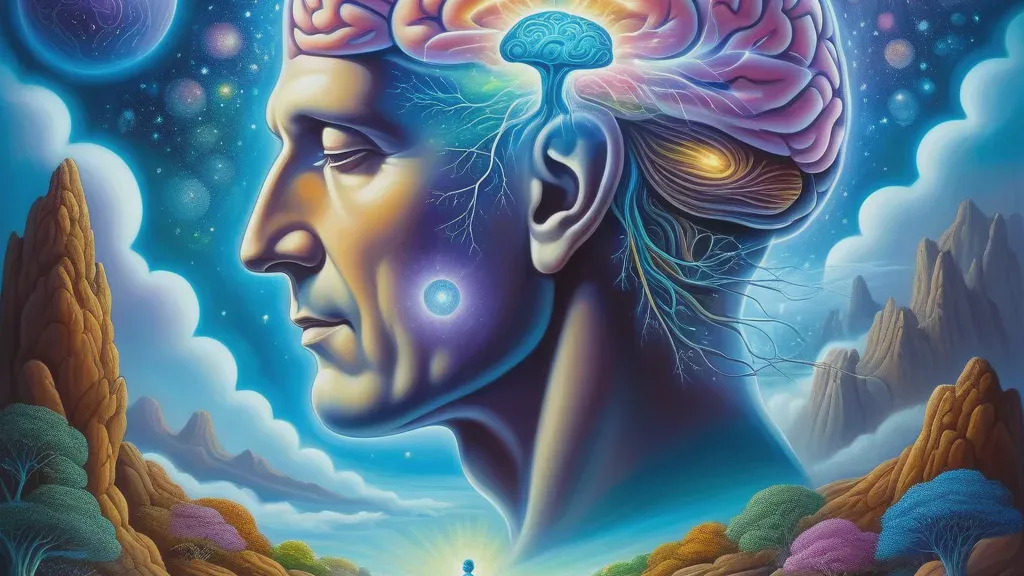
Brain
Jungian Archetypes
Meaning
Dreaming of a brain often signifies cognitive processes and mental clarity. Psychologically, this symbolizes self-awareness and the mechanism of introspection, where the brain embodies thought patterns, problem-solving, and the quest for knowledge.
Psychological Interpretation
From a Jungian perspective, the brain may represent the Wise Old Man archetype, indicating wisdom and insight. Cognitive frameworks would focus on the dreamer's mental state, while practical approaches might encourage exploring new ideas or enhancing critical thinking skills.
Cultural & Historical Origins
In ancient Greek philosophy, the brain was associated with rational thought, whereas in Hinduism, the mind is often seen as a source of illusion and ignorance, illustrating the diverse interpretations of the brain's role in consciousness.
Contextual Variations
You look into a mirror and your brain is visible like an intricate map behind glass. You feel curious, then overwhelmed by how many pathways light up at once.
A visible brain often points to heightened mental awareness and rumination—your mind is “on display.” The map imagery suggests many competing thoughts or perspectives, and the overwhelm signals difficulty narrowing attention to what matters most emotionally.
Someone asks you a question, and instead of speaking you can only think in slow motion. Your thoughts feel heavy, but when you breathe, they clear quickly.
Slow, heavy thinking can reflect stress affecting cognitive processing. The quick clearing with breath indicates your psyche responds to regulation—your mental clarity is tied to nervous-system state, not just intellect.
You find a knot of thoughts inside your head and try to untie it with your hands. The knot tightens until you stop forcing and simply observe it.
Knots in the brain symbolize mental blocks—repeating worries, unresolved questions, or conflicting beliefs. The knot tightening under force suggests that control strategies worsen the loop, and that mindful observation may help the issue reorganize.
Frequently Asked Questions
Why do I dream about my brain when I’m not studying or working on problems?
What does it mean if the dream brain is clear and organized versus chaotic?
Does a dream brain represent intelligence or emotional processing?
Journaling Prompts
- What thought pattern felt most dominant in the dream—overthinking, confusion, or a desire for clarity?
- Where in your body did the brain image feel located (head pressure, tension, calm), and what emotion matches that sensation?
- If you could untie the knot without forcing, what approach would you try in waking life—breathing, boundaries, or honest conversation?
Related Symbols
Dreamed about Brain?
Get a personalized AI interpretation that connects this symbol to your specific life circumstances.
Interpret My Dream