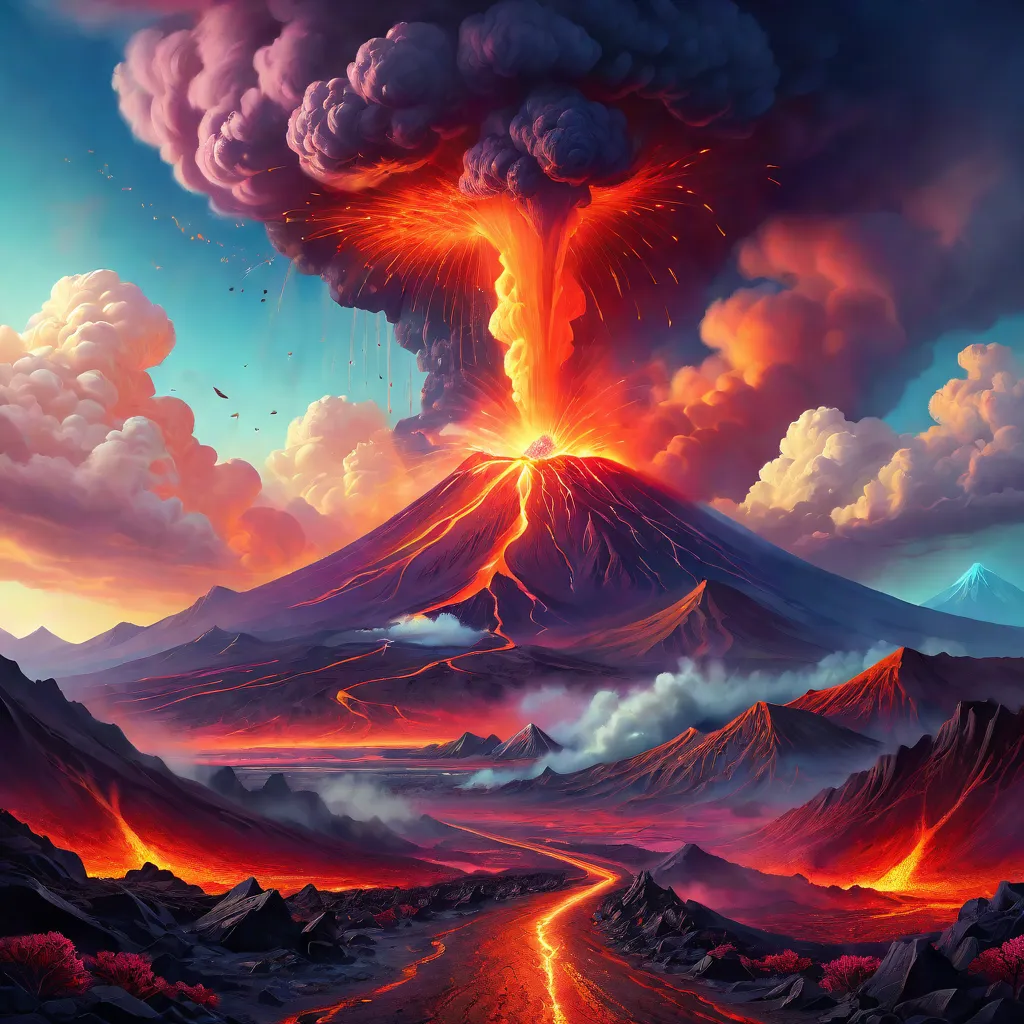
Volcano Eruption
Dreams of a volcano eruption often begin with a sudden rumble, followed by molten lava spewing across a landscape that shifts from familiar streets to barren ash fields. The dreamer experiences intense heat, a roar that vibrates the chest, and a visual blur of glowing ember and thick smoke.
Psychological Interpretation
You are likely confronting a situation that feels out of control, where suppressed emotions or hidden pressures are surfacing with explosive force. The eruption mirrors a breakthrough or a crisis that demands you to release tension and reassess priorities. When you notice the aftermath—ash, ruin, or new fertile soil—it can indicate whether the upheaval leaves you feeling drained or opens space for renewal.
Had this dream?
After a deep rumble, does lava flood familiar streets, ash bury the landscape, or heat drive you from the mountain? Tell us what happened and get a personalized interpretation of your own dream.
Interpret My DreamJungian / Archetypal
In Jungian terms a volcano eruption in a dream is often an image of the Self’s explosive energy breaking through the surface of consciousness. The volcano, as a natural symbol of hidden heat and pressure, corresponds to the archetypal “fire” of transformation that lies in the collective unconscious. When the dreamer witnesses the sudden outpouring of lava, the psyche is dramatizing the release of repressed material that has been building in the personal unconscious—often aspects of the shadow that have been denied or split off. The eruption therefore signals a moment in the individuation process when the unconscious is demanding integration, urging the dreamer to acknowledge the powerful, primal forces that have been confined within the ego’s rational framework. The emotional pattern that accompanies this dream typically includes a mixture of awe, fear, and a sense of being overwhelmed, reflecting the tension between the desire for safety and the urge toward growth. The awe arises from the recognition of something larger than the individual, a reminder of the archetypal forces that shape human experience; the fear signals the ego’s resistance to the destabilizing effect of confronting the shadow. People experience this dream when they are at a crossroads—perhaps after a period of intense stress, a major life change, or when suppressed emotions such as anger, grief, or sexual energy have reached a critical mass. The eruption serves as a psychic alarm, indicating that the current mode of coping is no longer sufficient and that a new, more authentic mode of being must be forged. A practical insight that can be drawn from this image is to treat the volcano as a cue for intentional inner work rather than as a threat. When the dreamer feels the symbolic heat rising, they can pause and ask what hidden feeling or belief is demanding expression, then create a safe ritual—such as journaling, expressive art, or a guided meditation—to give that energy a constructive outlet. By consciously channeling the eruptive force into a creative or restorative activity, the individual supports the individuation journey, allowing the shadow material to be integrated and the Self to emerge more whole.
Gestalt / Parts of Self
From a Gestalt perspective a volcano eruption in a dream is not a symbol of an abstract concept but a vivid projection of a disowned fragment of the dreamer’s own psyche. The erupting mountain stands for a part of the self that has been kept out of awareness—often an intense, volatile feeling such as anger, grief, or a surge of creative energy that the dreamer has deemed unacceptable or too powerful to acknowledge. When the volcano blows its top, the dream is dramatizing the moment that this excluded part forces its way into consciousness, demanding recognition. The accompanying imagery of lava flowing, ash filling the sky, or the ground shaking mirrors the emotional turbulence that follows the sudden surfacing of this hidden affect, highlighting the tension between the desire to contain the feeling and the inevitable release when containment fails. People experience this dream when they have been habitually suppressing strong affective states, perhaps because of external expectations, past trauma, or an internal belief that such emotions are dangerous. The eruption becomes a safety valve, a way for the mind to alert the dreamer that the unintegrated part is threatening to overwhelm the larger personality structure if left unattended. The emotional pattern typically involves a mixture of fear, awe, and a paradoxical sense of relief as the dreamer watches the destructive force unfold. A practical insight that emerges from this Gestalt reading is to treat the volcano not as a warning to avoid intensity but as an invitation to locate the “lava” within the waking self, to give that part a voice, and to experiment with allowing it to express itself in a controlled, creative manner—such as through art, writing, or a purposeful physical activity—thereby moving the disowned fragment from the realm of projection into conscious ownership and integration.
Psychodynamic / Freudian
The manifest image of a volcano erupting in a dream often appears as a dramatic, uncontrollable outburst of fire, ash, and molten rock that engulfs the surrounding landscape. From a psychodynamic perspective this spectacular scene is the symbolic condensation of latent material that the dreamer has kept out of conscious awareness. The latent content is frequently a mixture of repressed aggressive impulses, unacknowledged desires for profound change, and the fear that these forces might overwhelm the self. The eruption functions as a wish-fulfilling fantasy in which the dreamer’s hidden urge to release pent-up tension is dramatized, allowing the unconscious to experience a cathartic discharge without confronting the actual source of the tension. Defense mechanisms such as displacement (shifting hostile feelings onto the impersonal volcano), projection (attributing one’s own destructive potential to an external natural force), and sublimation (transforming raw aggression into the awe-inspiring spectacle of a natural disaster) are at work to keep the threatening affect from entering conscious awareness directly. The emotional pattern that accompanies this dream typically includes a blend of exhilaration, terror, and a lingering sense of powerlessness, reflecting the internal conflict between the desire for liberation and the fear of loss of control. People experience the volcano eruption motif when the emotional pressure of unresolved conflicts—perhaps stemming from suppressed anger toward a parental figure, an unexpressed need for autonomy, or a neglected creative drive—has accumulated to a critical mass. The dream signals that the psyche is seeking a release valve, and the intensity of the eruption mirrors the magnitude of the underlying affective charge. A practical insight for the dreamer is to monitor moments in waking life when feelings of frustration or restlessness begin to build, and to channel those energies into structured activities such as vigorous exercise, artistic expression, or purposeful confrontation of the underlying issue, thereby reducing the need for the unconscious to dramatize the release through a volcanic catastrophe.
Personal Meaning
From a psychodynamic perspective the volcano eruption dream often signals that the dreamer is carrying a surge of unexpressed affect that is reaching a tipping point. The molten lava and explosive ash can be read as symbolic equivalents of anger, frustration, or grief that have been contained in the conscious mind and are now demanding release. The dreamer might notice that the eruption occurs in a familiar landscape—a hometown, a workplace, or a family home—suggesting that the pressure is tied to a specific relational context rather than an abstract fear. To connect this imagery to waking life, the dreamer can ask what situations feel like a pressure cooker, whether there are recurring arguments that are avoided, or if there is a habit of suppressing disappointment to keep the peace. Reflecting on whether the eruption is sudden or gradual may reveal whether the underlying tension has been simmering for weeks or months, and whether the dreamer has noticed physical signs such as clenched jaw, shallow breathing, or a tight chest that accompany the emotional build-up. The emotional pattern behind the volcano motif is often a cycle of denial followed by an abrupt outburst, which can be traced to a fear of losing control or of being judged for expressing strong feelings. People experience this dream when the unconscious mind signals that the current coping strategy—usually avoidance or over-compensation—has become unsustainable, prompting the psyche to dramatize the need for a healthier outlet. A practical insight is that the dreamer can benefit from establishing a regular, low-stakes channel for emotional discharge, such as a brief daily journal entry, a physical activity that allows for vigorous movement, or a conversation with a trusted friend about a lingering irritation. By consciously acknowledging and naming the pressure before it reaches a crisis point, the dreamer reduces the likelihood that the subconscious will resort to the dramatic imagery of a volcanic eruption, and instead cultivates a steadier, more manageable flow of affect.
Contemporary Psychological
A dream in which a volcano erupts is often interpreted as a neural replay of a highly charged emotional episode that the brain is attempting to integrate into long-term memory. During REM sleep, the limbic system—particularly the amygdala and hippocampus—reactivates recent affective experiences, and the vivid, explosive imagery of a volcano mirrors the brain’s effort to encode a surge of arousal that exceeded ordinary thresholds. The eruption’s sudden release of lava and ash corresponds to the physiological cascade of sympathetic activation that accompanies intense stress, anger, or grief, and the dream’s visual intensity reflects the brain’s prioritization of that affective signal for consolidation. In this view, the volcano is not a symbolic metaphor but a concrete neural representation of an overflow of autonomic energy that the sleeper’s mind is trying to file away. The emotional pattern behind the volcano dream typically involves a clash between suppressed tension and a perceived loss of control in waking life. When individuals are navigating chronic pressures—such as unresolved conflict at work, looming health concerns, or a relationship that feels volatile—their predictive coding circuits generate a threat-simulation scenario that exaggerates the stakes, allowing the brain to rehearse coping strategies in a safe, simulated environment. The dream’s dramatic eruption can therefore be seen as a rehearsal of a catastrophic outcome, sharpening the individual’s sensitivity to warning signals and prompting a recalibration of emotional regulation mechanisms. Practically, recognizing that the volcano reflects an unprocessed surge of stress suggests that the dreamer should identify one concrete source of tension and practice a grounding technique, such as paced breathing or brief mindfulness, before bedtime; doing so can reduce the intensity of the simulated threat and promote a more balanced consolidation of emotional memories.
Stress & Emotional Patterns
A volcano eruption in a dream often mirrors a feeling that something inside you is building pressure until it can no longer be contained. The visual of molten lava spilling out and the roar of an explosion can be the mind’s way of translating chronic stress—whether from work deadlines, relationship tensions, or unresolved personal expectations—into a vivid, symbolic outburst. When the dreamer watches the volcano erupt from a safe distance, it may indicate an awareness that the stress is present but still managed; however, if the dreamer is caught in the flow of lava or feels the heat on their skin, it usually points to a sense of being overwhelmed, as if the emotional load has surpassed the capacity to cope. This pattern often aligns with physiological signs of chronic anxiety, such as a racing heart, shallow breathing, or muscle tension, suggesting that the nervous system is in a heightened state of alert and needs a reset. To move from that intense imagery to a calmer inner landscape, the dreamer can start by identifying the specific “pressure points” in waking life that feel like they could erupt at any moment. Practicing a brief grounding routine—such as placing a hand on the chest, feeling the rise and fall of breath, and naming three concrete things that are currently stable—can help the nervous system recognize safety and reduce the urge for the mind to dramatize stress. Additionally, setting aside a regular “release” practice, like a short walk, journaling about the emotions that feel hot or bubbling, or a creative outlet such as drawing the volcano and then erasing it, can transform the subconscious alarm into a manageable, observable process. If the dream recurs despite these steps, it may be useful to explore the underlying beliefs about control and perfection with a therapist, because often the volcano is less about the external situation and more about an internal narrative that equates worth with constant high performance. By acknowledging the heat, creating safe outlets, and gradually lowering the internal pressure, the dreamer can turn the eruptive symbolism into a signal for self-care rather than a foreboding omen.
Related Symbols
Had this dream?
Get a personalized AI interpretation that connects your dream to your specific life circumstances.
Interpret My Dream